 Talmud Bavli
The learning on the whole site is dedicated : L'ilui Nishmat Jamila bat Chlomo Abensour
The learning on the whole site is dedicated : L'ilui Nishmat Jacques Isaac Ben Amram Loubaton
The learning on the whole site is dedicated : L'ilui Nishmat Rav Chlomo Ben Jamilla
Bava Metzia 94b : Youtube
Daf TubeYoutube
1 video class :
Bava Metzia Page 94b
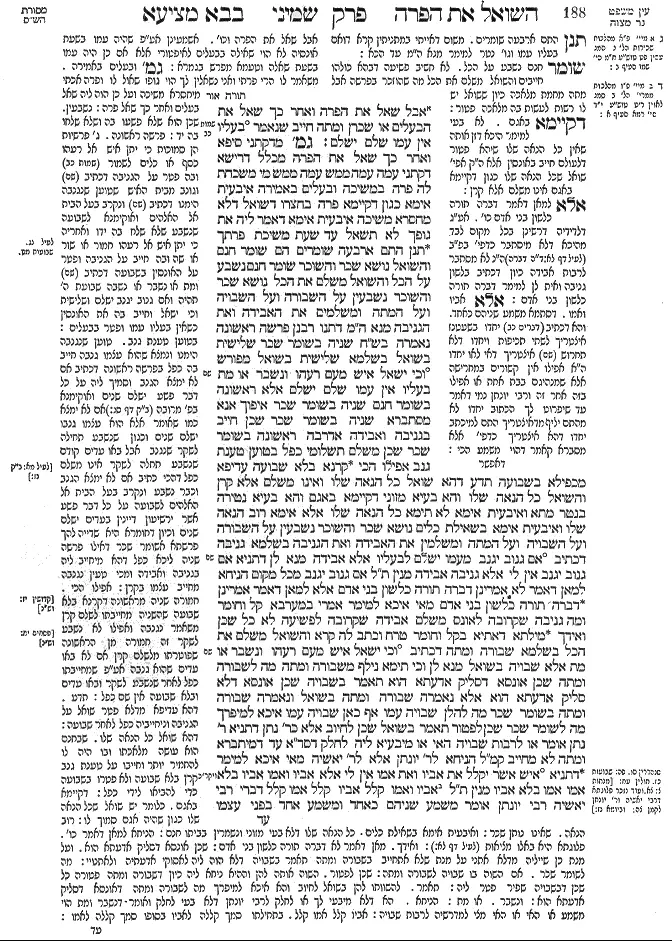
Bava Metzia 94b - Guemara
אבל שאל את הפרה ואחר כך שאל את הבעלים או שכרן ומתה חייב שנאמר (שמות כב, יג) בעליו אין עמו שלם ישלם:
גמ׳ מדקתני סיפא ואחר כך שאל את הפרה מכלל דרישא דקתני עמה עמה ממש עמה ממש מי משכחת לה פרה במשיכה ובעלים באמירה איבעית אימא כגון דקיימא פרה בחצרו דשואל דלא מחסרא משיכה איבעית אימא דאמר ליה את גופך לא תשאל עד שעת משיכת פרתך תנן התם ארבעה שומרים הם שומר חנם והשואל נושא שכר והשוכר שומר חנם נשבע על הכל והשואל משלם את הכל נושא שכר והשוכר נשבעין על השבורה ועל השבויה ועל המתה ומשלמים את האבידה ואת הגניבה מנא ה"מ דתנו רבנן פרשה ראשונה נאמרה בש"ח שניה בשומר שכר שלישית בשואל בשלמא שלישית בשואל מפורש (שמות כב, יג) וכי ישאל איש מעם רעהו ונשבר או מת בעליו אין עמו שלם ישלם אלא ראשונה בשומר חנם שניה בשומר שכר איפוך אנא מסתברא שניה בשומר שכר שכן חייב בגניבה ואבידה אדרבה ראשונה בשומר שכר שכן משלם תשלומי כפל בטוען טענת גנב אפילו הכי קרנא בלא שבועה עדיפא מכפילא בשבועה תדע דהא שואל כל הנאה שלו ואינו משלם אלא קרן והשואל כל הנאה שלו והא בעיא מזוני דקיימא באגם והא בעיא נטירה בנטר מתא ואיבעית אימא לא תימא כל הנאה שלו אלא אימא רוב הנאה שלו ואיבעית אימא בשאילת כלים נושא שכר והשוכר נשבעין על השבורה ועל השבויה ועל המתה ומשלמין את האבידה ואת הגניבה בשלמא גניבה דכתיב (שמות כב, יא) אם גנוב יגנב מעמו ישלם לבעליו אלא אבידה מנא לן דתניא אם גנוב יגנב אין לי אלא גניבה אבידה מנין ת"ל אם גנוב יגנב מכל מקום הניחא למאן דאמר לא אמרינן דברה תורה כלשון בני אדם אלא למאן דאמר אמרינן דברה תורה כלשון בני אדם מאי איכא למימר אמרי במערבא קל וחומר ומה גניבה שקרובה לאונס משלם אבידה שקרובה לפשיעה לא כל שכן ואידך מילתא דאתיא בקל וחומר טרח וכתב לה קרא והשואל משלם את הכל בשלמא שבורה ומתה דכתיב (שמות כב, יג) וכי ישאל איש מעם רעהו ונשבר או מת אלא שבויה בשואל מנא לן וכי תימא נילף משבורה ומתה מה לשבורה ומתה שכן אונסא דסליק אדעתא הוא תאמר בשבויה שכן אונסא דלא סליק אדעתא הוא אלא נאמרה שבורה ומתה בשואל ונאמרה שבורה ומתה בשומר שכר מה להלן שבויה עמו אף כאן שבויה עמו איכא למיפרך מה לשומר שכר שכן לפטור תאמר בשואל שכן לחיוב אלא כר' נתן דתניא ר' נתן אומר או לרבות שבויה האי או מיבעיא ליה לחלק דסד"א עד דמיתברא ומתה לא מחייב קמ"ל הניחא לר' יונתן אלא לר' יאשיה מאי איכא למימר דתניא (ויקרא כ, ט) איש אשר יקלל את אביו ואת אמו אין לי אלא אביו ואמו אביו בלא אמו אמו בלא אביו מנין ת"ל אביו ואמו קלל אביו קלל אמו קלל דברי רבי יאשיה רבי יונתן אומר משמע שניהם כאחד ומשמע אחד בפני עצמו
Comments from Rashi on Masechet Bava Metzia Page 94b
אבל שאל את הפרה וכו' . אשמעינן אע"פ שהיה עמו בשעת אונסיה לא הוי שאילה בבעלים לאיפטורי אלא אם כן היה עמו בשעת שאלה וטעמא מפרש בגמרא: גמ' ובעלים באמירה . משאמר לו הרי פרתי ואני נשאלין לך הוי גופו שאול לו ופרה אכתי מיחסרא משיכה ועל כן הוה ליה שאל בעלים ואחר כך שאל פרה: נשבעין . שכן הוא שלא פשעו בה ושלח שלחו בה יד: פרשה ראשונה . שלש פרשיות הן סמוכות כי יתן איש אל רעהו כסף או כלים לשמור (שמות כב) ובה פטר על הגניבה דכתיב (שם) וגונב מבית האיש שטוען שנגנבה הימנו דכתיב (שם) ונקרב בעל הבית אל האלהים ואוקימנא לשבועה שנשבע שלא שלח בה ידו ואחריה כי יתן איש אל רעהו חמור או שור או שה ובה חייב על הגניבה ופטר על האונסין בשבועה דכתיב (שם) ומת או נשבר או נשבה שבועת ה' תהיה ואם גנוב יגנב ישלם ושלישית וכי ישאל וחייב בה את האונסין כשאין בעליו עמו ופטר בבעלים: בטוען טענת גנב . טוען שנגנבה הימנו ונמצא שהוא עצמו גנבה חייב בה כפל בפרשה ראשונה דכתיב אם לא ימצא הגנב וסמיך ליה על כל דבר פשע ישלם שנים ואוקימנא בפרק מרובה (ב"ק דף סג:) אם לא ימצא כמו שאומר אלא הוא עצמו גנבו ישלם שנים וכגון שנשבע תחילה לשקר שנגנב אבל באו עדים קודם שנשבע תחלה לשקר אינו משלם כפל דהכי כתיב אם לא ימצא הגנב וכבר נשבע ונקרב בעל הבית אל האלהים לשבועה על כל דבר פשע אשר ירשיעון דיינין בעדים ישלם שנים וכיון דחומרא היא שדייה להך פרשתא אשומר שכר דאילו פרשה שניה ליכא כפל דהא מיחייב ליה בגניבה ואבידה ומכי טעין נגנבה מחייב עצמו בקרן: אפילו הכי . חמורה שניה מראשונה דקרנא בלא שבועה שהשניה מחייבתו לשלם קרן משאמר נגנבה ואפילו לא נשבע לשקר זה חמורה מן הראשונה שפוטרתו מלשלם קרן אם לא באו עדים שהוא גנבה אף על פי שמחייבתו כפל לאחר שנשבע לשקר ובאו עדים ובלא שבועה אין שם כפל: תדע . דהא עדיפא מדלא פטר שואל על הגניבה וניחייביה כפל לאחר שבועה: דהא שואל כל הנאה שלו . שבחנם הוא עושה מלאכתו ובו היה לו להחמיר יותר וחייבו על טענת גנב קרן בלא שבועה ולא פטרו בשבועה כדי להביאו לידי כפל: דקיימא באגם . כלומר יש שואל שכל הנאה שלו כגון שהיה אגם סמוך לו: רוב הנאה . שאינו נותן שכר: ואיבעית אימא בשאילת כלים . כל הנאה שלו דלא בעי מזוני ונשמרין בביתו חנם: הניחא למאן דאמר כו' . פלוגתא היא באלו מציאות (לעיל בבא מציעא דף לא:): ואידך . מאן דאמר לא דברה תורה כלשון בני אדם: שכן אונסא דסליק אדעתא הוא . ועל מנת כן שייליה מדלא אתני על מנת שלא אתחייב בשבורה ומתה תאמר בשבויה דלא הוה ליה לאסוקי אדעתיה ולאתנויי: מה לשומר שכר . אם השוה בו שבויה לשבורה ומתה: שכן לפטור . השוה אותה להן וההיא ניחא ליה כיון דשבורה ומתה פטורה כל שכן דבשבויה שפיר פטר ליה: תאמר . להשוותו להן בשואל לחיוב והא איכא למיפרך מה לשבורה ומתה דאונסא דסליק אדעתא הוא: הניחא . הא דלא מיבעי לך או לחלק לר' יונתן דלא בעי לחלק ואומר דנשבר ומת הוי משמע או האי או האי מצי למדרשיה לרבות שבויה: אביו קלל אמו קלל . בתחילתו סמך קללה לאביו בסופו סמך קללה לאמו:
Comments from Tosafot - Bava Metzia 94b
פרה במשיכה ובעלים באמירה . הק' ריב"ם דאמר לקמן בפירקין (בבא מציעא דף צז.) שתלא טבחא ואומנא וספר מתא כולהו בעידן עבידתייהו כשאלה בבעלים דמו משמע דשלא בעידן עבידתייהו לא הוי שאלה בבעלים וי"ל דלאו דוקא בעידן עבידתייהו אלא בשעת הליכתן או אפילו מזמנים עצמן לילך ולעשות חשוב בעידן עבידתייהו אבל ודאי משעת אמירה של קודם פסק מלאכה לא חשוב שאילה בבעלים כדאמרינן בס"פ האומנין (לעיל בבא מציעא דף פא.) לסוף איגלאי מילתא דההיא שעתא שכרא הוי שתי ולא הוי פשיעה בבעלים: תנן התם ארבעה שומרים . משום דאייתי במתניתין קרא דואם בעליו עמו וגו' נטר למימר מנא ה"מ עד הכא: שומר חנם נשבע על הכל . לא חשיב פשיעה דבהא כולהו חייבים והשואל משלם את הכל מה שהוזכר בפרשה אבל מתה מחמת מלאכה כיון ששואל יש לו רשות לעשות בה מלאכה פטור: דקיימא באגם . לא בעי למימר היכא דזן אותה שאין כל הנאה שלו שיהא פטור דלעולם חייב באונסין אלא ה"ק אפי' שואל שכל הנאה שלו כגון דקיימא באגם אינו משלם אלא קרן: אלא למאן דאמר דברה תורה כלשון בני אדם כו' . אע"ג דלדידיה דרשינן בכל מקום לבד מהיכא דלא מיסתבר כדפי' בפ"ב (לעיל בבא מציעא דף לא: ד"ה דברה) ה"נ לא מסתבר לרבות אבידה כיון דכתיב בלשון גניבה ואית לן למימר דברה תורה כלשון בני אדם: אלא אביו ואמו . דסתמא משמע שניהם כאחד. והא דכתיב (דברים כב) יחדו בשעטנז איצטריך לשתי תכיפות ויחדו דלא תחרוש (שם) איצטריך דאי לאו יחדו ה"א אפילו אין קשורים במחרישה אלא שמנהיגם בבת אחת או אפילו בזה אחר זה ורבי יונתן נמי דאמר עד שיפרוט לך הכתוב יחדו לא מהתם יליף מדאיצטריך התם למיכתב יחדו דהא איצטריך כדפי' אלא מסברא קאמר דהוי משמע הכי:
Bava Metzia 94b - Mishnah translated into english
But if one first borrowed the cow and only afterward borrowed the services of the owner or hired him, and the cow died, he is liable to pay the owner for the cow. This is the halakha even if the owner was working for the borrower at the time, as it is stated: “If its owner is not with him, he shall pay” (Exodus 22:13).
GEMARA: From the fact that the latter clause teaches: And afterward borrowed the cow, it may be inferred that when the first clause teaches: Borrowed its owner with it, the intention is: Literally with it, i.e., at the same moment. The Gemara asks: Can you find such a case where the owner obligates himself to serve the borrower literally with it? Given that one borrows the cow through pulling the cow and contracts the services of the owner through their verbal agreement, it emerges that if they agree to both matters at the same time, one borrows the services of the owner before he borrows the cow, which is the case mentioned in the latter clause of the mishna. What, then, is the case mentioned in the first clause?
The Gemara answers: If you wish, say that the mishna is referring to a case such as where the cow is standing in the borrower’s courtyard, which can effect acquisition of the rights to use the cow for him, so that it does not lack, i.e., there is no need for, pulling. Accordingly, both the borrowing of the owner’s services and the borrowing of his cow will take effect simultaneously upon their agreement. Alternatively, if you wish, say that the case is where the borrower says to him: You, yourself, will not be lent to me until the moment of the pulling of your cow.
§ The Gemara analyses the halakhot of the four types of bailees that were delineated in the previous chapter: We learned in a mishna there (93a): There are four types of bailees: An unpaid bailee, and the borrower, a paid bailee, and the renter.
The mishna there continues: If the item was stolen, lost, or broken, or if the animal died in any manner, the halakhot with regard to them are as follows: An unpaid bailee takes an oath over every outcome; whether the item was lost, stolen, or broken, or if the animal died, the unpaid bailee must take an oath that it happened as he described, and he is then exempt from payment. And the borrower does not take an oath, but pays for every outcome, whether it was stolen or lost, even in a circumstance beyond his control. The halakhot of a paid bailee and a renter are the same: They take an oath over an injured animal, over a captured animal, and over a dead animal, attesting that the mishaps were caused by circumstances beyond their control, and they are exempt; but they must pay for loss or theft.
The Gemara asks: From where are these matters derived? As the Sages taught in a baraita: The verses in the Torah about bailees can be divided into three passages. The first passage (Exodus 22:6–8) is stated about an unpaid bailee; the second (Exodus 22:9–12) is about a paid bailee; and the third (Exodus 22:13–14) is about a borrower.
The Gemara asks: Granted, it is clear that the third passage is about a borrower, as the verse explicitly states: “And when a man borrows from another, and it is injured or dies, if its owner is not with him, he shall pay” (Exodus 22:13). But with regard to the claim of the baraita that the first passage is about an unpaid bailee and the second is about a paid bailee, I could also say the reverse, as the verses do not state which type of bailee they are referring to.
The Gemara justifies the claim of the baraita: Clearly a paid bailee carries a more severe level of liability than an unpaid bailee. Accordingly, it stands to reason that the second passage is about a paid bailee, as it states a stringency, that the bailee is liable even in cases of theft or loss (see Exodus 22:11). The Gemara challenges this claim: On the contrary, it stands to reason that the first passage is about a paid bailee, as it states a stringency, that the bailee pays the double payment in a case where he takes a false oath stating the claim that a thief stole the item he was safeguarding (see Exodus 22:6).
The Gemara explains: Even so, being liable to pay the principal whenever one claims the deposit was stolen, without the ability to exempt oneself by taking an oath, is a greater stringency than being liable for the double payment, as that liability is only when one takes a false oath to that effect. Otherwise, he is exempt.
The Gemara adds: Know that this is so, as a borrower bears the most severe level of liability, because he is privileged. All benefit from the transaction is his, without incurring any cost to himself. And in cases of theft he pays only the principal but is never required to pay the double payment.
The Gemara questions the proof just cited: But is it true that with regard to the borrower all benefit from the transaction is his? But doesn’t the animal require food, which the borrower must provide? The Gemara answers: The halakhot of a borrower also apply when the animal is standing in a marsh, where food is freely available. The Gemara persists: But doesn’t the animal require safeguarding? The Gemara answers: The halakhot of a borrower also apply when the borrower is a city guard and does not need to do anything additional to safeguard the animal. And if you wish, say: Do not say that all benefit is his, rather say: Most of the benefit is his, and that is sufficient reason to render him liable in all circumstances. And if you wish, say that the halakhot of a borrower apply also with regard to borrowing vessels, which do not require constant care. In any event, it is clear that a borrower is uniquely privileged and accordingly bears the most severe level of liability.
§ The mishna cited previously states: The halakhot of a paid bailee and a renter are the same: They take an oath over an injured animal, over a captured animal, and over a dead animal, attesting that the mishaps were caused by circumstances beyond their control, and they are exempt; but they must pay for loss or theft.
The Gemara asks: Granted, a paid bailee is liable in the case of theft, as it is written: “If it is stolen from him, he must pay its owner” (Exodus 22:11). But in a case of loss, from where do we derive that a paid bailee is liable? The Gemara answers: As it is taught in a baraita: From the verse: “If it is stolen [ganov yigganev],” I have derived only that a paid bailee is liable if the item he is safeguarding is stolen; from where do I derive he is liable also if it is lost? The verse states: “ganov yigganev,” repeating the verb for emphasis. This teaches that he is liable in any case, i.e., for loss as well as theft.
The Gemara asks: This works out well according to the one who says: We do not say that the Torah spoke in the language of people, and so any repeated verb must serve to teach additional halakhot. But according to the one who says: We do say that the Torah spoke in the language of people, and so the use of a repeated verb is only for stylistic reasons, what can be said? From where is it derived that the bailee is liable for losing the item?
They say in the West, Eretz Yisrael: It is derived through an a fortiori inference: If in a case of theft, which is near to being a case of circumstances beyond his control, the halakha is that the bailee pays the owner the item’s value, then in a case of loss, which is near to being a case of negligence, is it not all the more so logical that he should pay?
The Gemara asks: And according to the other opinion, why is there a need for a verse to teach this halakha if it can be derived from an a fortiori inference? The Gemara answers: At times, there is a matter that can be derived through an a fortiori inference, and the verse nevertheless takes the trouble and writes it explicitly.
§ The mishna cited above states: And the borrower does not take an oath, but pays for every outcome, whether it was stolen or lost, even in a circumstance beyond his control. The Gemara asks: Granted, the bailee is liable if the animal is injured or dies, as it is written: “And if a man borrows from another and it is injured or dies…he shall pay” (Exodus 22:13). But from where do we derive the liability of a borrower when the animal is captured?
And if you would say: Let us derive it from the fact the borrower is liable if the animal was injured or dies because they are all similarly cases of circumstances beyond his control, then one could counter as follows: What is notable about a case where the animal is injured or died? It is notable in that it is the type of unavoidable accident whose possibility of occurring entered one’s mind, so it is reasonable that the borrower accepted responsibility for such mishaps. Can you say the same about being captured, which is an unavoidable accident whose possibility of occurring does not enter one’s mind?
Rather, the liability of a borrower in a case where the animal is captured is derived as follows: The cases where the animal is injured or dies are stated in the passage about a borrower, and similarly the cases where it is injured or dies are stated in the passage about a paid bailee. Just as below, i.e., in the passage in the Torah concerning a paid bailee, the case in which it is captured is included with it, as the verse there states: “If a man deliver to his neighbor a donkey, or an ox, or a sheep, or any beast, to safeguard, and it die, or be hurt, or is captured” (Exodus 22:9); so too here, with regard to a borrower, the case where it is captured is included with it.
The Gemara explains that this derivation can be refuted as follows: What is notable about a paid bailee? He is notable in that the cases in which the animal is injured or dies are mentioned in order to exempt him from liability. Can you say this is also true with regard to a borrower, where the cases are mentioned in order to teach that he is liable?
Rather, the liability of a borrower in a case where the animal is captured is derived in accordance with the statement of Rabbi Natan, as it is taught in a baraita: Rabbi Natan says: The word “or” in the phrase “injured or dies” (Exodus 22:13) serves to include the case in which the animal was captured.
The Gemara asks: But this word “or” is required in order to divide the cases, as otherwise it could enter your mind to say that the bailee is not liable unless the animal is first injured and then also dies. Therefore, the term “or” is necessary to teach us that these are two separate cases.
The Gemara comments: This works out well according to the opinion of Rabbi Yonatan, that it is obvious that the borrower is liable even if the animal died without being injured first. Consequently, “or” is unnecessary, and so it can be used for Rabbi Natan’s derivation. But according to the opinion of Rabbi Yoshiya, what is there to say? According to his opinion, it is necessary for the Torah to state “or” in this case, to teach that the borrower is liable even if the animal dies without being injured first, and so it cannot be used for a derivation.
The Gemara explains: As it is taught in a baraita: From the verse: “A man who curses his father and his mother shall die” (Leviticus 20:9), I have derived only that one is liable if he curses both his father and his mother. From where do I derive that if one curses his father but not his mother, or his mother but not his father, that he is liable? The continuation of the verse states: “His father and his mother he has cursed, his blood is upon him.” In the first part of the verse, the word “curses” is in proximity to “his father,” and in the last part of the verse, it is in proximity to “his mother.” This teaches that the verse is referring to both a case where he cursed only his father and a case where he cursed only his mother; this is the statement of Rabbi Yoshiya.
Rabbi Yonatan says: There is no need for this derivation, because the phrase “his father and his mother” indicates that one is liable if he curses both of them together, and it also indicates that he is liable if he curses either one of them on their own,
Traduction : The William Davidson digital edition of the Koren Noé Talmud, with commentary by Rabbi Adin Even-Israel Steinsaltz.