 Talmud Bavli
Bava Metzia 101a : Youtube
Daf TubeYoutube
1 video class :
Bava Metzia Page 101a
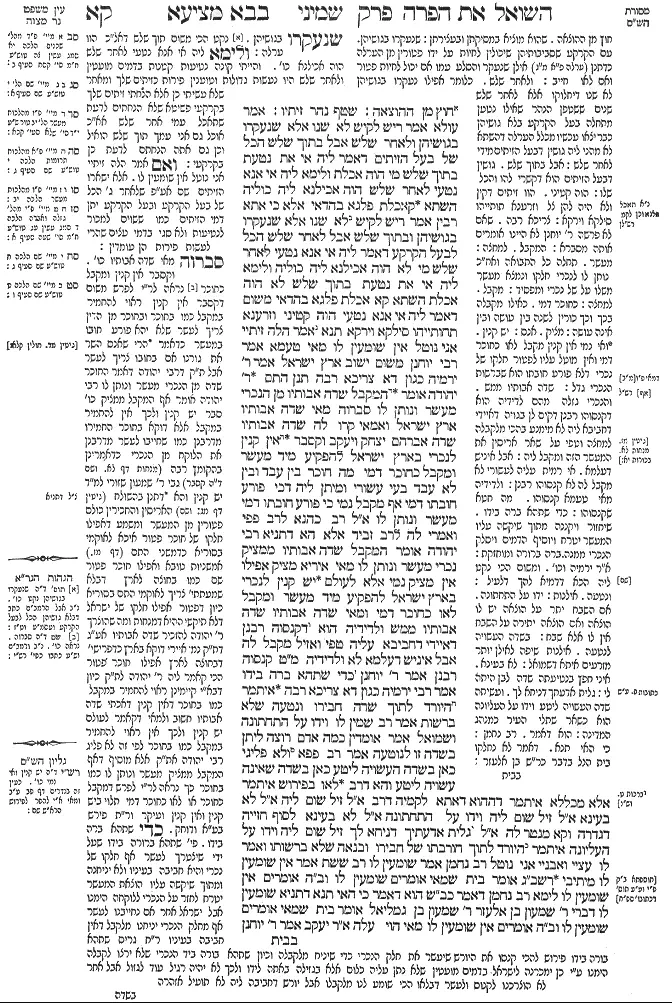
Bava Metzia 101a - Guemara
חוץ מן ההוצאה:
שטף נהר זיתיו:
אמר עולא אמר ריש לקיש לא שנו אלא שנעקרו בגושיהן ולאחר שלש אבל בתוך שלש הכל של בעל הזיתים דאמר ליה אי את נטעת בתוך שלש מי הוה אכלת ולימא ליה אי אנא נטעי לאחר שלש הוה אכילנא ליה כוליה השתא קאכלת פלגא בהדאי אלא כי אתא רבין אמר ריש לקיש לא שנו אלא שנעקרו בגושיהן ובתוך שלש אבל לאחר שלש הכל לבעל הקרקע דאמר ליה אי אנא נטעי לאחר שלש מי לא הוה אכילנא ליה כוליה ולימא ליה אי את נטעת בתוך שלש לא הוה אכלת השתא קא אכלת פלגא בהדאי משום דאמר ליה אי אנא נטעי הוה קטיני וזרענא תחותייהו סילקא וירקא תנא אמר הלה זיתיי אני נוטל אין שומעין לו מאי טעמא אמר רבי יוחנן משום ישוב ארץ ישראל אמר ר' ירמיה כגון דא צריכא רבה תנן התם ר' יהודה אומר המקבל שדה אבותיו מן הנכרי מעשר ונותן לו סברוה מאי שדה אבותיו ארץ ישראל ואמאי קרו לה שדה אבותיו שדה אברהם יצחק ויעקב וקסבר אין קנין לנכרי בארץ ישראל להפקיע מיד מעשר ומקבל כחוכר דמי מה חוכר בין עבד ובין לא עבד בעי עשורי ומיתן ליה דכי פורע חובתו דמי אף מקבל נמי כי פורע חובתו דמי מעשר ונותן לו א"ל רב כהנא לרב פפי ואמרי לה לרב זביד אלא הא דתניא רבי יהודה אומר המקבל שדה אבותיו ממציק נכרי מעשר ונותן לו מאי איריא מציק אפילו אין מציק נמי אלא לעולם יש קנין לנכרי בארץ ישראל להפקיע מיד מעשר ומקבל לאו כחוכר דמי ומאי שדה אבותיו שדה אבותיו ממש ולדידיה הוא דקנסוה רבנן דאיידי דחביבא עליה טפי ואזיל מקבל לה אבל איניש דעלמא לא ולדידיה מ"ט קנסוה רבנן אמר ר' יוחנן כדי שתהא ברה בידו אמר רבי ירמיה כגון דא צריכא רבה איתמר היורד לתוך שדה חבירו ונטעה שלא ברשות אמר רב שמין לו וידו על התחתונה ושמואל אמר אומדין כמה אדם רוצה ליתן בשדה זו לנוטעה אמר רב פפא ולא פליגי כאן בשדה העשויה ליטע כאן בשדה שאינה עשויה ליטע והא דרב לאו בפירוש איתמר אלא מכללא איתמר דההוא דאתא לקמיה דרב א"ל זיל שום ליה א"ל לא בעינא א"ל זיל שום ליה וידו על התחתונה א"ל לא בעינא לסוף חזייה דגדרה וקא מנטר לה א"ל גלית אדעתיך דניחא לך זיל שום ליה וידו על העליונה איתמר היורד לתוך חורבתו של חבירו ובנאה שלא ברשותו ואמר לו עציי ואבניי אני נוטל רב נחמן אמר שומעין לו רב ששת אמר אין שומעין לו מיתיבי רשב"ג אומר בית שמאי אומרים שומעין לו וב"ה אומרים אין שומעין לו לימא רב נחמן דאמר כב"ש הוא דאמר כי האי תנא דתניא שומעין לו דברי ר' שמעון בן אלעזר ר' שמעון בן גמליאל אומר בית שמאי אומרים שומעין לו וב"ה אומרים אין שומעין לו מאי הוי עלה א"ר יעקב אמר ר' יוחנן
Comments from Rashi on Masechet Bava Metzia Page 101a
גמ' חוץ מן ההוצאה . שהוא מוציא במסיקתן ובעצירתן: שנעקרו בגושיהן . עם הקרקע שסביבותיהן שיכולין לחיות על ידו פטורין מן הערלה כדתנן (ערלה פ"א מ"ג) אילן שנעקר והסלע עמו אם יכול לחיות פטור ואם לאו חייב: ולאחר שלש . כלומר אפילו נעקרו בגושיהן לא שנו דיחלוקו אלא לאחר שלש שנים ששטפן הנהר שאילו נטען מתחלה בעל הקרקע בלא גושיהן כבר יצאו עכשיו מכלל הערלה דהשתא לא מהני ליה גושין דבעל הזיתים מידי לאחר שלש: אבל בתוך שלש . גושין דבעל הזיתים הוא דקשרי להו והכל שלו: הוה קטיני . הוו זיתים דקין ולא היה להן צל וזרענא תותייהו סילקא וירקא: צריכא רבה . שאם לא פרשה רבי יוחנן לא היינו אומרים אותה מסברא: המקבל . למחצה: מעשר . תחלה כל התבואה ואח"כ נותן לו לנכרי חלקו ונמצא מעשר משלו על של נכרי ומפסיד: מקבל . למחצה: כחוכר דמי . כאילו מקבלה בכך וכך כורין לשנה בין עושה ובין אינה עושה: מציק . אנס: יש קנין . ואי נמי אין קנין מקבל לאו כחוכר דמי ואין מוטל עליו לפטור חלקו של נכרי דלא פורע חובתו הוא שברשות הנכרי גדל: שדה אבותיו ממש . והנכרי גזלה מהם לדידיה הוא דקנסוהו רבנן דקים לן בגויה דאיידי דחביבא ליה לא מימנע בהכי מלקבלה למחצה וטפי על שאר אריסין את המעשר הזה ומקבל ליה: אבל איניש דעלמא . אי רמית עליה לעשורי לא מקבל לה לא קנסוהו רבנן: ולדידיה מאי טעמא קנסוהו . מה חטא שקנסוהו: כדי שתהא ברה בידו . שיחזור ויקננה מתוך שיקשה עליו המעשר יטרח ויוסיף הדמים ויסלק הנכרי ממנה. ברה ברורה ומוחזקת: אמר רבי ירמיה וכו' . ומשום הכי נקט ליה הכא דדמיא להך דלעיל: ונטעה . אילנות: ידו על התחתונה . אם השבח יתר על הוצאה יש לו הוצאה ואם הוצאה יתירה על השבח אין לו אלא שבח: בשדה העשויה לנטעה . אילנות שיפה לאילן יותר מזרעים איתא דשמואל: לא בעינא . איני חפץ בנטיעתה שדה לבן היתה לי: גלית אדעתך דניחא לך . ועשיתה שדה העשויה ליטע וידו על העליונה הוא כשאר שתלי העיר כמנהג המדינה: הוא דאמר . רב נחמן: כי האי תנא . דאמר לא נחלקו בית הלל בדבר כר"ש בן אלעזר:
Comments from Tosafot - Bava Metzia 101a
שנעקרו בגושיהן . נקט הכי משום תוך שלש דאל"כ הוו ערלה: ולימא ליה אי אנא נטעי לאחר שלש הוה אכילנא כו' . והייתי קונה נטיעות קטנות בדמים מועטין ולאחר שלש היו נעשות גדולות וטוענין פירות כזיתים שלך ומאחר שלא עשיתי כן אלא הנחתי זיתים שלך בקרקעי פשיטא שלא הנחתים לדעת שתאכל עמי אחר שלש אא"כ אוכל גם אני עמך תוך שלש הואיל וכן גם אתה הנחתם לדעת כן בקרקעי: ואם אמר הלה זיתיי אני נוטל אין שומעין לו . אלא ישארו הזיתים שם אע"פ שלאחר ג' הכל של בעל הקרקע ובעל הקרקע יתן דמי הזיתים כמו ששוים למכור לנטיעות ולא סגי בדמי עצים שהרי לעשות פירות הן עומדין: סברוה מאי שדה אבותיו כו' . וקסבר אין קנין ומקבל כחוכר נראה לר"י לפרש משום דקסבר אין קנין ראוי להחמיר במקבל כמו בחוכר ובחוכר מן הדין צריך לעשר שלא יהא פורע חובו במעשר כדאמר. הרי שאנס השר את גורנו אם בחובו צריך לעשר אבל ת"ק דרבי יהודה דאמר החוכר שדה מן הנכרי מעשר ונותן לו רבי יהודה אומר אף המקבל ממציק כו' סבר יש קנין ולכך אין להחמיר במקבל אלא דוקא בחוכר החמירו מדרבנן כמו שחייבו לעשר מדרבנן את הלוקח מן הנכרי כדאמרינן בהקומץ רבה (מנחות דף לא. ושם ד"ה קסבר) גבי ר' שמעון שזורי למ"ד יש קנין והא דתנן בהשולח (גיטין דף מג: ושם) האריסין והחכירין כולם פטורין מן המעשר ומשמע דאפילו חלקו של חוכר פטור איכא לאוקמי בסוריא כדמשני התם (דף מז.) אמשניות טובא ואפילו חוכר פטור שם כמו בחוצה לארץ דבלא שמעתתי' צריך לאוקמי התם בסוריא כיון דפטור אפילו חלקו של ישראל דלא תיקשי ההיא דמנחות ומה שהוצרך ר' יהודה להזכיר שדה אבותיו אע"ג דת"ק נמי איירי דוקא בארץ כדפרישי' דבחוצה לארץ אפילו חוכר פטור הכי קאמר ליה ר' יהודה לת"ק כיון דבא"י קיימינן ראוי להחמיר במקבל כמו בחוכר דאין קנין דאכתי שדה אבותיו חשוב ולמאי דקאמר לעולם יש קנין ולכך אין ראוי להחמיר במקבל כמו בחוכר לפי זה לא פליג רבי יהודה את"ק אלא מוסיף דאף המקבל ממציק מעשר ונותן לו כמו בחוכר כך נראה לר"י לפרש דמקבל כחוכר או לאו כחוכר דמי תלוי ביש קנין ואין קנין ועיקר ור"ת פירש בע"א ודוחק: כדי שתהא ברה בידו . פי' שתהא ברורה בידו שעל ידי שיצטרך לעשר אף חלקו של נכרי והיא חביבה בעיניו ולא יניחנה ומתוך שיקשה עליו הוצאת המעשר יטרח לחזר על הנכרי ללוקחה הימנו אבל ישראל אחר אם נחייבנו לעשר אף מחלק הנכרי יניחנו מלקבל דאין חביבה בעיניו ר"ח גריס שתהא בורה בידו פירוש להכי קנסו את היורש שיעשר את חלק הנכרי כדי שיניח מלקבלה וכיון שתהא בורה ביד הנכרי שלא ירצו לקבלה הימנו ע"י כן ימכרנה לישראל בדמים מועטין שלא נתן עליה כלום אלא בגזילה באתה לידו ולכך לא יהיה רגיל עוד לגזול אבל אחר לא הוצרכנו לקנוס ולעשר דבלאו הכי שומע לנו מלקבלו אבל יורש דחביבה ליה לא תועיל אזהרה:
Bava Metzia 101a - Mishnah translated into english
is exclusive of the expense of processing the olives to produce oil.
§ The mishna teaches: In the event that a river swept away one’s olive trees and deposited them in the field of another, and they took root there and yielded olives, then the olives are divided between the owner of the trees and the owner of the field. Ulla says that Reish Lakish says: They taught this only about a case where the olive trees were uprooted and relocated together with their clods of earth in which they grew; and the ruling is with regard to olives that grew after three years since the trees took root in the new field. After three years there is no longer any prohibition of orla (see Leviticus 19:23) on the olives even if one presumes that the olives were nourished from the field owner’s land.
But during the first three years after the trees took root in the new field, everything that grows is the property of the owner of the olive trees, as he can say to the owner of the field: Even if you had planted the trees yourself at the time that they took root in your field, would you have eaten the olives during the first three years? If you claim that the nourishment from your land yielded the olives, the olives will be prohibited as orla. The only reason for them to be permitted is if it is assumed that they were nourished only from the clods of earth in which they were initially planted over three years ago, in which case they should belong entirely to me, as the owner of both the trees and the clods.
The Gemara asks: But let the owner of the field say to him: If I had uprooted your trees from my field and instead planted my own trees, then after three years I could have consumed all of the olives yielded by them. Now that I let your trees remain and so you have a right to consume half with me, in return I should be entitled to half the yield during the first three years as well.
The Gemara suggests another interpretation: Rather, when Ravin came from Eretz Yisrael to Babylonia he said in the name of Reish Lakish: They taught this only about a case where the olive trees were uprooted and relocated together with their clods of earth in which they grew, and the ruling is with regard to olives that grew during the first three years since the trees took root in the new field. But after the first three years, everything that grows is the property of the owner of the land, as he can say to the owner of the trees: If I had uprooted your trees from my field and instead planted my own trees, then after three years, could I not have consumed all of the olives produced by them?
The Gemara asks: But let the owner of the trees say to him: Even if you had planted trees yourself at the time my trees took root in your field, then during the first three years you would not have consumed their fruit at all. How, then, can you come now and claim you are entitled to consume half of the olives together with me during those first three years? The Gemara answers: He has a right to demand half of the olives due to the fact that the owner of the field can say to the owner of the trees: If I had uprooted your trees from my field and instead planted my own trees, they would be slender plants that do not cast heavy shadows, and I would have planted chard [silka] and vegetables underneath the trees and made a significant profit. Since, instead, I let your trees remain, in return I should be entitled to half of the fruit during the first three years.
§ The Sages taught in a baraita: If the other one, the owner of the trees, said: I am uprooting and taking my olive trees back, the court does not listen to him. What is the reason? Rabbi Yoḥanan said: Due to the desire to promote the settling of Eretz Yisrael, it is inappropriate to uproot trees. Upon hearing this ruling, Rabbi Yirmeya said: For rulings such as this, it is necessary to have a great Sage explain it, as that reason is not self-evident.
We learned in a mishna there (Demai 6:2): Rabbi Yehuda says that one who receives a field of his ancestors from a gentile under a sharecropping agreement, i.e., he is granted the right to cultivate the land and keep its produce in return for giving a portion of the produce to the gentile owner, must first tithe the produce grown in that field and only then give the gentile his portion from among the tithed produce.
Initially, when the Sages studied this mishna, they assumed the following interpretation: What is the meaning of: A field of his ancestors? It is a reference to any field in Eretz Yisrael. And why did they call it: A field of his ancestors? Because it is a field of his forefathers, Abraham, Isaac, and Jacob.
According to this interpretation, the mishna is referring to a field which was legitimately acquired by the gentile and to which the Jew has no claim. The Gemara explains why the Jewish sharecropper is required to tithe the produce he will give the landowner: And the reason the sharecropper tithes that produce is that the tanna holds that a gentile’s acquisition of land in Eretz Yisrael does not abrogate its sanctity with regard to separating tithes from its produce.
And Rabbi Yehuda also holds that the obligation of one who receives a field of his ancestors, i.e., a sharecropper, to pay the landowner is like that of a tenant farmer, i.e., just as a tenant farmer, whether the field produces a crop or whether it does not produce a crop, is required to procure produce from somewhere, tithe it, and then give it to the landowner, as he is like one paying his debt, so too, one who receives, i.e., a sharecropper, is also like one paying his debt, and he must consequently first tithe the produce and then give it to the landowner. Since his obligation to the landowner is regarded as a debt, apparently before the produce is given to the landowner, it belongs to the tenant farmer or sharecropper, who is therefore required to tithe it.
Rav Kahana said to Rav Pappi, and some say that he said it to Rav Zevid: But this explanation is challenged by that which is taught in a baraita: Rabbi Yehuda says that one who receives a field of his ancestors under a sharecropping agreement, from a gentile oppressor who seized it, first tithes produce and then gives the gentile his portion. According to the Sages’ initial understanding, why does the baraita specifically refer to an oppressor who stole the land? Even if the gentile was not an oppressor, the ruling of the baraita would also apply.
Rather, the tanna of the mishna holds that a gentile’s acquisition of land in Eretz Yisrael abrogates its sanctity with regard to separating tithes from its produce, and he also holds that the obligation of one who receives, i.e., a sharecropper, to pay the landowner is not like that of a tenant farmer. Since under the sharecropping arrangement the landowner retains a percentage stake in the yield, when the sharecropper provides the landowner with a portion of the produce, he is not considered to be paying a debt to him, but simply to be providing the landowner with the latter’s own produce. Therefore, fundamentally the sharecropper should not have to tithe the produce before giving it to the landowner. The requirement to do so is a fine the Sages imposed upon him, as the Gemara will explain.
And, according to this explanation, what is the meaning of: A field of his ancestors? It is referring to a field that belonged to his actual ancestors, of whom he is their heir, and it was then seized by a gentile. And it is only him whom the Sages penalized and required to take tithes from produce before giving it to the gentile oppressor, as, since the land is dear to him, he will more readily go and receive it in a sharecropping arrangement from the gentile, despite the Sages’ requirement. But with regard to another person of the world at large, the Sages did not penalize him, as no one else would be willing to receive the land under such disadvantageous terms.
This explains why the Sages limited the fine to a person who has an ancestral claim to the field, but what is the reason that the Sages penalized him? Rabbi Yoḥanan says: It was in order to encourage him to purchase the field, so that it will be clearly in his possession. The disadvantageous conditions will make it preferable for him to purchase the land outright from the gentile instead of entering into a sharecropping arrangement with him.
Upon hearing this ruling, Rabbi Yirmeya said: For rulings such as this, it is necessary to have a great Sage to explain it.
§ An amoraic dispute was stated with regard to one who entered another’s field and planted trees in it without the permission of the owner of the field. Since the owner of the field profits from the planter’s actions, he is required to pay him. Rav says: The court appraises both the expenses for the one who planted the trees and the value of the improvements and the planter is at a disadvantage, i.e., the owner of the field pays the lesser of the two amounts. And Shmuel says: The court estimates how much a person would be willing to give for someone to plant trees in this field, and that is how much the owner of the field must pay.
Rav Pappa said: And Rav and Shmuel do not disagree. Here, Shmuel’s ruling is with regard to a field that is designated for planting, while there, Rav’s ruling is with regard to a field that is not designated for planting.
The Gemara notes: And this ruling of Rav was not stated explicitly; rather, it was stated implicitly. As there was a certain person who came before Rav after someone had planted trees in that person’s field. Rav said to him: Go and have the court appraise both the expenses for the one who planted the trees and the value of the improvements. The owner of the field said to him: I do not want these trees; why should I pay for them? Rav said to him: Go and have the court appraise both the expenses for the one who planted the trees and the value of the improvements, and he is at a disadvantage, i.e., you are obligated to pay him only the lesser of the two amounts. The owner of the field again said to him: I do not want these trees; why should I pay for them? Rav did not persist with his ruling, indicating that he conceded that the owner of the field was not obligated to pay.
Eventually, Rav saw that the owner of the field had fenced in the field and was safeguarding the trees. Rav said to him: By doing so you have demonstrated your opinion that having those trees in your field is satisfactory to you. Therefore, I rule that you should go and have the court appraise both the expenses for the one who planted the trees and the value of the improvements, and he has the advantage, i.e., you are obligated to pay him the greater of the two amounts.
§ An amoraic dispute was stated with regard to one who entered another’s ruin and built it up using his own materials but without the landowner’s permission, and then later, the builder said to the landowner: I will dismantle the structure and take my timber and my stones back. Rav Naḥman says: The court listens to him and he is allowed to do so. Rav Sheshet says: The court does not listen to him and he is not allowed to do so.
The Gemara raises an objection to Rav Naḥman’s ruling from a baraita (Tosefta, Bava Kamma 10:6) about the same case: Rabban Shimon ben Gamliel says: Beit Shammai say that the court listens to him, and Beit Hillel say that the court does not listen to him. The Gemara explains the difficulty posed: Shall we say that Rav Naḥman said his ruling in accordance with the opinion of Beit Shammai? That is untenable, as this is not listed as one of the specific exceptions to the principle that the halakha is always in accordance with the opinion of Beit Hillel.
The Gemara answers: Rav Naḥman states his opinion in accordance with the opinion of that tanna, i.e., Rabbi Shimon ben Elazar, as it is taught in a baraita: According to both Beit Hillel and Beit Shammai, the court listens to him; this is the statement of Rabbi Shimon ben Elazar. Rabban Shimon ben Gamliel says: Beit Shammai say that the court listens to him, and Beit Hillel say that the court does not listen to him.
The Gemara inquires: What halakhic conclusion was reached about this matter? Rabbi Ya’akov said that Rabbi Yoḥanan said:
Traduction : The William Davidson digital edition of the Koren Noé Talmud, with commentary by Rabbi Adin Even-Israel Steinsaltz.