 Talmud Bavli
The learning on the whole site is dedicated : L'ilui Nishmat Reuven ben Rivka SEBBAG
The learning on the whole site is dedicated : L'ilui Nishmat יוסף בן מושה
The learning on the whole site is dedicated : L'ilui Nishmat אסתר בת חיים
Bava Metzia 7a : Youtube
Daf TubeYoutube
2 video classes :
Bava Metzia Page 7a
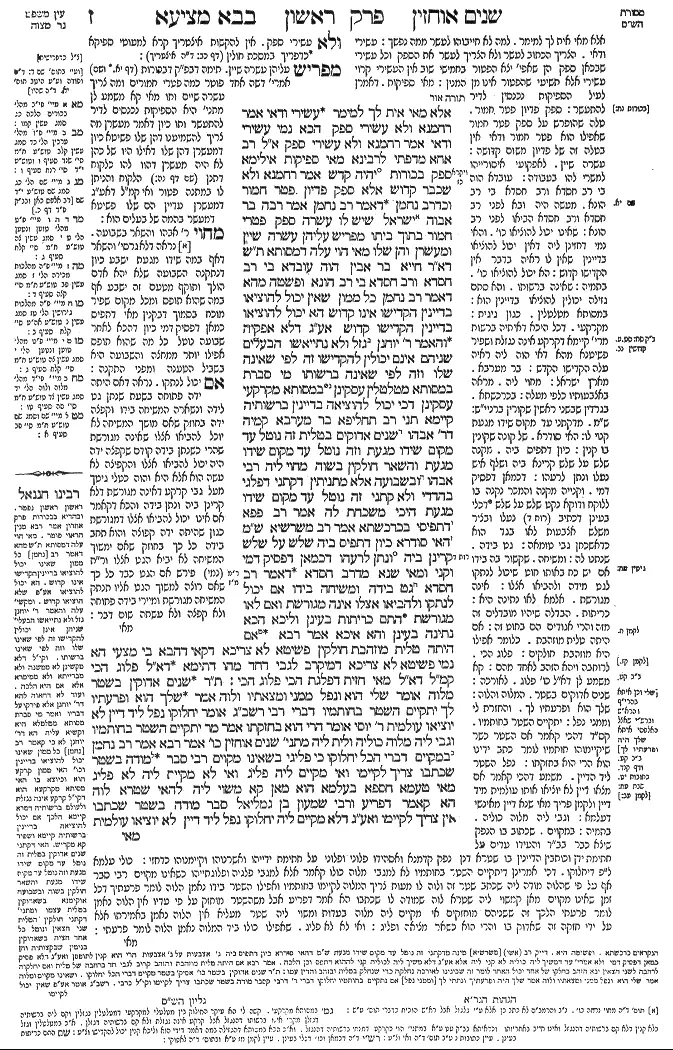
Bava Metzia 7a - Guemara
אלא מאי אית לך למימר עשירי ודאי אמר רחמנא ולא עשירי ספק הכא נמי עשירי ודאי אמר רחמנא ולא עשירי ספק א"ל רב אחא מדפתי לרבינא מאי ספיקות אילימא ספק בכורות (ויקרא כז, ט) יהיה קדש אמר רחמנא ולא שכבר קדוש אלא ספק פדיון פטר חמור וכדרב נחמן דאמר רב נחמן אמר רבה בר אבוה ישראל שיש לו עשרה ספק פטרי חמור בתוך ביתו מפריש עליהן עשרה שיין ומעשרן והן שלו מאי הוי עלה דמסותא ת"ש דא"ר חייא בר אבין הוה עובדא בי רב חסדא ורב חסדא בי רב הונא ופשטה מהא דאמר רב נחמן כל ממון שאין יכול להוציאו בדיינין הקדישו אינו קדוש הא יכול להוציאו בדיינין הקדישו קדוש אע"ג דלא אפקיה והאמר ר' יוחנן גזל ולא נתייאשו הבעלים שניהם אינם יכולין להקדישו זה לפי שאינה שלו וזה לפי שאינה ברשותו מי סברת במסותא מטלטלין עסקינן במסותא מקרקעי עסקינן דכי יכול להוציאה בדיינין ברשותיה קיימא תני רב תחליפא בר מערבא קמיה דר' אבהו שנים אדוקים בטלית זה נוטל עד מקום שידו מגעת וזה נוטל עד מקום שידו מגעת והשאר חולקין בשוה מחוי ליה רבי אבהו ובשבועה אלא מתניתין דקתני דפלגי בהדדי ולא קתני זה נוטל עד מקום שידו מגעת היכי משכחת לה אמר רב פפא דתפיסי בכרכשתא אמר רב משרשיא ש"מ האי סודרא כיון דתפיס ביה שלש על שלש קרינן ביה (רות ד, ז) ונתן לרעהו דכמאן דפסיק דמי וקני ומאי שנא מדרב חסדא דאמר רב חסדא גט בידה ומשיחה בידו אם יכול לנתקו ולהביאו אצלו אינה מגורשת ואם לאו מגורשת התם כריתות בעינן וליכא הכא נתינה בעינן והא איכא אמר רבא אם היתה טלית מוזהבת חולקין פשיטא לא צריכא דקאי דהבא בי מצעי הא נמי פשיטא לא צריכא דמיקרב לגבי דחד מהו דתימא דא"ל פלוג הכי קמ"ל דא"ל מאי חזית דפלגת הכי פלוג הכי:
ת"ר שנים אדוקין בשטר מלוה אומר שלי הוא ונפל ממני ומצאתיו ולוה אמר שלך הוא ופרעתיו לך יתקיים השטר בחותמיו דברי רבי רשב"ג אומר יחלוקו נפל ליד דיין לא יוציאו עולמית ר' יוסי אומר הרי הוא בחזקתו אמר מר יתקיים השטר בחותמיו וגבי ליה מלוה כוליה ולית ליה מתני' שנים אוחזין כו' אמר רבא אמר רב נחמן במקוים דברי הכל יחלוקו כי פליגי בשאינו מקוים רבי סבר מודה בשטר שכתבו צריך לקיימו ואי מקיים ליה פליג ואי לא מקיים ליה לא פליג מאי טעמא חספא בעלמא הוא מאן קא משוי ליה להאי שטרא לוה הא קאמר דפריע ורבי שמעון בן גמליאל סבר מודה בשטר שכתבו אין צריך לקיימו ואע"ג דלא מקיים ליה יחלוקו נפל ליד דיין לא יוציאו עולמית
Comments from Rashi on Masechet Bava Metzia Page 7a
אלא מאי אית לך למימר . למה לא חייבוהו לעשר ממה נפשך: עשירי ודאי . הצריך הכתוב לעשר ולא הצריך לעשר את הספק וכל עשירי שבכאן ספק הן שאפילו יצא הפטור בחמישי שוב אין העשירי קרוי עשירי אלא תשיעי שהפטור אינו מן המנין: מאי ספיקות . דאמרן לעיל הספיקות נכנסין לדיר להתעשר: ספק פדיון פטר חמור . טלה שהופרש על ספק פטר חמור שאפילו הוא פטר חמור ודאי אין בטלה זה של פדיון משום קדושה: עשרה שיין . לאפקועי איסורייהו למשרי להו בעבודה: עובדא הוה בי רב חסדא ורב חסדא בי רב הונא . מעשה היה ובא לפני רב חסדא ורב חסדא הביאו לפני רב הונא: שאינה יכול להוציאו כו' . והאי נמי דחזינן ליה דאין יכול להוציאו בדיינין שאין לו ראיה בדבר אין הקדישו קדוש: הא יכול להוציאו כו' . בתמיה: שאינו ברשותו . והא סתם גזילה יכולין להוציאו בדיינין הוא: במסותא מטלטלין . כגון גיגית: מקרקעי . דכל היכא דאיתיה ברשות מרי' קיימא דקרקע אינה נגזלת ושפיר פשיטנא מהא דאי הוה ליה ראיה עלה הקדישו הקדש: בר מערבא . מארץ ישראל: מחוי ליה . מראה באצבעותיו כלפי מעלה: בכרכשתא . בגרדין שבשני ראשין שקורין ברניי"ש: ש"מ . מדקתני עד מקום שידו מגעת קנוי לו: האי סודרא . של קונה שקונין בו קנין: כיון דתפיס ביה . מקנה שלש על שלש קרינא ביה ושלף איש נעלו ונתן לרעהו: דכמאן דפסיק דמי . וקנייה מקנה והמכר נקנה בו ללוקח ודוקא נקט שלש על שלש דכלי בעינן דכתיב (רות ד) נעלו ובציר משלש אצבעות לאו בגד הוא כדאשכחן גבי טומאה: גט בידה . שנתנו לה: ומשיחה . שקשור בה בידו אם יש כח באותו חוט שיכול לנתקו לגט מידה ולהביאו אצלו: אינה מגורשת . אלמא לאו נתינה היא: כריתות . הבדלה שיהיו מובדלים זה מזה והרי אגודים הם בחוט זה: אם היתה טלית מוזהבת . כלומר אפילו היא מוזהבת חולקים: פלוג הכי . לרוחבה ויהא הזהב לאחד מהם: קא משמע לן דא"ל כו' פלוג . לאורכה: שנים אדוקים בשטר . המלוה והלוה: שלך הוא ופרעתיו לך . והחזרת לי וממני נפל: יתקיים השטר בחותמיו . קס"ד דהכי קאמר אם השטר כשר שיקיימוהו חותמיו לומר כתב ידינו הוא הרי הוא בחזקתו: נפל השטר ליד הדיין . משמע דהכי קאמר: אם מצאו דיין לא יוציאו אותו עולמית מיד דיין ולקמן פריך מאי שנא דיין מאינשי דעלמא: וגבי ליה מלוה כוליה. בתמיה: במקוים . שכתוב בו הנפק שיצא כבר בבית דין והעידו עדים על חתימת ידן וכותבין הדיינין בו שטרא דנן נפק קדמנא ואסהידו פלוני ופלוני על חתימת ידייהו ואשרנוהו וקיימנוהו כדחזי: כולי עלמא לא פליגי דיחלוקו . דכי אמרינן דיתקיים השטר בחותמיו לא למגבי מלוה כולו קאמר אלא למגבי פלגיה ופלוגתייהו כשאינו מקוים רבי סבר אף על פי שהלוה מודה ליה שכתב שטר זה ולוה לו מעות צריך המלוה לקיימו בחותמיו ואפילו השטר בידו נאמן הלוה לומר פרעתיך דכל זמן שאינו מקוים מאן קמשוי ליה שטרא לוה שמודה לו שכתבו הא אמר דפריע אבל משהשטר מוחזק על פי עדיו אין הלוה נאמן לומר פרעתי הלכך זה ששניהם מוחזקים אי מקיים ליה מלוה בעדות ומשוי ליה שטר מעליא אין הלוה נאמן באמירתו אלא על ידי חזקה זה שאדוק בו והרי הוא כשאר מציאה ופליג: ואי לא לא פליג . שאפילו כולו ביד המלוה נאמן הלוה לומר פרעתי:
Comments from Tosafot - Bava Metzia 7a
ולא עשירי ספק . אין להקשות איצטריך קרא למעוטי ספיקא כדפריך במסכת חולין (דף כב: ד"ה איצטריך): מפריש עליהן עשרה שיין . תימה דבפ"ק דבכורות (דף יא. ושם) אמרי' דשה אחד פוטר כמה פטרי חמורים ומה צריך עשרה שיים ותו מאי קא משמע לן מתני' היא הספיקות נכנסים לדיר להתעשר ותו כיון דאמר מעשרן מה צריך להשמיענו דהן שלו פשיטא כיון דמעשרן דהן שלו דאילו היו של כהן לא היה מעשרן דהוו להו כלקוח דתנן (שם דף נה:) הלקוח והניתן לו במתנה פטור ואי קמ"ל דאע"ג דמעשרן עדיין הם שלו פשיטא דמעשר בהמה של בעלים הוא: מחוי ר' אבהו והשאר בשבועה . נראה דלא גרסי' והשאר דאף במה שידו מגעת ישבע כיון דנתקנה השבועה שלא יהא אדם הולך ותוקף מטעם זה ישבע אף במה שהוא תופס ומכל מקום שפיר מוכח בסמוך דבקנין מאי דתפיס כמאן דפסיק דמי כיון דהכא לאחר שבועה נוטל כל מה שהוא תופס אפילו יותר ממחצה והשבועה היא בשביל הטענה ומפני התקנה: אם יכול לנתקו . נראה דאם היתה ידה פתוחה בשעת שנתן גט לידה ונשארה המשיחה בידו וקפצה ידה בחוזק שאם מושך המשיחה לא יוכל להביאו אצלו שאינה מגורשת שהרי כשנתן בידה קודם שקפצה ידה היה יכול להביאו אצלו והקפיצה לא עשה הוא אלא היא והוה כטלי גיטך מעל גבי קרקע דאינה מגורשת דלא קרינן ביה ונתן בידה והכא דקאמר אם אינו יכול להביאו אצלו דמגורשת כגון שהיתה ידה קפוצה והוא תחב בידה כל כך בחוזק שאם ימשוך המשיחה לא יביא הגט אצלו ור"ת (נמי) פירש אם הגט כבד כל כך שאם רוצה למשוך הגט אליו תנתק המשיחה מגורשת ומיירי בידה פתוחה ולא קפצה ולא עשתה שום דבר:
Bava Metzia 7a - Mishnah translated into english
Rather, what have you to say to explain why one is not required to tithe his flock in a case where a counted animal jumped back into the pen? The Merciful One states: “And all the tithe of the herd or the flock, anyone that passes under the rod, the tenth shall be sacred to the Lord” (Leviticus 27:32), from which it is derived that a certain tenth animal must be tithed, but not an uncertain tenth, i.e., an animal that is not certainly the tenth. Here too, the entire flock is exempt from tithe because the Merciful One states that a certain tenth animal must be designated as tithe and not an uncertain tenth, i.e., an animal that is not certainly subject to tithe. Therefore, there is proof from the baraita that if a priest seizes an animal whose status as firstborn is uncertain, the court removes it from his possession.
Rav Aḥa of Difti said to Ravina: What are these animals of uncertain status that that are subject to tithe according to the mishna? If we say that the reference is to animals whose status as firstborns is uncertain, the Merciful One states: “The tenth shall be sacred to the Lord,” indicating that the tithe animal becomes sacred only when it is designated as tithe, from which it is inferred: But not an animal that is already sacred for a different reason. Therefore, since an animal whose status as firstborn is uncertain is already considered sacred due to the uncertainty, the sanctity of animal tithe would not apply to it.
Rather, the mishna must be referring to a case of an uncertain redemption of a firstborn donkey, i.e., a lamb used as redemption for a donkey whose status as firstborn is uncertain. And this is in accordance with the statement of Rav Naḥman, as Rav Naḥman says that Rabba bar Avuh says: An Israelite who has ten donkeys whose status as firstborn is uncertain in his home separates ten lambs to redeem them, and tithes the lambs, separating one as a tithe, and they all belong to him, as a priest cannot prove that he is entitled to any of the ten.
The Gemara asks: What halakhic conclusion was reached about this matter of the bathhouse? Come and hear a conclusion, as Rabbi Ḥiyya bar Avin said: There was a similar incident that was brought before the school of Rav Ḥisda, and Rav Ḥisda brought the case before the school of Rav Huna, and Rav Huna resolved the issue based on that which Rav Naḥman says: With regard to any property that one cannot recover from the possession of another party by legal process, if he consecrated it while it was in the possession of the other party the consecration is not valid.
The Gemara questions Rav Naḥman’s statement: By inference, is it so that if one can recover the property from the other party by legal process, and he consecrated it, the consecration is valid, although he has not yet recovered it? But doesn’t Rabbi Yoḥanan say: In a case where one robbed another of an item and the owner did not despair of retrieving it, neither the owner nor the robber can consecrate it; this one, the robber, because it is not his, and that one, the owner, because it is not in his possession? The indication is that one cannot consecrate even his own item if it is not in his possession.
The Gemara answers: Did you think that in the case of the bathhouse we are dealing with a movable bath? No, we are dealing with a bath that is excavated in the ground, in which case once its owner can recover it by legal process there is no need to take possession of it, as it already exists in his possession.
§ Rav Taḥalifa from the West, i.e., Eretz Yisrael, taught this baraita before Rabbi Abbahu: If two people are grasping a garment, this one takes up to where his hand reaches, and that one takes up to where his hand reaches, and they divide the remainder, the part of the garment that is in the grasp of neither, equally. Rabbi Abbahu indicated by means of a hand gesture that Rav Taḥalifa should add: And this is with the proviso that they take an oath.
The Gemara asks: But then how can you find a case where the halakha in the mishna applies? As the mishna teaches that they divide the garment between them, and does not teach that this one takes up to where his hand reaches and that one does likewise. Rav Pappa said: The mishna is discussing a case where neither of them is grasping the garment itself, but rather they are holding onto the fringes [bekarkashta] of the garment. Therefore, each is required to take an oath and they divide the garment between them.
Rav Mesharshiyya said: Learn a halakha with regard to the symbolic transfer of a cloth as a formal act of acquisition from Rav Pappa’s statement: The entire cloth need not change hands. Rather, once the recipient of the cloth has grasped three by three fingerbreadths of the cloth, which is the minimum size of a cloth that can be considered a utensil, the transaction takes effect, as we consider such an action to be an implementation of the verse upon which acquisition by means of a cloth is based: “Now this was the custom in former times in Israel…to confirm all things: A man drew off his shoe, and gave it to his neighbor; and this was the attestation in Israel” (Ruth 4:7).
This is because such an amount of the cloth is significant enough to be considered as though it were severed from the rest of the cloth, and therefore when the recipient grasps it, it effects the acquisition, even though the rest of the cloth is still in the hand of the other party.
The Gemara asks: But in what way is this case different from the ruling of Rav Ḥisda? As Rav Ḥisda said: In a case where a husband placed a bill of divorce in his wife’s hand, and a string attached to the bill of divorce remained in his hand, if the husband can still pull the bill of divorce out of her hand and bring it to him, she is not divorced; and if he is not able to do so, e.g., if the string is too flimsy, then she is divorced. This indicates that as long as part of the bill of divorce remains in his hand, it is not considered as though he gave it to her.
The Gemara answers: There, in the case of a bill of divorce, we require that it accomplish a complete severance between the husband and wife, and as long as the husband continues to have some hold on the bill of divorce there is no complete severance. By contrast, here, in the case of a transaction by means of a cloth, we require an act of giving, and there is a valid act of giving even if only part of the cloth was given.
Rava says: Even if the garment was fashioned with gold thread, they divide it. The Gemara asks: Isn’t this obvious? Why would a gold garment have a different halakha? The Gemara answers: No, it is necessary to state this halakha in a case where the gold is in the middle of the garment, neither in one’s hand nor in the other’s.
The Gemara challenges: This too is obvious; the halakha is that they divide the remainder. The Gemara answers: No, it is necessary to state this halakha in a case where the gold is closer to one of them, though it is not in his grasp. Lest you say that the one to whom the gold is closer can say to the other: Divide it in this manner, along the middle line of the garment between us, leaving most of the gold in my possession, Rava therefore teaches us that they divide the gold equally. The reason is that the other litigant can say to him in response: What did you see that led you to divide it in that manner, e.g., lengthwise? Divide it in this manner, e.g., widthwise, so that the gold will be divided equally between us.
§ The Sages taught in a baraita (Tosefta 1:8): In a case where two people, a creditor and a debtor, are grasping a promissory note, and the creditor says: The promissory note is mine, as the debt has not yet been repaid, and I merely dropped it and I subsequently found it, and the debtor says: The promissory note was once yours, i.e., you lent me the money, but I already repaid you, and you therefore gave me the note, in that case the promissory note must be ratified through its signatories for the creditor to collect the debt. In other words, the court must first ascertain the validity of the promissory note by verifying that the signatures of the witnesses are authentic. This is the statement of Rabbi Yehuda HaNasi.
Rabban Shimon ben Gamliel says: The creditor and the debtor divide the debt attested to in the promissory note, i.e., the debtor is liable to pay half the amount, due to uncertainty as to who is telling the truth.
If a promissory note fell into the possession of a judge and the two parties do not agree as to which of them it belongs, either to the creditor, and the debt has yet to have been repaid, or to the debtor, and the debt was repaid, it may never be removed from the judge’s possession to collect the debt until proof is provided. Rabbi Yosei says: The promissory note retains its presumptive status of validity and the litigants proceed in accordance with its contents.
The Gemara discusses the baraita. The Master said that the promissory note must be ratified through its signatories. And does this indicate that once it is ratified, the creditor collects the entire debt? But doesn’t Rabbi Yehuda HaNasi hold in accordance with the halakha taught in the mishna with regard to two people holding a garment, that they divide the garment? Here too, each party should be entitled half the promissory note, and the debtor should therefore be obligated to pay only half the debt.
Rava says that Rav Naḥman says: In a case where the promissory note was ratified by the court, everyone agrees that the litigants divide it, and the debtor repays only half of the debt. They disagree with regard to a case where it was not ratified.
Rabbi Yehuda HaNasi holds that even when a debtor admits that he wrote a promissory note, the creditor must ratify it in court in order for the creditor to collect the debt. And therefore, if he ratifies the promissory note in court he divides it with the debtor, and if he does not ratify it he does not divide it with the debtor. If he is unable to ratify the signatures of the witnesses, he receives nothing even if the debtor admits that he borrowed the money.
What is the reason for Rabbi Yehuda HaNasi’s opinion? He holds that an unratified promissory note is merely a shard. Who renders this document a valid promissory note? The debtor does. The validity of the note is solely dependent on the corroboration of the debtor, and doesn’t the debtor say that the debt mentioned in the promissory note was repaid? Therefore, the note is worthless unless it is ratified by the witnesses in court.
And Rabbi Shimon ben Gamliel holds that if a debtor admits that he wrote a promissory note, the creditor is not required to ratify it in court in order for the creditor to collect the debt. And therefore, even if the creditor does not ratify it, the promissory note is valid, and they divide it.
It is taught in the baraita that if a promissory note fell into the possession of a judge it may never be removed from his possession until proof is provided.
Traduction : The William Davidson digital edition of the Koren Noé Talmud, with commentary by Rabbi Adin Even-Israel Steinsaltz.