 Talmud Bavli
Yevamot 62b : Youtube
Daf TubeYoutube
2 video classes :
Yevamot Page 62b
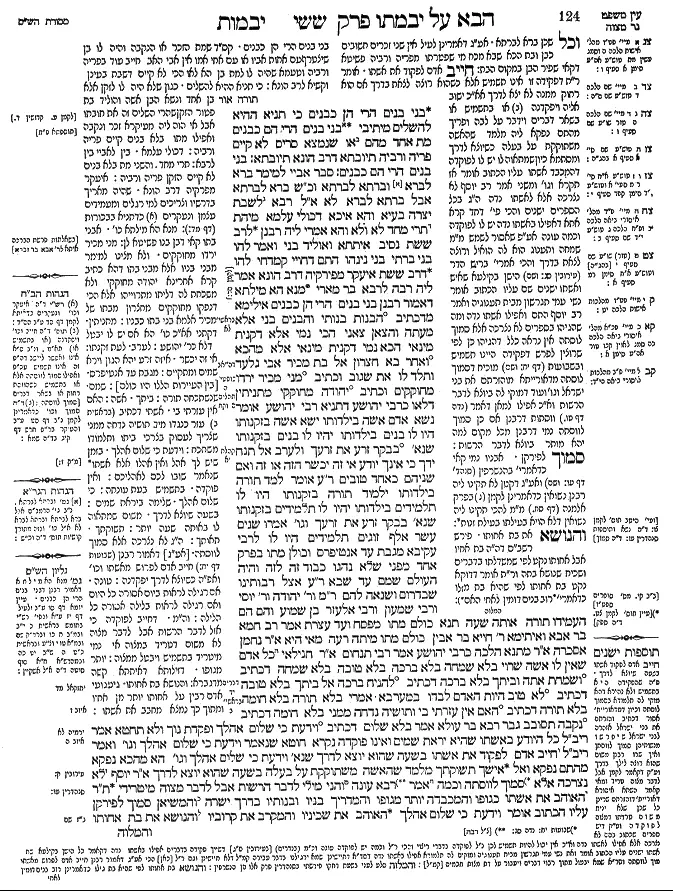
Yevamot 62b - Guemara
בני בנים הרי הן כבנים כי תניא ההיא להשלים מיתיבי בני בנים הרי הם כבנים מת אחד מהם או שנמצא סריס לא קיים פריה ורביה תיובתא דרב הונא תיובתא:
בני בנים הרי הם כבנים:
סבר אביי למימר ברא לברא וברתא לברתא וכ"ש ברא לברתא אבל ברתא לברא לא א"ל רבא לשבת יצרה בעיא והא איכא דכולי עלמא מיהת תרי מחד לא ולא והא אמרי ליה רבנן לרב ששת נסיב איתתא ואוליד בני ואמר להו בני ברתי בני נינהו התם דחויי קמדחי להו דרב ששת איעקר מפירקיה דרב הונא אמר ליה רבה לרבא בר מארי מנא הא מילתא דאמור רבנן בני בנים הרי הן כבנים אילימא מדכתיב (בראשית לא, מג) הבנות בנותי והבנים בני אלא מעתה והצאן צאני הכי נמי אלא דקנית מינאי הכא נמי דקנית מינאי אלא מהכא (דברי הימים א ב, כא) ואחר בא חצרון אל בת מכיר אבי גלעד ותלד לו את שגוב וכתיב (שופטים ה, יד) מני מכיר ירדו מחוקקים וכתיב (תהלים ס, ט) יהודה מחוקקי מתניתין דלאו כרבי יהושע דתניא רבי יהושע אומר נשא אדם אשה בילדותו ישא אשה בזקנותו היו לו בנים בילדותו יהיו לו בנים בזקנותו שנא' (קהלת יא, ו) בבקר זרע את זרעך ולערב אל תנח ידך כי אינך יודע אי זה יכשר הזה או זה ואם שניהם כאחד טובים ר"ע אומר למד תורה בילדותו ילמוד תורה בזקנותו היו לו תלמידים בילדותו יהיו לו תלמידים בזקנותו שנא' בבקר זרע את זרעך וגו' אמרו שנים עשר אלף זוגים תלמידים היו לו לרבי עקיבא מגבת עד אנטיפרס וכולן מתו בפרק אחד מפני שלא נהגו כבוד זה לזה והיה העולם שמם עד שבא ר"ע אצל רבותינו שבדרום ושנאה להם ר"מ ור' יהודה ור' יוסי ורבי שמעון ורבי אלעזר בן שמוע והם הם העמידו תורה אותה שעה תנא כולם מתו מפסח ועד עצרת אמר רב חמא בר אבא ואיתימא ר' חייא בר אבין כולם מתו מיתה רעה מאי היא א"ר נחמן אסכרה א"ר מתנא הלכה כרבי יהושע אמר רבי תנחום א"ר חנילאי כל אדם שאין לו אשה שרוי בלא שמחה בלא ברכה בלא טובה בלא שמחה דכתיב (דברים יד, כו) ושמחת אתה וביתך בלא ברכה דכתיב (יחזקאל מד, ל) להניח ברכה אל ביתך בלא טובה דכתיב (בראשית ב, יח) לא טוב היות האדם לבדו במערבא אמרי בלא תורה בלא חומה בלא תורה דכתיב (איוב ו, יג) האם אין עזרתי בי ותושיה נדחה ממני בלא חומה דכתיב (ירמיהו לא, כב) נקבה תסובב גבר רבא בר עולא אמר בלא שלום דכתיב (איוב ה, כד) וידעת כי שלום אהלך ופקדת נוך ולא תחטא אמר ריב"ל כל היודע באשתו שהיא יראת שמים ואינו פוקדה נקרא חוטא שנאמר וידעת כי שלום אהלך וגו' ואמר ריב"ל חייב אדם לפקוד את אשתו בשעה שהוא יוצא לדרך שנא' וידעת כי שלום אהלך וגו' הא מהכא נפקא מהתם נפקא ואל אישך תשוקתך מלמד שהאשה משתוקקת על בעלה בשעה שהוא יוצא לדרך א"ר יוסף לא נצרכה אלא סמוך לווסתה וכמה אמר רבא עונה והני מילי לדבר הרשות אבל לדבר מצוה מיטרידי ת"ר האוהב את אשתו כגופו והמכבדה יותר מגופו והמדריך בניו ובנותיו בדרך ישרה והמשיאן סמוך לפירקן עליו הכתוב אומר וידעת כי שלום אהלך האוהב את שכיניו והמקרב את קרוביו והנושא את בת אחותו
Comments from Rashi on Masechet Yevamot Page 62b
בני בנים הרי הן כבנים . קס"ד שמת הזכר או הנקבה והיה לו בן שיצטרף עם אחות אביו או עם אחי אמו אין אבי האב חייב עוד בפריה ורביה וטעמא שהיה לו למת בן הא לאו הכי לא קיים דשבת בעינן וקשיא לרב הונא: כי תניא ההיא להשלים . כגון שלא היה לו לזקן אלא בן אחד ונשא הבן אשה והוליד בת פטור הזקן שהרי השלים זה את חובתו אבל אי הוה ליה מעיקרא זכר ונקבה ואפילו מתו בלא בנים קיים פריה ורביה: דכולי עלמא . בין לאביי בין לרבא: תרי מחד . והשני מת בלא בנים לא קיים הזקן פריה ורביה: איעקר מפרקיה דרב הונא . שהיה מאריך בדרשיו וצריכים למי רגלים ומעמידים עצמן ונעקרים כדתניא בבכורות (דף מד:): מנא הא מילתא כו' . אבני בתו קאי דבן בנו פשיטא לן: מני מכיר ירדו מחוקקים . ולא מצינו למימר מבני בניו אלא מבני בתו דהא כתיב קרא אחרינא יהודה מחוקקי ולא משכחת לה דליתו מתרוייהו אלא הכי דנפקו מחוקקים מחצרון מבתו של מכיר אלמא בני בתו כבניו: מתניתין . דקתני אא"כ כו' הא אם יש לו יבטל דלא כר' יהושע: לערב . לעת זקנתו: אי זה יכשר . איזה זרע יהא הגון וירא שמים ומתקיים: מגבת עד אנטיפרס . [בין העיירות הללו היו כולם]: שמם . שנשתכחה תורה: ביתך . אשה: האם אין עזרתי בי . אשתי דכתיב (בראשית ב) עזר כנגדו מיד תושיה נדחה ממני שצריך לעסוק בצרכי ביתו ותלמודו משתכח: וידעת כי שלום אהלך . בזמן שיש לך אהל ואין אהלו אלא אשתו שנאמר שובו לכם לאהליכם: ואין פוקדה . בתשמיש בעת עונתה: כי שלום אהלך . שלימה ביראת שמים: בשעה שיוצא לדרך . משום שמתאוה לו באותה שעה יותר: תשוקתך . תאותך: ה"ג לא נצרכה אלא סמוך לווסתה . [אע"ג] דאמור רבנן (שבועות דף יח:) חייב אדם לפרוש מאשתו וכו' ואפ"ה כשיוצא לדרך יפקדנה: עונה . אם רגילה לראות ביום אסורה כל היום ואם רגילה לראות בלילה אסורה כל הלילה: וה"מ . דחייב לפוקדה כי אזל לדבר הרשות אבל לדבר מצוה לא משום דטריד במצוה אי נמי מיטריד בתשמיש ויבטל ממצוה: יותר מגופו . דזילותא דאיתתא קשה מדגברא: והנושא בת אחותו . גיעגועי אדם רבין על אחותו יותר מן אחיו ומתוך כך נמצא מחבב את אשתו:
Comments from Tosafot - Yevamot 62b
וכל שכן ברא לברתא . אע"ג דאמרינן לעיל אין שני זכרים חשובים כבן ובת הכא שבא מכח מי שפטרתו מפריה ורביה פשיטא דקאי שפיר הבן במקום הבת: חייב אדם לפקוד את אשתו . אומר ר"ת דפקידה זו אינו תשמיש אלא כשהוא רוצה לצאת בדרך אם הוא רחוק ממנה לא יצא לדרך אא"כ ישוב אליה ויפקדנה או בתשמיש או בשאר דברים וידבר על לבה ופריך מהתם נפקא ליה מלמד שהאשה משתוקקת על בעלה כשיוצא לדרך ומסתמא כיון שמתאוה לו יש לו לפוקדה דהמכבד אשתו עליו הכתוב אומר אז תקרא וגו' ומשני אמר רב יוסף לא נצרכה אלא לאשתו נדה ה"ג בכל הספרים ישנים והכי פי' דחד קרא אתא דאפילו באשתו נדה יש לו לפוקדה וכמה עונה אע"פ שאסור לשמש מ"מ שמחה ותענוג הוא לה הואיל ורוצה לצאת בדרך והכי אמרי' בריש הדר (עירובין סג: ושם) הישן בקילעא שאיש ואשתו ישנים שם עליו הכתוב אומר נשי עמי תגרשון מבית תענוגיה ואמר רב יוסף התם ואפילו אשתו נדה ומה שהגיהו בספרים לא נצרכה אלא סמוך לוסתה אין נראה כלל דהגיהו כן לפי שרוצין לפרש דפקידה היינו תשמיש ובשבועות (דף יח: ושם) מוכיח דסמוך לוסתה מדאורייתא מוהזרתם את בני ישראל וגו' ועוד דמוקי לה ביוצא לדבר הרשות וא"כ אפילו למאן דאמר (נדה דף טו.) ווסתות דרבנן אם כן סמוך לווסתה נמי דרבנן מכל מקום למה יהא מותר ביוצא לדבר הרשות: סמוך לפירקן . אבניו נמי קאי כדאמרי' בהנשרפין (סנהד' דף עו: ושם) ואע"ג דקטן לא תקינו ליה רבנן נשואין כדאמרינן לקמן בפרק אלמנה (יבמות דף סח.) מ"מ להכי תקינו ליה נשואין דלא הויא בעילתו בעילת זנות: והנושא את בת אחותו . פירש רשב"ם דה"ה בת אחיו אבל אחותו נקט לפי שמשדלתו בדברים ושכיח שנושא בתה ור"ת אומר דדוקא נקט בת אחותו לפי שהיא בת מזלו כדאמרי' רוב בנים דומין לאחי האם:
Yevamot 62b - Mishnah translated into english
Grandchildren are considered like children. This indicates that if one’s children have passed away, he has fulfilled the mitzva to be fruitful and multiply only if they had children of their own, as they are considered like his own children. The Gemara responds: When that baraita is taught it is with regard to completing the required number of children, e.g., if he had only a son, but his son had a daughter, he has fulfilled the mitzva to be fruitful and multiply.
The Gemara raises an objection to the opinion of Rav Huna from another baraita: Grandchildren are considered like children. If one of a man’s children died or was discovered to be a eunuch, the father has not fulfilled the mitzva to be fruitful and multiply. This directly contradicts Rav Huna’s statement that one fulfills the mitzva even if his children die. The Gemara concludes: The refutation of the opinion of Rav Huna is indeed a conclusive refutation.
§ It was taught in the baraita that grandchildren are considered like children. Abaye thought to say that if one’s children die, he fulfills the mitzva to be fruitful and multiply through grandchildren, provided a son was born to his son and a daughter to his daughter, and all the more so if a son was born to his daughter, as his grandchildren take the place of his children in these cases. However, if a daughter was born to his son, no, she cannot take the place of her father. Rava said to him: We require merely fulfillment of the verse: “He formed it to be inhabited,” and there is fulfillment in this case, as the earth is inhabited by his descendants.
The Gemara comments: In any event, everyone agrees that if one has two grandchildren from one child, no, he has not fulfilled the mitzva to be fruitful and multiply, even if he has both a grandson and a granddaughter. The Gemara asks: And has he not? Didn’t the Rabbis say to Rav Sheshet: Marry a woman and have sons, as you have not yet fathered any sons, and Rav Sheshet said to them: The sons of my daughter are my sons? This indicates that one can fulfill the mitzva through grandchildren even if he did not have a son and daughter of his own.
The Gemara answers: There, Rav Sheshet was merely putting them off. The real reason he did not want to get remarried was because Rav Sheshet became impotent from Rav Huna’s discourse. Rav Huna’s discourses were so lengthy that Rav Sheshet became impotent after waiting for so long without relieving himself.
Rabba said to Rava bar Mari: From where is this matter that the Sages stated derived, that grandchildren are considered like children? If we say it is derived from the fact that it is written in Laban’s speech to Jacob: “The daughters are my daughters and the children are my children” (Genesis 31:43), which indicates that Jacob’s children were also considered to be the children of their grandfather Laban, if that is so, does the continuation of Laban’s statement: “And the flocks are my flocks” (Genesis 31:43), indicate that so too, Jacob’s flocks were considered as belonging to Laban? Rather, Laban was saying that you, Jacob, acquired them from me. Here too, with regard to the children, Laban was saying: You acquired them from me, i.e., it is only due to me that you have children.
Rather, the proof is from here: “And afterward Hezron went in to the daughter of Machir, the father of Gilead…and she bore him Segub” (I Chronicles 2:21), and it is written: “Out of Machir came down governors” (Judges 5:14), and it is written: “Judah is my governor” (Psalms 60:9). Consequently, the governors, who were from the tribe of Judah, were also called the sons of Machir, who was from the tribe of Manasseh. This must be because they were the children of Machir’s daughter and Hezron, indicating that grandchildren are considered like children.
§ The Gemara comments: The mishna is not in accordance with the opinion of Rabbi Yehoshua. As it is taught in a baraita that Rabbi Yehoshua says: If a man married a woman in his youth, and she passed away, he should marry another woman in his old age. If he had children in his youth, he should have more children in his old age, as it is stated: “In the morning sow your seed, and in the evening do not withhold your hand; for you do not know which shall prosper, whether this or that, or whether they both alike shall be good” (Ecclesiastes 11:6). This verse indicates that a man should continue having children even after he has fulfilled the mitzva to be fruitful and multiply.
Rabbi Akiva says that the verse should be understood as follows: If one studied Torah in his youth he should study more Torah in his old age; if he had students in his youth he should have additional students in his old age, as it is stated: “In the morning sow your seed, etc.” They said by way of example that Rabbi Akiva had twelve thousand pairs of students in an area of land that stretched from Gevat to Antipatris in Judea, and they all died in one period of time, because they did not treat each other with respect.
And the world was desolate of Torah until Rabbi Akiva came to our Rabbis in the South and taught his Torah to them. This second group of disciples consisted of Rabbi Meir, Rabbi Yehuda, Rabbi Yosei, Rabbi Shimon, and Rabbi Elazar ben Shamua. And these are the very ones who upheld the study of Torah at that time. Although Rabbi Akiva’s earlier students did not survive, his later disciples were able to transmit the Torah to future generations.
With regard to the twelve thousand pairs of Rabbi Akiva’s students, the Gemara adds: It is taught that all of them died in the period from Passover until Shavuot. Rav Ḥama bar Abba said, and some say it was Rabbi Ḥiyya bar Avin: They all died a bad death. The Gemara inquires: What is it that is called a bad death? Rav Naḥman said: Diphtheria.
Rav Mattana said: The halakha is in accordance with the opinion of Rabbi Yehoshua, who said that one must attempt to have more children even if he has already fulfilled the mitzva to be fruitful and multiply.
§ Apropos the discussion with regard to the mitzva to have children, the Gemara cites statements about marriage in general. Rabbi Tanḥum said that Rabbi Ḥanilai said: Any man who does not have a wife is left without joy, without blessing, without goodness. He proceeds to quote verses to support each part of his statement. He is without joy, as it is written: “And you shall rejoice, you and your household” (Deuteronomy 14:26), which indicates that a man is in a joyful state only when he is with his household, i.e., his wife. He is without blessing, as it is written: “To cause a blessing to rest in your house” (Ezekiel 44:30), which indicates that blessing comes through one’s house, i.e., one’s wife. He is without goodness, as it is written: “It is not good that man should be alone” (Genesis 2:18), i.e., without a wife.
In the West, Eretz Yisrael, they say: One who lives without a wife is left without Torah, and without a wall of protection. He is without Torah, as it is written: “Is it that I have no help in me, and that sound wisdom is driven from me?” (Job 6:13), indicating that one who does not have a wife lacks sound wisdom, i.e., Torah. He is without a wall, as it is written: “A woman shall go round a man” (Jeremiah 31:22), similar to a protective wall.
Rava bar Ulla said: One who does not have a wife is left without peace, as it is written: “And you shall know that your tent is in peace; and you shall visit your habitation and shall miss nothing” (Job 5:24). This indicates that a man has peace only when he has a tent, i.e., a wife.
On the same verse, Rabbi Yehoshua ben Levi said: Whoever knows that his wife fears Heaven and she desires him, and he does not visit her, i.e., have intercourse with her, is called a sinner, as it is stated: And you shall know that your tent is in peace; and you shall visit your habitation. And Rabbi Yehoshua ben Levi said: A man is obligated to visit his wife for the purpose of having intercourse when he is about to depart on a journey, as it is stated: “And you shall know that your tent is in peace, etc.”
The Gemara asks: Is this last statement derived from here? It is derived from there: “And your desire shall be to your husband” (Genesis 3:16), which teaches that a wife desires her husband when he is about to depart on a journey. Rav Yosef said: The additional derivation cited by Rabbi Yehoshua ben Levi is necessary only near the time of her set pattern, i.e., when she expects to begin experiencing menstrual bleeding. Although the Sages generally prohibited intercourse at this time due to a concern that the couple might have intercourse after she begins bleeding, if he is about to depart on a journey he must have intercourse with her.
The Gemara asks: And how much before the expected onset of menstrual bleeding is considered near the time of her set pattern? Rava said: An interval of time, i.e., half a daily cycle, either a day or a night. The Gemara comments: And this statement that a man must have intercourse with his wife before he departs on a journey applies only if he is traveling for an optional matter, but if he is traveling in order to attend to a matter pertaining to a mitzva, he is not required to have intercourse with his wife so that he not become preoccupied and neglect the mitzva.
§ The Sages taught: One who loves his wife as he loves himself, and who honors her more than himself, and who instructs his sons and daughters in an upright path, and who marries them off near the time when they reach maturity, about him the verse states: And you shall know that your tent is in peace. As a result of his actions, there will be peace in his home, as it will be devoid of quarrel and sin. One who loves his neighbors, and who draws his relatives close, and who marries the daughter of his sister, a woman he knows and is fond of as a family relative and not only as a wife,
Traduction : The William Davidson digital edition of the Koren Noé Talmud, with commentary by Rabbi Adin Even-Israel Steinsaltz.