 Talmud Bavli
Yevamot 12a : Youtube
Daf TubeYoutube
2 video classes :
Yevamot Page 12a
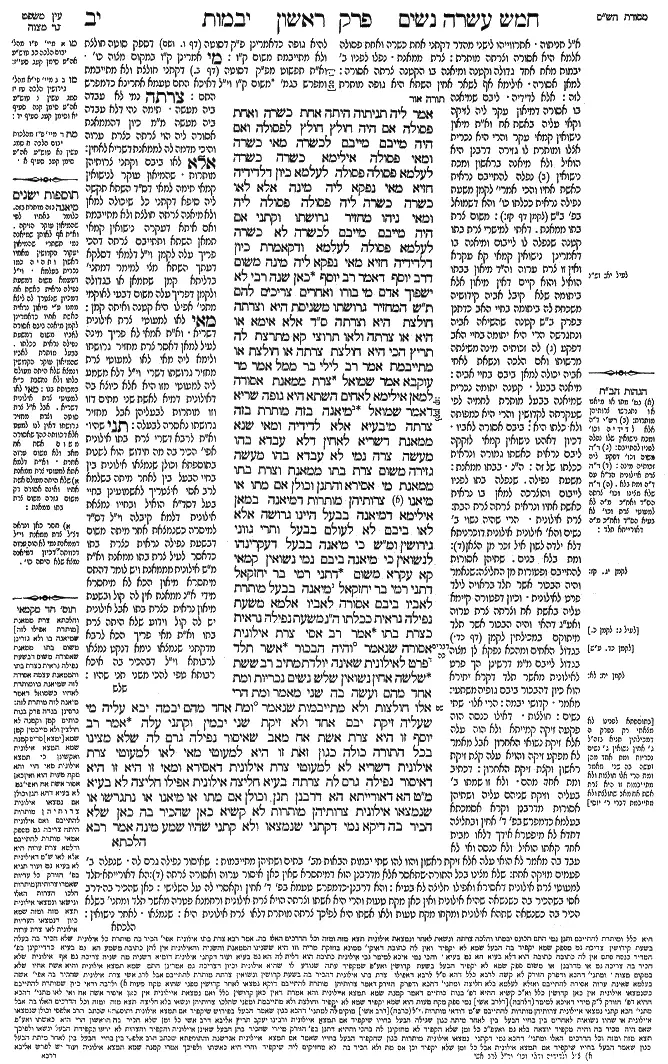
Yevamot 12a - Guemara
אמר ליה תניתוה היתה אחת כשרה ואחת פסולה אם היה חולץ חולץ לפסולה ואם היה מייבם מייבם לכשרה מאי כשרה ומאי פסולה אילימא כשרה כשרה לעלמא פסולה פסולה לעלמא כיון דלדידיה חזיא מאי נפקא ליה מינה אלא לאו כשרה כשרה ליה פסולה פסולה ליה ומאי ניהו מחזיר גרושתו וקתני אם היה מייבם מייבם לכשרה לא כשרה לעלמא פסולה לעלמא ודקאמרת כיון דלדידיה חזיא מאי נפקא ליה מינה משום דרב יוסף דאמר רב יוסף כאן שנה רבי לא ישפוך אדם מי בורו ואחרים צריכים להם ת"ש המחזיר גרושתו משניסת היא וצרתה חולצת היא וצרתה ס"ד אלא אימא או היא או צרתה ולאו תרוצי קא מתרצת לה תריץ הכי היא חולצת צרתה או חולצת או מתייבמת אמר רב לילי בר ממל אמר מר עוקבא אמר שמואל צרת ממאנת אסורה למאן אילימא לאחים השתא היא גופה שריא דאמר שמואל מיאנה בזה מותרת בזה צרתה מיבעיא אלא לדידיה ומאי שנא ממאנת דשריא לאחין דלא עבדא בהו מעשה צרה נמי לא עבדא בהו מעשה גזירה משום צרת בתו ממאנת וצרת בתו ממאנת מי אסירא והתנן וכולן אם מתו או מיאנו צרותיהן מותרות דמיאנה במאן אילימא דמיאנה בבעל היינו גרושה אלא לאו ביבם לא לעולם בבעל ותרי גווני גירושין ומ"ש כי מיאנה בבעל דעקרינהו לנשואין כי מיאנה ביבם נמי נשואין קמאי קא עקרא משום דתני רמי בר יחזקאל דתני רמי בר יחזקאל מיאנה בבעל מותרת לאביו ביבם אסורה לאביו אלמא משעת נפילה נראית ככלתו ה"נ משעת נפילה נראית כצרת בתו אמר רב אסי צרת אילונית אסורה שנאמר (דברים כה, ו) והיה הבכור אשר תלד פרט לאילונית שאינה יולדת מתיב רב ששת שלשה אחין נשואין שלש נשים נכריות ומת אחד מהם ועשה בה שני מאמר ומת הרי אלו חולצות ולא מתייבמות שנאמר (דברים כה, ה) ומת אחד מהם יבמה יבא עליה מי שעליה זיקת יבם אחד ולא זיקת שני יבמין וקתני עלה אמר רב יוסף זו היא צרת אשת אח מאב שאיסור נפילה גרם לה שלא מצינו בכל התורה כולה כגון זאת זו היא למעוטי מאי לאו למעוטי צרת אילונית דשריא לא למעוטי צרת אילונית דאסירא ומאי זו היא זו היא דאיסור נפילה גרם לה צרתה בעיא חליצה אילונית אפילו חליצה לא בעיא מ"ט הא דאורייתא הא דרבנן תנן וכולן אם מתו או מיאנו או נתגרשו או שנמצאו אילונית צרותיהן מותרות לא קשיא כאן שהכיר בה כאן שלא הכיר בה דיקא נמי דקתני שנמצאו ולא קתני שהיו שמע מינה אמר רבא
Comments from Rashi on Masechet Yevamot Page 12a
א"ל תניתוה . אתרווייהו לישני מהדר דקתני אחת כשרה ואחת פסולה אלמא היא אסורה וצרתה מותרת: צרת ממאנת . נפלו לפניו ב' יבמות מאח אחד גדולה וקטנה ומיאנה בו הקטנה צרתה אסורה: למאן . אסורה אילימא אף לשאר אחין השתא היא גופה מותרת לזה: אלא לדידיה . ליבם שמיאנה בו אסורה דמיאון עקר ליה לזיקה וקאי עליה באשת אח. וא"ת מיאון נישואין קמאי עקר והרי היא נכרית אצלו ומותרת לו גזירה דרבנן היא הואיל ולא מיאנה בראשון ומכח נישואין נפלה להתייבם נראית כאשת אחיו והכי אמרי' לקמן משעת נפילה נראית ככלתו כו'. והא דשמואל בפ' ב"ש (לקמן יבמות דף קז:): משום צרת בתו ממאנת . דאתי למישרי צרת בתו קטנה שנפלה לו לייבום ומיאנה בו דאמרינן נישואין קמאי קא עקרא ואין זו צרת ערוה. וה"ד מיאון בבתו הואיל והוא קיים דאין מיאון אלא ביתומה שלא קיבל אביה קידושיה משכחת לה ביתומה בחיי האב כדתנן בפרק ב"ש קטנה שהשיאה אביה ונתגרשה הרי היא יתומה בחיי האב דפקע לה זכותיה מינה משיצתה מרשותו ואם הלכה ונשאת לאחי אביה יכולה למאן ביבם בחיי אביה: מיאנה בבעל . קטנה יתומה נכרית שמיאנה בבעל מותרת לחמיה לפי שעקרתה לקדושין והרי היא כמפותה ולא כלתו היא: ביבם אסורה לאביו . דכיון דאהנו נישואין קמאי לזקקה ליבם נראית כאשתו גמורה ונראית ככלתו של זה: ה"נ . בבתו ממאנת: משעת נפילה . שנפלה בתו לפניו לייבום והוצרכה למאן בו נראית כאשת אחיו ונראית צרתה צרת הבת: צרת אילונית . הרי שהיה נשוי ב' נשים והא' אילונית. אילונית דוכרניתא דלא ילדה לשון איל זכר מן הצאן: ומת בלא בנים . שתיהן אסורות להתייבם ופטורות מן החליצה: שנאמר והיה הבכור אשר תלד בראויה לילד פרט לאילונית . וכיון דפטורה קיימא עליה באשת אח וצרתה צרת ערוה. ואע"ג דהאי והיה הבכור אשר תלד מיתוקם במכילתין לקמן (יבמות דף כד.) בגדול האחים ומהכא נפקא לן מצוה בגדול לייבם מ"מ דרשינן הך פרט לאילונית מאשר תלד דקרא יתירא הוא כיון דהבכור ביבם גופיה משתעי: מאמר . קדושי יבמה: דכתיב ומת אחד מהם . ולא זו שמתו ב' בעליה וזיקת שניהם עליה ושתיהן אסורות מדרבנן וקרא אסמכתא בעלמא כדמפרש בפ' ד' אחין ובחליצה דחדא לא מיפטרא אידך דלאו מבית אחד קאתו הואיל ולא כנסה ואי לא עבד בה מאמר לא הואי עלה אלא זיקת ראשון והוו להו שתי יבמות הבאות מב' בתים ושתיהן מתייבמות: הרי אלו . שתי נשים: חולצות . דאילו כנסה הוה פקעה זיקה קמייתא ולא הוה עלה אלא זיקת נשואי האחרון אבל מאמר לא מפקע זיקה והויא עלה קצת זיקת ראשון וקצת זיקת האחרון: שאיסור נפילה גרם לה . שנפלה ב' פעמים מזיקה אחת: שלא מצינו בכל התורה . שתאסר אלא מדרבנן הוא דמיתסרא שאין כאן איסור ערוה ואסורה צרתה: הא דאורייתא . תלד למעוטי צרת אילונית דאסירא ואפילו חליצה לא בעיא: והא דרבנן . כדמפרש טעמא בפ' ד' אחין וקאסרי לה על השלישי: כאן שהכיר בה . דרב אסי בשהכיר בה כשנשאה שהיא אילונית ואין כאן מקח טעות והרי היא אשתו וצרתה הויא צרת אילונית ורחמנא פטרה מאשר תלד ומתני' בשלא הכיר בה כשנשאה שתהא אילונית ומקחו מקח טעות ולאו אשתו היא לפיכך צרתה מותרת דלאו צרת אילונית היא: שנמצאו . לאחר נישואין:
Comments from Tosafot - Yevamot 12a
צרתה נמי לא עבדה ביה מעשה . תימה נהי דלא עבדה ביה מעשה מ"מ כיון דהממאנת אסורה ליה הוי צרתה כצרת ערוה והיכי מדמה לה לממאנת דשריא לאחין: אלא לאו ביבם וקתני צרותיהן מותרות . שהמיאון עוקר לנישואין קמאי תימה למאי דס"ד השתא תקשה ליה סיפא דקתני כל שיכולה למאן ולא מיאנה צרתה חולצת ולא מתייבמת ואם איתא דעקרה נישואין קמאי תמאן השתא ותתייבם צרתה דהכי פריך עלה לקמן וי"ל דלמאי דסלקא דעתך השתא מצי למימר דמתני' בדליתא קמן שתמאן או בגדולה ולקמן דפריך עלה משום דבעי לאוקמי מתני' אפילו היא קטנה ואיתה קמן: מאי לאו למעוטי צרת אילונית דשריא . וא"ת אמאי לא פריך מינה לעיל למאן דאסר צרת מחזיר גרושתו ולימא ליה מאי לאו למעוטי צרת מחזיר גרושתו דשרי וי"ל דלא משמע ליה למעוטי מזו היא אלא כיוצא בה דאילונית דמיא לאשת שני מתים דזו וזו מותרות לבעליהן אבל מחזיר גרושתו נאסרה לבעלה: תני שהיו . וא"ת לרבא דשרי צרת בתו אילונית אפי' הכיר בה מה חידוש הוא לשנות בתוספתא וכולן שנמצאו אילונית בין בחיי הבעל בין לאחר מיתה בשלמא לרב אסי איצטריך לאשמועינן בחיי בעל דסד"א הואיל ובחייו נמצאת אילונית דלמא קיבלה וי"ל דס"ד למיסרה כשנמצאת אחר מיתה משום דבשעת נפילה נראית כצרת בתו כדאסר לעיל צרת בתו ממאנת וא"ת מ"ש אילונית הממאנת ויש לומר דהתם מיחסרא מיאון הכא לא מיחסרא מידי א"נ ממאנת אין לה קול ובשעת מיאון נראית כצרת בתו אבל אילונית יש לה קול וידוע שלא היתה צרת בתו וא"ת מאי פריך הכא לרבא מדקתני שנמצאו נימא דנקט נמצאו לרבותא וי"ל דבהכיר בה איכא רבותא טפי להכי משני תני שהיו:
Yevamot 12a - Mishnah translated into english
Rabbi Ami said to Rabbi Ḥiyya bar Abba: We learned it in the same baraita: In a case where one of the women was fit and the other disqualified, if he would like to perform ḥalitza he performs ḥalitza with the disqualified woman, and if he would like to enter into levirate marriage, he enters into levirate marriage with the fit woman. What is fit and what is disqualified? If we say that fit means fit to all men, and disqualified means disqualified to all men, since for him she is suitable, what difference does it make for him whether she is disqualified from or fit for marriage to others?
Rather, is it not the case that fit means fit for him, and disqualified means disqualified for him? And what is that case in which a woman is fit or disqualified only with regard to him but not to any other man? This is referring to the case of one who remarries his divorcée. And it is taught that if he would like to enter into levirate marriage, he enters into levirate marriage with the fit woman. This answers Rabbi Yoḥanan’s question.
The Gemara rejects this argument: No; actually, fit means fit to all men, and disqualified means disqualified in general, e.g., a woman who had already been divorced is disqualified from marrying any priest. And that which you said: Since for him she is suitable, what difference does it make for him, this is significant because of that statement of Rav Yosef. As Rav Yosef said: Here Rabbi Yehuda HaNasi taught a valuable moral lesson, that a person should not pour the water from his well when others are in need of it.
Come and hear a different baraita: With regard to one who remarries his divorcée after she had married another, she and her rival wife must perform ḥalitza. Can it enter your mind that both she and her rival wife must perform ḥalitza? Rather, say: Either she or her rival wife. This indicates that both women are unfit for levirate marriage. The Gemara rejects this claim: And did you not already resolve a difficulty in the baraita? If so, answer as follows: She performs ḥalitza, while her rival wife either performs ḥalitza or enters into levirate marriage. If so, this baraita provides no conclusive proof that might resolve Rabbi Yoḥanan’s dilemma.
§ The Gemara cites another discussion concerning women who are forbidden in levirate marriage. Rav Lili bar Memel said that Mar Ukva said that Shmuel said: The rival wife of a girl who performed refusal is forbidden. If the deceased brother had two wives, one of whom was a minor who refused the brother who sought to be her yavam, not only is she forbidden in levirate marriage, but so too is her rival wife. The Gemara asks: To whom is she forbidden? If we say that she is forbidden to the other brothers, this cannot be the case, as now that she herself, the girl who actually performed refusal, is permitted to them, as Shmuel said: A minor yevama who refused this brother is permitted to that other brother of the deceased husband, is it necessary to state that her rival wife is likewise permitted?
Rather, it means that she is forbidden to him, i.e., as she refused a specific brother, both she and her rival wife are forbidden to him. The Gemara clarifies: And in what way is this halakha of the rival wife different from that of one who performed refusal, who is permitted to the other brothers? If the reason is that she did not perform any act of refusal with them that might nullify the obligation of levirate marriage, her rival wife did not perform any act with them either, and therefore she should be permitted to all of the brothers.
The Gemara answers: This is a rabbinic decree imposed due to the case of a rival wife of one’s daughter who performed refusal. If the girl who refused was his daughter or any other forbidden relative, her rival wife would be forbidden as the rival wife of one’s daughter. Therefore, the Sages rendered forbidden the rival wives of other women who performed refusal, not only his daughter. The Gemara asks: And is the rival wife of a daughter who performed refusal actually forbidden? But didn’t we learn in the mishna: And with regard to all of these women, if they died or performed refusal with their husbands, their rival wives are permitted.
The Gemara analyzes this statement: Whom did this girl refuse? If we say that she refused the husband, i.e., the deceased brother before he passed away, this is exactly the same as the case of a divorcée, and the mishna explicitly states that if one’s relative who had been married to his deceased brother died, or refused her husband, or was divorced, no prohibition applies to her rival wife. What is the difference between refusal and divorce? Rather, is it not referring to a case where she refused the yavam? If she refuses the yavam, her levirate bond is broken and her rival wife is no longer considered the rival wife of a forbidden relative. Consequently, the rival wife is fit for levirate marriage. This shows that no prohibition applies to the rival wife of a daughter who performed refusal.
The Gemara answers: No; actually, it means that she refused the husband, and two types of divorce are listed in the mishna: Divorce by Torah law and refusal, which is a form of divorce that applies by rabbinic law. The Gemara asks: And what is different between the two cases? Since refusal is not actually divorce but is a form of annulment that nullifies the matrimonial bond retroactively, when she refuses her husband it must be said that she uproots the marriage, and therefore the rival wife is rendered permitted.
If so, when she refuses the yavam, one should also say that she uproots the first marriage. The reasoning is that she cannot actually refuse the yavam, as she was never married to him. Rather, it must be that she annuls her first marriage, and the bond with the yavam is canceled automatically. Consequently, it is as though she were not married at all, and there was never a rival wife.
The Gemara explains that Shmuel’s reasoning is due to the statement that Rami bar Yeḥezkel taught in a baraita as Rami bar Yeḥezkel taught: If a minor refused her husband, she is permitted in marriage even to his father, as refusal completely nullifies the marriage, and it is as though there had never been any earlier marriage with the son. However, if she refused the yavam, not her husband, she is forbidden to his father.
Apparently, from the moment when she came before the yavam for levirate marriage she appears to be his father’s daughter-in-law. Since at the time of the husband’s death she had not yet performed refusal, to all appearances she was the father’s daughter-in-law. Consequently, although the marriage of this minor was not valid by Torah law, any observer would have assumed it was a proper marriage. Therefore, the Sages rendered a girl who refused her yavam forbidden to his father, so that people not take lightly the prohibition of those with whom relations are forbidden.
Here, too, the same reasoning applies: From the moment when the other wife came before the yavam for levirate marriage she appears to be the rival wife of his father’s daughter. For this reason she is forbidden, despite the fact that she is permitted by Torah law. Shmuel’s ruling that the rival wife of a girl who performed refusal is forbidden is therefore a decree due to the case of the rival wife of a daughter who performed refusal.
§ The Gemara continues to discuss various cases of forbidden women. Rav Asi said: The rival wife of a sexually underdeveloped woman [aylonit] is forbidden. In other words, if one of the wives of the deceased brother was an aylonit, who is incapable of giving birth, the mitzva of levirate marriage does not apply. As it is stated with regard to a woman who requires levirate marriage: “The firstborn that she bears” (Deuteronomy 25:6), which comes to exclude an aylonit, who cannot give birth. Since the halakhot of levirate marriage do not apply to an aylonit, she retains her status as a brother’s wife who is forbidden, and therefore her rival wife is also exempt from levirate marriage.
Rav Sheshet raised an objection to this from a mishna: Three brothers are married to three unrelated women, and one of the brothers died, and a second brother performed levirate betrothal with the yevama. A levirate betrothal does not have the legal status of a regular betrothal, as the levirate bond between yavam and yevama is not dependent upon betrothal; rather, it represents a kind of continuation of the previous marriage with her deceased husband. Full marriage with a yevama is effected by sexual intercourse alone. However, for reasons of modesty, the Sages instituted that the act of betrothal should apply to a yevama as well.
And this brother who performed the levirate betrothal died before consummation of the marriage. In this case, both of these, the wife of the first brother, who had already come before the second brother for levirate marriage, and the wife of the second brother, perform ḥalitza and may not enter into levirate marriage. As it is stated: “And one of them dies and he has no child, the wife of the dead man shall not be married outside of the family to one not of his kin; her brother-in-law will have intercourse with her” (Deuteronomy 25:5). This implies that the option of levirate marriage applies only to one who is subject to the levirate bond of one yavam, for only one deceased brother, and not the bond of two yevamin. Since it is considered as though the first widow has two levirate duties to fulfill, neither she nor her rival wife may enter into levirate marriage.
And it is taught with regard to this issue that Rav Yosef said: This is an example of a rival wife of a paternal half brother’s wife, i.e., a fully fit yevama, for whom coming before the yavam for levirate marriage caused her to be forbidden. In other words, she was fully fit for levirate marriage by Torah law, as all conditions of the mitzva are present in her case. The reason for her prohibition has nothing to do with her particular status but is the result of her having come before a yavam for levirate marriage once already. We have not found in the entire Torah an example like this, where the fact that she was obligated in a mitzva she was unable to fulfill means that not only she, but her rival wife as well, are both rendered forbidden.
The Gemara analyzes Rav Yosef’s statement: The emphasis of: This is, which indicates that it applies to this case and no other, comes to exclude what? Doesn’t it come to exclude the rival wife of an aylonit, which would mean that she is permitted? Although an aylonit herself may marry any man, she is not suitable for levirate marriage. If so, Rav Yosef’s comment indicates that only a woman subject to a double levirate bond, not any other case, renders her rival wife forbidden merely by coming before the yavam for levirate marriage.
The Gemara rejects this suggestion: No, Rav Yosef’s statement was meant to exclude the rival wife of an aylonit, that she is forbidden. And what is the meaning of: This is? It means that this is the one for whom coming before the yavam for levirate marriage caused her to be forbidden, and therefore her rival wife requires ḥalitza and is not entirely exempt. In contrast, in the case of the rival wife of an aylonit, she does not even require ḥalitza. What is the reason for this difference between the two cases? This one, an aylonit, is exempt from levirate marriage by Torah law, while this one, who was betrothed by levirate betrothal to the other brother, is forbidden by rabbinic law, and she therefore must perform ḥalitza.
§ The Gemara cites another relevant source. We learned in the mishna: And with regard to all of these women with whom relations are forbidden, if they died, or they refused their husbands, or were divorced, or were found to be aylonit, their rival wives are permitted in levirate marriage. This ruling apparently contradicts the statement of Rav Asi that the rival wife of an aylonit is forbidden. The Gemara responds: This is not difficult. Here, Rav Asi is referring to a situation in which her husband knew that she was an aylonit prior to marriage, and as he married her regardless of her condition their marriage is fully valid. Since the mitzva of levirate marriage does not apply to her because she cannot give birth, her rival wife is also exempt.
There, in the mishna, it is referring to a case where he did not know that she was an aylonit at the time of marriage, but only at a later stage. Since in this case it can be said that he would not choose to marry an aylonit, hers was a mistaken betrothal, and it is therefore nullified. Consequently, her rival wife is permitted.
The Gemara comments: The language of the mishna is also precise, as it teaches: Were found to be an aylonit, and it does not teach: Were an aylonit. This indicates that her condition was not known to the husband at the time of marriage but was discovered by him only later. The Gemara summarizes: Conclude from this that this is the correct interpretation of the mishna. Consequently, the mishna does not contradict the opinion of Rav Asi. Rava said:
Traduction : The William Davidson digital edition of the Koren Noé Talmud, with commentary by Rabbi Adin Even-Israel Steinsaltz.