 Talmud Bavli
The learning on the whole site is dedicated : L'ilui Nishmat Rav Chlomo Ben Jamilla
The learning on the whole site is dedicated : L'ilui Nishmat Avraham Ben Simha
The learning on the whole site is dedicated : L'ilui Nishmat אליעזר בן רחל
Yevamot 64b : Youtube
Daf TubeYoutube
2 video classes :
Yevamot Page 64b
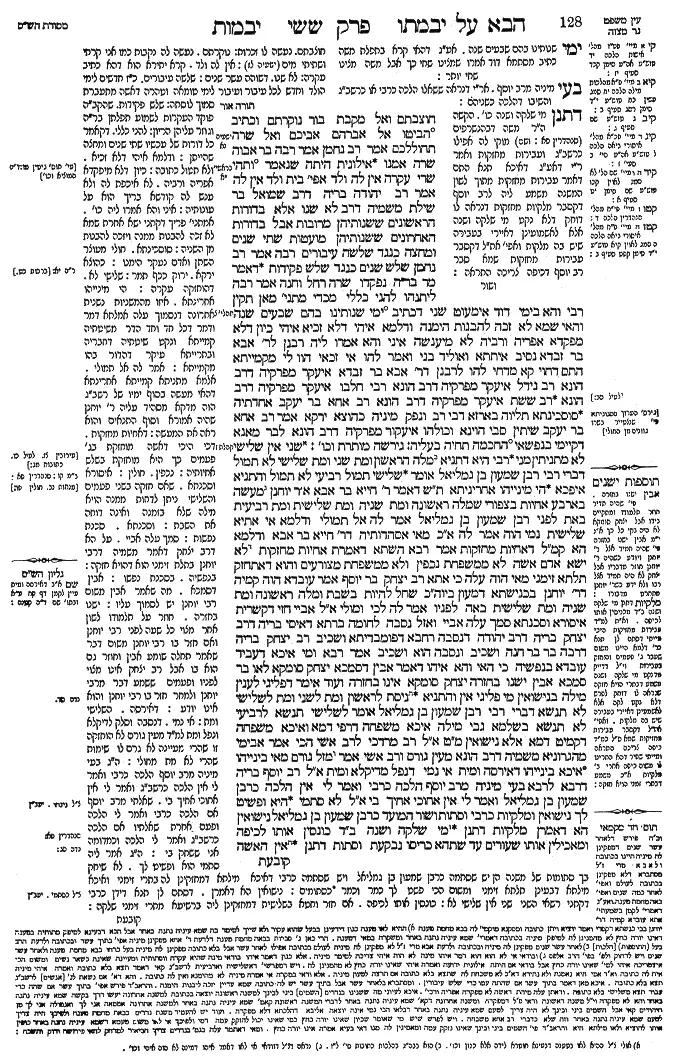
Yevamot 64b - Guemara
חוצבתם ואל מקבת בור נוקרתם וכתיב (ישעיהו נא, ב) הביטו אל אברהם אביכם ואל שרה תחוללכם אמר רב נחמן אמר רבה בר אבוה שרה אמנו אילונית היתה שנאמר (בראשית יא, ל) ותהי שרי עקרה אין לה ולד אפי' בית ולד אין לה אמר רב יהודה בריה דרב שמואל בר שילת משמיה דרב לא שנו אלא בדורות הראשונים ששנותיהן מרובות אבל בדורות האחרונים ששנותיהן מועטות שתי שנים ומחצה כנגד שלשה עיבורים רבה אמר רב נחמן שלש שנים כנגד שלש פקידות דאמר מר בר"ה נפקדו שרה רחל וחנה אמר רבה ליתנהו להני כללי מכדי מתני' מאן תקין רבי והא בימי דוד אימעוט שני דכתיב (תהלים צ, י) ימי שנותינו בהם שבעים שנה והאי שמא לא זכה להבנות הימנה ודלמא איהי דלא זכיא איהי כיון דלא מפקדא אפריה ורביה לא מיענשה איני והא אמרו ליה רבנן לר' אבא בר זבדא נסיב איתתא ואוליד בני ואמר להו אי זכאי הוו לי מקמייתא התם דחוי קא מדחי להו לרבנן דר' אבא בר זבדא איעקר מפרקיה דרב הונא רב גידל איעקר מפרקיה דרב הונא רבי חלבו איעקר מפרקיה דרב הונא רב ששת איעקר מפרקיה דרב הונא רב אחא בר יעקב אחדתיה סוסכינתא תליוה בארזא דבי רב ונפק מיניה כהוצא ירקא אמר רב אחא בר יעקב שיתין סבי הוינא וכולהו איעקור מפרקיה דרב הונא לבר מאנא דקיימי בנפשאי (קהלת ז, יב) החכמה תחיה בעליה:
גירשה מותרת וכו':
שני אין שלישי לא מתניתין מני רבי היא דתניא מלה הראשון ומת שני ומת שלישי לא תמול דברי רבי רבן שמעון בן גמליאל אומר שלישי תמול רביעי לא תמול והתניא איפכא הי מינייהו אחריניתא ת"ש דאמר ר' חייא בר אבא א"ר יוחנן מעשה בארבע אחיות בצפורי שמלה ראשונה ומת שניה ומת שלישית ומת רביעית באת לפני רבן שמעון בן גמליאל אמר לה אל תמולי ודלמא אי אתיא שלישית נמי הוה אמר לה א"כ מאי אסהדותיה דר' חייא בר אבא ודלמא הא קמ"ל דאחיות מחזקות אמר רבא השתא דאמרת אחיות מחזקות לא ישא אדם אשה לא ממשפחת נכפין ולא ממשפחת מצורעים והוא דאתחזק תלתא זימני מאי הוה עלה כי אתא רב יצחק בר יוסף אמר עובדא הוה קמיה דר' יוחנן בכנישתא דמעון ביוה"כ שחל להיות בשבת ומלה ראשונה ומת שניה ומת שלישית באה לפניו אמר לה לכי ומולי א"ל אביי חזי דקשרית איסורא וסכנתא סמך עלה אביי ואזל נסבה לחומה ברתא דאיסי בריה דרב יצחק בריה דרב יהודה דנסבה רחבא דפומבדיתא ושכיב רב יצחק בריה דרבה בר בר חנה ושכיב ונסבה הוא ושכיב אמר רבא ומי איכא דעביד עובדא בנפשיה כי האי והא איהו דאמר אבין דסמכא יצחק סומקא לאו בר סמכא אבין ישנו בחזרה יצחק סומקא אינו בחזרה ועוד אימר דפליגי לענין מילה בנישואין מי פליגי אין והתניא ניסת לראשון ומת לשני ומת לשלישי לא תנשא דברי רבי רבן שמעון בן גמליאל אומר לשלישי תנשא לרביעי לא תנשא בשלמא גבי מילה איכא משפחה דרפי דמא ואיכא משפחה דקמיט דמא אלא נישואין מ"ט א"ל רב מרדכי לרב אשי הכי אמר אבימי מהגרוניא משמיה דרב הונא מעין גורם ורב אשי אמר מזל גורם מאי בינייהו איכא בינייהו דאירסה ומית אי נמי דנפל מדיקלא ומית א"ל רב יוסף בריה דרבא לרבא בעי מיניה מרב יוסף הלכה כרבי ואמר לי אין הלכה כרבן שמעון בן גמליאל ואמר לי אין אחוכי אחיך בי א"ל לא סתמי היא ופשיט לך נישואין ומלקיות כרבי וסתות ושור המועד כרבן שמעון בן גמליאל נישואין הא דאמרן מלקיות דתנן מי שלקה ושנה ב"ד כונסין אותו לכיפה ומאכילין אותו שעורים עד שתהא כריסו נבקעת וסתות דתנן אין האשה
Comments from Rashi on Masechet Yevamot Page 64b
חוצבתם . נעשה לו זכרות: נוקרתם . נעשה לה נקבות כמו אני קרתי ושתיתי מים (ישעיהו לז): אין לה ולד . קרא יתירא הוא דהא כתיב עקרה: לא שנו . דשוהה עשר שנים: שלשה עיבורים . כ"ז חדשים לימי הולד וחדש לכל עיבור ועיבור לימי טומאה וטהרה דאשה מתעברת סמוך לוסתה: שלש פקידות . שהקב"ה פוקד העקרות לשמוע תפלתן בר"ה וגוזר עליהן הריון: להני כללי . דקאמר כל דורות של עכשיו שתי שנים ומחצה שהייתן: ודלמא איהי דלא זכיא . ולא תטול כתובה: כיון דלא מיפקדא אפריה ורביה . לא איכפת לה ולא ענש לה קודשא בריך הוא על עונותיה: איני והא אמרו ליה כו' . אמתני' פריך דקתני ישא אחרת שמא לא זכה להבנות ממנה ויזכה להבנות מן השניה: סוסכינתא . חולי מעוצר השתן ואדם נעקר הימנו: כהוצא ירקא . ירוק ככף תמר: שלישי לא . דהוחזקה עקרה: הי מינייהו אחרינתא . איזו מהמשניות נשנית אחרונה דנסמוך עלה אמלתא דמר ודמר דכל חד וחד הדר משיטתיה קמייתא ונקט שיטתיה דחבריה ובתרייתא עיקר דהדור בהו מקמייתא: אמר לה אל תמולי . אלמא מתניתא קמייתא אחרינתא דהאי מעשה בסוף ימיו של רשב"ג הוה מדקא מסהיד עליה ר' יוחנן שהיה אמורא וסוף התנאים והוא ראה את המעשה: דאחיות מחזקות . דכי היכי דאשה מוחזקת בג' פעמים כך היא מוחזקת בשלש אחיותיה: נכפין . חולין: איסורא וסכנתא . שאם חזקה בשני פעמים והשלישי ניתן לדחות ממנה הויא מילה שלא בזמנה ואינה דוחה את השבת: וסכנתא . סכנת נפשות: סמך עלה אביי . על הא דרב יצחק דאמר משמיה דרבי יוחנן בתלת זימני הוא דהויא חזקה: בנפשיה . בסכנת נפשו: אבין דסמכא . מה שאמר אבין משום רבי יוחנן יש לסמוך עליו: ישנו בחזרה . חוזר על תלמוד. לשון אחר מצוי כל שעה לפני רבי יוחנן ואם חזר בו רבי יוחנן משום דבר שאמר תחלה שומע אבין וחוזר גם הוא בו אבל רב יצחק אינו מצוי לפניו ופעמים ששמע דבר מרבי יוחנן ולמחר חזר בו רבי יוחנן והוא אינו יודע: דאירסה . השלישי ומת: אי נמי . דנסבה וסלק לדיקלא ונפל ומת למ"ד מעין גורם לא הוחזקה זו שהרי מעיינה לא גרם לו שימות שהרי לא מת מחולי: ה"ג בעי מיניה מרב יוסף הלכה כרבי ואמר לי אין הלכה כרשב"ג ואמר לי אין אחוכי אחיך בי . שאלתי מרב יוסף אם הלכה כרבי ואמר לי הלכה ופעם אחרת שאלתיו אם הלכה כרשב"ג ואמר לי הלכה וכמדומה אני ששחק בי: ה"ג אמר ליה סתמי הוא ופשיט לך . לא שיחק בך סתומות של משנה הן יש שסתמה כרבן שמעון בן גמליאל ויש שסתמה כרבי דאיכא מילתא דמחזקינן לה בתרי זימני ואיכא מילתא דבעינן תלתא זימני ומשום הכי פשט לך כמר וכמר כסתומים: נישואין הא דאמרן . דסתם לן תנא דידן כרבי דקתני רשאי השני שני אין שלישי לא: כונסין אותו לכיפה . אם חזר וחטא בשלישית דמחזקינן ליה ברשיעא מתרי זימני שלקה:
Comments from Tosafot - Yevamot 64b
ימי שנותינו בהם שבעים שנה . אע"ג דהאי קרא בתפלת משה כתיב מסתמא דוד אמרו שמצינו שחי כך אבל משה מצינו שחי יותר: בעי מיניה מרב יוסף . אר"י דנראה ששאלו הלכה כרבי או כרשב"ג והשיבו דהלכה כשניהם: דתנן מי שלקה ושנה כו' . הקשה ה"ר משה דבהנשרפים (סנהדרין פא: ושם) מוקי לה אפילו כרשב"ג ועבירות מחזקות ואמר ר"י דאע"ג דאיכא תנא התם דאמר עבירות מחזקות מתוך לשון המשנה משמע ליה לרב יוסף דקסבר מלקיות מחזקות דנראה לו דוחק דלא נקט מי שלקה ושנה אלא לאשמועינן דאיירי בעבירה שיש בה מלקות ואפי' את"ל דקסבר עבירות מחזקות שמא סבר רב יוסף דכיפה צריכה התראה:
Yevamot 64b - Mishnah translated into english
from where you were hewn, and to the hole of the pit from where you were dug” (Isaiah 51:1), and it is written in the next verse: “Look to Abraham your father and to Sarah who bore you” (Isaiah 51:2), which indicates that sexual organs were fashioned for them, signified by the words hewn and dug, over the course of time.
Rav Naḥman said that Rabba bar Avuh said: Our mother Sarah was initially a sexually underdeveloped woman [aylonit], as it is stated: “And Sarah was barren; she had no child” (Genesis 11:30). The superfluous words: “She had no child,” indicate that she did not have even a place, i.e., a womb, for a child.
Rav Yehuda, son of Rav Shmuel bar Sheilat, said in the name of Rav: They taught that he waits ten years only with regard to the people who lived in former generations, whose years were numerous, i.e., they lived longer. However, with regard to the people who live in later generations, whose years are few, he waits only two and half years before divorcing her, corresponding to the time period of three pregnancies. Rabba said in the name of Rav Naḥman: He waits three years, corresponding to the three remembrances of barren women by God, as the Master said: On Rosh HaShana Sarah, Rachel, and Hannah were remembered, i.e., God gave them children. Since God determines on Rosh HaShana whether barren women will conceive that year, one may remain married until three such opportunities have passed.
However, Rabba himself said: These principles are not accepted as halakha. Why not? Now consider, who established the content of the mishna? Rabbi Yehuda HaNasi. Yet, in the days of King David, many years before the time of Rabbi Yehuda HaNasi, the years of an average lifespan were already diminished, as it is written: “The days of our years are seventy years, and if with strength eighty years” (Psalms 90:10). Consequently, if Rabbi Yehuda HaNasi included in the mishna the statement that one remains married for ten years, that must apply even nowadays.
The Gemara asks about the language of the baraita. And what about this expression: Perhaps he did not merit to be built from her; perhaps it was she who did not merit to build a family. The Gemara answers: She, since she is not commanded to be fruitful and multiply, is not punished. Their worthiness therefore depends on him, not her.
The Gemara challenges the mishna’s statement that if one did not have children after ten years he should marry a different woman. Is that so? Didn’t the Sages say to Rabbi Abba bar Zavda: Marry a woman and have children, and he said to them: If I had merited, I would already have children from my first wife? This indicates that there is no obligation to remarry if one did not have children with his first wife. The Gemara answers: There, Rabbi Abba bar Zavda was merely putting the Rabbis off with an excuse, as the real reason why he would not marry was because Rabbi Abba bar Zavda became impotent from Rav Huna’s discourse. Rav Huna’s students would hold back from relieving themselves until his lengthy sermons were finished, which caused them to become sterile.
The Gemara similarly relates that Rav Giddel became impotent from Rav Huna’s discourse, Rav Ḥelbo became impotent from Rav Huna’s discourse, and Rav Sheshet became impotent from Rav Huna’s discourse. The Gemara relates: Rav Aḥa bar Ya’akov was afflicted by suskhinta, a disease caused by holding back from urinating. They suspended him from the cedar column that supported the study hall, and a substance that was as green as a palm leaf emerged from him, and he was healed. Rav Aḥa bar Ya’akov said: We were sixty elders present at the time, and they all became impotent from Rav Huna’s discourse, aside from me, as I fulfilled with regard to myself the verse: “Wisdom preserves the life of he who has it” (Ecclesiastes 7:12). I used the above cure to avoid becoming impotent.
§ It was taught in the mishna that if a man divorced his wife after ten years without children, she is permitted to marry a second man, who may remain married to her for ten years. The Gemara comments: A second husband, yes, but a third one, no. Once she has been married to two men without children for ten years each, it is presumed that she is unable to have children.
The Gemara comments: Who is the tanna of the mishna? It is Rabbi Yehuda HaNasi, who holds that a legal presumption [ḥazaka] is established after two occurrences. As it is taught in a baraita: If a woman circumcised her first son and he died as a result of the circumcision, and she circumcised her second son and he also died, she should not circumcise her third son, as the deaths of the first two produce a presumption that this woman’s sons die as a result of circumcision. This is the statement of Rabbi Yehuda HaNasi. Rabban Shimon ben Gamliel says: She should circumcise her third son, as there is not considered to be a legal presumption that her sons die from circumcision, but she should not circumcise her fourth son if her first three sons died from circumcision.
The Gemara asks: Isn’t the reverse taught in a baraita, that Rabbi Yehuda HaNasi holds that the woman’s third son must be circumcised and Rabban Shimon ben Gamliel holds that he is not circumcised? Which of them was composed later and is therefore presumed to be more reliable?
The Gemara suggests: Come and hear, as Rabbi Ḥiyya bar Abba said that Rabbi Yoḥanan said: An incident occurred involving four sisters in Tzippori, that the first sister circumcised her son and he died, and the second sister circumcised her son and he died, and the third one circumcised her son and he too died. The fourth sister came before Rabban Shimon ben Gamliel, who said to her: Do not circumcise him. This indicates that according to Rabban Shimon ben Gamliel a presumption is established only after three occurrences.
The Gemara refutes this proof: Perhaps if the third sister had come before him he would also have said to her the same ruling. The Gemara asks: If so, what is the purpose of Rabbi Ḥiyya bar Abba’s testimony? Why would he have related this incident if it does not teach us anything? The Gemara answers: Perhaps he comes to teach us that sisters establish a presumption in a case like this even though the children who died were not from the same mother.
Rava said: Now that you have said that sisters establish a presumption, a man should not marry a woman from a family of epileptics or from a family of lepers, as these diseases might be hereditary. The Gemara adds: And this applies only if it was established three times, i.e., three members of the family are afflicted with the disease.
The Gemara asks: Which halakhic conclusion was about this matter? Is a presumption established after two occurrences or only after three? When Rav Yitzḥak bar Yosef came from Eretz Yisrael, he said: An incident occurred before Rabbi Yoḥanan in the synagogue of the town of Maon on a Yom Kippur that occurred on Shabbat. The first sister had circumcised her son and he died; the second sister circumcised her son and he also died. The third sister came before him, and he said to her: Go and circumcise your son, as a presumption is not established after only two occurrences.
Abaye said to Rav Yitzḥak: See to it that your report is accurate, as you are permitting an action that would otherwise constitute a prohibition and a danger. If the third baby should not be circumcised, doing so would be a prohibited labor and would endanger the life of the child.
The Gemara comments: Abaye relied on this report and went and married Ḥuma, the daughter of Isi, son of Rav Yitzḥak, son of Rav Yehuda. Ḥuma had previously married Raḥava of Pumbedita, and he died, and then she married Rav Yitzḥak, son of Rabba bar bar Ḥana, and he died; and he, Abaye, married her nevertheless, without concern that she had been established to be a woman whose husbands die; and he died as well while married to her.
Rava said: Is there anyone who performs an action like this and endangers himself by marrying such a woman? Wasn’t it he, Abaye, who said that Avin is reliable but Yitzḥak the Red, i.e., Rav Yitzḥak bar Yosef, is not reliable? He proceeds to explain the difference between them: Avin returns to Eretz Yisrael and hears whether the Sages there rescind their previous rulings, whereas Yitzḥak the Red does not return to Eretz Yisrael and never finds out if the Sages there rescind their rulings. And furthermore, say that they disagree with regard to whether a presumption is established by two or by three deaths due to circumcision, but do they necessarily argue with regard to marriage?
The Gemara responds: Yes, and it is taught in a baraita: If a woman was married to her first husband and he died, to a second one and he also died, she may not get married to a third husband. This is the statement of Rabbi Yehuda HaNasi. Rabban Shimon ben Gamliel says: She may get married to a third husband, but if he also dies, she may not get married to a fourth husband.
The Gemara asks: Granted with regard to circumcision a presumption of death due to circumcision can be established because there are families whose blood is thin and does not clot well, and there are families whose blood clots. However, in the case of marriage, what is the reason for concern that a subsequent husband will die? Rav Mordekhai said to Rav Ashi: Avimi of Hagron-ya said in the name of Rav Huna as follows: Her spring is the cause. In other words, the woman has some sort of condition that causes those who have intercourse with her to die. And Rav Ashi said that her constellation is the cause of her husbands’ deaths.
The Gemara asks: What is the practical difference between them? The Gemara answers: There is a difference between them in a case where a man betrothed her and died before the wedding; alternatively, in a case where he fell off a palm tree and died. If the concern is due to intercourse, then in these cases the husband’s death cannot be attributed to his wife. Conversely, if the concern is due to her bad fortune, the husband’s death can be attributed to his wife even in these cases.
Rav Yosef, son of Rava, said to Rava: I inquired of Rav Yosef whether the halakha is in accordance with the opinion of Rabbi Yehuda HaNasi, and he said to me: Yes. I subsequently asked him if the halakha is in accordance with the opinion of Rabban Shimon ben Gamliel, and he said to me: Yes. Was he mocking me by issuing contradictory rulings?
Rava said to him: No, there are unattributed mishnayot in accordance with each opinion, and he resolved for you that the halakha is in accordance with each opinion in particular cases. With regard to marriage and lashings the halakha is in accordance with the opinion of Rabbi Yehuda HaNasi that two occurrences are sufficient for a presumption. Concerning set patterns of menstrual bleeding and a forewarned ox, the halakha is in accordance with the opinion of Rabban Shimon ben Gamliel that a presumption is established after three occurrences.
The Gemara identifies the aforementioned halakhot. Marriage is referring to that which we said with regard to a woman whose husbands have died. The case of lashings is as we learned in a mishna (Nidda 63b): One who was flogged for transgressing a Torah law, and repeated the same transgression and was flogged again, if he then repeats the sin a third time, the court places him in a narrow, vaulted chamber and they feed him barley until his stomach bursts. Once he has sinned and been flogged twice he has established a presumption of wickedness, and when he sins again he is caused to die so that he will not continue to sin. The case of set patterns of menstrual bleeding is as we learned in a mishna (Nidda 63b): A woman does not
Traduction : The William Davidson digital edition of the Koren Noé Talmud, with commentary by Rabbi Adin Even-Israel Steinsaltz.