 Talmud Bavli
The learning on the whole site is dedicated : L'ilui Nishmat Chemouel Eliezer ben Batcheva
The learning on the whole site is dedicated : L'ilui Nishmat רינה בת לדיסיה
The learning on the whole site is dedicated : L'ilui Nishmat Rav Chlomo Ben Jamilla
Yevamot 44a : Youtube
Daf TubeYoutube
2 video classes :
Yevamot Page 44a
Yevamot 44a - Guemara
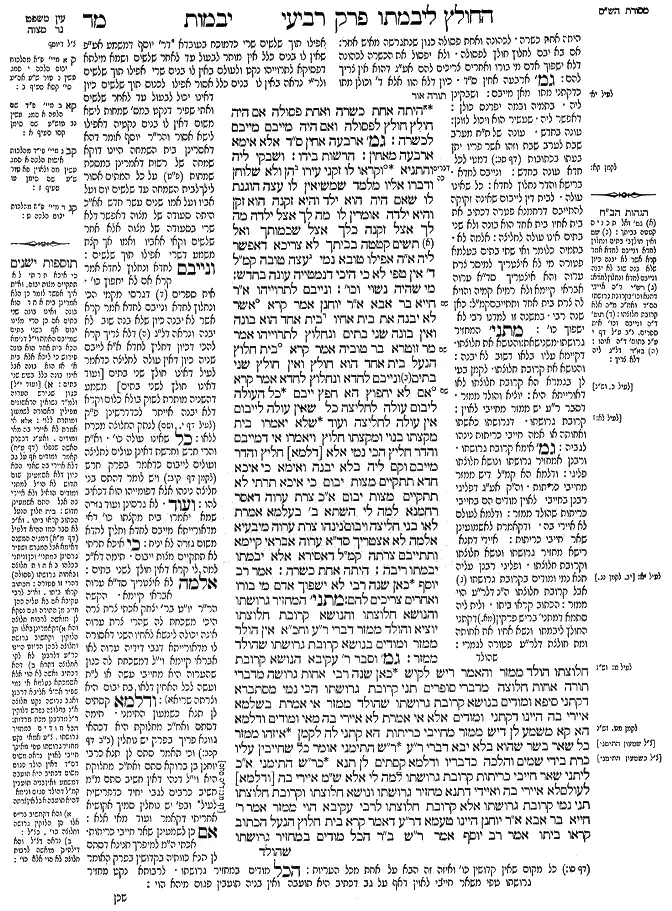
היתה אחת כשרה ואחת פסולה אם היה חולץ חולץ לפסולה ואם היה מייבם מייבם לכשרה:
גמ׳ ארבעה אחין ס"ד אלא אימא ארבעה מאחין:
הרשות בידו:
ושבקי ליה והתניא (דברים כה, ח) וקראו לו זקני עירו הן ולא שלוחן ודברו אליו מלמד שמשיאין לו עצה הוגנת לו שאם היה הוא ילד והיא זקנה הוא זקן והיא ילדה אומרין לו מה לך אצל ילדה מה לך אצל זקנה כלך אצל שכמותך ואל תשים קטטה בביתך לא צריכא דאפשר ליה א"ה אפילו טובא נמי עצה טובה קמ"ל ד' אין טפי לא כי היכי דנמטייה עונה בחדש:
מי שהיה נשוי וכו':
ונייבם לתרוייהו א"ר חייא בר אבא א"ר יוחנן אמר קרא (דברים כה, ט) אשר לא יבנה את בית אחיו בית אחד הוא בונה ואין בונה שני בתים ונחלוץ לתרוייהו אמר מר זוטרא בר טוביה אמר קרא (דברים כה, י) בית חלוץ הנעל בית אחד הוא חולץ ואין חולץ שני בתים ונייבם לחדא ונחלוץ לחדא אמר קרא (דברים כה, ז) אם לא יחפוץ הא חפץ ייבם כל העולה ליבום עולה לחליצה כל שאין עולה לייבום אין עולה לחליצה ועוד שלא יאמרו בית מקצתו בנוי ומקצתו חלוץ ויאמרו אי דמייבם והדר חליץ הכי נמי אלא [דלמא] חליץ והדר מייבם וקם ליה בלא יבנה ואימא כי איכא חדא תתקיים מצות יבום כי איכא תרתי לא תתקיים מצות יבום א"כ צרת ערוה דאסר רחמנא למה לי השתא ב' בעלמא אמרת לאו בני חליצה ויבום נינהו צרת ערוה מיבעיא אלמה לא אצטריך סד"א ערוה אבראי קיימא ותתייבם צרתה קמ"ל דאסירא אלא יבמתו יבמתו ריבה:
היתה אחת כשרה:
אמר רב יוסף כאן שנה רבי לא ישפוך אדם מי בורו ואחרים צריכים להם:
מתני׳ המחזיר גרושתו והנושא חלוצתו והנושא קרובת חלוצתו יוציא והולד ממזר דברי ר"ע וחכ"א אין הולד ממזר ומודים בנושא קרובת גרושתו שהולד ממזר:
גמ׳ וסבר ר' עקיבא הנושא קרובת חלוצתו הולד ממזר והאמר ריש לקיש כאן שנה רבי אחות גרושה מדברי תורה אחות חלוצה מדברי סופרים תני קרובת גרושתו הכי נמי מסתברא דקתני סיפא ומודים בנושא קרובת גרושתו שהולד ממזר אי אמרת בשלמא איירי בה היינו דקתני ומודים אלא אי אמרת לא איירי בה מאי ומודים ודלמא הא קא משמע לן דיש ממזר מחייבי כריתות הא קתני לה לקמן איזהו ממזר כל שאר בשר שהוא בלא יבא דברי ר"ע ר"ש התימני אומר כל שחייבין עליו כרת בידי שמים והלכה כדבריו ודלמא קסתים לן תנא כר"ש התימני א"כ ליתני שאר חייבי כריתות קרובת גרושתו למה לי אלא ש"מ איירי בה [ודלמא] לעולם לא איירי בה ואיידי דתנא מחזיר גרושתו ונושא חלוצתו וקרובת חלוצתו תני נמי קרובת גרושתו אלא קרובת חלוצתו לרבי עקיבא הוי ממזר אמר ר' חייא בר אבא א"ר יוחנן היינו טעמא דר"ע דאמר קרא בית חלוץ הנעל הכתוב קראו ביתו אמר רב יוסף אמר ר"ש ב"ר הכל מודים במחזיר גרושתו
Comments from Rashi on Masechet Yevamot Page 44a
מתני' היתה אחת כשרה . לכהונה ואחת פסולה כגון שנתגרשה מאיש אחר: אם בא יבם לחלוץ חולץ לפסולה . ולא יפסול את הכשרה לכהונה דלא ישפוך אדם מי בורו ואחרים צריכים להם אע"ג דהוא אין צריך להם: גמ' ארבעה אחין ס"ד . כיון דלא הוו אלא ד' וכולן מתו כדקתני מתו מאן מייבם: ושבקינן ליה . בתמיה ובמה יפרנס כולן: דאפשר ליה . שעשיר הוא ויכול לזונן: עונה בחדש . עונה של ת"ח מערב שבת לערב שבת וזהו אשר פריו יתן בעתו בכתובות (דף סב:) דמטי לכל חדא עונה בחדש: ונייבם לחדא . ברישא והדר נחלוץ לחדא: כל שאינה עולה . לבית דין לייבום שאינה זקוקה להתייבם דרחמנא פטרה דכתיב את בית אחיו בית אחד הוא בונה ולא שני בתים אינו עולה לחליצה: אלמה לא . בתמיה. כלומר ואי שתי בתים בעלמא פטורה מי לא איצטריך למיסר צרת ערוה והא איצטריך סד"א ערוה אבראי קיימא ולא רמיא קמיה והויא לה צרת בית אחד ותתייבם קמ"ל: כאן שנה רבי . במשנה זו למדנו רבי לא ישפוך כו': מתני' המחזיר גרושתו . משנישאת: והנושא את חלוצתו . דקיימא עליו בלאו דשוב לא יבנה: והנושא את קרובת חלוצתו . לקמן בעי לן בגמרא הא קרובת חלוצתו לאו דאורייתא היא: יוציא והולד ממזר . דסבר ר"ע יש ממזר מחייבי לאוין: קרובת גרושתו . דגרושתו כאשתו ואחותה או אמה חייבי כריתות נינהו לגביה: גמ' אימא קרובת גרושתו . ורבנן אמחזיר גרושתו ונושא חלוצתו פליגי: ודלמא הא קמ"ל דיש ממזר מחייבי כריתות . וה"ק אע"ג דפליגי רבנן בחייבי לאוין מודים הם בחייבי כריתות שהולד ממזר: ודלמא לעולם לא איירי בה . ודקאמרת לאשמועינן שאר חייבי כריתות: איידי דתנא רישא מחזיר גרושתו ונושא חלוצתו וקרובת חלוצתו . ופליגי רבנן עליה תנא נמי ומודים בקרובת גרושתו אבל קרובת חלוצתו ה"נ דלר"ע הוי ממזר: הכתוב קראו ביתו . ולית ליה סתמא דמתני' בריש פרקין (מא.) דקתני החולץ ליבמתו ונשא אחיו את אחותה ומת חולצת דלר"ע פטורה לגמרי:
Comments from Tosafot - Yevamot 44a
ונייבם לחדא ונחלוץ לחדא אמר קרא אם לא יחפוץ כו' . אית ספרים דגרסי מקמי הכי ונחלוץ לחדא ונייבם לחדא אמר קרא אשר לא יבנה כיון שלא בנה שוב לא יבנה ונראה דל"ג דלא צריך קרא להכי דכיון דחליץ לחדא א"א לייבם שניה כיון דאין עולה לחליצה כדאמר לעיל דאינו חולץ שני בתים ועוד דאינו חולץ לשני בתים משמע דהשניה מותרת לשוק בולא כלום וקרא דלא יבנה אייתר לכדדרשינן פ"ק (לעיל יבמות דף י: ושם) לנתק החלוצה מכרת ללאו: כל שאינו עולה כו' . וא"ת והרי חרש וחרשת דאינן עולים לחליצה ועולים לייבום כדאמר בפרק חרש (לקמן יבמות דף קיב:) ויש לומר דהתם בני חליצה נינהו אלא דפומייהו הוא דכאיב להו: ועוד . לא גרסינן ועוד גזרה שמא יאמרו בית מקצתו כו' דאי מדאורייתא מייבם לחדא וחליץ לחדא משום גזרה לא יניח: כי איכא תרתי לא תתקיים מצות ייבום . תימה דא"כ למה לי קרא דאין חולץ לשני בתים: אלמה לא איצטריך סד"א ערוה אבראי קיימא . הקשה הר"ר יו"ט בר' יצחק אכתי צרת צרה היכי משכחת לה שהרי צרת ערוה אינה יכולה לינשא לאחיו השני דאסורה לו מדאורייתא דגבי דידיה ערוה לאו אבראי קיימא וי"ל דמשכחת לה כגון שהערוה היא מחייבי עשה או ל"ת ועשה לכל האחין דלאו בת יבום היא וצרתה שריא: ודילמא קסתים לן תנא כשמעון התימני . תימה דסתם ואח"כ מחלוקת היא דכהאי גוונא פריך בפרק יש נוחלין (ב"ב דף קכב:) וכי תאמר סתם לן תנא כרבי יוחנן בן ברוקא סתם ואח"כ מחלוקת היא וי"ל דנהי דאין חשיב סתם מ"מ חשיב כרבים לגבי יחיד כדפרישית לעיל ובפ' יש נוחלין סמיך אקושיא אחריתי דקאמר ועוד מאי אלא: אם כן לשמעינן שאר חייבי כריתות . אכתי ה"מ למיפרך תנינא דסתם לן תנא כוותיה בקדושין בפרק האומר (דף סו:) כל מקום שאין קדושין כו' ואיזה זה הבא על אחת מכל העריות: הכל מודים במחזיר גרושתו . לרבותא נקט מחזיר גרושתו טפי משאר חייבי לאוין דאף על גב דכתיב היא תועבה ואין בניה תועבין פגום מיהא הוי:
Yevamot 44a - Mishnah translated into english
If one of these women was fit to marry into the priesthood and one was unfit, then if he performs ḥalitza, he should perform ḥalitza with the unfit woman rather than with the one who is fit for the priesthood, since doing so with the woman who is fit would needlessly disqualify her from marrying into the priesthood. But if he consummates the levirate marriage, he may consummate the levirate marriage with the one who is fit.
GEMARA: The simple reading of the mishna’s first clause implies that all four brothers died. The Gemara questions this: Can it enter your mind to say that all four brothers died? If they all died, then who remains to consummate the levirate marriage? Rather, emend the mishna and say instead: Four married men of a set of more than four brothers died.
The mishna continues: If the eldest of them wished to consummate the levirate marriage with all of his yevamot, he has permission to do so. The Gemara asks: Do they actually leave him to do so? Isn’t it taught in a baraita: The verse states: “And the Elders of his city shall call him” (Deuteronomy 25:8), which indicates that they, the Elders, and not their agent, should call him. The verse continues: “And they speak to him”; this phrase teaches that they offer him advice that is appropriate for him.
The baraita explains: Appropriate advice means that if he was a young man and she an elderly woman or if he was an elderly man and she a young woman, they say to him: What do you want with a young woman when you are elderly? Or: What do you want with an elderly woman when you are young? Go after your own kind, i.e., a woman of a similar age, and do not place discord in your household that could be caused by marrying a woman of a significantly different age. From the baraita it is apparent that if consummating the levirate marriage will ultimately lead to contention between the couple, it is preferable to perform ḥalitza. Similarly, in the case of the mishna, marrying four women will likely lead to contention since it is difficult to support so many people, and poverty will lead to strife. Therefore, the yavam should not be allowed to consummate levirate marriages with all of them.
The Gemara qualifies the mishna’s case: No, it is necessary to teach that he has permission to consummate the levirate marriage with all of his yevamot in the case where it is possible for him to provide for all four women. The Gemara asks: If so, then the same should be true even if there are many more women as well; why does the mishna specifically discuss a case of four women? The Gemara explains: The mishna teaches us good advice; in a case of up to four women, yes, if he can provide for them then it is acceptable to marry all of them. But if there are any more than that, no, he should not, in order that he will be able to meet the conjugal rights of each woman at least once in each month. A Torah scholar is expected to provide conjugal relations once a week. If he marries no more than four women, then that will ensure that each of his wives will receive their conjugal rights at least once a month.
§ The mishna states: In the case of one who was married to two women and died childless, the intercourse or ḥalitza of either one of them with the yavam releases her rival wife from the levirate bond. The Gemara questions why the mishna considers only the possibility that he would do so with only one of the women: But let him instead consummate levirate marriages with both of them. Rabbi Ḥiyya bar Abba said that Rabbi Yoḥanan said: The verse states that a yavam who performs ḥalitza is referred to as: “The man who does not build his brother’s house” (Deuteronomy 25:9). The fact that the word “house” appears in the singular indicates that even had he instead chosen to consummate a levirate marriage, only one house may he build, by consummating a levirate marriage with one of his brother’s wives, but he may not build two houses.
The Gemara suggests: But let him perform ḥalitza with both of them; why does the mishna state that he does so with only one woman? Mar Zutra bar Toviya said: The verse states that following the ḥalitza the man is called: “The house of him who had his shoe removed” (Deuteronomy 25:10). The fact that the word “house” appears in the singular indicates that he performs ḥalitza with only one house, i.e., only one of his brother’s wives, and he does not perform ḥalitza with two houses.
The Gemara suggests: But let him consummate the levirate marriage with one and perform ḥalitza with the other. The Gemara explains that the verse states: “If the man does not wish to take his yevama” (Deuteronomy 25:7), which implies that with regard to anyone who performs ḥalitza, were he to wish to, he could consummate the levirate marriage. This teaches the principle that only one who is eligible for levirate marriage is eligible for ḥalitza, but one who is ineligible for levirate marriage is ineligible for ḥalitza. And since, in the case of the mishna, if the yavam consummated the levirate marriage with one of his brother’s wives he may not do so with the second, consequently he may not perform ḥalitza with her either.
And furthermore, an additional reason that one may not do so is so that people should not say that the brother’s house was partially built through levirate marriage and partially released through ḥalitza. The Gemara asks: And even if they will say that, what of it? The Gemara explains: If he first consummated the levirate marriage with one wife and subsequently performed ḥalitza with the other, indeed, there is no reason not to do this. However, perhaps he might first perform ḥalitza with one wife and subsequently consummate levirate marriage with the other, and by doing so he is liable for a violation of the prohibition of: “He does not build his brother’s house” (Deuteronomy 25:9). The verse indicates that one who performs ḥalitza has not built his brother’s house and is therefore subsequently prohibited from attempting to do so by consummating a levirate marriage with either the ḥalutza or any of her rival wives.
The Gemara asks. But since the Torah’s description of levirate marriage mentions only a case in which the deceased brother had only one wife, say: When there is only one wife, the mitzva of levirate marriage exists, but when there are two wives, the mitzva of levirate marriage does not exist.
The Gemara suggests a proof: If that were so, why do I need the halakha concerning a rival wife of a forbidden relation, which is forbidden by the Merciful One in the Torah? Now that even in the case of two women in general, where neither woman is a forbidden relation, you say that they are not eligible for ḥalitza and levirate marriage, is it necessary to say a rival wife of a forbidden relation is also forbidden? The fact that the Torah does prohibit a rival wife of a forbidden relation indicates that the mitzva of levirate marriage does exist in a general case of two wives in which neither is a forbidden relation.
The Gemara objects: Why not? Even if one assumes that there is no mitzva of levirate marriage when the deceased brother had two wives, it is still necessary to teach the halakha concerning a rival wife of a forbidden relation because it could enter your mind to say that since there is no possibility of consummating the levirate marriage with her, the forbidden relation stands outside the calculation such that her presence is disregarded, and her rival wife should enter into levirate marriage as though she were the only wife. Therefore, the verse needs to teach us that the rival wife is forbidden.
Rather, the repeated use of the phrase “his yevama,” “his yevama” in the verses concerning levirate marriage amplifies the mitzva of levirate marriage so that it applies even when the deceased brother had more than one wife.
§ The mishna states: If one of these wives of the deceased brother was fit for the priesthood and one was unfit, ḥalitza should not be performed with the fit woman since doing so would needlessly disqualify her from the priesthood. Rav Yosef said that here, through this mishna, Rabbi Yehuda HaNasi taught the principle that one should not perform an action that will needlessly disadvantage others, and so a person should not spill out water collected in his pit that he does not need when others are in need of it.
MISHNA: With regard to one who remarries his divorcée after she had been married to another man from whom she was then widowed or divorced, or one who marries the woman with whom he performed ḥalitza [ḥalutza], or one who marries a relative of his ḥalutza, since all such marriages are forbidden he must divorce her, and the offspring born from such unions is a mamzer; this is the statement of Rabbi Akiva. He holds that even the offspring from relations forbidden by a prohibition punishable by lashes is a mamzer.
The Rabbis say: The offspring in those cases is not a mamzer, but they concede with regard to one who marries a relative of his divorcée, a union forbidden by a prohibition entailing karet, that the offspring is a mamzer. They hold that only the offspring from relations forbidden by a prohibition entailing karet is a mamzer.
GEMARA: The Gemara asks: But does Rabbi Akiva actually hold that with regard to one who marries a relative of his ḥalutza, the offspring is a mamzer? Didn’t Reish Lakish say that through the mishna here, Rabbi Yehuda HaNasi taught that a sister of one’s divorcée is forbidden by Torah law whereas a sister of one’s ḥalutza is forbidden by rabbinic law? If a relative of one’s ḥalutza is forbidden by rabbinic law, how can the offspring of that union be a mamzer? The Gemara concedes: Emend the mishna and teach instead: A relative of his divorcée.
The Gemara notes: So, too, it is reasonable that this is the correct version of the mishna, as the latter clause teaches: But they concede in the case of one who marries a relative of his divorcée that the offspring is a mamzer. Granted, if you say that Rabbi Akiva was talking about that case, this is consistent with that which the mishna teaches: They concede, which implies that they agree to a case already mentioned. However, if you say that he was not talking about that case, what could the phrase: They concede, possibly be referring to?
The Gemara objects: But perhaps this phrase teaches us that the Rabbis concede that the offspring from forbidden relations for which one is liable to receive karet is a mamzer. The Gemara rejects this option: This is already taught later on in a mishna (49a): Which offspring of forbidden relations has the status of a mamzer? It is the offspring of a union with any next of kin that is subject to a Torah prohibition that one should not engage in sexual relations with them; this is the statement of Rabbi Akiva. Rabbi Shimon HaTimni says: It is the offspring of a union with any forbidden relative for which one is liable to receive karet at the hand of Heaven. And the halakha is in accordance with his statement. Since the mishna explicitly rules in accordance with Rabbi Shimon HaTimni, it would be unnecessary for the mishna here to teach that fact.
The Gemara persists: But perhaps the tanna taught us as unattributed a mishna that is in accordance with the opinion of Rabbi Shimon HaTimni to indicate that this is indeed the accepted halakha. The Gemara rejects this: If so, then let him teach other cases of forbidden relations for which one is liable to receive karet; why do I need the mishna to specifically consider the case of a relative of one’s divorcée? Rather, conclude from this that Rabbi Akiva indeed was talking about that case.
The Gemara persists: But perhaps he was not actually talking about that case, but since Rabbi Akiva taught the cases of one who remarries his divorcée, or one who marries his ḥalutza or a relative of his ḥalutza, the mishna also taught in the name of the Rabbis the case of one who marries a relative of his divorcée because it is a similar case. The Gemara concedes that this would be an acceptable reading of the mishna.
Rather, the mishna should not be emended, and with regard to the Gemara’s original question as to how Rabbi Akiva could claim that the offspring from one’s union with a relative of his ḥalutza is a mamzer if that union is forbidden only by rabbinic law, one must conclude that a relative of one’s ḥalutza is forbidden by Torah law according to Rabbi Akiva and therefore the offspring is a mamzer. Rabbi Ḥiyya bar Abba said that Rabbi Yoḥanan said that this is Rabbi Akiva’s reasoning: As the verse states: “The house of he who had his shoe removed” (Deuteronomy 25:10). The verse called his relationship with the ḥalutza his house, indicating that the ḥalutza is considered as though she had been married to the yavam, and therefore her relative is forbidden to him by Torah law.
Rav Yosef said that Rabbi Shimon bar Rabbi Yehuda HaNasi said: All agree in the case of one who remarries his divorcée
Traduction : The William Davidson digital edition of the Koren Noé Talmud, with commentary by Rabbi Adin Even-Israel Steinsaltz.