 Talmud Bavli
The learning on the whole site is dedicated : L'ilui Nishmat Jacques Isaac Ben Amram Loubaton
The learning on the whole site is dedicated : L'ilui Nishmat Reuven ben Rivka SEBBAG
The learning on the whole site is dedicated : L'ilui Nishmat רינה בת לדיסיה
Yevamot 65b : Youtube
Daf TubeYoutube
2 video classes :
Yevamot Page 65b
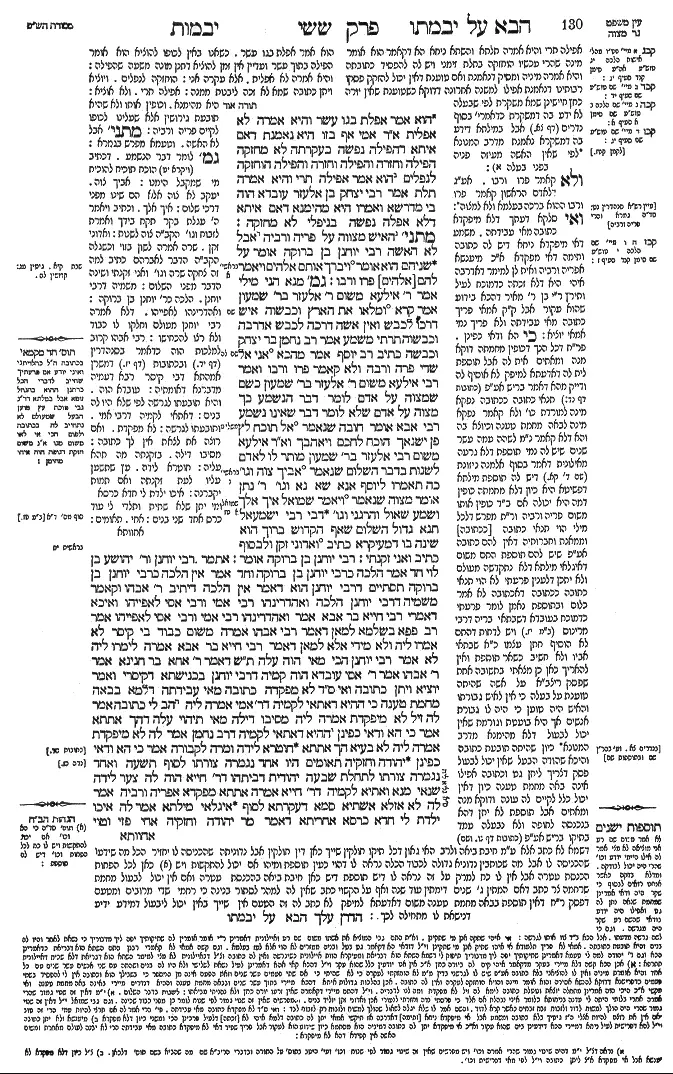
Yevamot 65b - Guemara
הוא אמר אפלת בגו עשר והיא אמרה לא אפלית א"ר אמי אף בזו היא נאמנת דאם איתא דהפילה נפשה בעקרתה לא מחזקה הפילה וחזרה והפילה וחזרה והפילה הוחזקה לנפלים הוא אמר אפילה תרי והיא אמרה תלת אמר רבי יצחק בן אלעזר עובדא הוה בי מדרשא ואמרו היא מהימנא דאם איתא דלא אפלה נפשה בניפלי לא מחזקה:
מתני׳ האיש מצווה על פריה ורביה אבל לא האשה רבי יוחנן בן ברוקה אומר על שניהם הוא אומר (בראשית א, כח) ויברך אותם אלהים ויאמר להם [אלהים] פרו ורבו:
גמ׳ מנא הני מילי אמר ר' אילעא משום ר' אלעזר בר' שמעון אמר קרא (בראשית א, כח) ומלאו את הארץ וכבשוה איש דרכו לכבש ואין אשה דרכה לכבש אדרבה וכבשוה תרתי משמע אמר רב נחמן בר יצחק וכבשה כתיב רב יוסף אמר מהכא (בראשית לה, יא) אני אל שדי פרה ורבה ולא קאמר פרו ורבו ואמר רבי אילעא משום ר' אלעזר בר' שמעון כשם שמצוה על אדם לומר דבר הנשמע כך מצוה על אדם שלא לומר דבר שאינו נשמע רבי אבא אומר חובה שנאמר (משלי ט, ח) אל תוכח לץ פן ישנאך הוכח לחכם ויאהבך וא"ר אילעא משום רבי אלעזר בר' שמעון מותר לו לאדם לשנות בדבר השלום שנאמר (בראשית נ, טז) אביך צוה וגו כה תאמרו ליוסף אנא שא נא וגו' ר' נתן אומר מצוה שנאמר (שמואל א טז, ב) ויאמר שמואל איך אלך ושמע שאול והרגני וגו' דבי רבי ישמעאל תנא גדול השלום שאף הקדוש ברוך הוא שינה בו דמעיקרא כתיב (בראשית יח, יב) ואדוני זקן ולבסוף כתיב ואני זקנתי:
רבי יוחנן בן ברוקה אומר:
אתמר רבי יוחנן ור' יהושע בן לוי חד אמר הלכה כרבי יוחנן בן ברוקה וחד אמר אין הלכה כרבי יוחנן בן ברוקה תסתיים דרבי יוחנן הוא דאמר אין הלכה דיתיב ר' אבהו וקאמר משמיה דרבי יוחנן הלכה ואהדרינהו רבי אמי ורבי אסי לאפייהו ואיכא דאמרי רבי חייא בר אבא אמר ואהדרינהו רבי אמי ורבי אסי לאפייהו אמר רב פפא בשלמא למאן דאמר רבי אבהו אמרה משום כבוד בי קיסר לא אמרו ליה ולא מידי אלא למאן דאמר רבי חייא בר אבא אמרה לימרו ליה לא אמר רבי יוחנן הכי מאי הוה עלה ת"ש דאמר ר' אחא בר חנינא אמר ר' אבהו אמר ר' אסי עובדא הוה קמיה דרבי יוחנן בכנישתא דקיסרי ואמר יוציא ויתן כתובה ואי ס"ד לא מפקדה כתובה מאי עבידתה דלמא בבאה מחמת טענה כי ההיא דאתאי לקמיה דר' אמי אמרה ליה הב לי כתובה אמר לה זיל לא מיפקדת אמרה ליה מסיבו דילה מאי תיהוי עלה דהך אתתא אמר כי הא ודאי כפינן ההיא דאתאי לקמיה דרב נחמן אמר לה לא מיפקדת אמרה ליה לא בעיא הך אתתא חוטרא לידה ומרה לקבורה אמר כי הא ודאי כפינן יהודה וחזקיה תאומים היו אחד נגמרה צורתו לסוף תשעה ואחד נגמרה צורתו לתחלת שבעה יהודית דביתהו דר' חייא הוה לה צער לידה שנאי מנא ואתיא לקמיה דר' חייא ואמרה אתתא מפקדא אפריה ורביה אמר לה לא אזלא אשתיא סמא דעקרתא לסוף איגלאי מילתא אמר לה איכו ילדת לי חדא כרסא אחריתא דאמר מר יהודה וחזקיה אחי פזי וטוי
Comments from Rashi on Masechet Yevamot Page 65b
הוא אמר אפלת בגו עשר . כשאנו באין לכופו להוציא הוא אומר הפילה בתוך עשר ועדיין אין זמן להוציא דתנן מונה משעה שהפילה: והיא אמרה לא אפלית . אלא עקרה אני: הוחזקה לנפלים . ויוציא ויתן כתובה שמא לא זכה ליבנות ממנה: אפילה תרי . ולא אוציא: היא מהימנא . וכופין אותו ולא שהיא תובעת גירושין אלא שעלינו לכופו לקיים פריה ורביה: מתני' אבל לא האשה . וטעמא מפרש בגמרא: גמ' לומר דבר הנשמע . דכתיב (ויקרא יט) הוכח תוכיח להוכיח מי שמקבל הימנו: אביך צוה . יעקב לא צוה אלא הם שינו מפני דרכי שלום: איך אלך . וכתיב ויאמר ה' עגלת בקר תקח בידך ואמרת לזבוח וגו' הקב"ה צוה לשנות: ואדוני זקן . שרה אמרה לשון בזוי וכשגלה הקב"ה הדבר לאברהם כתיב למה זה צחקה שרה וגו' ואני זקנתי ושינה הדבר מפני השלום: משמיה דרבי יוחנן . הלכה כר' יוחנן בן ברוקה: ואהדרינהו לאפייהו . דלא אמרה רבי יוחנן מעולם וחלקו לו כבוד ולא רצו להכחישו: רבי אבהו קרוב למלכות הוה כדאמר בסנהדרין (דף יד.) ובכתובות (דף יז.) דמשרן אמהתא דבי קיסר רבא דעמיה מדברנא דאומתיה: עובדא הוה . והיא תובעתו לגרשה לפי שלא היו לה בנים: דאתאי לקמיה דרבי אמי . ותובעתו לגרשה: לא מפקדת . ואם רוצה את לצאת אין לך כתובה: מסיבו דילה . בזקנתה מה תהא עליה: חוטרא לידה . עץ שתשען עליו לעת זקנתה ואם תמות יקברנה: איכו ילדת לי חדא כרסא . ומי יתן שלא שתית ותלדי לי עוד כרס אחד שני בנים: אחי . תאומים:
Comments from Tosafot - Yevamot 65b
ולא קאמר פרו ורבו . אע"ג דלאדם הראשון קאמר פרו ורבו ההוא ברכה בעלמא ולא למצוה: ואי סלקא דעתך דלא מיפקדא כתובה מאי עבידתה . משמע דאי מיפקדא ניחא דיש לה כתובה ותימה דאי מפקדא א"כ מיענשא אפריה ורביה ואית לן למימר דאדרבה איהי היא דלא זכתה כדמוכח לעיל ותירץ ר"י בן ר' מאיר דהכא בידוע שהוא עקור אבל ק"ק אמאי פריך כתובה מאי עבידתה ולא פריך נמי אמאי יוציא: כי הא ודאי כפינן . פר"ח דכל הנך דכופין מחמתה דוקא מנה ומאתים אית לה אבל תוספת לית לה דאדעתא למיפק לא אוסיף לה ודייק מהא דאמר בריש אע"פ (כתובות דף נד:) תנאי כתובה ככתובה נפקא מינה למורדת כו' ולא קאמר נפקא מינה לבאה מחמת טענה וכיוצא בה והא דלא קאמר נ"מ לשהה עמה עשר שנים שיש לה נמי תוספת דלא גרעה מאילונית דאמר בסוף אלמנה ניזונת (שם ד' קא.) דיש לה תוספת מילתא דפשיטא היא כיון דלא מחמתה כופין דמה היא יכולה אם ב"ד כופין אותו משום פריה ורביה ור"ת מפרש דלכל מילי הוי תנאי כתובה ככתובה וממאנת וחברותיה דאין להם כתובה אע"פ שיש להם תוספת התם משום דאיגלאי מילתא דלא נתקדשה מעולם ולא יתכן דלענין פרעתי לא הוי תנאי כתובה ככתובה דאכתובה לא אמר כלום ובתוספת נאמן לומר פרעתי כדמוכח בעובדא דשבתאי בריה דרבי מרינוס (ב"מ יז.) ויש לדחות דהתם לא הוסיף חתן עצמו כ"א שבתאי אביו ולא חשיב כשאר תוספת ואין להאריך כאן כן מצאתי בתשובה אחת שפסק ריצב"א על אשה שהיתה טוענת על בעלה כי אין לאיש גבורתו והאיש היה טוען כי היה לו גבורת אנשים אך היא בועטת וגורמת שאין יכול לבעול דלא מהימנא מדרב המנונא כיון שהיתה תובעת כתובה והיכא שהודה הבעל שאין יכול לבעול פסק דצריך ליתן גט וכתובה אפילו אינה באה מחמת טענה כיון דאין יכול כלל לקיים לה עונה ודוקא מנה ומאתים אבל תוספת לא יתן דהא בנכנסה לחופה ולא נבעלה עמד בתיקו בריש אע"פ (כתובות דף נו. ושם) דשמא לא כתב אלא ע"מ חיבת ביאה ולרב האי גאון דכל תיקו חולקין שייך כאן דין חולקין אבל נדוניתה שהכניסה לו יחזיר הכל מה שידעו שהכניסה לו אבל מה שכותבין נדוניא גדולה לכבוד הכלה נראה לו דהוי כעין תוספת ומיהו אם יכול להתקשות ויש כאן לכל הפחות הכנסת עטרה אבל אין לו כח למרק על זה נראה לו דיש תוספת דיש כאן חיבת ביאה בהכנסת עטרה ואם אין יכול לבעול מחמת שרחמה צר כתב דאם המתין ג' שנים דימתין עוד שנה ואף על הקשוי כתב שאין לה למהר לסתור בנינה כי רחמי שדי מרובים ומטעם דפסק ר"ח דאין תוספת בבאה מחמת טענה משום דאדעתא למיפק לא כתב לה זה הטעם אין שייך באין יכול ליבעול דמידע ידיע דנישאת לו מתחילה לכך:
Yevamot 65b - Mishnah translated into english
The Gemara addresses another case in which the court forces a man to divorce his wife who has not had children after ten years. If he said: You miscarried within the ten years of our marriage, and since less than ten years have elapsed since that time he should not have to divorce her, and she said: I did not miscarry, Rabbi Ami said: Even in this case she is believed, because if it is so that she miscarried she would not establish herself as barren through denying his claim.
If she miscarried, and then miscarried again, and miscarried again, she has been established to be a woman who is prone to miscarriages, and her husband must divorce her so that he can have children with another woman. If he said she miscarried twice, and she said it occurred three times, Rabbi Yitzḥak ben Elazar said: There was an incident of this kind that was adjudicated in the study hall and they said that she is believed, because if it is so that she had not miscarried a third time she would not establish herself as one who is prone to miscarriages.
MISHNA: A man is commanded with regard to the mitzva to be fruitful and multiply, but not a woman. Rabbi Yoḥanan ben Beroka says that a woman is also commanded, as the verse states with regard to both of them: “And God blessed them, and God said to them: Be fruitful and multiply” (Genesis 1:28).
GEMARA: From where are these matters derived, that a woman is not obligated in the mitzva to be fruitful and multiply? Rabbi Ile’a said in the name of Rabbi Elazar, son of Rabbi Shimon: The verse states: “Be fruitful and multiply, and fill the land and conquer it” (Genesis 1:28). It is the manner of a man to conquer and it is not the manner of a woman to conquer. Consequently, it is evident that the entire command, including the mitzva to be fruitful and multiply, was given only to men and not to women.
The Gemara raises a difficulty. On the contrary, the plural term: “And conquer it [vekhivshuha],” indicates that the two of them are included. Rav Naḥman bar Yitzḥak said: It is written in the Torah without the letter vav, so that it can be read: And conquer it [vekhivsha], in the singular. Rav Yosef said: The proof is from here: “And God said to him: I am God Almighty, be fruitful and multiply [perei urvei]” (Genesis 35:11), which is in singular, and it does not state: Be fruitful and multiply [peru urvu] in the plural.
The Gemara cites other statements made by Rabbi Ile’a in the name of Rabbi Elazar, son of Rabbi Shimon. And Rabbi Ile’a said in the name of Rabbi Elazar, son of Rabbi Shimon: Just as it is a mitzva for a person to say that which will be heeded, so is it a mitzva for a person not to say that which will not be heeded. One should not rebuke those who will be unreceptive to his message. Rabbi Abba says: It is obligatory for him to refrain from speaking, as it is stated: “Do not reprove a scorner lest he hate you; reprove a wise man and he will love you” (Proverbs 9:8).
And Rabbi Ile’a further said in the name of Rabbi Elazar, son of Rabbi Shimon: It is permitted for a person to depart from the truth in a matter that will bring peace, as it is stated: “Your father commanded before he died, saying: So you shall say to Joseph: Please pardon your brothers’ crime, etc.” (Genesis 50:16–17). Jacob never issued this command, but his sons falsely attributed this statement to him in order to preserve peace between them and Joseph.
Rabbi Natan says: It is a mitzva to depart from the truth in order to preserve peace, as it is stated: “And Samuel said: How can I go, and Saul will hear and kill me” (I Samuel 16:2). God responded in the next verse that Samuel should say he went to sacrifice an offering, indicating that God commands one to lie in order to preserve peace.
It was taught in the school of Rabbi Yishmael: Great is peace, as even the Holy One, Blessed be He, departed from the truth for it. As, initially it is written that Sarah said of Abraham: “And my lord is old” (Genesis 18:12), and in the end it is written that God told Abraham that Sarah said: “And I am old” (Genesis 18:13). God adjusted Sarah’s words in order to spare Abraham hurt feelings that might lead Abraham and Sarah to quarrel.
§ It is taught in the mishna that Rabbi Yoḥanan ben Beroka says that women are also included in the mitzva to be fruitful and multiply. It was stated that two amora’im, Rabbi Yoḥanan and Rabbi Yehoshua ben Levi, disagreed concerning this matter. One said that the halakha is in accordance with the opinion of Rabbi Yoḥanan ben Beroka, and one said that the halakha is not in accordance with the opinion of Rabbi Yoḥanan ben Beroka.
The Gemara comments: Conclude that it was Rabbi Yoḥanan who said that the halakha is not in accordance with the opinion of Rabbi Yoḥanan ben Beroka, as Rabbi Abbahu sat and said in the name of Rabbi Yoḥanan that the halakha is in accordance with the opinion of Rabbi Yoḥanan ben Beroka, and Rabbi Ami and Rabbi Asi, who were sitting across from him, turned their faces as an indication that they disagreed with this report of Rabbi Yoḥanan’s opinion, but did not want to explicitly contradict Rabbi Abbahu’s statement out of respect for him.
And some say a different version of the incident, that it was Rabbi Ḥiyya bar Abba who said this statement, and Rabbi Ami and Rabbi Asi turned their faces. Rav Pappa said: Granted, according to the one who said that Rabbi Abbahu said it, it makes sense that due to the honor of Caesar’s court, where Rabbi Abbahu maintained close ties, Rabbi Ami and Rabbi Asi did not say anything to him and merely hinted at their disagreement. However, according to the one who said that Rabbi Ḥiyya bar Abba said it, let them say to him explicitly: Rabbi Yoḥanan did not say this. In any event, it is clear that according to Rabbi Ami and Rabbi Asi, Rabbi Yoḥanan disagreed with the opinion of Rabbi Yoḥanan ben Beroka.
The Gemara asks: What conclusion was reached about this issue? The Gemara suggests: Come and hear, as Rabbi Aḥa bar Ḥanina said that Rabbi Abbahu said that Rabbi Asi said: There was an incident that came before Rabbi Yoḥanan in the synagogue of Caesarea involving a woman who wanted a divorce from her husband after ten years of childless marriage, and he said that the husband must divorce her and give her the payment for her marriage contract. If it enters your mind to say that she is not commanded to be fruitful and multiply, what is payment for a marriage contract doing here? Why does she have a right to demand to be divorced and to receive the payment for her marriage contract?
The Gemara responds: Perhaps that was in a case when she came to demand a divorce due to another claim, i.e., she wanted children for a reason other than the fulfillment of the mitzva to be fruitful and multiply. Since this claim has merit, her husband must divorce her and pay her marriage contract.
This is like the case of a certain woman who came before Rabbi Ami and requested a divorce due to her husband’s inability to father children. She said to him: Give me the payment for my marriage contract. He said to her: Go away, as you are not commanded to be fruitful and multiply and have no right to demand a divorce. She said to him: In her old age, what will be with this woman, i.e., if I have no children, who will take care of me when I grow old? Rabbi Ami said: In a situation such as this, we certainly force the husband to divorce her and pay her marriage contract.
The Gemara relates a similar incident: A certain woman came before Rav Naḥman and requested a divorce due to her husband’s inability to father children. He said to her: You are not commanded to be fruitful and multiply. She said to him: Does this woman not require a staff for her hand and a hoe for her burial? In other words, the woman said that she wanted children so that they could care for her in her old age and bury her when she would die. Rav Naḥman said: In a case such as this, we certainly force the husband to divorce her.
The Gemara relates that Rabbi Ḥiyya’s sons, Yehuda and Ḥizkiyya, were twins, but one of them was fully developed after nine months of pregnancy and one was fully developed at the beginning of the seventh month, and they were born two months apart. Yehudit, the wife of Rabbi Ḥiyya, had acute birthing pain from these unusual deliveries. She changed her clothes to prevent Rabbi Ḥiyya from recognizing her and came before Rabbi Ḥiyya to ask him a halakhic question. She said: Is a woman commanded to be fruitful and multiply? He said to her: No. She went and drank an infertility potion.
Eventually the matter was revealed, and Rabbi Ḥiyya found out about what Yehudit had done. He said to her: If only you had given birth to one more belly for me, i.e., another set of twins. As the Master said: Yehuda and Ḥizkiyya were twin brothers and became prominent Torah scholars, and Pazi and Tavi, Rabbi Ḥiyya’s daughters,
Traduction : The William Davidson digital edition of the Koren Noé Talmud, with commentary by Rabbi Adin Even-Israel Steinsaltz.