 Talmud Bavli
Yevamot 40a : Youtube
Daf TubeYoutube
2 video classes :
Yevamot Page 40a
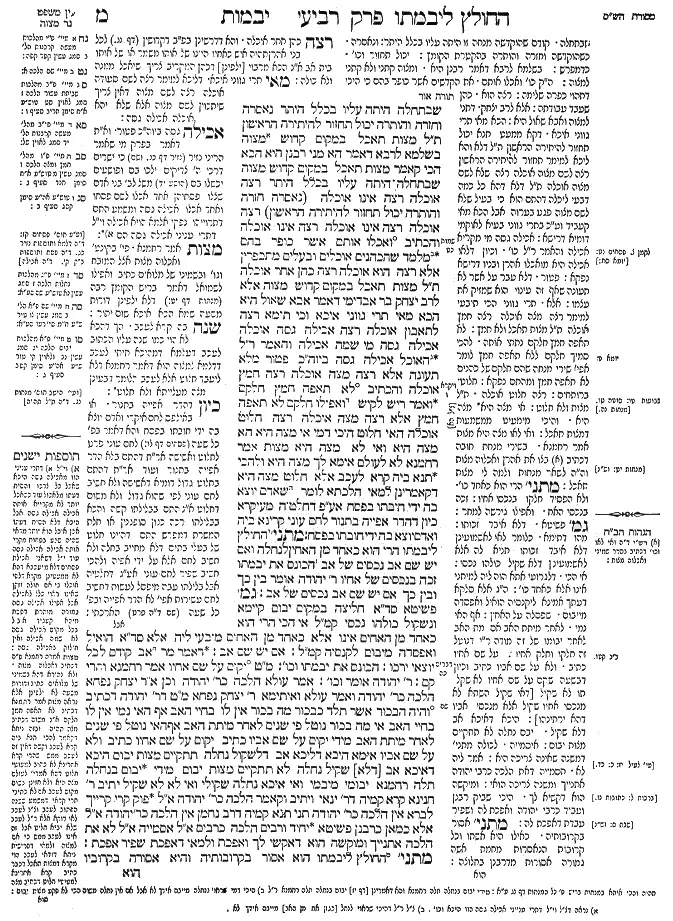
Yevamot 40a - Guemara
שבתחלה היתה עליו בכלל היתר נאסרה וחזרה והותרה יכול תחזור להיתירה הראשון ת"ל מצות תאכל במקום קדוש מצוה בשלמא לרבא דאמר הא מני רבנן היא הכא הכי קאמר מצות תאכל במקום קדוש מצוה שבתחלה היתה עליו בכלל היתר רצה אוכלה רצה אינו אוכלה (נאסרה חזרה והותרה יכול תחזור להיתירה הראשון) רצה אוכלה רצה אינו אוכלה רצה אינו אוכלה והכתיב (שמות כט, לג) ואכלו אותם אשר כופר בהם מלמד שהכהנים אוכלים ובעלים מתכפרין אלא רצה הוא אוכלה רצה כהן אחר אוכלה ת"ל מצות תאכל במקום קדוש מצוה אלא לרב יצחק בר אבדימי דאמר אבא שאול היא הכא מאי תרי גווני איכא וכי תימא רצה לתאבון אוכלה רצה אכילה גסה אוכלה אכילה גסה מי שמה אכילה והאמר ר"ל האוכל אכילה גסה ביוה"כ פטור מלא תעונה אלא רצה מצה אוכלה רצה חמץ אוכלה והכתיב (ויקרא ו, י) לא תאפה חמץ חלקם ואמר ריש לקיש ואפילו חלקם לא תאפה חמץ אלא רצה מצה אוכלה רצה חלוט אוכלה האי חלוט היכי דמי אי מצה היא הא מצה היא ואי לא מצה היא מצות אמר רחמנא לא לעולם אימא לך מצה היא ולהכי תנא ביה קרא לעכב אלא חלוט מצה היא דקאמרינן למאי הלכתא לומר שאדם יוצא בה ידי חובתו בפסח אע"פ דחלטיה מעיקרא כיון דהדר אפייה בתנור לחם עוני קרינא ביה ואדם יוצא בה ידי חובתו בפסח:
מתני׳ החולץ ליבמתו הרי הוא כאחד מן האחין לנחלה ואם יש שם אב נכסים של אב הכונס את יבמתו זכה בנכסים של אחיו ר' יהודה אומר בין כך ובין כך אם יש שם אב נכסים של אב:
גמ׳ פשיטא סד"א חליצה במקום יבום קיימא ונשקול כולהו נכסי קמ"ל אי הכי הרי הוא כאחד מן האחים אינו אלא כאחד מן האחים מיבעי ליה אלא סד"א הואיל ואפסדה מיבום לקנסיה קמ"ל:
אם יש שם אב:
דאמר מר אב קודם לכל יוצאי ירכו:
הכונס את יבמתו וכו':
מ"ט (דברים כה, ו) יקום על שם אחיו אמר רחמנא והרי קם:
ר' יהודה אומר וכו':
אמר עולא הלכה כר' יהודה וכן א"ר יצחק נפחא הלכה כר' יהודה ואמר עולא ואיתימא ר' יצחק נפחא מ"ט דר' יהודה דכתיב (דברים כה, ו) והיה הבכור אשר תלד כבכור מה בכור אין לו בחיי האב אף האי נמי אין לו בחיי האב אי מה בכור נוטל פי שנים לאחר מיתת האב אף האי נוטל פי שנים לאחר מיתת האב מידי יקום על שם אביו כתיב יקום על שם אחיו כתיב ולא על שם אביו אימא היכא דליכא אב דלשקול נחלה תתקיים מצות יבום היכא דאיכא אב [דלא] שקיל נחלה לא תתקיים מצות יבום מידי יבום בנחלה תלה רחמנא יבומי מיבמי ואי איכא נחלה שקולי ואי לא לא שקיל יתיב ר' חנינא קרא קמיה דר' ינאי ויתיב וקאמר הלכה כר' יהודה א"ל פוק קרי קרייך לברא אין הלכה כר' יהודה תני תנא קמיה דרב נחמן אין הלכה כר' יהודה א"ל אלא כמאן כרבנן פשיטא יחיד ורבים הלכה כרבים א"ל אסמייה א"ל לא את הלכה אתנייך ומוקשה הוא דאקשי לך ואפכת ולמאי דאפכת שפיר אפכת:
מתני׳ החולץ ליבמתו הוא אסור בקרובותיה והיא אסורה בקרוביו
Comments from Rashi on Masechet Yevamot Page 40a
שבתחלה . קודם שהוקדשה מנחה זו היתה עליו בכלל היתר: ונאסרה . כשהוקדשה וחזרה והותרה בהקטרת הקומץ: יכול תחזור וכו' . כדמפרש: בשלמא לרבא דאמר רבנן היא . ומצוה קתני ולא קתני למצוה: ה"ק כו' ואכלו אותם . את הקדשים אשר כופר בהם כי היכי דתהוי כפרה שלימה: רצה הוא . כהן שעבד עבודתה: אלא לרב יצחק . דתני למצוה ואבא שאול היא: הכא מאי תרי גווני איכא . דקא ממעט תנא יכול תחזור להיתירה הראשון ת"ל דלא והא ליכא למימר תחזור להיתירה הראשון רצה לשם מצוה אוכלה רצה שלא לשם מצוה אוכלה ת"ל דלא דהא כל כמה דבעי ליכלה דהתם הוא כי בעיל שלא לשם מצוה פגע בערוה אבל הכא מאי קעביד וע"כ בתרי גווני בעיא לאוקמי דומיא דרישא: אכילה גסה מי מקריא אכילה והאמר ר"ל כו' . וכיון דלאו אכילה היא מואכלו אהרן ובניו דרישא נפקא: פטור . דלא עבר על אשר לא תעונה שאף זה עינוי הוא שמזיק את עצמו: אלא . תרי גווני הכי תיבעי למימר רצה מצה אוכלה רצה חמץ אוכלה ת"ל מצות תאכל ולא חמץ: לא תאפה חמץ חלקם נתתי אותה . להכי סמיך חלקם ללא תאפה חמץ לומר אפי' שירי מנחה שהם חלקם של כהנים לא תאפה חמץ ומהתם נפקא: חלוט . ברותחים: רצה חלוט אוכלה . ת"ל מצות ולא חלוט: אי מצה היא מצה היא . והיכי מימעיט ממשמעות דמצות תאכל: ואי לאו מצה היא מצות אמר רחמנא . בשירי מנחת חובה דכתיב בצו את אהרן ואכלוה מצות וה"ה לשאר מנחות ולמה לי מצות תאכל: מתני' הרי הוא כאחד כו' . ולא הפסיד חלקו בנכסי אחיו: זכה בנכסי האח . ואפילו גירשה למחר: גמ' פשיטא . דלא איבד זכותו: מהו דתימא . כלומר לאו לאשמועינן דלא איבד זכותו תניא לה אלא לאשמועינן דלא שקיל כולהו נכסי: אי הכי . דלגרועי אתא הוה ליה למיתני אינו אלא כאחד כו': ה"ג אלא סלקא דעתך אמינא ליקנסיה הואיל ואפסדה מייבום . שפסלה על האחין: אף האי נמי . לאחר מיתת האב אם מת האב לאחר יבומו של זה מודה ר"י דנוטל זה חלקו וחלק אחיו: על שם אחיו כתיב ולא על שם אביו . כתיב וכיון דבשעה שקם על שם אחיו לא שקל תו לא שקיל [דאי שקיל השתא לא מנכסי אחיו שקיל אלא מנכסי אביו דהא ירתינהו]: היכא דאיכא אב דלא שקיל . יבם נחלה לא תתקיים מצות יבום: איסמייה . לכולה מתני' דמשנה שאינה צריכה היא: אמר ליה לא . תסמייה דאת הלכה כרבי יהודה אתנייך ומשנה צריכה הואי: ומיקשה הוא דקשיא לך . היכי שביק רבנן ועביד כרבי יהודה ואפכת לה ושפיר עבדת דאפכת לה: מתני' אסור בקרובותיה . כאילו היא אשתו וכל קרובות הנאסרות מחמת אשה גמורה אסורות מדרבנן בחלוצה:
Comments from Tosafot - Yevamot 40a
רצה כהן אחר אוכלה . והא דדרשינן בפ"ב דקדושין (דף נג.) לכל בני אהרן תהיה איש כאחיו היינו של אותו משמר או של אותו בית אב א"נ הכא מרבוי ילפינן דכהן המקריב צריך שיאכל ממנה ולא כולה: מאי תרי גווני איכא . דליכא למימר רצה לשם סעודה אוכלה רצה לשם מצוה דאין צריך שיתכוין לשם מצוה אלא שלא יהא אוכלה אכילה גסה: אכילה גסה ביוה"כ פטור . וא"ת דאמר בפרק מי שאמר הריני נזיר (נזיר דף כג. ושם) כי ישרים דרכי ה' צדיקים ילכו בם ופושעים יכשלו בם (הושע יד) משל לב' בני אדם שצלו פסחיהן אחד אכלו לשם פסחו ואחד אכלו אכילה גסה ומשמע התם דתרוייהו נפקי אלמא הויא אכילה וי"ל דתרי עניני אכילה גסה הם: מצות אמר רחמנא . פי' בקונט' ואכלוה מצות אצל המזבח וגו' ובשמיני של מלואים כתיב ואפילו לשמואל דאמר בריש הקומץ רבה (מנחות דף יט:) דלא ילפינן דורות משעה שמא הכא איכא שום יתור: שנה בה קרא לעכב . הך דהכא לא הוי כמו שנה עליו הכתוב לעכב דעלמא דמהיכא תיתי לעכב דדלמא למצוה הוא דאמר רחמנא דלא ליעבד חלוט אלא לעכב כלומר דבעינן מצה מעלייתא ולא חלוט: כיון דהדר אפייה בתנור . או באילפס לחם איקרי ואדם יוצא בה ידי חובתו בפסח והא דאמר בפ' כל שעה (פסחים דף לו:) לחם עוני פרט לחלוט ואשישה אר"ת דהתם בלא הדר אפייה בתנור ועוד אר"ת דהתם בחלוט גדול דומיא דאשישה ולא חשיב לחם עוני לפי שהוא גדול ולא משום דחלוט א"נ התם בבלילתו קשה והכא בבלילתו רכה כגון סופגנין או חלת המשרת דמפרש התם דהיינו חלוט של בעלי בתים דלא מחייב בחלה ולא חשיב לחם אלא על ידי אפיה ולהכי חשיב שפיר לחם עוני אע"ג דחלטיה אבל בלילתו עבה מיפסל לעשות דחשיב לחם עשירות אפי' לא הדר אפייה ובפ' כל שעה (שם ד"ה פרט) הארכתי:
Yevamot 40a - Mishnah translated into english
as initially, before the flour was consecrated, it was among all other foods that are permitted to him, and then when the flour was consecrated as a meal-offering, it became forbidden to him, and then once a handful of the offering was brought on the altar, it reverted from its forbidden status and became permitted to him. One might have thought that it would revert to its original permitted status; therefore, the verse states: “It shall be eaten unleavened in a sacred place” (Leviticus 6:9), which indicates that it is a mitzva to eat it.
The Gemara asks: Granted, according to Rava, who said: In accordance with whose opinion is this baraita? It is in accordance with the opinion of the Rabbis; according to him, here, in the first clause, this is what the baraita is saying: “It shall be eaten unleavened in a sacred place” indicates that it is a mitzva for the priest who prepares the offering to eat it himself. As, initially, before the flour was consecrated, it was among all other foods that are permitted to him: If he wishes, he may eat it, and if he wishes, he may choose not to eat it. When the flour was consecrated, it became forbidden to him, and then once a handful was brought on the altar, it reverted from its forbidden status and became permitted to him. One might have thought that it would revert to its original permitted status, so that if he wishes, he may eat it, and if he wishes, he may choose not to eat it.
The Gemara interjects that the logic of this last statement seems implausible: Could it be that if he wishes, he may choose not to eat it? But isn’t it written: “And they shall eat those things through which atonement is attained” (Exodus 29:33), which teaches that the priests eat portions of the offering and by their doing so the owners who brought the offering attain atonement? Clearly, then, the eating of the offerings is not volitional.
Rather, the baraita should be understood as saying: One might have thought that if he wishes, he may eat it, and if he wishes, another priest may eat it; therefore, the verse states: “It shall be eaten unleavened in a sacred place” (Leviticus 6:9), to teach that it is a mitzva for the priest who prepares the offering to eat it himself. This explanation of the first clause of the baraita is entirely consistent with Rava’s explanation of the latter clause concerning the mitzvot of levirate marriage. In his opinion, both clauses demonstrate that there is a mitzva to perform an action in a case where one might have thought there was none.
However, according to Rav Yitzḥak bar Avdimi, who said that the baraita is in accordance with the opinion of Abba Shaul and explained the baraita accordingly as teaching the correct manner in which the mitzva is to be performed, here, in the first clause concerning the meal-offering, what two manners of eating are there of which one would be prohibited?
And if you would say that the baraita might refer to two types of eating and is saying: One might have thought that if he wishes he may eat it with an appetite, and if he wishes he may eat it though an act of excessive eating, forcing himself to eat despite already being fully satiated; perforce this is not correct, as does excessive eating have the legal status of an act of eating? Didn’t Reish Lakish say: One who eats through an act of excessive eating on Yom Kippur is exempt from the punishment of karet indicated in the verse: “For whatever soul it be that shall not be afflicted in that same day shall be cut off from his people” (Leviticus 23:29)? From this it is apparent that excessive eating does not have the legal status of an act of eating.
The Gemara therefore suggests a different interpretation of the baraita that is consistent with Rav Yitzḥak’s opinion: Rather, say the baraita is referring to two different manners in which the meal-offering was prepared: If he wishes he may eat it unleavened, and if he wishes he may eat it leavened.
The Gemara interjects that the logic of this last statement seems implausible: Could it be that if he wishes, the offering could be leavened? But isn’t it written: “Their portion shall not be baked leavened” (Leviticus 6:10), and Reish Lakish said that both the handful brought on the altar and even the priest’s portion shall not be baked leavened? Rather, the baraita should be understood as saying: One might have thought that if he wishes he may eat it unleavened, and if he wishes he may eat it even if it was prepared by being boiled. Therefore, the verse taught that one must eat it unleavened. Understood in this way, this clause of the baraita is also consistent with Rav Yitzḥak’s opinion.
The Gemara asks: With regard to this possibility of eating the meal-offering boiled, what are the circumstances, i.e., how is it classified? If it is considered to be unleavened because it is presumed that the flour never managed to rise before it was cooked, then it is unleavened and there is no reason to prohibit its use; and if it is not considered to be unleavened because it is presumed that the flour managed to rise before it was cooked, then it is certainly disqualified from use because the Merciful One states that the offering must be “unleavened” (Leviticus 10:12). How, then, could one ever have questioned whether it is permitted to eat the meal-offering if it was boiled?
The Gemara explains: No; actually, I could say to you that the boiled meal-offering is considered to be unleavened, and nevertheless it is disqualified because it is for this very reason that the verse repeated the requirement that it be unleavened, in order to invalidate a meal-offering that was boiled.
The Gemara asks: But if boiled flour is invalid as a meal offering, then with regard to this statement that we said that boiled flour is unleavened, for what halakha is it relevant? The Gemara answers: It is to say that a person fulfills his obligation with it on Passover. This is because even though he initially boiled it, since he subsequently baked it in an oven, it is called “bread of affliction” (Deuteronomy 16:3), and therefore a person fulfills his obligation with it on Passover.
MISHNA: One who performs ḥalitza with his yevama is like any one of the other brothers with respect to the inheritance of the deceased brother’s estate, i.e., each of the brothers takes an equal share of the inheritance. And if there is a father of the deceased, who is still alive, the property of the deceased belongs to the father. One who consummates levirate marriage with his yevama thereby acquires his deceased brother’s property solely for himself. Rabbi Yehuda says: In either case, whether he consummated the levirate marriage or performed ḥalitza, if there is a father who is still alive, the property belongs to the father.
GEMARA: The Gemara asks with regard to the opening clause of the mishna: The fact that one who performs ḥalitza does not gain any special rights to the inheritance of the deceased brother is obvious; why did the mishna teach it? The Gemara answers: It could enter your mind to say that the ḥalitza takes the place of the levirate marriage and therefore the brother who performs ḥalitza should take all the property in the same way as one who consummates the levirate marriage. Therefore, the mishna teaches us that this is not the case.
The Gemara asks: If so, that the mishna’s point is to teach that by performing ḥalitza one is not afforded any additional rights to the inheritance, why is the mishna formulated as: He is like any one of the other brothers, placing the emphasis on what he gains? It should have instead taught: He is still only like one of the other brothers, which would emphasize the mishna’s point that by performing ḥalitza he does not gain any additional rights.
Rather, the mishna needs to teach the opening clause in this manner because it could enter your mind to say that since by performing ḥalitza with his yevama he caused her to forfeit the possibility of consummating the levirate marriage, he should be penalized and should forfeit any entitlement to his brother’s property. Therefore the mishna teaches us that this is not so.
§ The mishna states: If there is a father of the deceased, who is still alive, the property of the deceased belongs to the father. The Gemara explains: As the Master said with regard to the laws of inheritance (Bava Batra 115a): A father of the deceased takes precedence over all the father’s descendants. Therefore, since the father is still alive, the brothers do not inherit at all.
The mishna states: One who consummates levirate marriage with his yevama thereby acquires his deceased brother’s property. The Gemara asks: What is the reason for this? The Merciful One states in the Torah: “He shall succeed in the name of his dead brother” (Deuteronomy 25:6), and he has succeeded him by marrying his wife; consequently, he succeeds him by acquiring his property as well.
§ The mishna continues by citing an opposing opinion. Rabbi Yehuda says: In either case, whether he consummated levirate marriage or performed ḥalitza, if there is a father who is still alive, the property belongs to the father. The Gemara cites a ruling on this dispute: Ulla said: The halakha is in accordance with the opinion of Rabbi Yehuda. And similarly, Rabbi Yitzḥak Nappaḥa said: The halakha is in accordance with the opinion of Rabbi Yehuda.
And Ulla said, and some say that it was Rabbi Yitzḥak Nappaḥa who said: What is the reason for the opinion of Rabbi Yehuda? As it is written: “And it shall be that the firstborn that she bears shall succeed in the name of his dead brother” (Deuteronomy 25:6). The term “firstborn” is understood to be a reference to the yavam. By referring to him in this way the Torah indicates that his rights to his brother’s estate are like those of a firstborn child’s rights to his father’s estate: Just as a firstborn has no rights to any of his father’s estate during the lifetime of the father, and he may take his double portion only upon the father’s death, so too, this yavam as well has no rights to any of his brother’s estate during the lifetime of the father.
The Gemara asks: If there is truly a comparison between the yavam who consummated the levirate marriage and a firstborn, then one should also say that just as the firstborn takes a double portion of his father’s estate after the death of the father, so too, this yavam should become entitled to take a double portion of the father’s estate after the father’s death, i.e., the portion due to him as a son, and that portion that would have been awarded to his brother. However, this is not the case; if the yavam is not actually the father’s firstborn then he receives only an equal portion of the inheritance together with the other brothers.
The Gemara explains: Is it written in the Torah: He shall succeed in the name of his father? No, it is written: “He shall succeed in the name of his dead brother,” which indicates that he succeeds his brother but not in the name of his father, i.e., the Torah never granted him any special entitlement to his father’s estate, and so he should not receive a double portion of it.
The Gemara asks: Since Rabbi Yehuda holds that the halakha that the yavam inherits from his brother, which is stated in the verses describing levirate marriage, applies only when the father is no longer alive, perhaps the other halakhot in those verses also apply only when the father is no longer alive, and accordingly one should say: When there is no father who is still alive, which means that the yavam takes the inheritance, only then should the mitzva of levirate marriage apply, but when there is a father who is still alive, which means that the yavam does not take the inheritance, in that case the mitzva of levirate marriage should not apply.
The Gemara rejects the possibility of saying this: Does the Merciful One make the mitzva of levirate marriage dependent upon inheritance? Certainly not; rather, in all cases the yavam should consummate the levirate marriage, and then if there is an inheritance to which he is entitled, he takes it, and if not, he does not take it.
Rabbi Ḥanina Kara, the Bible expert, was sitting before Rabbi Yannai, and he was sitting and saying: The halakha is in accordance with the opinion of Rabbi Yehuda. Rabbi Yannai said to him: Leave the study hall and recite your verses outside, as you are incorrect in your ruling; in fact, the halakha is not in accordance with the opinion of Rabbi Yehuda.
In another incident, a tanna who would recite baraitot in the study hall taught a baraita before Rav Naḥman: The halakha is not in accordance with the opinion of Rabbi Yehuda. Rav Naḥman said to him: But then it follows that in accordance with whose opinion is the halakha? It is the opinion of the Rabbis. The Gemara asks: But this fact is obvious, as in a dispute between one individual Sage and many other Sages, the halakha is always decided in accordance with the opinion of the many.
The tanna said to him: Are you saying that this statement in the baraita is unnecessary and so I should remove that ruling from the baraita when I recite it in the future? Rav Naḥman said to him: No, do not remove it, as although the statement is unnecessary, it is correct. Rav Naḥman explained further: It must be that originally the baraita that you were taught stated: The halakha is in accordance with the opinion of Rabbi Yehuda, and that ruling was difficult for you because you knew that the halakha is always decided in accordance with many, and so you reversed the statement of the baraita to say, as you presently recited it, that the halakha is not in accordance with the opinion of Rabbi Yehuda. And with regard to the manner in which you reversed it, you reversed it well, and therefore you should leave it in its current form.
MISHNA: In the case of one who performs ḥalitza with his yevama, by rabbinic decree it is as though she had been married to him and then he divorced her. Consequently, he is forbidden to engage in relations with her relatives and she is forbidden to engage in relations with his relatives.
Traduction : The William Davidson digital edition of the Koren Noé Talmud, with commentary by Rabbi Adin Even-Israel Steinsaltz.