 Talmud Bavli
The learning on the whole site is dedicated : L'ilui Nishmat Jamila bat Chlomo Abensour
The learning on the whole site is dedicated : L'ilui Nishmat Jacques Isaac Ben Amram Loubaton
The learning on the whole site is dedicated : L'ilui Nishmat Avraham Ben Simha
Yevamot 61b : Youtube
Daf TubeYoutube
2 video classes :
Yevamot Page 61b
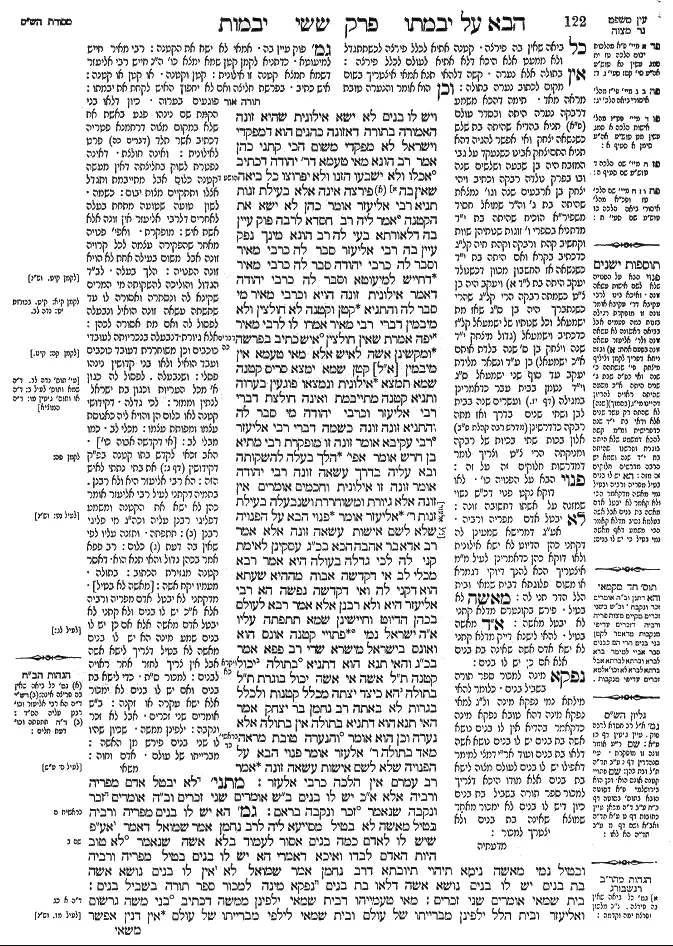
Yevamot 61b - Guemara
ויש לו בנים לא ישא אילונית שהיא זונה האמורה בתורה דאזונה כהנים הוא דמפקדי וישראל לא מפקדי משום הכי קתני כהן אמר רב הונא מאי טעמא דר' יהודה דכתיב (הושע ד, י) אכלו ולא ישבעו הזנו ולא יפרוצו כל ביאה שאין בה פירצה אינה אלא בעילת זנות תניא רבי אליעזר אומר כהן לא ישא את הקטנה אמר ליה רב חסדא לרבה פוק עיין בה דלאורתא בעי לה רב הונא מינך נפק עיין בה רבי אליעזר סבר לה כרבי מאיר וסבר לה כרבי יהודה סבר לה כרבי מאיר דחייש למיעוטא וסבר לה כרבי יהודה דאמר אילונית זונה הויא וכרבי מאיר מי סבר לה והתניא קטן וקטנה לא חולצין ולא מיבמין דברי רבי מאיר אמרו לו לרבי מאיר יפה אמרת שאין חולצין (דברים כה, ז) איש כתיב בפרשה ומקשינן אשה לאיש אלא מאי טעמא אין מיבמין [א"ל] קטן שמא ימצא סריס קטנה שמא תמצא אילונית ונמצאו פוגעין בערוה ותניא קטנה מתייבמת ואינה חולצת דברי רבי אליעזר וכרבי יהודה מי סבר לה והתניא זונה זונה כשמה דברי רבי אליעזר רבי עקיבא אומר זונה זו מופקרת רבי מתיא בן חרש אומר אפי' הלך בעלה להשקותה ובא עליה בדרך עשאה זונה רבי יהודה אומר זונה זו אילונית וחכמים אומרים אין זונה אלא גיורת ומשוחררת ושנבעלה בעילת זנות ר' אליעזר אומר פנוי הבא על הפנויה שלא לשם אישות עשאה זונה אלא אמר רב אדא בר אהבה הכא בכ"ג עסקינן לאימת קני לה לכי גדלה בעולה היא אמר רבא מכלי לב אי דקדשה אבוה מההיא שעתא הוא דקני לה ואי דקדשה נפשה הא רבי אליעזר היא ולא רבנן אלא אמר רבא לעולם בכהן הדיוט וחיישינן שמא תתפתה עליו א"ה ישראל נמי פתויי קטנה אונס הוא ואונס בישראל מישרא שרי רב פפא אמר בכ"ג והאי תנא הוא דתניא (ויקרא כא, ג) בתולה יכול קטנה ת"ל אשה אי אשה יכול בוגרת ת"ל בתולה הא כיצד יצתה מכלל קטנות ולכלל בגרות לא באתה רב נחמן בר יצחק אמר האי תנא הוא דתניא בתולה אין בתולה אלא נערה וכן הוא אומר (בראשית כד, טז) והנערה טובת מראה מאד בתולה ר' אלעזר אומר פנוי הבא על הפנויה שלא לשם אישות עשאה זונה אמר רב עמרם אין הלכה כרבי אלעזר:
מתני׳ לא יבטל אדם מפריה ורביה אלא א"כ יש לו בנים ב"ש אומרים שני זכרים וב"ה אומרים זכר ונקבה שנאמר (בראשית ה, ב) זכר ונקבה בראם:
גמ׳ הא יש לו בנים מפריה ורביה בטיל מאשה לא בטיל מסייעא ליה לרב נחמן אמר שמואל דאמר אע"פ שיש לו לאדם כמה בנים אסור לעמוד בלא אשה שנאמר (בראשית ב, יח) לא טוב היות האדם לבדו ואיכא דאמרי הא יש לו בנים בטיל מפריה ורביה ובטיל נמי מאשה נימא תיהוי תיובתא דרב נחמן אמר שמואל לא אין לו בנים נושא אשה בת בנים יש לו בנים נושא אשה דלאו בת בנים נפקא מינה למכור ספר תורה בשביל בנים:
בית שמאי אומרים שני זכרים:
מאי טעמייהו דבית שמאי ילפינן ממשה דכתיב (דברי הימים א כג, טו) בני משה גרשום ואליעזר ובית הלל ילפינן מברייתו של עולם ובית שמאי לילפי מברייתו של עולם אין דנין אפשר
Comments from Rashi on Masechet Yevamot Page 61b
גמ' פוק עיין בה . אמאי לא ישא את הקטנה: רבי מאיר חייש למיעוטא . כדתניא לקמן קטן שמא ימצא כו' ה"נ חייש רבי אליעזר דשמא תמצא קטנה זו אילונית: קטן וקטנה . או קטן או קטנה: איש כתיב . בפרשת חליצה ואם לא יחפוץ האיש לקחת את יבמתו: פוגעים בערוה . כיון דלאו בני הקמת שם נינהו פגע באשת אח שלא במקום מצוה דרחמנא פטריה דכתיב אשר תלד (דברים כה) פרט לאילונית: ואינה חולצת . דאינה נפטרת לשוק בחליצתה דאין מעשה קטנה כלום אבל מתייבמת ותגדל אצלו ותתקיים מצות יבום: כשמה . לשון טועה שטועה מתחת בעלה לאחרים דלרבי אליעזר אין זונה אלא אשת איש: מופקרת . ואפי' פנויה מאחר שהפקירה עצמה לכל קרויה זונה אבל משום בעילה אחת לא הויא זונה הפנויה: הלך בעלה . לב"ד הגדול והוליכה להשקותה מי המרים שקינא לה ונסתרה ואסורה לו עד שתשתה עשאה זונה הואיל ונבעלה לפסול לה ואם מת אסורה לכהן: אלא גיורת . דנבעלה בנכריותה לעובדי כוכבים וכן משוחררת דעובד כוכבים ועבד הואיל ולאו בני קדושין נינהו פסלי: ושנבעלה . לפסול לה כגון א' מכל העריות וכגון בת ישראל לנתין וממזר: לכי גדלה . דקידושי קטנה לאו כלום הן והויא ליה כאנוסת עצמו ומפותת עצמו: מכלי לב . כמו מבלי לב: [אי דקדשה אבוה כו'] . האב זכאי לקדש בתו קטנה בפ"ק דקידושין (דף ג:) את בתי נתתי לאיש הזה: הא רבי אליעזר היא ולא רבנן . בתמיה. דקתני לעיל רבי אליעזר אומר כהן לא ישא את הקטנה ומשמע דפליגי רבנן עליה וכה"ג מי פליגי רבנן: תתפתה . ותזנה עליו לפי שאין בה דעת כלום: רב פפא אמר בכהן גדול והאי תנא הוא . דאסר קטנה מגזירת הכתוב: בתולה . מעמיו יקח אשה: [מאשה לא בטיל] . מדקתני לא יבטל אדם מפריה ורביה אלא א"כ יש לו בנים ולא קתני לא יבטל אדם מאשה אלא אם כן יש לו בנים שמע מינה הא יש לו בנים מאשה לא בטיל דצריך לישא אשה אבל אין צריך לחזר אחר ראויה לבנים: למכור ס"ת . כדי לישא בת בנים ואם יש לו בנים לא ימכור אלא ישא עקרה או זקנה: ב"ש אומרים שני זכרים . אבל לא זכר ונקבה: ילפינן ממשה . שכיון שהיו לו שני בנים פירש מן האשה: מברייתו של עולם . אדם וחוה:
Comments from Tosafot - Yevamot 61b
כל ביאה שאין בה פירצה . קטנה אתיא לכלל פירצה לכשתתגדל ולא ממעט אלא היכא דלא אתיא לעולם לכלל פירצה: אין בתולה אלא נערה . קשה דלהאי תנא אמאי איצטריך בשום מקום לכתוב נערה בתולה: וכן הוא אומר והנערה טובת מראה מאד . תימה דהכא משמע דרבקה נערה היתה ובסדר עולם (פ"א) תניא בהדיא שהיתה בת שלש כשנשאה יצחק ואי אפשר להגיה דהא תניא התם יצחק אבינו כשנעקד על גבי המזבח היה בן שבעה ושלשים שנה ובו בפרק נולדה רבקה וכתיב ויהי יצחק בן ארבעים שנה וגו' נמצאת שהיתה בת ג' וה"ר שמואל חסיד משפיר"א הוכיח שהיתה בת י"ד מדתניא בספרי ו' זוגות שנותיהן שוות וקחשיב קהת ורבקה וקהת חיה קל"ג כדכתיב בקרא ואם היתה בת י"ד כשנשאה אז החשבון מכוון דכשנולד יעקב היתה בת ל"ד ויעקב היה בן צ"ט כשמתה רבקה הרי קל"ג שהרי כשנתברך היה בן ס"ג שאז מת ישמעאל וכל שנותיו של ישמעאל קל"ז כדכתיב וישמעאל (גדול מיצחק י"ד שנה ויצחק בן ס' שנה בלדת אותם א"כ ישמעאל) בן ע"ד ונשאר מלידת יעקב עד סוף שני ישמעאל ס"ג וי"ד נטמן בבית עבר כדאמרינן במגילה (דף יז.) ועשרים שנה בבית לבן ושתי שנים בדרך ואז מתה רבקה כדדרשינן (מדרש רבה קהלת פ"ב) אלון בכות שתי בכיות של רבקה ומניקתה הרי צ"ט וצריך לומר דמדרשות חלוקים זה על זה: פנוי הבא על הפנויה כו' . לאו דוקא נקט פנוי דכ"ש נשוי שמזנה על אשתו דחשובה זונה: לא יבטל אדם מפריה ורביה . אע"ג דמרישא שמעינן לה דקתני כהן הדיוט לא ישא אילונית ולאו דוקא כהן כדאמרינן לעיל מ"מ איצטריך הכא להנך דיוקי דגמרא או משום פלוגתא דבית שמאי ובית הלל הדר תני לה: מאשה לא בטיל . פירש בקונטרס מדלא קתני לא יבטל מאשה: א"ד מאשה בטיל . להאי לישנא דייק מדלא קתני לא ישא אדם אשה שאינה בת בנים אלא אם כן יש לו בנים: נפקא מינה למכור ספר תורה בשביל בנים . כלומר להאי מילתא נמי נפקא מינה ול"ג למאי נפקא מינה דהא טובא נפקא מינה כדקאמר בהדיא אין לו בנים נושא אשה בת בנים יש לו בנים נושא אשה דלאו בת בנים ועוד אר"י דמצי למימר דאפילו יש לו בנים לעולם מצוה לישא בת בנים אלא מודו היכא דצריך למכור ספר תורה בשביל בת בנים כיון דיש לו בנים לא ימכור מאחר שמוצא שאינה בת בנים ולא יצטרך למכור:
Yevamot 61b - Mishnah translated into english
and he has children, he may not marry a sexually underdeveloped woman, as she is the zona about whom it is stated in the Torah that a priest may not marry her. It is priests who were commanded not to marry a zona, but Israelites were not commanded this. It is due to that reason that he taught the first clause of the mishna about a priest, even though that halakha applies equally to Israelites.
Rav Huna said: What is the reason for the opinion of Rabbi Yehuda? As it is written: “And they shall eat, and not have enough, they shall commit harlotry, and shall not increase” (Hosea 4:10). He expounds the verse as follows: Any intercourse that does not have the possibility to increase the population because the woman is incapable of having children, is nothing other than licentious sexual intercourse.
§ It is taught in a baraita that Rabbi Eliezer says: A priest may not marry a minor. Rav Ḥisda said to Rabba: Go and investigate this halakha, as in the evening Rav Huna will ask you the reason for Rabbi Eliezer’s ruling. He went and investigated it, and arrived at the following conclusion: Rabbi Eliezer holds in accordance with the opinion of Rabbi Meir, and he also holds in accordance with the opinion of Rabbi Yehuda.
Rabba explains: He holds in accordance with the opinion of Rabbi Meir, who says that one must be concerned for the minority. Rabbi Meir does not allow one to assume that an unknown case is similar to the majority of cases. Consequently, one must take into account the possibility that a minor will turn out to be sexually underdeveloped, although this will not be true of most individuals. And he also holds in accordance with the opinion of Rabbi Yehuda, who said that a sexually underdeveloped woman is a zona and therefore forbidden to a priest.
The Gemara challenges Rabba’s explanation: And does Rabbi Eliezer hold in accordance with the opinion of Rabbi Meir? Isn’t it taught in a baraita: A boy minor and a girl minor may not perform ḥalitza or levirate marriage; this is the statement of Rabbi Meir. The Rabbis said to Rabbi Meir: You spoke well when you said that they may not perform ḥalitza, as the term “man” is written in the passage of ḥalitza (Deuteronomy 25:7–10), which limits the halakha to an adult male, and we compare a woman to a man and therefore limit ḥalitza to an adult woman. However, what is the reason that they may not perform levirate marriage?
Rabbi Meir said to them: A boy minor may not perform levirate marriage lest he be found to be a eunuch, i.e., one who is incapable of fathering children for his late brother. Similarly, a girl minor may not perform levirate marriage lest she be found to be sexually underdeveloped when she grows up. In either case, the mitzva of levirate marriage does not apply, and they turn out to have encountered a forbidden relative. And it was taught in a different baraita: A girl minor enters into levirate marriage but does not perform ḥalitza; this is the statement of Rabbi Eliezer. This proves that Rabbi Eliezer disagrees with Rabbi Meir and is not concerned that a girl may turn out to be sexually underdeveloped.
The Gemara continues to challenge Rabba’s explanation of Rabbi Eliezer’s ruling. And does Rabbi Eliezer hold in accordance with the opinion of Rabbi Yehuda? Wasn’t it is taught in a baraita: The zona forbidden to a priest is as the name zona implies, i.e., a married woman who committed adultery; this is the statement of Rabbi Eliezer. Rabbi Akiva says: A zona is a woman, even an unmarried woman, who is available to all, i.e., she has intercourse with whoever is interested. Rabbi Matya ben Ḥarash says: Even if her husband went to make her drink the bitter waters after she disregarded his warning not to seclude herself with a certain man, and he had intercourse with her on the way, he has thereby caused her to become a zona because she was forbidden to him at the time, despite the fact that she is his wife.
Rabbi Yehuda says: A zona is a sexually underdeveloped woman. And the Rabbis say: The term zona applies only to a female convert, a freed maidservant, and one who engaged in licentious sexual intercourse. Rabbi Elazar says: Even in the case of an unmarried man who had intercourse with an unmarried woman not for the purpose of marriage, he has thereby caused her to become a zona. This baraita proves that Rabbi Eliezer does not agree with Rabbi Yehuda.
Rather, Rav Adda bar Ahava said that Rabbi Eliezer’s ruling that a priest may not marry a minor must be explained differently: Here we are dealing with a High Priest, and the problem is as follows: When can he acquire her as his wife? Only when she is grown up. However, if they had started living together as husband and wife when she was a minor, then when she is grown up and the marriage can legally take effect, she is already a non-virgin, and a High Priest is commanded to marry a virgin.
Rava said: This explanation is without reason. If her father betrothed her to her husband, her husband acquired her from that time, as betrothal that a father carries out on his daughter’s behalf when she is a minor is effective by Torah law. And if the minor betrothed herself, is this Rabbi Eliezer’s opinion and not that of the Rabbis? The Rabbis would certainly agree that a High Priest may not marry a minor under these circumstances.
Rather, Rava said: Actually, Rabbi Eliezer’s ruling includes a common priest, and the reason he cannot marry a minor is that we are concerned lest she be seduced by another man, due to her tender age and naïveté, while married to him. The Gemara asks: If so, the same concern should apply to an Israelite also. The Gemara answers: The seduction of a minor is considered rape, and a rape victim remains permitted to her husband in a case where she is married to an Israelite, but not if she is married to a priest.
Rav Pappa said: Rabbi Eliezer’s ruling applies specifically to a High Priest, and it is the opinion of this tanna, as it is taught in a baraita that when the verse states: “A virgin of his own people shall he take for a wife [isha]” (Leviticus 21:14), one might have thought a High Priest may marry a minor; the verse therefore states that he must marry a woman [isha], i.e., an adult. If he must marry a woman, one might have thought it means a grown woman. The verse therefore states that he must marry a virgin, which excludes a grown woman, who is considered only a partial virgin because her hymen is not fully intact. How so? He must marry a woman who has left the class of minority but who has not yet reached the class of grown womanhood, i.e., he must marry a maiden.
Rav Naḥman bar Yitzḥak said: It is the opinion of this tanna, as it is taught in a baraita: The High Priest must marry a virgin, and the term virgin refers only to a maiden. And a verse similarly states: “And the maiden was very fair to look upon, a virgin, and no man had known her” (Genesis 24:16).
The baraita cited above mentioned that Rabbi Elazar says: In the case of an unmarried man who had intercourse with an unmarried woman not for the purpose of marriage, he has caused her to become a zona. Rav Amram said: The halakha is not in accordance with the opinion of Rabbi Elazar.
MISHNA: A man may not neglect the mitzva to be fruitful and multiply unless he already has children. Beit Shammai say: One fulfills this mitzva with two males, and Beit Hillel say: A male and a female, as it is stated: “Male and female He created them” (Genesis 5:2).
GEMARA: The Gemara infers from the mishna’s wording that if he already has children he may neglect the mitzva to be fruitful and multiply, but he may not neglect the mitzva to have a wife. This supports what Rav Naḥman said in the name of Shmuel, who said: Even if a man has several children, it is prohibited to remain without a wife, as it is stated: “It is not good that the man should be alone” (Genesis 2:18).
And some say a different version of the inference from the mishna: If he already has children, he may neglect the mitzva to be fruitful and multiply and he may also neglect the mitzva to have a wife. Shall we say this is a conclusive refutation of what Rav Naḥman said that Shmuel said? The Gemara responds: No, it means that if he does not have children he must marry a woman capable of bearing children, whereas if he has children he may marry a woman who is not capable of bearing children. A practical difference between a man who has children and one who does not is whether he is permitted to sell a Torah scroll in order to marry a woman capable of having children. This is permitted only for one who does not yet have children.
§ The mishna states that Beit Shammai say that one fulfills the mitzva to be fruitful and multiply when he has two males. The Gemara asks: What is the reason of Beit Shammai? The Gemara answers: We learn this from Moses as it is written: “The sons of Moses, Gershom and Eliezer” (I Chronicles 23:15). Since Moses did not have any other children, two sons must be sufficient to fulfill the mitzva. And the reason of Beit Hillel is that we learn from the creation of the world, as mankind was created male and female. The Gemara asks: And Beit Shammai, let them learn from the creation of the world as well. The Gemara answers that Beit Shammai could say to you: We do not derive a case where it is possible
Traduction : The William Davidson digital edition of the Koren Noé Talmud, with commentary by Rabbi Adin Even-Israel Steinsaltz.