 Talmud Bavli
Yevamot 102a : Youtube
Daf TubeYoutube
1 video class :
Yevamot Page 102a
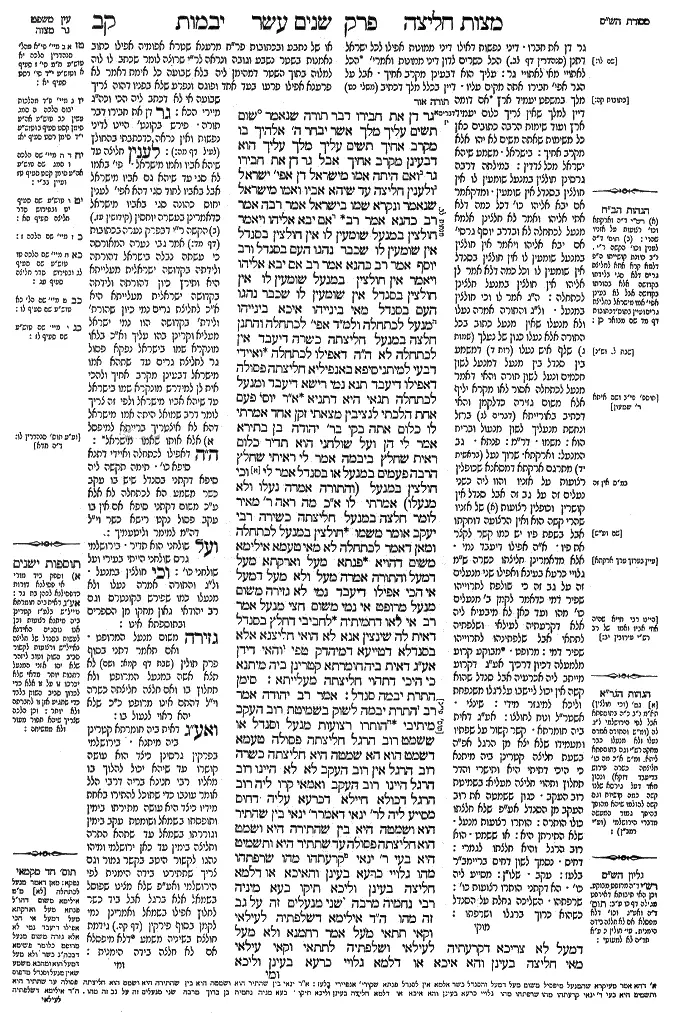
Yevamot 102a - Guemara
גר דן את חבירו דבר תורה שנאמר (דברים יז, טו) שום תשים עליך מלך אשר יבחר ה' אלהיך בו מקרב אחיך תשים עליך מלך עליך הוא דבעינן מקרב אחיך אבל גר דן את חבירו גר ואם היתה אמו מישראל דן אפי' ישראל ולענין חליצה עד שיהא אביו ואמו מישראל שנאמר ונקרא שמו בישראל אמר רבה אמר רב כהנא אמר רב אם יבא אליהו ויאמר חולצין במנעל שומעין לו אין חולצין בסנדל אין שומעין לו שכבר נהגו העם בסנדל ורב יוסף אמר רב כהנא אמר רב אם יבא אליהו ויאמר אין חולצין במנעל שומעין לו אין חולצין בסנדל אין שומעין לו שכבר נהגו העם בסנדל מאי בינייהו איכא בינייהו מנעל לכתחלה ולמ"ד אפי' לכתחלה והתנן חלצה במנעל חליצתה כשרה דיעבד אין לכתחלה לא ה"ה דאפילו לכתחלה ואיידי דבעי למיתני סיפא באנפיליא חליצתה פסולה דאפילו דיעבד תנא נמי רישא דיעבד ומנעל לכתחלה תנאי היא דתניא א"ר יוסי פעם אחת הלכתי לנציבין מצאתי זקן אחד אמרתי לו כלום אתה בקי בר' יהודה בן בתירא אמר לי הן ועל שולחני הוא תדיר כלום ראית שחלץ ביבמה אמר לי ראיתי שחלץ הרבה פעמים במנעל או בסנדל אמר לי וכי חולצין במנעל והתורה אמרה נעלו ולא מנעלו אמרתי לו א"כ מה ראה ר' מאיר לומר חלצה במנעל חליצתה כשירה רבי יעקב אומר משמו חולצין במנעל לכתחלה ומאן דאמר לכתחלה לא מאי טעמא אילימא משום דהויא פנתא מעל וארקתא מעל דמעל והתורה אמרה מעל ולא מעל דמעל אי הכי אפילו דיעבד נמי לא גזירה משום מנעל מרופט אי נמי משום חצי מנעל אמר רב אי לאו דחמיתיה לחביבי דחלץ בסנדל דאית לה שינצין אנא לא הואי חליצנא אלא בסנדלא דטייעא דמיהדק טפי והאי דידן אע"ג דאית ביה חומרתא קטרינן ביה מיתנא כי היכי דתהוי חליצתה מעלייתא:
סימן התרת יבמה סנדל:
אמר רב יהודה אמר רב התרת יבמה לשוק בשמיטת רוב העקב מיתיבי הותרו רצועות מנעל וסנדל או ששמט רוב הרגל חליצתה פסולה טעמא דשמט הוא הא שמטה היא חליצתה כשרה רוב הרגל אין רוב העקב לא לא היינו רוב הרגל היינו רוב העקב ואמאי קרו ליה רוב הרגל דכולא חיילא דכרעא עליה דחיס מסייע ליה לר' ינאי דאמר ר' ינאי בין שהתיר הוא ושמטה היא בין שהתירה היא ושמט הוא חליצתה פסולה עד שתתיר היא ותשמיט היא בעי ר' ינאי קרעתהו מהו שרפתהו מהו גלויי כרעא בעינן והאיכא או דלמא חליצה בעינן וליכא תיקו בעא מיניה רבי נחמיה מרבה שני מנעלים זה על גב זה מהו ה"ד אילימא דשלפתיה לעילאי וקאי תתאי מעל אמר רחמנא ולא מעל דמעל לא צריכא דקרעתיה לעילאי ושלפתיה לתתאי וקאי עילאי מאי חליצה בעינן והא איכא או דלמא גלויי כרעא בעינן וליכא
Comments from Rashi on Masechet Yevamot Page 102a
גר דן את חברו . דיני נפשות דאילו דיני ממונות אפילו לכל ישראל דתנן (סנהדרין דף לב.) הכל כשרים לדון דיני ממונות ואמרי' הכל לאתויי מאי לאתויי גר: עליך הוא דבעינן מקרב אחיך . אבל על הגר אפי' חבירו אתה מקים עליו. דיין בכלל מלך דכתיב (משלי כט) מלך במשפט יעמיד ארץ אם דומה דיין למלך שאין צריך כלום יעמיד ארץ ועוד שימות הרבה כתובים כאן כל משימות שאתה משים לא יהו אלא מקרב אחיך: בישראל . משמע שיהא ישראל מכל צדדין: במילתה דרבה גרסינן חולצין במנעל שומעין לו אין חולצין בסנדל אין שומעין . ומדקאמר אם יבא אליהו כו' דכל כמה דלא אתי אליהו ואמר לא חלצינן אלמא מנעל לכתחלה לא. ובדרב יוסף גרסי' אם יבא אליהו ויאמר אין חולצין במנעל שומעין לו אין חולצין בסנדל אין שומעין לו וכל כמה דלא אמר לן אליהו אין חולצין במנעל חלצינן לכתחלה: ה"ג אמר לו וכי חולצין במנעל . ול"ג והתורה אמרה נעלו ולא מנעלו שאין מנעל כתוב בכל התורה אלא נעלו כגון של נעלך (שמות ג) שלף איש נעלו (רות ד) דמשמע בין סנדל בין מנעל דמנעל לשון חכמים ונעל לשון תורה והאי דאמר מנעל לכתחלה אסור לאו מקרא יליף אלא משום גזירה כדלקמן. והאי דכתיב באורייתא (דברים לג) ברזל ונחשת מנעליך לשון מנעול ובריח הוא: משמו . דר"מ: פנתא . גב המנעל: וארקתא . שרוך נעל (בראשית יד) מתרגם ארקתא דמסאנא שכופלין רצועות על אזניו והוו ליה כשני נעלים זה על גב זה אבל סנדל אין קושרין וכופלין רצועות של אזניו שהרי קשה הוא ואין הרצועה דוחקתו אבל בשפת פיו יש כמו קשר לקצר את פיו: א"ה אפילו דיעבד נמי . אלא מדאמרינן חליצתו כשרה ש"מ גלויי כרעא בעינא ואפילו שני מנעלים זה על גב זה כי שולפת לתרוייהו שפיר דמי כדאמר לקמן ב' מנעלים כו' מהו ועד כאן לא מיבעיא ליה אלא דקרעתיה לעילאי ושלפתיה לתתאי אבל שלפתינהו לתרוייהו שפיר דמי: מרופט . מבוקע קרוע מלמעלה דכיון דרכיך אע"ג דקרוע מייתב ליה אכרעיה אבל סנדל שהוא קשה אין יכול ליישבו על רגלו משנפחת וליכא למיגזר מידי: שינצי . אשטר"ל ונוח לחולצו: אע"ג דאית ביה חומרתא . קשר קשור על שפתיו ומעמידו שלא יצא מן הרגל אפ"ה בשעת חליצה קטרינן ביה מיתנא כי היכי דתיתי היא ותישרי והדר תחלוץ ותהוי חליצה מעליא: בשמיטת רוב העקב . כגון ששמטה את רוב העקב מן הסנדל אע"פ שלא חלצתו כולו הותרה: הותרו רצועות מנעל . שלא התירתן היא: או ששמט . הוא רוב הרגל והיא חלצתו לגמרי: עקב . שלו"ן: דחיס . נסמך. לשון דחוס בריימב"ר בלע"ז: מסייע ליה כו' . הא דקתני הותרו רצועות כו': שרפתהו . השליכה גחלת על הסנדל כשהוא כרוך ברגלו ושרפתו:
Comments from Tosafot - Yevamot 102a
גר דן את חבירו דבר תורה . פירש בקונט' היינו לדיני נפשות ואין נראה כדכתבתי בהחולץ (לעיל יבמות דף מה:): לענין חליצה עד שיהא אביו ואמו מישראל . פי' באמו לא סגי עד שיהא גם אביו מישראל אבל באביו לחוד סגי דהא אפי' לענין יחוס כהונה סגי באביו מישראל כדאמרינן בעשרה יוחסין (קידושין עז.) הקשה ר"י דבפרק נערה בכתובות (דף מד:) אמר גבי נערה המאורסה כי עשתה נבלה בישראל דהורתה ולידתה בקדושה ישראלית מעלייתא היא ותירץ כיון דהורתה ולידתה בקדושה ישראלית מעלייתא היא א"כ לחליצת גרים נמי כיון שהורת' ולידת' בקדושה הוו נמי ישראל מעליא וקרינן בהו עליך וא"כ בלאו מונקרא שמו בישראל נפקא פסול גר לחליצת גרים עד שתהא אמו מישראל דבעינן מקרב אחיך ולהכי אית לן למידרש מונקרא שמו בישראל עד שיהא אביו מישראל ולפי זה צריך לומר דרב שמואל היתה אמו מישראל דהא לא איצטריך ברייתא למיפסל אלא אותו שאמו מישראל: ה"ה דאפילו לכתחלה ואיידי דתנא סיפא כו' . תימה תקשה ליה סיפא דקתני בסנדל שיש בו עקב כשר משמע הא לכתחלה לא אלא ע"כ משום דקתני סיפא אם אין בו עקב פסול נקט רישא כשר וי"ל דה"מ למימר וליטעמיך: ועל שולחני הוא תדיר . בירושלמי גרס שולחני הייתי בעירי ועל שולחני כו': וכי חולצין במנעל . ול"ג והתורה אמרה נעלו ולא מנעלו כמו שפירש בקונטרס וגם רב יהודאי גאון מחקו מן הספרים ובתוספתא אינו: גזירה משום מנעל המרופט . ואם תאמר דתני בסוף פרק תולין (שבת דף קמא: ושם) לא תצא אשה במנעל המרופט ולא תחלוץ בו ואם חלצה חליצתה כשרה וי"ל דהתם אינו מרופט כ"כ שלא יהא ראוי לנעול בו: ואע"ג דאית ביה חומרתא קטרינן ביה מיתנא . בירושלמי בפרקין גרסינן כיצד הוא עושה קושרו עד שיהא יכול להלוך בו מאליו רבי חנינא בריה דרבי הלל אומר עונבו כדי שתוכל להתירו באחת מידיו כיצד היא עושה מתירתו בימין ותופסתו בשמאל ושומטת עקב בימין וגוררתו בשמאל עד שתהא התרה וחליצה בימין עד כאן ירושלמי ומיהו נהגו לקשור היטב בקשר גמור וגם צריך שתתירנו בידה הימנית לפי הירושלמי ואע"פ שלא מצינו שפוסל בשמאל אלא ברגל אבל ביד כשר לחלוץ אפילו בשמאל ואמרינן נמי לקמן בסוף פירקין (יבמות דף קה.) גידמת חולצת בשיניה משמע דלא מיפסלא אם לא חלצה בידה הימנית:
Yevamot 102a - Mishnah translated into english
By Torah law a convert may judge his fellow convert, as it is stated: “You shall set a king over you, whom the Lord your God shall choose; one from among your brothers you shall set king over you” (Deuteronomy 17:15). The Gemara deduces from the terminology of the phrase “over you,” i.e., when presiding over Jews by birth either as a king, a judge, or any other official, that from here it is where we require that the official must be: “From among your brothers,” meaning a Jew by birth. However, a convert may judge his fellow convert, as the requirement of “one from among your brothers” doesn’t apply when presiding over fellow converts.
And if the convert’s mother was from Israel, he may even preside as a judge in a court to adjudicate legal matters involving a native-born Jew. But with regard to ḥalitza, he may not act as a judge unless both his father and his mother were from Israel from birth, as it is stated with regard to ḥalitza: “And his name shall be called in Israel: The house of he who had his shoe removed” (Deuteronomy 25:10), implying that he must be born as a member of the Jewish people from both of his parents.
§ Rabba said that Rav Kahana said that Rav said: If Elijah the Prophet should come and say: One may perform ḥalitza using a soft leather shoe, the Rabbis would listen to him. But if he says: One may not perform ḥalitza using a hard leather sandal, they would not listen to him, for the people already have established the practice of performing ḥalitza using a sandal.
And Rav Yosef said that Rav Kahana said that Rav said: If Elijah the Prophet should come and say: One may not perform ḥalitza using a soft leather shoe, they would listen to him. But if he says: One may not perform ḥalitza using a hard leather sandal, they would not listen to him, for the people already have established the practice of performing ḥalitza using a sandal.
The Gemara asks: What is the practical difference between these two opinions? Seemingly, they both say the same thing. The Gemara answers: The practical difference between them is with respect to performing ḥalitza with a soft leather shoe ab initio. According to Rabba’s opinion, one may not perform ḥalitza this way ab initio, as Rabba said that only if Elijah comes and permits it would he be heeded, implying that until Elijah does so one may not perform ḥalitza this way. According to Rav Yosef’s opinion, one may perform ḥalitza with a soft leather shoe until Elijah comes and teaches us otherwise.
The Gemara asks: And according to the one who says that one may even perform ḥalitza with a soft leather shoe ab initio, didn’t we learn in the mishna (101a): If she performed ḥalitza with a soft leather shoe, her ḥalitza is valid, and the past tense wording indicates after the fact, yes, but it is not valid ab initio?
The Gemara answers: The same is true that one may perform ḥalitza with a soft leather shoe even ab initio, but since the tanna wished to teach in the latter clause of that mishna: If an anpileya, a soft shoe made of cloth, was used for ḥalitza, her ḥalitza is disqualified even after the fact, he also taught the first clause of the mishna using wording that indicates validity after the fact, even though it is in fact permitted even ab initio.
The Gemara comments: And performing ḥalitza with a soft leather shoe ab initio is a dispute between tanna’im, as it is taught in a baraita, Rabbi Yosei said: One time I went to the city of Netzivin in Babylonia, and I found there a certain Elder. I said to him: Do you know Rabbi Yehuda ben Beteira, who was from Netzivin? He said to me: Yes, and he is a frequent visitor at my table. I asked the Elder: Have you ever seen if he conducted the ḥalitza of a yevama?
He said to me: I saw that he conducted ḥalitza many times. I asked him: Using a soft leather shoe or a hard leather sandal? He said to me: Does anyone allow performing ḥalitza with a soft leather shoe? But the Torah said: “His shoe [na’alo]” (Deuteronomy 25:9) and not: His shoe [minalo]. I said to him: If so, what did Rabbi Meir see that made him say that if a woman performed ḥalitza using a soft leather shoe her ḥalitza is valid?
Rabbi Ya’akov says in the name of Rabbi Meir: One may perform ḥalitza using a soft leather shoe ab initio. The Gemara explains: And for the one who said one may not perform ḥalitza with a soft leather shoe ab initio, what is the reason for this?
If we say that a soft leather shoe is disqualified because the upper side of the soft leather shoe [panta] is on his foot directly, and the straps [arketa] tied around the upper portion of the shoe are like a second shoe on top of the shoe that is directly on top of his foot, and the Torah says: “Remove the shoe from on his foot,” indicating that the entire shoe must be “on his foot” but not from on something else that is on his foot, if so, then even after the fact as well, it should not be fit for use. If a soft leather shoe is unfit for ḥalitza by Torah law, it should be prohibited under all circumstances.
Rather, it is a rabbinic decree due to the concern that one might use a torn soft leather shoe, which may nevertheless be worn if torn due to its softness but is prohibited as it does not cover his foot. No similar concern exists with regard to a torn sandal, as due to its hard exterior it would never be worn if torn, and therefore there is no concern that it will be used for ḥalitza.
Alternatively, it is a rabbinic decree due to concern that one might perform ḥalitza with a half shoe, as the ḥalitza shoe must cover most of the foot, yet there are some who wear soft leather shoes that cover only half of the foot. Therefore, there is a prohibition against using a soft leather shoe for ḥalitza ab initio for fear that a half shoe might also accidentally be used. No similar fear exists with a hard leather sandal as a half sandal is never worn.
Rav said: If I had not seen my beloved uncle, Rabbi Ḥiyya, conduct a ḥalitza using a sandal with laces, I would not have conducted ḥalitza with anything other than a sandal of Arabs, which is more tight fitting and snug. The Gemara explains: And with regard to this sandal of ours, i.e., the customary sandal of that day, although it does have a ring [ḥumrata] on top to ensure that it will not fall off the foot easily, we tie a strap to it during ḥalitza in order to make it tighter, so that her ḥalitza will be of the highest standard. The strap is tied on so that the sandal will not come off by itself, to ensure that the yevama will have to untie the strap in order to remove the sandal.
§ The Gemara presents a mnemonic device for the following three halakhot that Rav Yehuda taught in the name of Rav: Hatarat, meaning release of; yevama; sandal. This mnemonic serves as a reminder that the release of a yevama is done through removing a sandal. Rav Yehuda said that Rav said: The release of a yevama to enable her marriage to a member of the public occurs when most of the heel is removed from the shoe. Even though the shoe has not been entirely removed, or even removed from most of the yavam’s foot; it is still permitted for her to remarry.
The Gemara raises an objection from the following baraita: If the straps of a soft leather shoe or a hard leather sandal were untied, but not through the actions of the yevama, or if the yavam removed most of his foot from the shoe himself before the yevama completed the removal, her ḥalitza is disqualified.
The Gemara infers: The reason her ḥalitza is disqualified is specifically that he removed most of his foot and she only completed the removal, but had she removed most of the foot from the shoe, then her ḥalitza would be valid. The Gemara continues: If so, yes, only when the yevama removes most of the foot is the ḥalitza valid, but if she removed only most of the heel, it would not be sufficient.
The Gemara rejects this question: No, most of the foot is the same as most of the heel, and therefore the inference should be that even if she removed most of the heel from the shoe the ḥalitza is valid. And why do they call it: Most of the foot? Because the whole weight of the leg puts pressure on the heel.
The Gemara comments: This baraita supports Rabbi Yannai, as Rabbi Yannai said: Whether he unties the shoe and she removes it, or whether she unties it and he removes it, her ḥalitza is disqualified unless she both unties it and takes it off. And on the same topic, Rabbi Yannai asked: If she did not remove the sandal, but instead ripped it off him, what is the halakha? If she burned it using coals, what is the halakha? The Gemara presents the real issue in question: Is exposure of the foot the essential act of ḥalitza that we require, through any act of removing that which covers the foot, which exists here? Or perhaps it is removal of the shoe from over the foot that we require, which is lacking here? No answer was found to this question, so the Gemara concludes: The question shall stand unresolved.
Rabbi Neḥemya asked Rabba the following question: If the man was wearing two shoes, one on top of the other, what is the halakha? The Gemara asks: What are the circumstances of the case? If we say that she removed the outer shoe and the inner shoe remains in place, but the Merciful One states in the Torah: “From on his foot” and not: From on that which is on his foot. The Gemara answers: No, this question wasn’t asked in a case where the inner shoe remained on his foot. Rather, it is necessary in a case where she tore the outer shoe and took off the inner shoe, and the outer one still remains on his foot although it is torn. The question centers around the previous one with regard to the nature of ḥalitza: What is the halakha for valid ḥalitza? Is it removal of the shoe that we require, which we have brought about in this example? Or perhaps it is exposing the foot that we require, which is lacking here, as the foot is still covered by the torn outer shoe.
Traduction : The William Davidson digital edition of the Koren Noé Talmud, with commentary by Rabbi Adin Even-Israel Steinsaltz.