 Talmud Bavli
Yevamot 37a : Youtube
Daf TubeYoutube
2 video classes :
Yevamot Page 37a
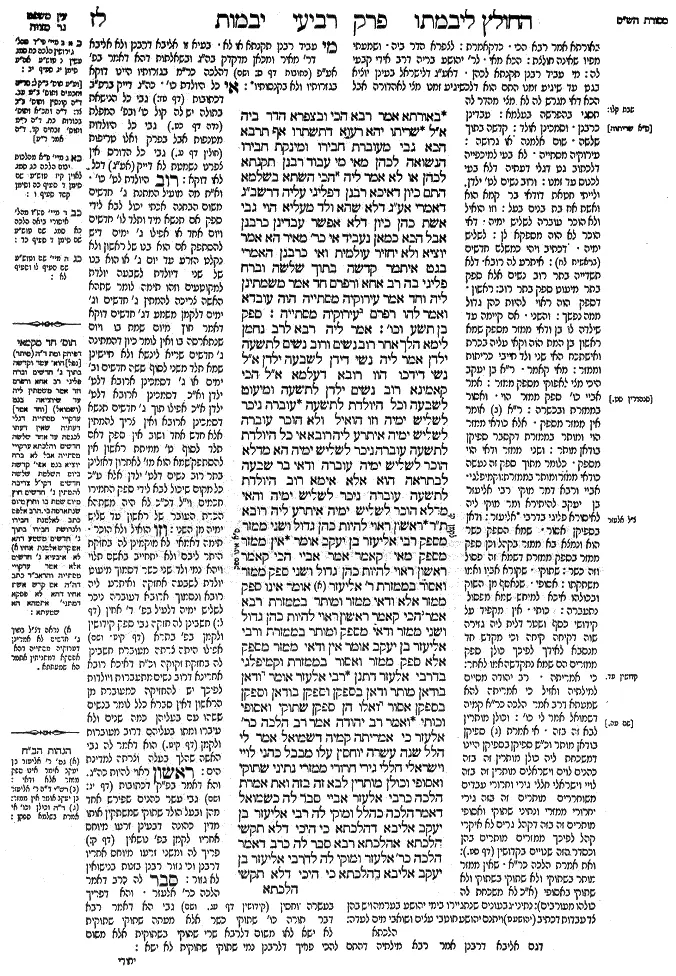
Yevamot 37a - Guemara
באורתא אמר רבא הכי ובצפרא הדר ביה א"ל שריתו יהא רעוא דתשתרו אף תרבא הכא גבי מעוברת חבירו ומינקת חבירו הנשואה לכהן מאי מי עבוד רבנן תקנתא לכהן או לא אמר ליה הכי השתא בשלמא התם כיון דאיכא רבנן דפליגי עליה דרשב"ג דאמרי אע"ג דלא שהא ולד מעליא הוי גבי אשת כהן כיון דלא אפשר עבדינן כרבנן אבל הכא כמאן נעביד אי כר' מאיר הא אמר יוציא ולא יחזיר עולמית ואי כרבנן האמרי בגט איתמר קדשה בתוך שלשה וברח פליגי בה רב אחא ורפרם חד אמר משמתינן ליה וחד אמר עירוקיה מסתייה הוה עובדא ואמר להו רפרם עירוקיה מסתייה:
ספק בן תשע וכו':
אמר ליה רבא לרב נחמן לימא הלך אחר רוב נשים ורוב נשים לתשעה ילדן אמר ליה נשי דידן לשבעה ילדן א"ל נשי דידכו הוו רובא דעלמא א"ל הכי קאמינא רוב נשים ילדן לתשעה ומיעוט לשבעה וכל היולדת לתשעה עוברה ניכר לשליש ימיה וזו הואיל ולא הוכר עוברה לשליש ימיה איתרע ליה רובא אי כל היולדת לתשעה עוברה ניכר לשליש ימיה הא מדלא הוכר לשליש ימיה עוברה ודאי בר שבעה לבתראה הוא אלא אימא רוב היולדת לתשעה עוברה ניכר לשליש ימיה והאי מדלא הוכר לשליש ימיה איתרע ליה רובא ת"ר ראשון ראוי להיות כהן גדול ושני ממזר מספק רבי אליעזר בן יעקב אומר אין ממזר מספק מאי קאמר אמר אביי הכי קאמר ראשון ראוי להיות כהן גדול ושני ספק ממזר ואסור בממזרת ר' אליעזר אומר אינו ספק ממזר אלא ודאי ממזר ומותר בממזרת רבא אמר הכי קאמר ראשון ראוי להיות כהן גדול ושני ממזר ודאי מספק ומותר בממזרת ורבי אליעזר בן יעקב אומר אין ודאי ממזר מספק אלא ספק ממזר ואסור בממזרת וקמיפלגי בדרבי אלעזר דתנן רבי אלעזר אומר ודאן בודאן מותר ודאן בספקן וספקן בודאן וספקן בספקן אסור ואלו הן ספקן שתוקי ואסופי וכותי ואמר רב יהודה אמר רב הלכה כר' אלעזר כי אמריתה קמיה דשמואל אמר לי הלל שנה עשרה יוחסין עלו מבבל כהני לויי וישראלי חללי גירי חרורי ממזרי נתיני שתוקי ואסופי וכולן מותרין לבא זה בזה ואת אמרת הלכה כרבי אלעזר אביי סבר לה כשמואל דאמר הלכה כהלל ומוקי לה רבי אליעזר בן יעקב אליבא דהלכתא כי היכי דלא תקשי הלכתא אהלכתא רבא סבר לה כרב דאמר הלכה כר' אלעזר ומוקי לה לדרבי אליעזר בן יעקב אליבא דהלכתא כי היכי דלא תקשי
Comments from Rashi on Masechet Yevamot Page 37a
באורתא אמר רבא הכי . כדקאמרת: לצפרא הדר ביה . ושמעתי מפיו שאינה חולצת: הכא מאי . לר' יהושע בריה דרב אידי קבעי לה: מי עביד רבנן תקנתא לכהן . דאע"ג דלישראל בעינן יוציא בגט עד שיגיע זמנו התם הוא דלכשיגיע זמנו מצי לאהדורה אבל הכא דאי מגרש לה לא מצי מהדר לה תסגי בהפרשה בעלמא: עבדינן כרבנן . וסמכינן אולד: קדשה בתוך שלשה . שום אלמנה או גרושה: עירוקיה מסתייה . לא בעי למיכפייה דלכתוב גט דגלי דעתיה דלא בעי לכנוס עד זמנו: ורוב נשים לט' ילדן . ולייתי חטאת דודאי בר קמא הוא ואשת אח בת בנים בעל: וזו הואיל ולא הוכר עוברה לשליש ימיה . דאי הוכר לא הוה מספקא לן: לשליש ימיה . דכתיב ויהי כמשלש חדשים (בראשית לח): איתרע לה רובא . דלא תשדייה בתר רוב נשים אלא ספק בתר מיעוט ספק בתר רוב: ראשון . דספק הוה ראוי להיות כהן גדול ממה נפשך: והשני . אם קיימה עד שילדה לו בן ודאי ממזר מספק שמא ראשון בן המת הוה וקאי עליה בכרת ואישתכח האי שני ולד חייבי כריתות וממזר: מאי קאמר . ר"א בן יעקב היכי מצי לאפוקי מספק ממזר: אמר אביי כו' ספק ממזר הוי ואסור בממזרת . ובכשרה: ר"א אומר אין ממזר מספק אלא כודאי ממזר הוי ומותר בממזרת . דקסבר ספיקן בודאן מותר: ושני ממזר ודאי הוי מספק . כלומר מתוך ספק זה נעשה כודאי ממזר ומותר בממזרת: וקמיפלגי . אביי ורבא דמר מוקי רבי אליעזר בן יעקב להיתירא ומר מוקי ליה לאיסורא פליגי בדרבי אליעזר: ודאן בספיקן אסור . שמא הספק כשר הוא ונמצא בא ממזר בקהל וכן ספק ממזר בספק ממזרת דשמא זה פסול וזה כשר: שתוקי . שקורא אביו ואמו משתקתו: אסופי . שנאסף מן השוק. ובכולהו איכא למיחש שמא מפסול נתעברה: כותי . אין מקפיד על קידושי כסף ושטר דלית ליה גזירה שוה דקיחה קיחה וכי מקדש חד מנסבא לאידך לפיכך כולן ספק ממזרים הם שמא נתקדשה אמו לאחר: כי אמריתה . רב יהודה מסיים למילתיה ואזיל כי אמריתה להא שמעתא דרב אמר הלכה כר"א קמיה דשמואל אמר לי כו': נתיני . גבעונים שנתגיירו בימי יהושע בערמה ויש בהן צד עבדות דכתיב (יהושע ט) ויתנם יהושע חוטבי עצים ושואבי מים לעדה: וכולן מותרין לבא זה בזה . אי אמרת ספיקן בודאן מותר וכ"ש ספיקן בספיקן היינו דמשכחת ליה כולן מותרין זה בזה. כהנים לוים וישראלים מותרין זה בזה. לויי וישראלי חללי גירי וחרורי עבדים משוחררים מותרים זה בזה גירי וחרורי ממזרי ונתיני שתוקי ואסופי מותרים זה בזה דקהל גרים לא איקרי קהל לפיכך ממזרים מותרים בהן. וכסדר הזה שנויים בקדושין (דף סט.): ואת אמרת הלכה כר"א . שאין ממזר מותר בשתוקי ולא שתוקי בשתוקי ולא שתוקי באסופי (א"כ לא משכחת לה כולהו מעורבים):
Comments from Tosafot - Yevamot 37a
מי עביד רבנן תקנתא או לא . בעיא זו אליבא דרבנן ולא אליבא דר' מאיר ומכאן מדקדק בה"ג ובשאלתות דהא דאמר בפ' אע"פ (כתובות דף ס: ושם) דהלכה כר"מ בגזרותיו היינו דוקא בגזרותיו ולא בקנסותיו: אי כל היולדת כו' . כה"ג דייק ברפ"ב דכתובות (דף טז:) גבי כל הנישאת בתולה יש לה קול כו' ובפ' המפלת (נדה דף כט.) גבי כל היולדות מטנפות אבל בפרק ואלו טריפות (חולין דף נג.) גבי כל הדורס אין צפרנו נשמטת לא דייק (אע"ג) דכל לאו דוקא: רוב היולדת לט' כו' . וא"ת מה מועיל המתנת ג' חדשים משום הבחנה אכתי יכול לבא לידי ספק אם תנשא מיד ותלד לו' חדשים ויום אחד או אפילו ג' ימים דיש להסתפק אם הוא בנו של ראשון ולא נקלט הזרע עד יום ג' או הוא בנו של שני דיולדת לשבעה יולדת למקוטעים וזהו תימה לומר שתהא האשה צריכה להמתין ג' חדשים וג' ימים דלקמן משמע דג' חדשים דוקא דאמר חוץ מיום שמת בו ויום שנתארסה בו ואין לומר כיון דהמתינה ג' חדשים שריא לינשא ולא חיישינן שמא תלד משני לסוף ששה חדשים וב' ימים או ג' דסמכינן ארובא דלט' ילדן וא"כ דסמכינן ארובא דלט' ילדן א"כ אפילו תוך ג' חדשים תנשא דסמכינן ארובא ואין צריך להמתין אלא חדש אחד ושוב אין ספק דאם תלד לסוף ט' ממיתת ראשון אין להסתפק שמא הוא מז' לאחרון דאזלינן בתר רוב נשים דלט' ילדן אלא ע"כ כל מקום שיכול לבא לידי ספק החמירו חכמים וי"ל דכ"כ לא היה משתהא הכרת העובר של ראשון עד שליש ימיה מן השני: וזו הואיל ולא הוכר . תימה דאמאי לא מוקמינן לה בחזקת היתר ליבם ולא יתחייב באשם תלוי ויהא נמי ולד שני כשר דסמוך מיעוט יולדת לשבעה אחזקה ואיתרע ליה רובא ונסמוך ארובא דעוברה ניכר לשליש ימיה דלעיל בפ' ד' אחין (יבמות דף ל:) חשבינן לה חזקה גבי ספק קידושין ולקמן בפ' בתרא (יבמות דף קיט. ושם) אפילו היתה צרתה מעוברת חשבינן לה בחזקת זקוקה וכ"ת דאיכא רובא אחרינא דרוב נשים מתעברות ויולדות לפיכך יש להחזיקה כמעוברת מן הראשון דאין סברא כלל לומר בנשים ששהו עם בעליהן כמה שנים ולא עיברו ומתו בעליהם דרוב מעוברות ולקמן (יבמות דף קיט.) הוא דאמר לה גבי האשה שהלך בעלה וצרתה למדינת הים: ראשון ראוי להיות כה"ג . והא דאמר בפ"ק דכתובות (דף יג: ושם) גבי עשר כהנים שפירש אחד מהן ובעל הולד שתוקי שמשתקין אותו מדין כהונה דבעינן זרעו מיוחס אחריו לקמן בפ' נושאין (יבמות דף ק:) פריך לה ומשני זרעו מיוחס אחריו דרבנן וכי גזור רבנן בזנות בנישואין לא גזור: סבר לה כרב דאמר הלכה כר' אלעזר . והא דפריך בעשרה יוחסין (קידושין דף עג. ושם) גבי הא דאמר רבא דבר תורה כו' שתוקי כשר אלא מעתה שתוקי שתוקית לא ישא לאו משום דלרבא שרי שתוקי בשתוקית אלא משום דגם אליבא דרבנן אמר רבא מילתיה דהתם להכי פריך דלרבנן נמי שתוקי שתוקית לא ישא:
Yevamot 37a - Mishnah translated into english
In the evening Rava stated this ruling in accordance with the way you cited him, but in the morning he retracted his opinion and ruled as I cited him. Rav Mesharshiyya said to him: Do you really permit her to marry without ḥalitza? He added sarcastically: May it be God’s will that you will even permit forbidden fats [tarba] as well. In Rav Mesharshiyya’s opinion, the prohibition against the widow remarrying without ḥalitza was as obvious as the prohibition of forbidden fats.
After citing this dispute, Rav Ashi said to Rav Hoshaya, son of Rav Idi: According to Rava’s citation of Rav, when a woman is married to a priest, the Sages were more lenient in order to allow the couple to remain married. Here, with regard to a woman who is pregnant with the child of another man or a woman who is nursing the child of another man, who is married to a priest, what is the halakha? Did the Sages enact an ordinance for the benefit of a priest and say that it is sufficient for him to separate from his wife and he does not need to divorce her, or not?
He said to him: How can these cases be compared? Granted, there, in the case where the offspring died during its first thirty days of life, since there are the Rabbis who disagree with Rabban Shimon ben Gamliel concerning it, as they say that although the offspring did not survive for thirty days it is nevertheless considered a full-fledged, i.e., viable, offspring, therefore, with regard to the wife of a priest, since it is not possible for her to perform ḥalitza and remain permitted to her husband, we will be lenient and act in accordance with the opinion of the Rabbis.
However, here, in the case of a woman who is pregnant with or nursing the child of another man, in accordance with whose opinion should we act? If we act in accordance with the opinion of Rabbi Meir, it will be of no benefit to the priest because Rabbi Meir said even with regard to the wife of an Israelite that he must divorce her and may never take her back. And if we act in accordance with the opinion of the Rabbis, it will also be of no benefit to the priest because they say he must send her out with a bill of divorce and only remarry her at a later point. Since there is no opinion that does not require a bill of divorce to be given, there is no possibility to be lenient in this case by not requiring a bill of divorce to be given.
A pregnancy is generally noticeable only after three months have passed. Therefore, during the first three months after a woman is divorced or widowed, she may not remarry due to the possibility that she is pregnant. The Sages decreed that even betrothing her during that time is prohibited, lest one also marry her (see 41a). Concerning this, an amoraic dispute was stated: In a case in which a man betrothed a woman during the three months following her divorce or her husband’s death, and then he fled, Rav Aḥa and Rafram disagree over what should be done. One said: We excommunicate him for violating the prohibition. And the other one said: His flight is sufficient for him, since it proves that he does not intend to marry her until it is determined that she is not pregnant. Therefore, there is no need to penalize him further. The Gemara relates: There was an incident like that, and Rafram said to those who asked what to do: His flight is sufficient for him.
§ The mishna states that if a yevama consummated the levirate marriage and gave birth seven months later, there is an uncertainty whether the child is nine months old, counting from conception, and is the offspring of the first husband, i.e., the deceased brother, or whether the child is only seven months old and is the offspring of the second husband. If it is the child of the first husband, then there was never any obligation of levirate marriage, and the supposed consummation was in fact forbidden by penalty of karet. Due to that possibility, both the man and the woman are obligated to bring a guilt-offering for uncertainty. Rava said to Rav Naḥman: How can they bring a guilt-offering for uncertainty? Let us say: Follow the majority of women, and since the majority of women give birth after nine months, it should be presumed that the child is the offspring of the deceased brother. Accordingly, the couple would be obligated to bring a certain sin-offering, not a guilt-offering for uncertainty.
Rav Naḥman said to him: The women of our family regularly give birth after seven months. Therefore, how can you presume that this woman gave birth after nine months? Rava said to him: Do the women of your family constitute the majority of the women of the world? Ultimately, the majority of women give birth after nine months, and one should therefore presume accordingly in a case of uncertainty.
Rav Naḥman said to him: This is what I am saying: Although it is true that the majority of women give birth after nine months and only a minority give birth after seven, still, in the case of every woman who gives birth after nine months, her fetus is already recognizable after a third of her days, i.e., in the third month of her pregnancy. Accordingly, in the case of this woman, since her fetus was not recognizable after a third of her days, as were it already recognizable at that point then it would be obvious that the child was the offspring of the first husband, therefore, the ability to presume she is like the majority of women is compromised, and the uncertainty as to who the father of the child is remains. Consequently, the yavam and yevama should each bring a guilt-offering for uncertainty.
The Gemara asks: If it is true that in the case of every woman who gives birth after nine months, her fetus is already recognizable after a third of her days, then with regard to this woman, from the fact that her fetus was not recognized after a third of her days, it follows that her fetus was certainly only seven months old and is the offspring of the latter husband, i.e., the yavam. If so, it is clear the yavam is the father of the child and there should be no need to bring an offering at all. Rather, one must emend Rav Naḥman’s words and say: In the majority of cases, with regard to a woman who gives birth after nine months, her fetus is already recognizable after a third of her days, and with regard to this woman, from the fact that her fetus was not recognized after a third of her days, the ability to presume she is like the majority of women is compromised.
§ The mishna states that the child of the yevama has unflawed lineage since regardless of whether it is the offspring of the deceased husband or the yavam, there was no transgression involved in its conception. With regard to this case, the Sages taught in a baraita: The first child is even fit to become a High Priest. However, since it is possible that the child is the offspring of the deceased husband, in which case the widow remains forbidden to the yavam as his brother’s wife, if she has a second child with her yavam then that child is a mamzer due to an uncertainty with regard to his status. Rabbi Eliezer ben Ya’akov says: One is not rendered a mamzer due to uncertainty.
The meaning of Rabbi Eliezer ben Ya’akov’s statement and how he differs from the first tanna is unclear. The Gemara clarifies: What is the baraita saying? Abaye said: This is what it is saying: The first child is even fit to become a High Priest. And if she has a second child, his status as a mamzer is uncertain and therefore he is both prohibited from marrying an Israelite woman of unflawed lineage, since he might actually be a mamzer, and he is also prohibited from marrying a mamzeret, since he might not be a mamzer. Rabbi Eliezer ben Ya’akov says: He is not treated like one whose status as a mamzer is uncertain; rather, due to the uncertainty concerning his status he is treated like one who is definitely a mamzer, and he is permitted to marry a mamzeret. In other words, Rabbi Eliezer ben Ya’akov holds that even one whose status as a mamzer is uncertain is permitted to marry one who is definitely a mamzeret.
Rava said: This is what the baraita is saying: The first child is even fit to become a High Priest. And if she has a second child, he is treated as though he is definitely a mamzer due to the uncertainty concerning his status, and therefore he is permitted to marry a mamzeret, i.e., this tanna holds that even one whose status as a mamzer is uncertain is permitted to marry one who is definitely a mamzeret. And Rabbi Eliezer ben Ya’akov says: He is not treated as though he is definitely a mamzer due to an uncertainty concerning his status; rather, his status as a mamzer is uncertain and he is treated accordingly, and therefore he is both prohibited from marrying an Israelite woman of unflawed lineage since he might be a mamzer, and he is also prohibited from marrying a mamzeret since he might not be a mamzer.
The Gemara explains: And Abaye and Rava disagree with regard to whether the halakha is decided in accordance with the opinion of Rabbi Elazar. As we learned in a mishna (Kiddushin 74a): With regard to the prohibition against marrying people with certain types of flawed lineage, Rabbi Elazar said: The marriage of those people whose flawed lineage status is certain to those whose status is certain is permitted, but the marriage of those whose status is certain to those whose status is uncertain, and the marriage of those whose status is uncertain to those whose status is certain, and even the marriage of those whose status is uncertain to those whose status is uncertain, is prohibited.
The mishna concludes: And these are those who are considered to have an uncertain status: A child of unknown paternity [shetuki], although his mother’s identity is known; and a foundling who was found abandoned in the streets; and a Samaritan [Kuti], who is possibly a mamzer since the Samaritans do not accept and abide by the halakhot of marriage.
And with regard to this mishna Rav Yehuda said that Rav said: The halakha is in accordance with the opinion of Rabbi Elazar. But when I said this halakha of Rav’s in the presence of Shmuel, he said to me: Hillel taught in a baraita that ten categories of lineage came up from Babylon to Eretz Yisrael: Priests; Levites; and Israelites; priests disqualified due to flawed lineage [ḥalallim]; converts; freed slaves; mamzerim; Gibeonites; shetukei; and foundlings. And it is permitted for all men and women in these categories to marry one another, i.e., the list is arranged such that the marriage between people in any two categories that are adjacent to one another is permitted. This is possible only if one assumes that it is permitted for one whose flawed lineage status is uncertain to marry one whose flawed lineage status is certain.
After citing the baraita taught by Hillel, which assumes that it is permitted for one whose flawed lineage status is uncertain to marry one whose flawed lineage status is certain, Shmuel concluded: The halakha is certainly decided in accordance with the opinion of Hillel, and yet you, Rabbi Yehuda, said the halakha is in accordance with the opinion of Rabbi Elazar, which states that a marriage between two people whose flawed lineage status is uncertain is prohibited; your ruling is incorrect.
The Gemara proceeds to explain the dispute between Abaye and Rava: Abaye holds in accordance with the opinion of Shmuel, who said that the halakha is decided in accordance with the opinion of Hillel that it is permitted for one whose flawed lineage status is uncertain to marry one whose flawed lineage status is certain. Therefore, Abaye establishes that opinion of Rabbi Eliezer ben Ya’akov to be in accordance with this halakha, in order that there should not be a contradiction between one halakha, i.e., that the halakha is always decided in accordance with the opinion of Hillel, and another halakha, i.e., that the halakha is always decided in accordance with the opinion of Rabbi Eliezer ben Ya’akov.
Rava, however, holds in accordance with the opinion of Rav, who said: The halakha is decided in accordance with the opinion of Rabbi Elazar that the marriage of those whose status is certain to those whose status is uncertain is prohibited. Therefore, Rava establishes that opinion of Rabbi Eliezer ben Ya’akov to be in accordance with this halakha, so that there should not be a contradiction between
Traduction : The William Davidson digital edition of the Koren Noé Talmud, with commentary by Rabbi Adin Even-Israel Steinsaltz.