 Talmud Bavli
Yevamot 14a : Youtube
Daf TubeYoutube
2 video classes :
Yevamot Page 14a
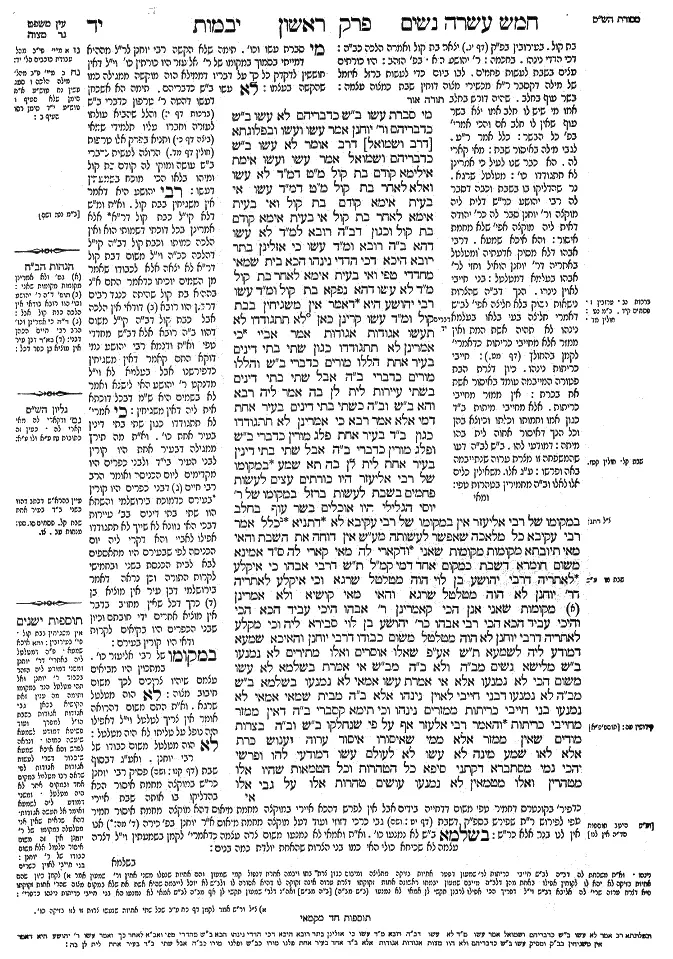
Yevamot 14a - Guemara
מי סברת עשו ב"ש כדבריהם לא עשו ב"ש כדבריהם ור' יוחנן אמר עשו ועשו ובפלוגתא [דרב ושמואל] דרב אומר לא עשו ב"ש כדבריהם ושמואל אמר עשו ועשו אימת אילימא קודם בת קול מ"ט דמ"ד לא עשו ואלא לאחר בת קול מ"ט דמ"ד עשו אי בעית אימא קודם בת קול ואי בעית אימא לאחר בת קול אי בעית אימא קודם בת קול וכגון דב"ה רובא למ"ד לא עשו דהא ב"ה רובא ומ"ד עשו כי אזלינן בתר רובא היכא דכי הדדי נינהו הכא בית שמאי מחדדי טפי ואי בעית אימא לאחר בת קול מ"ד לא עשו דהא נפקא בת קול ומ"ד עשו רבי יהושע היא דאמר אין משגיחין בבת קול ומ"ד עשו קרינן כאן (דברים יד, א) לא תתגודדו לא תעשו אגודות אגודות אמר אביי כי אמרינן לא תתגודדו כגון שתי בתי דינים בעיר אחת הללו מורים כדברי ב"ש והללו מורים כדברי ב"ה אבל שתי בתי דינים בשתי עיירות לית לן בה אמר ליה רבא והא ב"ש וב"ה כשתי בתי דינים בעיר אחת דמי אלא אמר רבא כי אמרינן לא תתגודדו כגון ב"ד בעיר אחת פלג מורין כדברי ב"ש ופלג מורין כדברי ב"ה אבל שתי בתי דינין בעיר אחת לית לן בה תא שמע במקומו של רבי אליעזר היו כורתים עצים לעשות פחמים בשבת לעשות ברזל במקומו של ר' יוסי הגלילי היו אוכלים בשר עוף בחלב במקומו של רבי אליעזר אין במקומו של רבי עקיבא לא דתניא כלל אמר רבי עקיבא כל מלאכה שאפשר לעשותה מע"ש אין דוחה את השבת והאי מאי תיובתא מקומות מקומות שאני ודקארי לה מאי קארי לה ס"ד אמינא משום חומרא דשבת כמקום אחד דמי קמ"ל ת"ש דרבי אבהו כי איקלע לאתריה דרבי יהושע בן לוי הוה מטלטל שרגא וכי איקלע לאתריה דר' יוחנן לא הוה מטלטל שרגא והאי מאי קושיא ולא אמרינן מקומות שאני אנן הכי קאמרינן ר' אבהו היכי עביד הכא הכי והיכי עביד הכא הכי רבי אבהו כר' יהושע בן לוי סבירא ליה וכי מקלע לאתריה דרבי יוחנן לא הוה מטלטל משום כבודו דרבי יוחנן והאיכא שמעא דמודע ליה לשמעא ת"ש אע"פ שאלו אוסרים ואלו מתירים לא נמנעו ב"ש מלישא נשים מב"ה ולא ב"ה מב"ש אי אמרת בשלמא לא עשו משום הכי לא נמנעו אלא אי אמרת עשו אמאי לא נמנעו בשלמא ב"ש מב"ה לא נמנעו דבני חייבי לאוין נינהו אלא ב"ה מבית שמאי אמאי לא נמנעו בני חייבי כריתות ממזרים נינהו וכי תימא קסברי ב"ה דאין ממזר מחייבי כריתות והאמר רבי אלעזר אף על פי שנחלקו ב"ש וב"ה בצרות מודים שאין ממזר אלא ממי שאיסורו איסור ערוה וענוש כרת אלא לאו שמע מינה לא עשו לא לעולם עשו דמודעי להו ופרשי והכי נמי מסתברא דקתני סיפא כל הטהרות וכל הטמאות שהיו אלו מטהרין ואלו מטמאין לא נמנעו עושים טהרות אלו על גבי אלו
Comments from Rashi on Masechet Yevamot Page 14a
בת קול . בעירובין בפ"ק (דף יג.) יצאה בת קול ואמרה הלכה כב"ה: דכי הדדי נינהו . בחכמה: ר' יהושע היא . בפ' הזהב: היו כורתים עצים בשבת לעשות פחמים . לבו ביום כדי לעשות ברזל איזמל של מילה. דקסבר ר"א מכשירי מצוה דוחין שבת כמצוה עצמה: בשר עוף בחלב . שהיה דורש בחלב אמו מי שיש לו חלב אמו יצא בשר עוף שאין לו חלב אם והכי אמרי' בפ' כל הבשר: כלל אמר ר"ע . לגבי מילה באיסור שבת: מאי קארי לה . הא כבר שנו לעיל כי אמרינן לא תתגודדו כו': מטלטל שרגא . נר שהדליקו בו בשבת וכבה. דסבר לה רבי יהושע כר"ש דלית ליה מוקצה ור' יוחנן סבר לה כר' יהודה דאית ליה מוקצה אפי' שלא מחמת איסור: והא איכא שמעא . דרבי אבהו דלא מסיק אדעתיה ומטלטל באתריה דר' יוחנן הואיל וחזי לר' אבהו בעלמא דמטלטל: בני חייבי לאוין נינהו . הנך דב"ה שהצרות נישאות לשוק בלא חליצה אפי' לב"ש דאמרי חליצה בעי בלאו בעלמא נינהו לא תהיה אשת המת ואין ממזר אלא מחייבי כריתות כדאמרי' לקמן בהחולץ (יבמות דף מט.): חייבי כריתות נינהו . כיון דצרת הבת פטורה המייבמה עומד באיסור אשת אח בכרת: אין ממזר מחייבי כריתות . אלא מחייבי מיתות ב"ד כגון אמו וחמותו וכלתו וכיוצא בהן וכל הנך דאיסור אחוה לית בהו מיתה: דמודעי להו . ב"ש לב"ה דעו שהמשפחה זו מצרת ערוה שנתייבמה באה ופרשו: ע"ג אלו . משאילין כלים אלו לאלו וב"ה מחמירין בטהרות טפי:
Comments from Tosafot - Yevamot 14a
מי סברת עשו וכו' . תימה שלא הקשה רבי יוחנן לר"ל מההיא דמייתי בסמוך במקומו של ר' אליעזר היו כורתין כו' וי"ל דאין חוששין לדקדק כל כך על דבריו דממילא הוה מוקשה ממגילה כמו שהקשה בעצמו: לא עשו ב"ש כדבריהם . תימה הא אשכחן דעשו דהטה ר' טרפון כדברי ב"ש (ברכות דף י:) והלל שהביא עולתו לעזרה וחברו עליו תלמידי שמאי (ביצה דף כ.) ותניא בפרק אלו טרפות (חולין דף מד.) הרוצה לעשות כדברי ב"ש עושה ומוקי לה קודם בת קול ומיהו בלאו הכי מוכח בשמעתין דעשו: רבי יהושע היא דאמר אין משגיחין בבת קול . וא"ת ומ"ש דלא קי"ל כבת קול דר"א אלא אמרינן בכל דוכתי דשמותי הוא ואין הלכה כמותו וכבת קול דב"ה קי"ל דהלכה כב"ה וי"ל משום דבת קול דר"א לא יצאה אלא לכבודו שאמר מן השמים יוכיחו כדאמר התם א"נ בההיא בת קול שהיתה כנגד רבים דרבנן הוו רובא דודאי אין הלכה אבל כבת קול דב"ה קי"ל משום דהוו ב"ה רובא אלא דב"ש מחדדי טפי וא"ת ודלמא רבי יהושע נמי דוקא התם קאמר דאין משגיחין כדפירשנו אבל בעלמא לא וי"ל מדנקט ר' יהושע האי לישנא ואמר לא בשמים היא ש"מ דבכל דוכתא אית ליה דאין משגיחין: כי אמרי' לא תתגודדו כגון שתי בתי דינין בעיר אחת כו' . וא"ת מה תירץ ממגילה דבעיר אחת היו קורין לבני העיר בי"ד ולבני כפרים היו מקדימים ליום הכניסה ואומר הרב רבי חיים דבני כפרים היו קורין בעירם כדמוכח בירושלמי והשתא הוו שתי בתי דינים בב' עיירות דבכי האי גוונא לא שייך לא תתגודדו אפילו לאביי והא דקרי ליה יום הכניסה לפי שבעירם היו מתאספים לבא לבית הכנסת בשני ובחמישי לקרות התורה וכן נראה דאמר בירושלמי דבן עיר אין מוציא בן כרך דכל שאין מחויב בדבר אין מוציא אחרים ידי חובתם וכיון שבני הכפרים היו בקיאים לקרות ודאי היו קורין בעירם: במקומו של רבי אליעזר כו' . במתכוין היו מביאים עצמם שיהיו צריכים לכך משום חיבוב מצוה: לא הוה מטלטל שרגא . וא"ת התם משום דהרואה אומר אין צריך לטלטל וי"ל דאפילו היה נופל על טליתו לא היה מטלטל: לא הוה מטלטל משום כבודו של רבי יוחנן . ואע"ג דבסוף שבת (דף קנו: ושם) פסיק רבי יוחנן כר"ש במוקצה מחמת איסור הכא בהדליקו בו אותה שבת איירי כדפיר' בקונטרס דחמיר טפי משום דדחייה בידים אבל אין לפרש דהכא איירי במוקצה מחמת מיאוס דהא מוקצה מחמת איסור חמיר טפי לפירוש ר"ת שפירש בספ"ק דשבת (דף יט: ושם) גבי כרכי דזוזי ועוד דעל מוקצה מחמת מיאוס א"ר יוחנן בפ' כירה (ד' מה:) אנו אין לנו בנר אלא כר"ש: בשלמא ב"ש לא נמנעו כו' . וא"ת ואמאי לא נמנעו משום צרה עצמה כדאמרי' לקמן בשמעתין וי"ל דצרה עצמה לא שכיחא כולי האי כמו בני הצרות שהאחת יולדת כמה בנים:
Yevamot 14a - Mishnah translated into english
Reish Lakish said to him: Do you hold that Beit Shammai actually acted in accordance with their own statement? Beit Shammai did not in fact act in accordance with their own statement, as the dispute was merely theoretical. And Rabbi Yoḥanan said: Beit Shammai certainly did act in accordance with their opinion. The Gemara comments: And this is also reflected in the dispute between Rav and Shmuel, as Rav says: Beit Shammai did not act in accordance with their own statement, and Shmuel said: They certainly did act in that manner.
The Gemara inquires: When does this question apply? If we say that it is referring to the period prior to the Divine Voice that declared that the halakha is in accordance with the opinion of Beit Hillel, then what is the rationale of the one who said that Beit Shammai did not act in accordance with their opinion? But rather, if one would say it is referring to after the Divine Voice, what is the reason for the one who said that they did act in accordance with their opinion? After all, the Divine Voice established that the halakha is in accordance with the opinion of Beit Hillel.
The Gemara answers: Neither of these options poses a difficulty. If you wish, say that it is referring to the period prior to the Divine Voice, and if you wish, say instead that it is after the Divine Voice. The Gemara elaborates: If you wish, say it is prior to the Divine Voice, and it is referring to the period when Beit Hillel formed the majority of the Sages. Therefore, according to the one who said that Beit Shammai did not act in accordance with their opinion, the reason is that Beit Hillel was the majority, and the halakha is in accordance with the majority.
And the one who said that they did act in accordance with their opinion maintains that when do we follow the majority? It is in a case where the disputing parties are equal in wisdom to one another. Here, however, Beit Shammai are sharper than Beit Hillel, and therefore they acted in accordance with their own opinion despite the fact that they were in the minority.
And if you wish, say instead that it was after the Divine Voice. The one who said that Beit Shammai did not act in accordance with their opinion would say that this was due to the pronouncement of the Divine Voice. And the one who said that they did do so, this is in accordance with the opinion of Rabbi Yehoshua, who said, with regard to the Divine Voice that emerged and proclaimed that the halakha is in accordance with the opinion of Rabbi Eliezer in the case of the oven of akhnai (Bava Metzia 59b), that one disregards a Heavenly Voice. Just as he disregarded the Divine Voice in his dispute with Rabbi Eliezer, so too, one disregards the Divine Voice that proclaimed that the halakha is in accordance with the opinion of Beit Hillel.
And yet the question remains: According to the one who said that Beit Shammai acted in accordance with their opinion, we should read here: “You shall not cut yourselves” (Deuteronomy 14:1), which is interpreted to mean: Do not become numerous factions. Abaye said: When we say that the prohibition: “You shall not cut yourselves” applies, we are referring to a case where two courts are located in one city, and these rule in accordance with the statement of Beit Shammai and those rule in accordance with the statement of Beit Hillel. However, with regard to two courts located in two different cities, we have no problem with it.
Rava said to him: But the dispute between Beit Shammai and Beit Hillel is considered like a case of two courts in one city, as these two schools of thought were found everywhere, not in any specific place. Rather, Rava said: When we say that the prohibition: “You shall not cut yourselves” applies, we are referring to a case where there is a court in one city, a section of which rules in accordance with the statement of Beit Shammai and another section rules in accordance with the statement of Beit Hillel. However, with regard to two courts located in one city, we have no problem with it.
§ The Gemara cites other relevant sources. Come and hear: In the locale of Rabbi Eliezer, where his ruling was followed, they would cut down trees on Shabbat to prepare charcoal from them to fashion iron tools with which to circumcise a child on Shabbat. In Rabbi Eliezer’s opinion, not only does the mitzva of circumcision override Shabbat, but also any action required for the preparation of the tools necessary for the circumcision likewise overrides Shabbat. The baraita adds: In the locale of Rabbi Yosei HaGelili they would eat poultry meat in milk, as Rabbi Yosei HaGelili held that the prohibition of meat in milk does not include poultry.
The Gemara infers: In the locale of Rabbi Eliezer, yes, they would act in this manner, whereas in the locale of Rabbi Akiva, for instance, no, they would not do so, as it is taught in a baraita that a principle was stated by Rabbi Akiva: Any prohibited labor that can be performed on Shabbat eve does not override Shabbat even if it involves a mitzva. A mitzva whose proper time is on Shabbat overrides Shabbat only if its performance was impossible earlier, e.g., the act of circumcision itself, which cannot be performed earlier.
The Gemara asks: And what is this refutation? As stated above, it is different when dealing with numerous places, and the baraita explicitly states that this practice was followed in Rabbi Eliezer’s locale. Consequently, there is no violation of the prohibition against splitting into factions. The Gemara asks: He who asked it, why did he ask it, i.e., what is the basis for the question in the first place? It is obvious that the baraita is referring to a specific place.
The Gemara answers: It might enter your mind to say that due to the severity of Shabbat, it, i.e., the world, is considered like a single locale. In other words, one might have thought that the permission to tolerate diverse customs in different places applies only to other prohibitions, whereas the prohibition of Shabbat is so severe that it is unacceptable to allow different customs, as this might lead people to disrespect Shabbat. Therefore, the baraita teaches us that even in the case of Shabbat there can be different customs in various locales.
§ The Gemara cites another relevant case involving Shabbat: Come and hear that Rabbi Abbahu, when he happened to come to the place of Rabbi Yehoshua ben Levi, would move an oil lamp [sheraga] after the flame that had been lit for that Shabbat had burned out, as Rabbi Yehoshua accepted the ruling that it is permitted to carry items of this sort that had been set aside. But when he happened to come to the place of Rabbi Yoḥanan, who prohibited carrying items of this kind that had been set aside on Shabbat, he would not move an oil lamp. This indicates that divergent customs are followed in different places.
Again, the Gemara asks: And what is this difficulty? Didn’t we say that it is different when dealing with numerous places? The Gemara explains that this is what we are saying: With regard to Rabbi Abbahu himself, how could he act in this manner here and how could he act in that manner there?
The Gemara answers: Rabbi Abbahu holds in accordance with the opinion of Rabbi Yehoshua ben Levi that it is permitted to carry this item. And when he happened to come to the place of Rabbi Yoḥanan he would not carry it, in deference to Rabbi Yoḥanan, so as not to act contrary to his ruling in the place where he was the authority. The Gemara asks: But there was a servant accompanying Rabbi Abbahu who would see him carrying these types of articles that had been set aside. Wasn’t Rabbi Abbahu concerned that the servant might carry them in Rabbi Yoḥanan’s locale? The Gemara explains that he would inform the servant and explain to him the reason for his change in behavior.
§ The Gemara continues to discuss the question of whether Beit Shammai followed their own rulings. Come and hear that which is taught in the mishna: Although Beit Hillel prohibit and Beit Shammai permit, and these disqualify the women and those deem them fit, Beit Shammai did not refrain from marrying women from Beit Hillel, nor did Beit Hillel refrain from marrying women from Beit Shammai. Granted, if you say that Beit Shammai did not act in accordance with their opinion, it is due to that reason that they did not have to refrain from marrying women from Beit Hillel. However, if you say that they did act in accordance with their opinion, why didn’t they refrain from marrying one another?
The Gemara elaborates: Granted, Beit Shammai did not refrain from marrying into Beit Hillel, as even if Beit Shammai maintain in a certain case that a rival wife required levirate marriage or ḥalitza, if she went ahead and married another man their children are born to a union whose partners are liable by a regular prohibition: “The wife of the dead man shall not be married outside” (Deuteronomy 25:5). Since this transgression does not entail karet, the children of this relationship are not mamzerim.
However, why did Beit Hillel not refrain from marrying into Beit Shammai? In the opinion of Beit Hillel the children of these rival wives who entered into levirate marriage are born of a union whose partners are liable to receive karet, as the prohibition of a brother’s wife was never nullified in this case, which means that the children are mamzerim. If so, how could Beit Hillel allow these marriages?
And if you would say that Beit Hillel maintain that the child of a union whose partners are liable to receive karet is not a mamzer, as a mamzer is only one whose parents violated a prohibition that entails the death penalty, didn’t Rabbi Elazar say: Although Beit Shammai and Beit Hillel disagreed with regard to rival wives, they concede that a mamzer is only from a union whose prohibition is a prohibition of forbidden relations punishable by karet? Consequently, the children of rival wives are mamzerim according to Beit Hillel. Rather, isn’t it correct to conclude from here that Beit Shammai did not act in accordance with their own opinion?
The Gemara rejects this conclusion: No; actually, Beit Shammai did act in accordance with their opinion. As for the problem with these marriages, the answer is that they would inform Beit Hillel and Beit Hillel would withdraw from the match. When those who acted in accordance with the opinion of Beit Hillel would come to marry women from those who followed the rulings of Beit Shammai, they would be notified that certain children were born of rival wives and that those people were considered mamzerim in the opinion of Beit Hillel, who therefore declared them forbidden in marriage.
The Gemara comments: And so too, it is reasonable that this is the case, as the mishna teaches in the latter clause: With regard to all of the disputes concerning the halakhot of ritual purity and impurity, where those, Beit Hillel, rule an article ritually pure and these, Beit Shammai, rule it ritually impure, they did not refrain from handling ritually pure objects each with the other.
Traduction : The William Davidson digital edition of the Koren Noé Talmud, with commentary by Rabbi Adin Even-Israel Steinsaltz.