 Talmud Bavli
Yevamot 53a : Youtube
Daf TubeYoutube
2 video classes :
Yevamot Page 53a
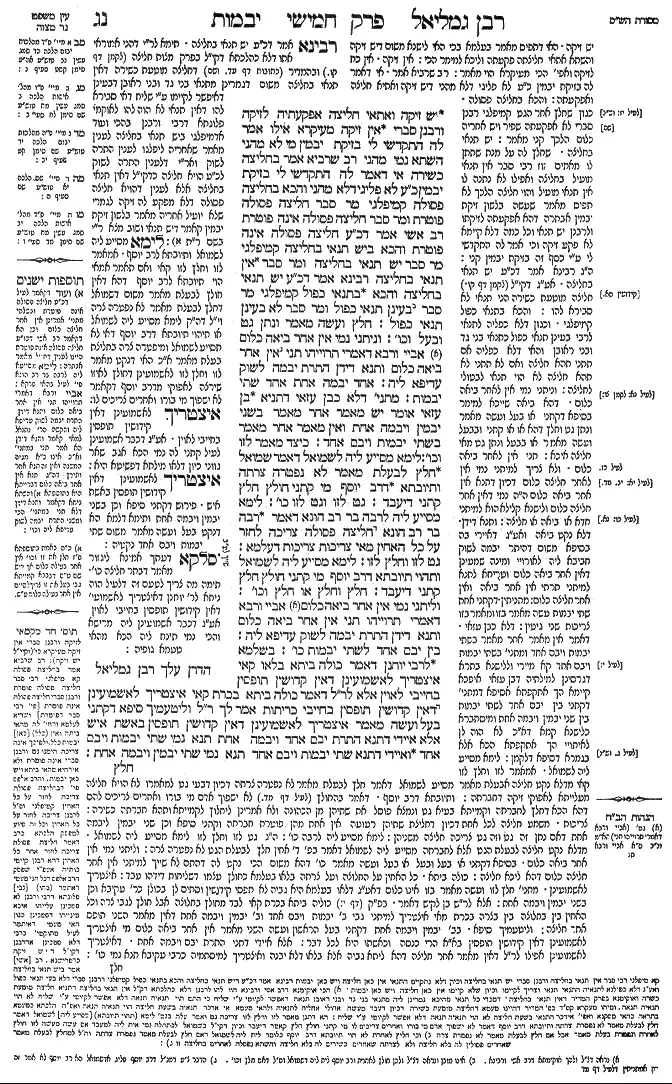
Yevamot 53a - Guemara
יש זיקה ואתאי חליצה אפקעתיה לזיקה ורבנן סברי אין זיקה מעיקרא אילו אמר לה התקדשי לי בזיקת יבמין מי לא מהני השתא נמי מהני רב שרביא אמר בחליצה כשירה אי דאמר לה התקדשי לי בזיקת יבמין כ"ע לא פליגי דלא מהני והכא בחליצה פסולה קמיפלגי מר סבר חליצה פסולה פוטרת ומר סבר חליצה פסולה אינה פוטרת רב אשי אמר דכ"ע חליצה פסולה אינה פוטרת והכא ביש תנאי בחליצה קמיפלגי מר סבר יש תנאי בחליצה ומר סבר אין תנאי בחליצה רבינא אמר דכ"ע יש תנאי בחליצה והכא בתנאי כפול קמיפלגי מר סבר בעינן תנאי כפול ומר סבר לא בעינן תנאי כפול:
חלץ ועשה מאמר ונתן גט ובעל וכו':
וניתני נמי אין אחר ביאה כלום אביי ורבא דאמרי תרוייהו תני אין אחר ביאה כלום ותנא דידן התרת יבמה לשוק עדיפא ליה:
אחד יבמה אחת אחד שתי יבמות:
מתני' דלא כבן עזאי דתניא בן עזאי אומר יש מאמר אחר מאמר בשני יבמין ויבמה אחת ואין מאמר אחר מאמר בשתי יבמות ויבם אחד:
כיצד מאמר לזו וכו':
לימא מסייע ליה לשמואל דאמר שמואל חלץ לבעלת מאמר לא נפטרה צרתה ותיובתא דרב יוסף מי קתני חולץ חלץ קתני דיעבד:
גט לזו וגט לזו כו':
לימא מסייע ליה לרבה בר רב הונא דאמר רבה בר רב הונא חליצה פסולה צריכה לחזר על כל האחין מאי צריכות צריכות דעלמא:
גט לזו וחלץ לזו:
לימא מסייע ליה לשמואל ותהוי תיובתא דרב יוסף מי קתני חולץ חלץ קתני דיעבד:
חלץ וחלץ או חלץ וכו':
וליתני נמי אין אחר ביאה כלום אביי ורבא דאמרי תרוייהו תני אין אחר ביאה כלום ותנא דידן התרת יבמה לשוק עדיפא ליה:
בין יבם אחד לשתי יבמות כו':
בשלמא לרבי יוחנן דאמר כולה ביתא בלאו קאי איצטריך לאשמועינן דאין קדושין תופסין בחייבי לאוין אלא לר"ל דאמר כולה ביתא בכרת קאי איצטריך לאשמועינן דאין קדושין תופסין בחייבי כריתות אמר לך ר"ל וליטעמיך סיפא דקתני בעל ועשה מאמר איצטריך לאשמועינן דאין קדושין תופסין באשת איש אלא איידי דתנא התרת יבם אחד ויבמה אחת תנא נמי שתי יבמות ויבם אחד ואיידי דתנא שתי יבמות ויבם אחד תנא נמי שתי יבמין ויבמה אחת:
Comments from Rashi on Masechet Yevamot Page 53a
יש זיקה . האי דתפיס מאמר בעלמא בכי האי לישנא משום דיש זיקה והשתא אתאי חליצתה פקעתה וליכא למימר הכי: אין זיקה . אין כח לזיקה ואפי' הכי מעיקרא הוי מאמר: רב שרביא אמר . אי דאמר לה בזיקת יבמין כ"ע לא פליגי דלא מהני דיש זיקה ואתיא חליצה ואפקעתה: והכא בחליצה פסולה . כגון שחלץ אחר הגט קמיפלגי רבנן סברי לא אפקעתה שפיר ויש אחריה כלום הלכך קני מאמר: יש תנאי בחליצה . שחלץ לה על מנת שתתן לו מאתים זוז. רבי סבר אין תנאי מועיל בחליצה ואפילו לא נתנה לו אין תנאי מועיל והוי חליצה הלכך לא תפיס מאמר שעשה בלשון זיקת יבמין אבתרה דהא אפקעתה לזיקתו ולרבנן יש תנאי וכל כמה דלא קיימא לא פקע זיקה וכי אמר לה התקדשי לי ע"י כסף זה בזיקת יבמין קני: ה"ג רבינא אמר דכ"ע יש תנאי בחליצה . אע"ג דקי"ל (לקמן יבמות דף קו.) חליצה מוטעת כשירה הני תנאי לא סבירא להו: והכא בתנאי כפול קמיפלגי . וכגון דלא כפליה לתנאי. לרבי בעינן תנאי כפול כתנאי בני גד ובני ראובן והאי דלא כפליה אם תתני תהא חליצה ואם לא תתני לא תהא חליצה לא הוי תנאי לבטולי לחליצה: וניתני נמי אין לאחר ביאה כלום . דהא ביאה שייכא למימר בסיפא דקתני או בעל ועשה מאמר ונתן גט וחלץ דהא או או קתני ובבעל ועשה מאמר או בבעל ונתן גט מאי חליצה איכא: תני אין לאחר ביאה כלום . ולא צריך למיתני נמי אין לאחר חליצה כלום דכיון דתנא אין אחר ביאה כלום ה"ה נמי דאין אחר חליצה כלום ולישנא קלילא הוא למיתני חדא או ביאה או חליצה: ותנא דידן . דלא נקט ביאה ואע"ג דאיירי בה בסיפא משום דהיתר יבמה לשוק חביבא ליה לאורויי ומינה שמעינן דאין אחר ביאה כלום וטריחא לתנא למיתני תרתי אין אחר ביאה ואין אחר חליצה כלום: מתניתין . דקתני אחת שתי יבמות עשה מאמר בזו ומאמר בזו צריכות שני גיטין: דלא כבן עזאי . דאמר אין מאמר אחר מאמר בשתי יבמות ויבם אחד ומתני' בשתי יבמות ויבם אחד קא מיירי. וללישנא בתרא דגרסינן למילתיה דבן עזאי איפכא קיימא הך אתקפתא אסיפא דמתני' דקתני בין יבם אחד לשתי יבמות בין שני יבמין ויבמה אחת. ומיסתברא כלישנא קמא דא"כ לא הוה לן לאיתויי הך אתקפתא הכא אלא בגמרא דסיפא דלקמן: לימא מסייע ליה לשמואל . אמאמר לזו וחלץ לזו קאי. מדלא נקט חליצה אבעלת מאמר מסייע לשמואל דאמר חלץ לבעלת מאמר לא נפטרה צרתה דכיון דבעי גט למאמרו לא הויא חליצה מעלייתא לאפוקי זיקה דחברתה: ותיובתא דרב יוסף . דאמר בהחולץ (לעיל יבמות דף מד.) לא ישפוך אדם מי בורו ואחרים צריכים להם דהא הכא דחלץ לחברתה וקמייתא בעיא גט ונמצא פוסל את שתיהן מן הכהונה ולא אמרינן ליחלוץ לקמייתא ותהא חברתה כשירה: צריכות . משמע חליצה לכל אחת דכיון דחליצת שתיהן רעועה אין אחת מהן פוטרת חברתה וקתני סיפא וכן שני יבמין ליבמה אחת דאם נתן זה גט וזה גט צריכה חליצה משניהן: לימא מסייע ליה לרבה כו': ה"ג גט לזו וחלץ לזו לימא מסייע ליה לשמואל . מדלא נקט חליצה לבעלת הגט אלא לחברתה מסייע ליה לשמואל דאמר בפ' ד' אחין חלץ לבעלת הגט לא נפטרה צרה: וליתני נמי אין אחר ביאה כלום . בסיפא דקתני או בעל ובעל או בעל ועשה מאמר כו' דהא משום הכי נקט לה דהתם לא שייך למיתני אין אחר חליצה כלום דהא ליכא חליצה: כולה ביתא . כל האחין על החלוצה ועל צרתה בלאו בעלמא כחולץ עצמו דשליחות דידהו עבד: איצטריך לאשמועינן . מתני' חלץ לזו ועשה מאמר בזו אינו כלום דאע"ג דלאו בעלמא היא גביה לא תפסי קידושין וסתים לן בכולן כר' עקיבא וכן בשני יבמין ויבמה אחת: אלא לר"ש בן לקיש דאמר . בפ"ק (דף י:) כוליה ביתא בכרת קאי לבד מחולץ בחלוצה אבל חולץ לגבי צרה וכל האחין בין בחלוצה בין בצרה בכרת מאי איצטריך למיתני גבי ב' יבמות ויבם אחד וב' יבמין ויבמה אחת דאין מאמר השני תופס אחר חליצה: וליטעמיך סיפא . בב' יבמין ויבמה אחת דקתני בעל הראשון ועשה השני מאמר אין אחר ביאה כלום מי איצטריך לאשמועינן דאין קידושין תופסין בא"א הרי כנסה וכאשתו היא לכל דבר: אלא איידי דתני התרת יבם ויבמה אחת . דאיצטריך לאשמועינן אפילו לר"ל דאין מאמר אחר חליצה דהא ליתא גביה אלא בלאו דלא יבנה ואיצטריך למיסתמיה כרבי עקיבא תנא נמי כו':
Comments from Tosafot - Yevamot 53a
רבינא אמר דכ"ע יש תנאי בחליצה . תימא לר"י דהני אמוראי אתו דלא כהלכתא דקי"ל בפרק מצות חליצה (לקמן יבמות דף קו.) ובהמדיר (כתובות דף עד. ושם) דחליצה מוטעת כשירה דאין תנאי בחליצה משום דגמרינן מתנאי בני גד ובני ראובן דבעינן דאיפשר לקיימו ע"י שליח דאי סבירא להו דאין תנאי לא הוה להו לאוקמי פלוגתא דרבי ורבנן בהכי ועוד אדמיפלגי ביש תנאי בחליצה לענין מאמר שאחריה ליפלגו לענין התרה לשוק ואר"י דלענין התרה לשוק לכ"ע הויא חליצה כדקי"ל דאין תנאי בחליצה אלא לענין דהויא חליצה פסולה דלא מפקע לה זיקה לגמרי שלא יועיל אחריה מאמר בלשון זיקת יבמין קאמר דיש תנאי ושוב מצא ר"י בשם ר"ת: לימא מסייע ליה לשמואל ותיובתא לרב יוסף . אמאמר לזו וחלץ לזו קאי ואם תאמר אמאי הוי תיובתא לרב יוסף דהא דאין חולץ לבעלת מאמר משום דשמואל דחלץ לבעלת מאמר לא נפטרה צרה וי"ל דה"ק לימא מסייע ליה לשמואל או תיהוי תיובתא דרב יוסף דאי לא תסייע לשמואל ומיפטרה צרה בחליצת בעלת מאמר א"כ האי דנקט מאמר לזו וחלץ לזו לאשמועינן דחולץ לאיזו שירצה לאפוקי מדרב יוסף דקאמר לא ישפוך מי בורו ואחרים צריכים לו: איצטריך לאשמועינן דאין קידושין תופסין בחייבי לאוין . אע"ג דכבר אשמועינן לעיל קתני לה נמי הכא אגב שאר גווני כיון דלאו מילתא דפשיטא היא: איצטריך לאשמועינן דאין קידושין תופסין באשת איש . פירוש דקתני סיפא וכן בשני יבמין ויבמה אחת ותימא דלמא הא דנקט בעל ועשה מאמר משום שתי יבמות ויבם אחד נקטיה:
Yevamot 53a - Mishnah translated into english
that the levirate bond is substantial, and this betrothal is based on the levirate bond. And in this case, the ḥalitza comes and releases the levirate bond. Therefore this type of betrothal does not acquire the ḥalutza. But the Rabbis hold that the levirate bond is not substantial, that is, the bond itself does not create a connection between the yavam and yevama, and that in general, levirate betrothal acquires a yevama as a form of betrothal unrelated to the levirate bond. And consequently, at the outset, if he had said to her: Be betrothed to me by the levirate bond, would this not be effective? Now too, after ḥalitza, even without the bond, it should likewise be effective.
Rav Sherevya suggested a different point of dispute and said: In a case when the woman performed valid ḥalitza, if he later said to her: Be betrothed to me by the levirate bond, everyone agrees that it is not effective, as there is no longer any bond. And here, they disagree with regard to one who performed invalid ḥalitza. One Sage, Rabbi Yehuda HaNasi, holds that invalid ḥalitza exempts her from the levirate bond and disqualifies her from betrothal as a yevama. And one Sage, i.e., the Rabbis, holds that invalid ḥalitza does not fully exempt her, and some element of the levirate bond remains intact and she can therefore be betrothed with the levirate bond.
Rav Ashi said: Everyone agrees that invalid ḥalitza does not exempt her and does not entirely nullify the bond. And here they disagree as to whether a condition is effective with regard to ḥalitza. When the yavam states he is performing ḥalitza on the condition that the yevama give him one hundred dinars, for example, is this condition effective and therefore the ḥalitza is nullified if the condition is not fulfilled? One Sage, i.e., the Rabbis, holds that a condition is effective with regard to ḥalitza. If the yevama fails to comply with the condition, the ḥalitza is ineffective and she can still be betrothed with the levirate bond. And one Sage, Rabbi Yehuda HaNasi, holds that a condition is not effective with regard to ḥalitza, and therefore the ḥalitza is always effective, and the subsequent levirate betrothal is ineffective.
Ravina said: Everyone agrees that a condition is effective with regard to ḥalitza, and here they disagree with regard to a compound condition. One Sage, Rabbi Yehuda HaNasi, holds that we require a compound condition. The man must explicitly stipulate that the ḥalitza should be effective if the condition is upheld, and that it should not be effective if she does not fulfill the condition. If he did not state both the positive and negative sides of the condition it does not take effect, and the ḥalitza is effective and the levirate bond is canceled. Consequently, betrothal by the levirate bond is ineffective. And one Sage, i.e., the Rabbis, holds that we do not require a compound condition. Therefore, the condition applies and cancels the ḥalitza, which leaves the levirate bond intact.
§ The mishna teaches: If the yavam performed ḥalitza and then either performed levirate betrothal, or gave a bill of divorce, or engaged in intercourse, nothing is effective after ḥalitza. The Gemara asks: And let the tanna likewise teach that nothing is effective after intercourse, for he also mentioned the case of one who engaged in intercourse and then proceeded to perform other actions such as levirate betrothal, divorce and ḥalitza. Indeed, Abaye and Rava both say that the mishna should teach: Nothing is effective after intercourse, as this clause is fit to be inserted into the mishna. The Gemara asks: And the tanna of our mishna; why did he not state this? The Gemara explains: The permission for a yevama to marry a member of the public is preferable to him. He preferred to teach cases in which the yevama is permitted to marry any man from the general public as opposed to a situation where she is married to the yavam.
The mishna teaches that all the halakhot with regard to levirate betrothal after levirate betrothal and the like apply both in cases of one yevama to one yavam, as well as in cases of two yevamot to one yavam. The Gemara comments: The mishna is not in accordance with the opinion of ben Azzai. As it is taught in a baraita: Ben Azzai says: Levirate betrothal is effective after levirate betrothal in the case of two yevamin and one yevama, but levirate betrothal is not effective after levirate betrothal in the case of two yevamot and one yavam. The tanna of the mishna, in contrast, does not differentiate between the cases.
The mishna further teaches: How so? If he performed levirate betrothal with this one and performed ḥalitza with that one, the first woman requires a bill of divorce to cancel the levirate betrothal. The Gemara suggests: Let us say that this teaching supports the opinion of Shmuel. As Shmuel said: If a yavam performed ḥalitza with the woman who received levirate betrothal, then the rival wife is not exempt as this ḥalitza is invalid. The fact that the Gemara does not state that the ḥalitza be performed with the woman who received levirate betrothal indicates that this ḥalitza is not a valid ḥalitza and would not be sufficient to exempt the rival wife.
And this would constitute a conclusive refutation of Rav Yosef’s opinion, for he holds that it is preferable to perform ḥalitza with the woman who received levirate betrothal and thereby exempt the second woman. As the first woman requires a bill of divorce and therefore is necessarily disqualified from marrying into the priesthood, it is preferable to perform ḥalitza with her as well and consequently leave the second woman eligible to marry a priest. The Gemara refutes this claim: Does the mishna teach: He should perform ḥalitza, which would imply that the yavam should do so ab initio? It teaches that he performed ḥalitza, implying that the ruling in the mishna is after the fact. Therefore, there is no indication in the mishna that the yavam should perform ḥalitza with the second woman, and it is possible that if he were to perform ḥalitza with the first woman he would thereby exempt the second one. It is simply that the particular case discussed by the mishna here concerns a man who performed levirate betrothal with this woman and ḥalitza with that one.
It is further taught in the mishna: If he gave a bill of divorce to this one and a bill of divorce to that one, they require ḥalitza from him. The Gemara suggests: Let us say that it supports the statement of Rabba bar Rav Huna. As Rabba bar Rav Huna said: In cases of invalid ḥalitza, the yevama is required to repeat the ḥalitza with all of the brothers, as that single invalid ḥalitza is insufficient. Similarly, in this case of invalid ḥalitza, it would be necessary to perform ḥalitza with all of the yevamot. The Gemara rejects this suggestion: What is the meaning of require in this context? It means that such women require in general. The plural form does not refer to all the yevamot mentioned in the mishna, but rather it means that all yevamot in similar situations require ḥalitza.
It was taught in the mishna: If he gave a bill of divorce to this one and performed ḥalitza with that one, nothing is effective after ḥalitza. The Gemara suggests: Let us say that this supports the opinion of Shmuel, as it indicates that the yavam should perform ḥalitza with the rival wife rather than the woman who received a bill of divorce. And it would likewise be a conclusive refutation of the opinion of Rav Yosef, who prefers performing ḥalitza with the disqualified woman. The Gemara again rejects this proof: Does it teach: He should perform ḥalitza, a ruling ab initio? It teaches: He performed ḥalitza, which is only after the fact, meaning he acted in that manner in this particular case.
The mishna taught that if he performed ḥalitza with one woman and then performed ḥalitza with another one, or he performed ḥalitza and then proceeded to perform levirate betrothal, nothing is effective after ḥalitza. The Gemara suggests: And let the tanna also teach: Nothing is effective after intercourse, as this is indicated in the mishna as well. The Gemara answers: Indeed, Abaye and Rava both say that it should teach: Nothing is effective after intercourse. The Gemara comments: And the tanna of our mishna did not state this because the permission for a yevama to marry a member of the public is preferable to him, and he therefore specified a case that involves ḥalitza.
§ It was taught in the mishna: Nothing is effective after ḥalitza, both in cases of one yavam to two yevamot, as well as cases of two yevamin to one yevama. The Gemara comments: Granted, according to the opinion of Rabbi Yoḥanan, who said that once a yavam has performed ḥalitza with his yevama, the entire household, the woman who performed ḥalitza as well as her rival wives, is liable due to a prohibition derived from the verse “So shall it be done to the man who does not build his brother’s house” (Deuteronomy 25:9), but the women are not liable to karet due to the prohibition with regard to a brother’s wife. In light of Rabbi Yoḥanan’s ruling, it was necessary to teach us that betrothal does not take effect on the rival wife of the woman who performed ḥalitza, despite the fact that she is only liable for violating a prohibition, in accordance with the opinion of Rabbi Akiva.
However, according to Reish Lakish, who said that the entire household, apart from the woman who received ḥalitza, is liable to receive karet, was it necessary to teach us that betrothal does not take effect on forbidden relations for which one is liable to receive karet? According to Reish Lakish, after the yavam performs ḥalitza, the mitzva of levirate marriage is canceled and the karet prohibition against marrying a brother’s wife is once again in force. As all agree that betrothal does not take effect on those liable to receive karet, it is unnecessary for the mishna to teach this ruling.
The Gemara answers: Reish Lakish could have said to you: And according to your reasoning, that the mishna would not be teaching us an apparently obvious halakha, consider the latter clause of the mishna, which teaches that if a yavam engaged in intercourse and another yavam performed levirate betrothal with the same woman, the levirate betrothal is not effective. Now was it necessary to teach us that betrothal is not effective for a married woman? Once a yavam has engaged in relations with a yevama she is his full-fledged wife, and certainly no other betrothal is effective.
Rather, it must be that not every clause in the mishna teaches a novel halakha, and the reasoning of the tanna is as follows: Since he teaches the release of the bond between one yavam and one yevama, he also teaches the case of two yevamot and one yavam, and since he teaches the case of two yevamot and one yavam, he also teaches the case of two yevamin and one yevama. The tanna therefore listed all possible cases even though we do not learn a novel halakha from each and every one.
Traduction : The William Davidson digital edition of the Koren Noé Talmud, with commentary by Rabbi Adin Even-Israel Steinsaltz.