 Talmud Bavli
The learning on the whole site is dedicated : L'ilui Nishmat Ledicia bat David Banoun
The learning on the whole site is dedicated : L'ilui Nishmat יוסף בן מושה
The learning on the whole site is dedicated : L'ilui Nishmat רינה בת לדיסיה
Yevamot 66a : Youtube
Daf TubeYoutube
2 video classes :
Yevamot Page 66a
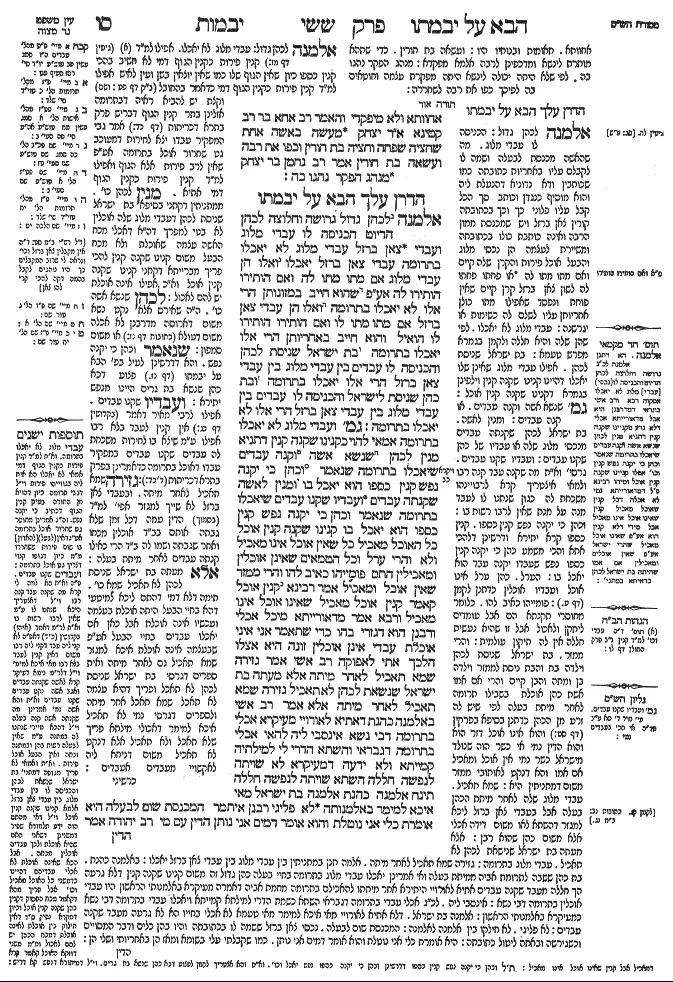
Yevamot 66a - Guemara
אחוותא ולא מיפקדי והאמר רב אחא בר רב קטינא א"ר יצחק מעשה באשה אחת שחציה שפחה וחציה בת חורין וכפו את רבה ועשאה בת חורין אמר רב נחמן בר יצחק מנהג הפקר נהגו בה:
הדרן עלך הבא על יבמתו
מתני׳ אלמנה לכהן גדול גרושה וחלוצה לכהן הדיוט הכניסה לו עבדי מלוג ועבדי צאן ברזל עבדי מלוג לא יאכלו בתרומה עבדי צאן ברזל יאכלו ואלו הן עבדי מלוג אם מתו מתו לה ואם הותירו הותירו לה אע"פ שהוא חייב במזונותן הרי אלו לא יאכלו בתרומה ואלו הן עבדי צאן ברזל אם מתו מתו לו ואם הותירו הותירו לו הואיל והוא חייב באחריותן הרי אלו יאכלו בתרומה בת ישראל שניסת לכהן והכניסה לו עבדים בין עבדי מלוג בין עבדי צאן ברזל הרי אלו יאכלו בתרומה ובת כהן שניסת לישראל והכניסה לו עבדים בין עבדי מלוג בין עבדי צאן ברזל הרי אלו לא יאכלו בתרומה:
גמ׳ ועבדי מלוג לא יאכלו בתרומה אמאי להוי כקנינו שקנה קנין דתניא מנין לכהן שנשא אשה וקנה עבדים שיאכלו בתרומה שנאמר (ויקרא כב, יא) וכהן כי יקנה נפש קנין כספו הוא יאכל בו ומנין לאשה שקנתה עבדים ועבדיו שקנו עבדים שיאכלו בתרומה שנאמר וכהן כי יקנה נפש קנין כספו הוא יאכל בו קנינו שקנה קנין אוכל כל האוכל מאכיל כל שאין אוכל אינו מאכיל ולא והרי ערל וכל הטמאים שאינן אוכלין ומאכילין התם פומייהו כאיב להו והרי ממזר שאין אוכל ומאכיל אמר רבינא קנין אוכל קאמר קנין אוכל מאכיל שאינו אוכל אינו מאכיל ורבא אמר מדאורייתא מיכל אכלי ורבנן הוא דגזרי בהו כדי שתאמר אני איני אוכלת עבדי אינן אוכלין זונה היא אצלו הלכך אתי לאפוקה רב אשי אמר גזירה שמא תאכיל לאחר מיתה אלא מעתה בת ישראל שנשאת לכהן לא תאכיל גזירה שמא תאכיל לאחר מיתה אלא אמר רב אשי באלמנה כהנת דאתיא לאורויי מעיקרא אכלי בתרומה דבי נשא אינסבי ליה להאי אכלי בתרומה דגבראי והשתא הדרי לי למילתיה קמייתא ולא ידעה דמעיקרא לא שויתה לנפשה חללה השתא שויתה לנפשה חללה תינח אלמנה כהנת אלמנה בת ישראל מאי איכא למימר באלמנותה לא פליגי רבנן איתמר המכנסת שום לבעלה היא אומרת כלי אני נוטלת והוא אומר דמים אני נותן הדין עם מי רב יהודה אמר
Comments from Rashi on Masechet Yevamot Page 66a
אחוותא . תאומות ובנותיו היו: ועשאה בת חורין . כדי שתהא מותרת לינשא. ומדכפינן לרבה אלמא מפקדא: מנהג הפקר נהגו בה . לפי שלא היתה יכולה לינשא היתה מפקרת עצמה וחוטאים בה לפיכך כפו את רבה לשחררה: פרק שביעי . אלמנה לכהן גדול מתני' אלמנה לכהן גדול. הכניסה לו עבדי מלוג . מה שהאשה מכנסת לבעלה ושמה לו לקבלם עליו באחריות כתובתה כמו שכותבין ודא נדוניא דהנעלת ליה והוא מוסיף כנגדן וכותב סך הכל קבל עליו פלוני כך וכך בכתובתה קורין צאן ברזל ויש שמכנסת ממון הרבה ואינה כותבת כולו בכתובתה ומשיירת לעצמה הן נכסי מלוג והבעל אוכל פירות והקרן שלה קיים ואם מתו מתו לה או פחתו פחתו לה. לשון צאן ברזל קרן קיים שאין פוחת ונפסד שאפילו מתו כולן אחריותן עליו לשלם לה כשימות או יגרשנה: עבדי מלוג לא יאכלו . לפי שהן שלה והיא חללה ולקמן בגמרא מפרש טעמא: בת ישראל שניסת לכהן . אפילו עבדי מלוג שאינן שלו יאכלו דהיינו קנינו שקנה קנין וילפינן בגמרא דקנינו שקנה קנין אוכל: גמ' שנשא אשה וקנה עבדים . או קנה עבדים: ומנין לאשה . בת ישראל לכהן שקנתה עבדים מנכסי מלוג שלה או עבדיו של כהן שקנו עבדים: ועבדיו שקנו עבדים . גרסי'. וא"ת מה שקנה עבד קנה רבו ולמאי איצטריך קרא לרבויינהו משכחת לה כגון שנתנו לו לעבד מנה על מנת שאין לרבו רשות בו: וכהן כי יקנה נפש קנין כספו . קנין כספו קרא יתירא ודרשינן דלהכי אתא והכי משמע כהן כי יקנה קנין כספו נפש שעבדו יקנה עבד הוא יאכל בו: הערל . כהן ערל אינו אוכל ועבדיו אוכלין כדתנן לקמן (יבמות דף ע.): פומייהו כאיב להו . כלומר מחוסרי תקנתא הם אבל עומדים ליתקן ולאכול אבל זו שהיא נעשית חללה אין לה תיקון עולמית: והרי ממזר . בת ישראל שניסת לכהן וילדה בת והבת ניסת לממזר וילדה בן ומתה והבן קיים והרי אם אמו אשת כהן אוכלת בשבילו תרומה לאחר מיתת בעלה לפי שיש לה זרע מן הכהן כדתנן בסיפא בפרקין (דף סט:) והוא אינו אוכל דזר הוא. והוא הדין נמי אי כשר הוה שנולד מישראל כשר נמי אין אוכל ומאכיל אם אמו והא דנקט לאותובי ממזר משום דמתניתין היא: שמא תאכיל . עבדי מלוג שלה לאחר מיתת הכהן בעלה אבל בעבדי צאן ברזל ליכא למגזר דהשתא לאו משום דידה אכלי אלא משום כהן שהוא רבן: אלא מעתה בת ישראל שנישאת לכהן לא תאכיל . עבדי מלוג בתרומה: גזירה שמא תאכיל לאחר מיתה . אלמה תנן במתניתין בין עבדי מלוג בין עבדי צאן ברזל יאכלו: באלמנה כהנת . בת כהן ששבה לתרומת אביה ממיתת בעלה. ואי אמרינן יאכלו עבדי מלוג בתרומה בחיי בעלה כהן גדול זה משום קנינו שקנה קנין דלא גרעה הך חללה מעבד שקנה עבדים אתיא לאורויי היתירא אחר מיתתו להאכילם בתרומה מחמת אביה דאמרה מעיקרא באלמנותי הראשון היו עבדי אוכלין בתרומה דבי נשא: אינסבי ליה . לכ"ג אכלי עבדי בתרומה דגבראי השתא כשמת הדרי למילתא קמייתא ויאכלו עבדי בתרומה דבי נשא כמעיקרא באלמנותי הראשון: אלמנה בת ישראל . דלא אתיא לאורויי מאי איכא למימר מאי טעמא לא אכלי בחייו הא לא גרעה מעבד שקנה עבדים: לא פליגי . לא חילקו בין אלמנה לאלמנה: המכנסת שום לבעלה . נכסי צאן ברזל ששמה לו בכתובתה והיו בהן כלים ודבר המסויים וכשגירשה ובאתה ליטול כתובתה: היא אומרת כלי אני נוטלת והוא אומר דמים אני נותן . כמו שקבלתי עלי בשומא ומאז הן באחריותי ושלי הן:
Comments from Tosafot - Yevamot 66a
אלמנה לכהן גדול: עבדי מלוג לא יאכלו . אפילו למ"ד (גיטין דף מז:) קנין פירות כקנין הגוף דמי לא חשיב בהכי קנין כספו כיון שאין הגוף שלו כמו שאין יוצאין בשן ועין לאיש אפילו למ"ד קנין פירות כקנין הגוף דמי כדאמר בהחובל (ב"ק דף פט: ושם) וקצת יש להביא ראיה דבתרומה אזלינן בתר קנין הגוף דבריש פרק בתרא דכריתות (דף כד:) אמר גבי המפקיר עבדו יצא לחירות דמעוכב גט שחרור אוכל בתרומה אע"פ שאין לרב פירות אלא הגוף ואפילו למ"ד קנין פירות כקנין הגוף דמי אתיא: מנין לכהן כו' . ממתניתין דקתני בסיפא בת ישראל שניסת לכהן דעבדי מלוג שלה אוכלין לא בעי למפרך דה"א דאכלי מכח האשה עצמה שאוכלת ולא מכח הבעל משום קנינו שקנה קנין להכי פריך מברייתא דקתני קנינו שקנה קנין אוכל וא"כ אפילו אינה אוכלת יש להם לאכול: לכהן שנשא אשה כו' . ה"ה שאירס אלא נקט נשא משום דארוסה מדרבנן לא אכלה משום דעולא (כתובות דף נז:) או משום סמפון: שנאמר וכהן כי יקנה נפש . והא דדרשינן לעיל בפ' הבא על יבמתו (יבמות דף נז.) פצוע דכא כהן שנשא בת גרים היינו מנפש יתירא: ועבדיו שקנו עבדים . אפילו לרבי מאיר דאמר (בקדושין דף כג:) אין קנין לעבד בלא רבו אפילו ע"מ שיצא בו לחירות משכחת לה עבדים שקנו עבדים במפקיר עבדו דאוכל בתרומה כדאמרינן בפרק בתרא דכריתות (ד' כד:): גזירה שמא תאכיל לאחר מיתה . ובעבדי צאן ברזל לא שייך למגזר אפי' למ"ד בסמוך הדין עמה דכל זמן שלא גבתה אותם בב"ד אוכלין מכחו ואחר שגבתה ושמו לה ב"ד הרי כאילו קנתה עבדים לאחר מיתת בעלה: אלא מעתה בת ישראל שניסת לכהן לא תאכיל שמא כו' . תימה דלא דמי דהתם ליכא למיטעי דהא בחיי הבעל היתה אוכלת בעצמה ועכשיו אינה אוכלת אבל כאן אם יאכלו עבדים בחיי הבעל אע"פ שבעצמה אינה אוכלת איכא למגזר שמא תאכיל גם לאחר מיתה ואית ספרים דגרסי בת ישראל שניסת לכהן לא תאכל ופריך דהיא עצמה לא תאכל שמא תאכל אחר מיתה ולספרים דגרסי נמי לא תאכיל איכא למימר דאכולי מילתא פריך שלא תאכל ולא תאכיל אלא דנקט לא תאכיל משום דניחא ליה לאקשויי מעבדים אעבדים:
Yevamot 66a - Mishnah translated into english
were twin sisters, and became the matriarchs of families of distinguished Torah scholars.
The Gemara asks: Are women not commanded to be fruitful and multiply? Didn’t Rav Aḥa bar Rav Ketina say that Rabbi Yitzḥak said: There was an incident with a certain woman who was half-slave and half-free woman and therefore could marry neither a Canaanite slave nor a Jew, and they forced her master and he made her a free woman. Presumably, the reason the court forced her master to free her was so that she could fulfill the mitzva to be fruitful and multiply. Rav Naḥman bar Yitzḥak said: The reason they forced her master to free her was because others treated her in a loose manner. Since she knew that she could not marry she engaged in promiscuous activity, and the court forced her master to free her in order to save her and others from sin.
MISHNA: A widow married to a High Priest, and a divorcée or a yevama who performed ḥalitza [ḥalutza] married to a common priest are all unions prohibited by Torah law. If one of these women brought with her into the marriage slaves of usufruct [melog] property or slaves of guaranteed investment, then the slaves of usufruct property do not partake of teruma but the slaves of guaranteed investment do partake of teruma.
And these are slaves of usufruct property: They are those with regard to whom the couple stipulated that if the slaves die, their death is her loss, and if they increase in value, their increase is her gain. Although the husband is obligated in their sustenance, they do not partake of teruma, as they belong to her, not to him. He owns only the right of their use while he is married to her. And these are slaves of guaranteed investment: They are those with regard to whom the couple stipulated that if they die, their death is his loss, and if they increase in value, their increase is his gain. Since he bears financial responsibility for compensating her in the event of their loss, they partake of teruma, as they are considered his property.
In the case of an Israelite woman who married a priest in a halakhic marriage and who brought slaves with her into the marriage, whether they are slaves of usufruct property or slaves of guaranteed investment, they partake of teruma. And in the case of the daughter of a priest who married an Israelite and who brought slaves with her into the marriage, whether they are slaves of usufruct property or slaves of guaranteed investment, they do not partake of teruma, although, as she is the daughter of a priest, it is permitted for her and her slaves to partake of teruma beforehand.
GEMARA: The mishna states that if a priest married a woman forbidden to him, his wife’s slaves of usufruct property do not partake of teruma. The Gemara asks: Why is this so? Let this case be like that of his acquisition who acquired an acquisition, as it is taught in a baraita: From where is it derived with regard to a priest who married a woman and acquired slaves that they partake of teruma? As it is stated: “But if a priest buys any soul, the purchase of his money, he may eat of it” (Leviticus 22:11).
And from where is it derived with regard to both the wife of a priest who acquired slaves and a priest’s slaves who acquired slaves, that the acquired slaves may also partake of teruma? As it is stated: “But if a priest buys any soul, the purchase of his money, he may eat of it,” which is interpreted to mean: If his acquisition acquired an acquisition, the latter partakes of teruma. Here too, since the slaves of usufruct property belong to his wife, it should be permitted for them to partake of teruma.
The Gemara answers: The principle is that anyone who is fit to partake of teruma can enable others to partake of teruma, and anyone who does not partake of teruma cannot enable others to partake. Since the priest’s wife in this case does not partake of teruma, as her marriage is forbidden, her slaves do not partake of teruma either.
The Gemara asks: And is it so that one who does not partake of teruma cannot enable others to partake? But aren’t there the cases of a priest who is uncircumcised because it was considered too dangerous for him and all impure priests, who do not partake of teruma, and yet they enable their wives and slaves to partake of teruma? The Gemara answers: The difference is that there, in those cases, there is no inherent disqualification rendering them unfit to partake of teruma. The hindrance to their partaking of teruma is tantamount to a situation where their mouths hurt, and that is why they refrain from eating teruma. They retain, however, the fundamental right to partake of teruma, and therefore they can enable others to partake as well.
The Gemara asks: But isn’t there the case of a son born from an incestuous or adulterous relationship [mamzer], who does not partake of teruma yet enables others to partake? If an Israelite woman was married to a priest and was subsequently widowed or divorced, and a child from that union married a mamzer and then had a child, in that case, even if the woman’s child is dead, she partakes of teruma due to her grandchild, as she has a living descendant from a priest, although that descendant is a mamzer. Although this child does not partake of teruma, he enables his grandmother to partake of it.
Ravina said that the above principle is referring to the case of an acquisition who partakes of teruma. If the acquisition of a priest partakes of teruma, he enables others to partake, whereas an acquisition who does not partake, e.g., his forbidden wife, cannot enable others to partake.
And Rava said a different solution. By Torah law, the forbidden wife’s slaves indeed partake of teruma, as they are included in the category of: His acquisition who acquired an acquisition. And it was the Sages who issued a decree prohibiting them from partaking of teruma, so that the woman unlawfully married to a priest would say: I do not partake of his teruma and my slaves do not partake of it either, so that she will realize that she is not a valid wife, but rather she is like a prostitute to him. Her husband will therefore come to divorce her, which is the desired outcome.
Rav Ashi said a different reason for the prohibition: It is a rabbinic decree lest she have those slaves partake of teruma even after the death of her husband the priest. As long as he is alive, they are permitted to partake of teruma, as she is considered his acquisition and they belong to her. Once he dies, she is no longer his acquisition.
The Gemara asks: However, if that is so, that the decree is lest she have those slaves partake of teruma after her husband’s death, any Israelite woman who marries a priest should not enable her slaves of usufruct property to partake of teruma either, due to the same rabbinic decree, lest she have them partake of teruma after her husband’s death.
Rather, Rav Ashi said that the decree is dealing with a widowed priestess, the daughter of a priest, who then married the High Priest, as she is likely to rationalize enabling her slaves to partake of teruma after the death of the High Priest as follows: Initially, my slaves partook of the teruma of my father’s house. I then married this man, and they partook of the teruma of my husband. And now that my husband died, I have returned to the original circumstance, and therefore they may once again partake of my father’s teruma. And she does not realize that this is not so, as initially she did not render herself a woman disqualified from marrying a priest [ḥalala], but now, by marrying a High Priest unlawfully, she rendered herself a ḥalala, and both she and her slaves do not partake of teruma even upon returning to her father’s house.
The Gemara asks: This works out well as an explanation of the mishna, with regard to a widowed priestess. However, if that widow who married a High Priest was an Israelite woman, what can be said? There is no reason for the decree in that case. The Gemara answers: With regard to widowhood, the Sages did not distinguish between one type of widow and another. Once they issued a decree due to one widow, they applied it to all widows.
It was stated: With regard to a woman who brings appraised, guaranteed property into her marital contract with her husband, he is obligated to return it at the conclusion of the marriage. Upon collection of her marriage contract, e.g., following divorce, if she says: I am taking my belongings, and he says: I am willing to give you only their monetary value, the halakha favors whom? Rav Yehuda said:
Traduction : The William Davidson digital edition of the Koren Noé Talmud, with commentary by Rabbi Adin Even-Israel Steinsaltz.