 Talmud Bavli
The learning on the whole site is dedicated : L'ilui Nishmat Reuven ben Rivka SEBBAG
The learning on the whole site is dedicated : L'ilui Nishmat Ledicia bat David Banoun
The learning on the whole site is dedicated : L'ilui Nishmat Yaakov ben Myriam
Yevamot 71a : Youtube
Daf TubeYoutube
2 video classes :
Yevamot Page 71a
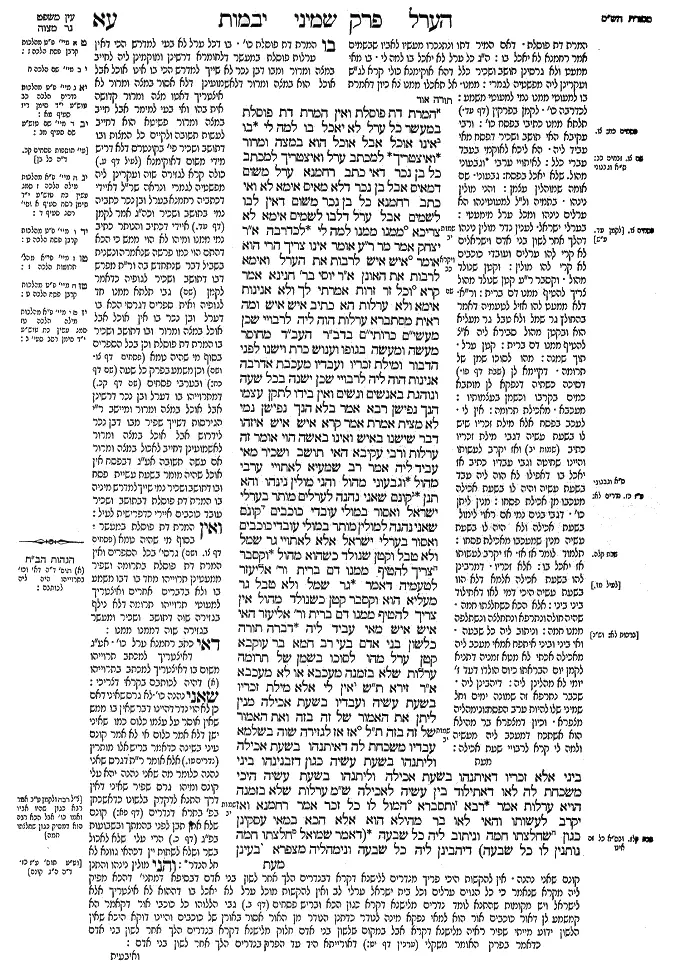
Yevamot 71a - Guemara
המרת דת פוסלת ואין המרת דת פוסלת במעשר כל ערל לא יאכל בו למה לי בו אינו אוכל אבל אוכל הוא במצה ומרור ואיצטריך למכתב ערל ואיצטריך למכתב כל בן נכר דאי כתב רחמנא ערל משום דמאיס אבל בן נכר דלא מאיס אימא לא ואי כתב רחמנא כל בן נכר משום דאין לבו לשמים אבל ערל דלבו לשמים אימא לא צריכא (שמות יב, ט) ממנו ממנו למה לי לכדרבה א"ר יצחק אמר מר ר"ע אומר אינו צריך הרי הוא אומר (ויקרא כב, ד) איש איש לרבות את הערל ואימא לרבות את האונן א"ר יוסי בר' חנינא אמר קרא (ויקרא כב, י) וכל זר זרות אמרתי לך ולא אנינות אימא ולא ערלות הא כתיב איש איש ומה ראית מסתברא ערלות הוה ליה לרבויי שכן מעשי"ם כרותי"ם בדב"ר העב"ד מחוסר מעשה ומעשה בגופו וענוש כרת וישנו לפני הדבור ומילת זכריו ועבדיו מעכבת אדרבה אנינות הוה ליה לרבויי שכן ישנה בכל שעה ונוהגת באנשים ונשים ואין בידו לתקן עצמו הנך נפישן רבא אמר בלא הנך נפישן נמי לא מצית אמרת אמר קרא איש איש איזהו דבר שישנו באיש ואינו באשה הוי אומר זה ערלות ורבי עקיבא האי תושב ושכיר מאי עביד ליה אמר רב שמעיא לאתויי ערבי מהול וגבעוני מהול והני מולין נינהו והא תנן קונם שאני נהנה לערלים מותר בערלי ישראל ואסור במולי עובדי כוכבים קונם שאני נהנה למולין מותר במולי עובדי כוכבים ואסור בערלי ישראל אלא לאתויי גר שמל ולא טבל וקטן שנולד כשהוא מהול וקסבר צריך להטיף ממנו דם ברית ור' אליעזר לטעמיה דאמר גר שמל ולא טבל גר מעליא הוא וקסבר קטן כשנולד מהול אין צריך להטיף ממנו דם ברית ור' אליעזר האי איש איש מאי עביד ליה דברה תורה כלשון בני אדם בעי רב חמא בר עוקבא קטן ערל מהו לסוכו בשמן של תרומה ערלות שלא בזמנה מעכבא או לא מעכבא א"ר זירא ת"ש אין לי אלא מילת זכריו בשעת עשיה ועבדיו בשעת אכילה מנין ליתן את האמור של זה בזה ואת האמור של זה בזה ת"ל (שמות יב, מח) אז אז לגזירה שוה בשלמא עבדיו משכחת לה דאיתנהו בשעת אכילה וליתנהו בשעת עשיה כגון דזבנינהו ביני ביני אלא זכריו דאיתנהו בשעת אכילה וליתנהו בשעת עשיה היכי משכחת לה לאו דאתילוד בין עשיה לאכילה ש"מ ערלות שלא בזמנה הויא ערלות אמר רבא ותסברא (שמות יב, מח) המול לו כל זכר אמר רחמנא ואז יקרב לעשותו והאי לאו בר מהילא הוא אלא הכא במאי עסקינן כגון שחלצתו חמה וניתוב ליה כל שבעה (דאמר שמואל חלצתו חמה נותנין לו כל שבעה) דיהבינן ליה כל שבעה ונימהליה מצפרא בעינן
Comments from Rashi on Masechet Yevamot Page 71a
המרת דת פוסלת . דאם המיר דתו ונתנכרו מעשיו לאביו שבשמים אמר רחמנא לא יאכל בו: ה"ג כל ערל לא יאכל בו למה לי . בו מאי ממעט. ולא גרסינן תושב ושכיר כלל דהא אוקימנא כולי קרא לג"ש ועקרינן ליה מפשטיה לגמרי: ממנו . אל תאכלו ממנו נא. כיון דאמרת בו למעוטי ממנו נמי למעוטי משמע: לכדרבה כו' . לקמן בפרקין (יבמות דף עד.) תלתא ממנו כתיבי בפסח כו': ורבי עקיבא האי תושב ושכיר דפסח מאי עביד ליה . הא ליכא לאוקמי בעבד עברי כלל: לאיתויי ערבי וגבעוני מהול . שלא יאכל בפסח: גבעוני . שם אומה שמוהלין עצמן: והני מולין נינהו . בתמיה ול"ל למעוטינהו הא ערלים נינהו ומכל ערל מימעטי: בערלי ישראל . לענין נדר מולין נינהו דהלך אחר לשון בני אדם וישראלים לא קרי להו ערלים ועובדי כוכבים לא קרי להו מולין: וקטן שנולד מהול . וקסבר ר"ע קטן שנולד מהול צריך להטיף ממנו דם ברית: ור"א . דלא ממעט להו אזיל לטעמיה דאמר בהחולץ גר שמל ולא טבל גר מעליא הוא ובקטן מהול סבירא ליה א"צ להטיף ממנו דם ברית: קטן ערל . תוך שמנה: מהו לסוכו שמן של תרומה . דקיימא לן (שבת דף פו.) דסיכה כשתיה דנפקא לן מותבא כמים בקרבו וכשמן בעצמותיו: מעכבא . מאכילת תרומה: אין לי . לעכב בפסח אלא מילת זכריו שיש לו בשעת עשיה דגבי מילת זכריו כתיב (שמות יב) ואז יקרב לעשותו והיינו שחיטה וגבי עבדיו כתיב אז יאכל בו דאפילו לא הוה ליה עבד בשעת עשיה והיה לו בשעת אכילה מעכבו מן אכילת פסחו: מנין ליתן כו' . דגבי בנים נמי אם ראוי לימול בשעת אכילה ולא היה לו בשעת עשיה מנין שמעכבו מאכילת פסחו: תלמוד לומר אז אז . אז יקרב לעשותו אז יאכל בו: אלא זכריו . דמרבינן להו בשעת אכילה אלמא דלא הוו בשעת עשיה היכי דמי לאו דאתילוד ביני ביני: אלא הכא כשחלצתו חמה . שהיה חולה ונתרפא ונתחלצה ונשתלפה ממנו חמה: וניתוב ליה כל שבעה . ואי ביני וביני איתפח אמאי מעכב ליה מאכילה אכתי לא מטא זמניה דתניא לקמן יום הבראתו כיום הולדו דעד ז' יומי לא מהלינן ליה: דיהבינן ליה . שכבר נתרפא זה שמונה ימים וחל שמיני שלו להיות ערב הפסח: ונימהליה מצפרא . וכיון דמצפרא בר מהילא הוא אשתכח דמעכב ליה מעשיה ולמה לי קרא לרבויי שעת אכילה:
Comments from Tosafot - Yevamot 71a
בו המרת דת פוסלת כו' . בו דכל ערל לא בעי למדרש הכי דאין ערלות פוסלת במעשר דלחומרא דרשינן ומוקמינן ליה לחייב במצה ומרור ומבו דבן נכר לא שייך למדרש הכי בו אינו אוכל אבל אוכל הוא במצה ומרור דלאשמועינן דלא אסור במצה ומרור לא איצטריך דאטו מצה ומרור קדושה אית בהו ואי בעי למימר אבל חייב במצה ומרור פשיטא הוא דחייב לעשות תשובה ולקיים כל המצות ובו דתושב ושכיר פי' בקונטרס דלא דריש מידי משום דאוקימנא (לעיל יבמות דף ע.) כולה קרא לגזירה שוה ועקרינן ליה מפשטיה לגמרי ונראה שר"ל דאיידי דכתביה רחמנא בערל ובן נכר כתביה נמי בתושב ושכיר וכה"ג אמר לקמן (יבמות דף עד.) איידי דכתיב והנותר כתיב נמי ממנו ומיהו לא הוי ממש כי הכא דהתם הוי כמו פרשה שנאמרה ונשנית בשביל דבר שנתחדש בה ור"ת מפרש דבו דתושב ושכיר לגופיה כדאמר לקמן (שם) גבי תלתא ממנו חד לגופיה ואית ספרים דגרסי הכא בו דערל ובן נכר בו אין אוכל אבל אוכל במצה ומרור ובו דתושב ושכיר בו המרת דת פוסלת וכן בכל הספרים בסוף מי שהיה טמא (פסחים דף צו. ושם) וכן משמע בפרק כל שעה (שם דף כח:) ובערבי פסחים (שם דף קכ.) דמתרוייהו בו דערל ובן נכר דרשינן אבל אוכל במצה ומרור ומיישב ר"י הגירסות דשייך שפיר מבו דבן נכר לידרוש אבל אוכל במצה ומרור לאשמועינן דחייב לאכול במצה ומרור אם עשה תשובה אע"ג דבפסח אין אוכל שהיה מומר בשעת עשיית פסח ובו דתושב ושכיר נמי שייך למדרש מיניה בו המרת דת פוסלת דבתושב ושכיר עובד כוכבים איירי כדפרישית לעיל: ואין המרת דת פוסלת במעשר . בסוף מי שהיה טמא (פסחים דף צו. ושם) גרסי' בכל הספרים ואין המרת דת פוסלת בתרומה ושפיר ממעטינן תרוייהו מחד בו דבו משמע בו ולא בדברים אחרים ואיצטריך למעוטי תרוייהו תרומה דלא נילף בגזירה שוה דתושב ושכיר ומעשר בגזירה שוה דממנו ממנו: דאי כתב רחמנא ערל כו' . אע"ג דאיצטריך למכתב תרוייהו משום בו דאיצטריך למכתב בתרוייהו דהיה לכותבם בקראי דצריכי: והני מולין נינהו והתנן קונם שאני נהנה . אין להקשות היכי פריך מנדרים ללישנא דקרא דבנדרים הלך אחר לשון בני אדם דבסיפא דמתני' דהכא מפיק ליה מקרא שנאמר כי כל הגוים ערלים וכל בית ישראל ערלי לב ואין להקשות מוכל ערל לא יאכל בו דההוא לא איצטריך אלא לישראל ויש מקומות שהתנא לומד נדרים מלישנא דקרא כגון הכא ובריש פסחים (דף ב.) גבי הללוהו כל כוכבי אור דקאמר הא קמשמע לן דאור כוכבים אור הוא למאי נפקא מינה לנודר כדתנן הנודר מן האור אסור באורן של כוכבים והיינו דוקא היכא שאין הלשון ידוע מייתי שפיר ראיה מלישנא דקרא אבל במקום שלשון בני אדם חלוק מלישנא דקרא בנדרים הלך אחר לשון בני אדם כדאמר בפרק האומר משקלי (ערכין דף יט:) דאורייתא היד עד הפרק בנדרים הלך אחר לשון בני אדם: שאני נהנה כו' . לא גרס שאיני דאם כן לא הוי נדר דהיינו דבר שאין בו ממש שאין אוסר על עצמו כלום כמו שאיני ישן דלא אמר כלום אי לא אמר קונם עיני בשינה כדאמר בריש אלו מותרין (נדרים טו.) אלא אומר ר"ת דגרס שאני נהנה כלומר מה שאני נהנה יהא עלי קונם ומיהו גרס שפיר שאיני דאין דרך התנא לדקדק בלשונו כדאשכחן בפ' בתרא דנדרים (דף פא:) קונם שלא אתן תבן לפני בהמתך ובשבועות בפ"ג (דף כ.) הרי עלי שלא לאכול בשר ושלא לשתות יין דכהאי גוונא לא חל הנדר:
Yevamot 71a - Mishnah translated into english
that apostasy [meshumadut] disqualifies, as the term “stranger” in this context is understood to refer to a Jew whose conduct makes him estranged from God, and he is disqualified from eating the Paschal lamb, but apostasy does not disqualify one from eating tithe.
The Gemara asks further: If so, with regard to the phrase “from it” in the verse “No uncircumcised person shall eat from it” (Exodus 12:48), which again emphasizes “from it” and not from another item, why do I need it? The Gemara answers: This teaches that only from it, the Paschal lamb, one who is uncircumcised may not eat, but he eats matza and bitter herbs. One who is uncircumcised is obligated to eat matza and bitter herbs on Passover, just like any other Jew.
The Gemara continues: And it was necessary for the Torah to write the prohibition with regard to an uncircumcised man, and it was necessary for the Torah to write a separate prohibition with regard to any stranger. As, if the Merciful One had written only about an uncircumcised man, one might have thought that only for him is it prohibited to eat from the Paschal lamb because the foreskin is repulsive, but with regard to a stranger, who is not repulsive, say that it is not prohibited. And if the Merciful One had written only about any stranger, one might have concluded that only for him is it prohibited to eat from the Paschal lamb because his heart is not directed toward Heaven due to his apostasy, but with regard to an uncircumcised man, whose heart is directed toward Heaven, and it is only on account of unavoidable circumstances that he has not undergone circumcision, say that there is no prohibition against his eating the Paschal lamb. Therefore, it is necessary to teach both cases.
The Gemara asks: With regard to the phrase “of it” in the verse “Do not eat of it raw, nor boiled in water, but roasted in fire” (Exodus 12:9), and the phrase “of it” in the verse “And you shall let nothing of it remain until the morning” (Exodus 12:10), both of which are terms of exclusion, why do I need them? The Gemara answers that they are necessary for that which Rabba said that Rabbi Yitzḥak said, as will be explained later (74a).
The Master said above in the baraita: Rabbi Akiva says that it is not necessary to derive by way of a verbal analogy the halakha that an uncircumcised priest may not eat teruma, as the verse says: “Any man [ish ish] from the seed of Aaron who is a leper or a zav shall not eat of the holy things” (Leviticus 22:4). The repetition of the word ish comes to include an uncircumcised man and indicate that he too may not partake of consecrated food. The Gemara asks: But say that the verse comes to include an acute mourner in the prohibition against eating teruma. Rabbi Yosei, son of Rabbi Ḥanina, said: The verse states: “No foreigner may eat of the holy thing” (Leviticus 22:10), which indicates: A disqualification stemming from foreignness I told you prevents one from eating teruma, but not a disqualification based on acute mourning.
The Gemara asks: Say that the verse comes to teach that a disqualification stemming from foreignness prevents one from eating teruma, but not a disqualification based on the priest’s lack of circumcision, and so it should be permitted for an uncircumcised priest to partake of teruma. The Gemara answers: Isn’t it written: “Any man [ish ish],” where the repetition of the word ish comes to include an uncircumcised priest in the prohibition?
The Gemara asks: And what did you see that led you to include an uncircumcised priest in the prohibition against eating teruma and exclude an acute mourner? The Gemara answers: It stands to reason that lack of circumcision should be included and should preclude a priest’s eating teruma, as the halakhot governing an uncircumcised man are stringent in several respects, as alluded to by the following mnemonic of key words: Acts; karetim; the divine word; the slave. The Gemara explains: An uncircumcised man lacks the act of circumcision, and this act is performed on his body; the failure to perform circumcision is punishable by karet; circumcision existed before the divine word was spoken at Mount Sinai, as the mitzva of circumcision had already been given to Abraham; and the lack of circumcision of one’s male children and slaves precludes one’s eating the Paschal lamb.
The Gemara counters: On the contrary, acute mourning should be included and it should prevent a priest from eating teruma, as acute mourning is relevant at any time, it applies to both men and women, and it is not in the mourner’s power to render himself fit until after the deceased is buried.
The Gemara answers: These arguments for including an uncircumcised priest in the prohibition are more numerous. Rava said: Even without the rationale that these arguments are more numerous, you still cannot say that an acute mourner should be included and an uncircumcised priest should be excluded, as the verse states: “Any man [ish ish],” emphasizing maleness. Now, what matter applies to a man and not to a woman? You must say that it is lack of circumcision, and therefore it cannot be that the phrase comes to include acute mourning in the prohibition.
The Gemara asks: And what does Rabbi Akiva do with this phrase: “A sojourner and a hired servant,” as it is not needed for the Paschal lamb? Rav Shemaya said: It serves to include a circumcised Arab and a circumcised Gibeonite in the prohibition against the eating of the Paschal lamb. Although they have been circumcised, it is prohibited for them to partake of the offering.
The Gemara poses a question: And are these considered circumcised? But didn’t we learn in a mishna (Nedarim 31b): If one vowed: The benefit that I might gain from the uncircumcised is konam to me, i.e., forbidden to me like consecrated property, then it is permitted for him to derive benefit from uncircumcised Jews, and it is prohibited for him to derive benefit from the circumcised of the nations of the world, as gentiles are considered uncircumcised even if they have their foreskins removed. And conversely, if he vowed: The benefit that I might gain from the circumcised is konam to me, it is permitted for him to derive benefit from the circumcised of the nations of the world, as they are not considered circumcised, and it is prohibited for him to derive benefit from uncircumcised Jews. This indicates that the circumcision of gentiles is disregarded.
Rather, the phrase “a sojourner and a hired servant” comes to include in the prohibition against eating of the Paschal lamb a convert to Judaism who was circumcised but did not yet immerse in a ritual bath, and a child who was born circumcised, i.e., without a foreskin. Although he does not have a foreskin, he is still seen as lacking the act of circumcision. And he, Rabbi Akiva, maintains that it is necessary to drip covenantal blood from him, in lieu of circumcision, in order to usher him into the covenant of Abraham, even though he has no foreskin that can be removed.
And Rabbi Eliezer, who uses the words “a sojourner and a hired servant” for a verbal analogy, conforms to his standard line of reasoning, as he said: A convert who was circumcised but did not yet immerse is a proper convert in every way. Therefore, the verse cannot come to exclude such an individual. And he maintains that in the case of a child who was born circumcised, it is not necessary to drip covenantal blood from him. Since he was born without a foreskin, no additional procedure is necessary.
The Gemara asks: And what does Rabbi Eliezer do with this inclusive phrase “any man [ish ish]”? The Gemara answers: He maintains that the Torah spoke in the language of men, meaning that no special halakha is derived from this expression, as it is common biblical vernacular.
Rav Ḥama bar Ukva raises a dilemma: With regard to an uncircumcised child who is less than eight days old and not yet fit for circumcision, what is the halakha with respect to anointing him with oil of teruma? The Gemara explains the two sides of the question: Does lack of circumcision not at its appointed time, meaning before the obligation of circumcision goes into effect, preclude the infant’s benefiting from teruma, as he has the status of one who is uncircumcised, or perhaps it does not preclude his benefiting from teruma, as he is not considered uncircumcised until the mitzva of circumcision is applicable?
Rabbi Zeira said: Come and hear a proof from the following baraita: I have derived only the halakha concerning the circumcision of one’s male children at the time of the preparation, i.e., the slaughter, of the Paschal lamb, as it is stated: “Let all his males be circumcised, and then let him come near and keep it” (Exodus 12:48), and the halakha concerning the circumcision of one’s slaves at the time of the eating of the Paschal lamb, as it is stated: “But every man’s servant…when you have circumcised him, then shall he eat from it” (Exodus 12:44). From where do I derive that it is proper to apply the prohibition that was stated about this case to that case, and the prohibition that was said about that case to this case, i.e., that the circumcision of both one’s male children and one’s slaves is indispensable both at the time of the preparation of the Paschal lamb and at the time of its consumption? The tanna answers that the verse states the term “then” with regard to male children and the term “then” with regard to slaves as a verbal analogy.
The Gemara comments: Granted, with regard to one’s slaves you find a case where they are present at the time of eating but they were not present at the time of preparation; for example, if he purchased them in the meantime, i.e., they did not belong to him when the Paschal lamb was slaughtered but he bought them immediately afterward, before it was time to eat it.
However, with regard to his male children, how can you find a case where they are present at the time of eating, but they were not present at the time of preparation? Does it not involve a situation where they were born between the time of the Paschal lamb’s preparation and the time of its eating? Learn from this that lack of circumcision, even not at, i.e., before, its appointed time, is nevertheless considered lack of circumcision that prevents the father from partaking of the offering.
Rava said: And how can you understand it that way? How can you think that the lack of circumcision of a newborn child precludes his father’s eating from the Paschal lamb? Doesn’t the Merciful One state: “Let all his males be circumcised,” followed by “and then let him come near and keep it” (Exodus 12:48), and as this infant is not yet fit for circumcision he cannot possibly preclude the father’s partaking of the offering? Rather, with what case are we dealing here? With the case, for example, of a baby who was exempt from circumcision at the time of the preparation of the Paschal lamb because he was sick with a high fever, and subsequently the fever left him and he recovered. In such a case, failure to immediately circumcise his son precludes the father’s eating from the Paschal lamb.
The Gemara raises a difficulty: If the case is one of a child recovering from an illness, let us give him the full seven days that he needs to recuperate properly. As Shmuel said: In the case of a baby that was sick with a high fever, and subsequently the fever left him, one gives him a full seven days to heal and only then is he circumcised, but not before. The Gemara answers: The case is in fact one where we already gave him a full seven days to heal, but they culminated on the eve of Passover. The Gemara asks: But if the seven-day recovery period ended on the eve of Passover, why did the father wait until the time of eating the Paschal lamb, i.e., the first night of Passover? He should have circumcised him already in the morning, before the time of the preparation of the Paschal lamb. The Gemara answers: We require
Traduction : The William Davidson digital edition of the Koren Noé Talmud, with commentary by Rabbi Adin Even-Israel Steinsaltz.