 Talmud Bavli
The learning on the whole site is dedicated : L'ilui Nishmat רינה בת לדיסיה
The learning on the whole site is dedicated : L'ilui Nishmat יוסף בן מושה
The learning on the whole site is dedicated : L'ilui Nishmat Rav Chlomo Ben Jamilla
Hullin 68a : Youtube
Rabbi Dr. Moshe WeisblumYoutube
1 video class :
Hullin Page 68a
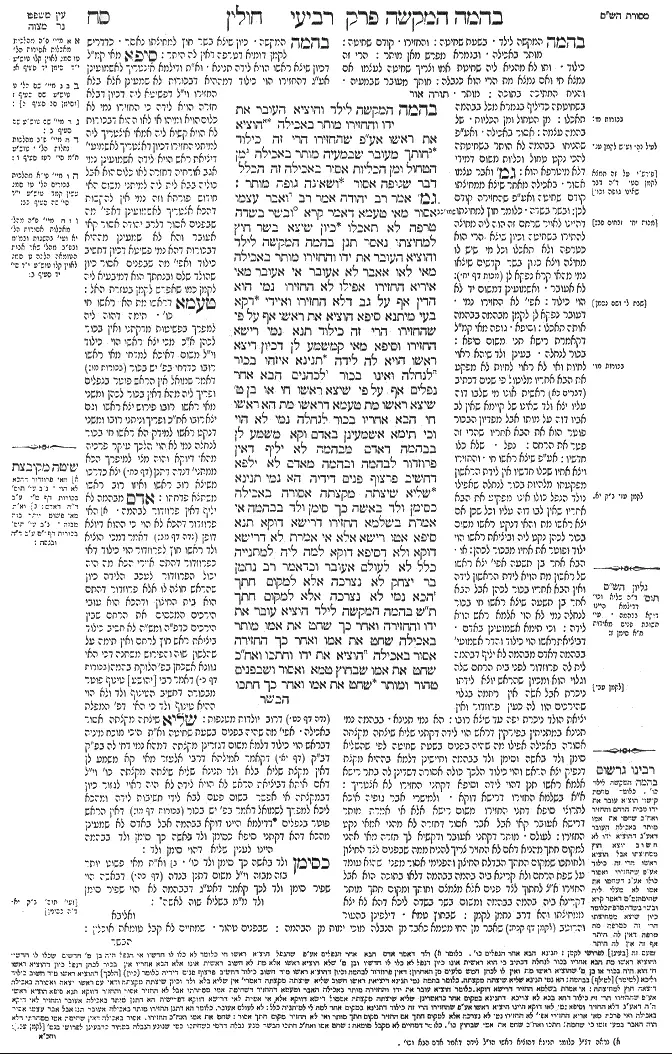
Hullin 68a - Guemara
מתני׳ בהמה המקשה לילד והוציא העובר את ידו והחזירו מותר באכילה הוציא את ראשו אע"פ שהחזירו הרי זה כילוד חותך מעובר שבמעיה מותר באכילה מן הטחול ומן הכליות אסור באכילה זה הכלל דבר שגופה אסור ושאינה גופה מותר:
גמ׳ אמר רב יהודה אמר רב ואבר עצמו אסור מאי טעמא דאמר קרא (שמות כב, ל) ובשר בשדה טרפה לא תאכלו כיון שיצא בשר חוץ למחיצתו נאסר תנן בהמה המקשה לילד והוציא העובר את ידו והחזירו מותר באכילה מאי לאו אאבר לא אעובר אי אעובר מאי איריא החזירו אפילו לא החזירו נמי הוא הדין אף על גב דלא החזירו ואיידי דקא בעי מיתנא סיפא הוציא את ראשו אף על פי שהחזירו הרי זה כילוד תנא נמי רישא החזירו וסיפא מאי קמשמע לן דכיון דיצא ראשו הויא לה לידה תנינא איזהו בכור לנחלה ואינו בכור לכהנים הבא אחר נפלים אף על פי שיצא ראשו חי או בן ט' שיצא ראשו מת טעמא דראשו מת הא ראשו חי הבא אחריו בכור לנחלה נמי לא הוי וכי תימא אשמעינן באדם וקא משמע לן בבהמה דאדם מבהמה לא יליף דאין פרוזדור לבהמה ובהמה מאדם לא ילפא דחשיב פרצוף פנים דידיה הא נמי תנינא שליא שיצתה מקצתה אסורה באכילה כסימן ולד באשה כך סימן ולד בבהמה אי אמרת בשלמא החזירו דרישא דוקא תנא סיפא אטו רישא אלא אי אמרת לא דרישא דוקא ולא דסיפא דוקא למה ליה למתנייה כלל לא לעולם אעובר וכדאמר רב נחמן בר יצחק לא נצרכה אלא למקום חתך הכא נמי לא נצרכה אלא למקום חתך ת"ש בהמה המקשה לילד הוציא עובר את ידו והחזירה ואחר כך שחט את אמו מותר באכילה שחט את אמו ואחר כך החזירה אסור באכילה הוציא את ידו וחתכו ואח"כ שחט את אמו שבחוץ טמא ואסור ושבפנים טהור ומותר שחט את אמו ואחר כך חתכו
Comments from Rashi on Masechet Hullin Page 68a
מתני' בהמה המקשה לילד . בשעת שחיטה: והחזירו . קודם שחיטה: מותר באכילה . ובגמרא מפרש מאן מותר: הרי זה כילוד . ותו לא מהניא ליה שחיטת אמו וצריך שחיטה לעצמו אם נמצא חי ואם נמצא מת הרי הוא כנבלה: חותך מעובר שבמעיה . והניח החתיכה בתוכה: מותר . בשחיטתה כדיליף בגמרא מכל בבהמה תאכלו: מן הטחול ומן הכליות . של בהמה עצמה: אסור באכילה . ואע"פ שהניחו בבהמה לא הותר בשחיטתה. להכי נקט טחול וכליות משום דמידי דלא מיטרפא הוא: גמ' ואבר עצמו אסור . באכילה מאחר שיצא ממחיצתו קודם שחיטה ואע"פ שהחזירה קודם לכן: ובשר בשדה . כלומר חוץ למחיצתו דהיינו לאויר שרחם זה הוה ליה מחיצה להתירו בשחיטה וכיון שיצא הרי הוא כטרפה ולא תאכלו. וכל מי שיש לו מחיצה ויצא כגון בשר קדשים שיצאו נמי מהאי קרא נפקא לן (מכות דף יח.): לא אעובר . ואשמועינן דמשום יד לא הוי כילוד: אפי' לא החזירו נמי . דעובר נפקא לן לקמן מבהמה בבהמה אותה תאכלו: וסיפא . גופה מאי קמ"ל דקאמרת רישא תני משום סיפא: בכור לנחלה . בעינן ולד שיהא ראוי לחיות ואי לא ראוי לחיות לא מפקע את הבא אחריו מליטול פי שנים דכתיב (דברים כא) ראשית אונו מי שלבו דוה עליו יצא ולד שאינו של קיימא שאין לב אביו דוה על מותו אבל מפדיון הבכור פוטר הוא את הבא אחריו שהרי זה פטר את הרחם: נפל . שלא כלו חדשיו: אע"פ שיצא ראשו חי . והחזירו ויצא אחיו שכלו חדשיו אין לידת הראשון מפקעתו מלהיות בכור לנחלה שאפילו נולד הנפל כולו אינו מפקיע את הבא אחריו שאין לבו דוה עליו וכל שכן אם יצא ראשו מת. והאי דנקט ראשו משום בכור לכהן נקט ליה וביציאת ראשו הוי ילוד ופוטר את אחיו מבכור לכהן: או . הבא אחר בן תשעה אפי' יצא ראשו של ראשון מת הויא לידת הראשון לידה ואין הבא אחריו בכור לכהן אבל הבא אחר בן תשעה שיצא ראשו חי בכור לנחלה נמי לא הוי. אלמא ראש הויא לידה: וכי תימא אשמועינן באדם . דביציאת ראשו הוי כילוד והדר אשמועי' בבהמה דאדם מבהמה לא יליף דבהמה לית לה פרוזדור לפני בית הרחם שלה וגלוי הוא ומכיון שהראש יוצא לידתו ניכרת אבל אשה אין רחמה בגלוי שהירכים הוו לה כעין פרוזדור ואין יציאת הולד ניכרת יפה עד שיצא רובו: הא נמי תנינא . בבהמה נמי תנינא במתניתין בפירקין דראש הוי לידה דקתני שליא שיצתה מקצתה אסורה באכילה אפילו מה שהיה בפנים בשעת שחיטה לפי שהשליא סימן ולד באשה וסימן ולד בבהמה וחיישינן דלמא בההיא מקצת דנפיק יצא הראש והוי כילוד הלכך כולה אסורה דשדינן לה בתר רישא אלמא ראשו תנן דהוי לידה וסיפא דקתני החזירו לא אצטריך: א"א בשלמא החזירו דרישא דוקא . ולמישרי אבר גופיה איכא לתרוצי סיפא דתני החזירו משום רישא אלא אי אמרת מותר דרישא אעובר קאי אבל אבר אסור דחזרה לא מהני אמאי נקט החזירו: לעולם . מותר דקתני אעובר ודקשיא לך חזרה מאי אהני למקום חתך מהניא דאם לא החזיר צריך להניח ממה שבפנים לצד החיצון ולחותכו שמקום החתך הבדלת החיצון והפנימי אסור מפני שהוא עומד על שפת הרחם ולא קרינא ביה בהמה בבהמה דלאו בתוכה הוא אבל החזירו א"צ לחתוך לצד פנים אלא מצמצם וחותך ומקום חתך מותר דקרינא ביה בהמה בבהמה ומשום בשר בשדה ליכא דהא לא יצא ממחיצתו. והא דרב נחמן לקמן: שבחוץ טמא . דילפינן בהעור והרוטב (לקמן חולין דף קכח:) שאבר מן החי מטמא כאבר מן הנבלה מוכי ימות מן הבהמה: שבפנים טהור . שמחיים לא קבל טומאת אוכלין:
Comments from Tosafot - Hullin 68a
מתני' בהמה המקשה: כיון שיצא בשר חוץ למחיצתו נאסר . כדדריש לקמן דומיא דטרפה דאין לה היתר: סיפא מאי קמ"ל דכיון שיצא ראשו הויא לידה תנינא . וא"ת ודילמא איצטריך לאשמועינן אע"ג דהחזירו הוי כילוד דמההיא דבכורות לא שמעינן אלא בלא החזירו וי"ל דפשיטא ליה דכיון דבלא חזרה הויא לידה כי החזירו נמי לא כלום הויא ומיהו אי לאו ההוא דבכורות לא הויא קשיא ליה אמאי איצטריך ליה למיתני החזירו דכיון דאצטריך לאשמועי' דיציאת ראש הויא לידה אשמועינן נמי אגב אורחיה דחזרה לאו כלום הוא אבל כוליה בבא לית ליה למיתני משום האי חידוש פורתא וזה נמי אין להקשות דהכא אצטריך לאשמועינן דאפי' מה שבפנים אסור דלרב יהודה אסור קאי אעובר והא לא שמעינן מההיא דבכורות דהא נמי פשיטא דכיון דחשיב כילוד ואפי' מה שבפנים אסור כיון שהולד שלם ובנחתך הוא דמיבעיא ליה לקמן כמו שאפרש לקמן בעזרת האל: טעמא דראשו מת הא ראשו חי כו' . תימה דהוה ליה למפרך בפשיטות מדקתני ואין בכור לכהן א"כ מכי יצא ראשו הוי כילוד וי"ל משום דאיכא למדחי מאי ראשו רובו כדדחי בפ' יש בכור (בכורות מו:) דאמר שמואל אין הראש פוטר בנפלים ופריך ליה מהא דאין בכור לכהן ומשני מאי ראשו רובו פירוש יצא ראשו וגם יצא רובו אח"כ ופריך וניתני רובו ומשני דנקט ראשו למידק הא ראשו חי בכור לנחלה נמי לא הוי הלכך עיקר פרכיה מהאי דיוקא והוה מצי למיפרך הכא ממתני' דנדה דתנן (דף כח.) יצא כדרכו משיצא רוב ראשו ואיזו רוב ראשו משתצא פדחתו: אדם מבהמה לא יליף דאין פרוזדור לבהמה . האי פרוזדור דהכא לא הוי כי ההוא דיוצא דופן (נדה דף מב:) דאמר דמכי הוציא ולד ראשו חוץ לפרוזדור הוי כילוד דאי כפרוזדור דהתם איירי הכא מה היה יכול הפרוזדור לעכב הלידה כיון שהראש חוצה לו אלא פרוזדור דהתם הוא בית החיצון ודהכא הוא עובי הירכים המכסים את הרחם שבין הירכים כדפ"ה ומש"ה לא חשיב כילוד ביציאת ראש חוץ לרחם ואין תימה על שהלשון שוה והפירוש משתנה דכי האי גוונא אשכחן בפ' הלוקח בהמה (בכורות דף כ.) דאמר רבי [יהושע] טינוף פוטר מבכורה דחשיב הטינוף ולד ולא הוי ההיא טינוף ולד כי האי דפ' המפלת (נדה דף כט.) דרוב יולדות מטנפות: שליא שיצתה מקצתה אסור באכילה . אפי' מה שהיה בפנים בשעת שחיטה וא"ת היכי מוכח מיניה דבראש הוי כילוד דלמא משום דגזרינן מקצתה דמהא נמי דחי לה בפ"ק דב"ק (דף יא.) דקאמר אמילתא דרבי אלעזר מאי קא משמע לן דאין מקצת שליא בלא ולד תנינא שליא שיצתה מקצתה כו' וי"ל דאם איתא דביציאת הראש לא הויא לידה לא היה ראוי לגזור כיון דבמקצתה אי אפשר בשום פעם לבא לידי חשיבות לידה ומהכא ליכא למפרך לשמואל דאמר בפ' יש בכור (בכורות דף מו:) דאין הראש פוטר בנפלים דדילמא היינו דוקא בבהמה אבל באדם לא שמעינן מהכא דהא דקתני סיפא כסימן ולד באשה כך סימן ולד בבהמה היינו לענין שליא דהוי סימן ולד: כסימן ולד באשה כך סימן ולד כו' . וא"ת מאי פשוט יותר בזה מבזה וי"ל משום דתנן בנדה (דף כה.) דבאשה הוי שפיר סימן ולד לכך קאמר דאע"ג דבבהמה לא הוי שפיר סימן ולד מ"מ בשליא שוה לאשה:
Hullin 68a - Mishnah translated into english
MISHNA: When a pregnant kosher animal is slaughtered, the slaughter also renders the consumption of its fetus permitted. Even if an animal was encountering difficulty giving birth and meanwhile the fetus extended its foreleg outside the mother animal’s womb and then brought it back inside, and then the mother animal was slaughtered, the consumption of the fetus is permitted by virtue of the slaughter of the mother animal. But if the fetus extended its head outside the womb, even if it then brought it back inside, the halakhic status of that fetus is like that of a newborn, and the slaughter of the mother animal does not permit the consumption of the fetus. Rather, it requires its own slaughter.
If, prior to slaughtering an animal, one severs pieces from a fetus that is in the womb and leaves those pieces in the womb, their consumption is permitted by virtue of the slaughter of the mother animal. By contrast, if one severs pieces of the spleen or of the kidneys of an animal and then slaughters it, then even if those pieces are left inside the animal their consumption is prohibited, because an organ severed from a living being is not permitted by the subsequent slaughter of the animal. This is the principle: An item that is part of an animal’s body that was severed prior to its slaughter is prohibited even after slaughter, and an item that is not part of its body, i.e., its fetus, is permitted by virtue of its slaughter.
GEMARA: The Gemara qualifies the first ruling of the mishna: Rav Yehuda says that Rav says: But as for the limb itself, i.e., the foreleg, its consumption is prohibited, even though the fetus brought it back inside prior to the slaughter.
What is the reason for this? It is as the verse states: “And flesh, in the field, a tereifa, you shall not eat” (Exodus 22:30). A tereifa is an animal with a wound that will cause it to die within twelve months; its consumption is prohibited even if it is ritually slaughtered. The Gemara interprets the verse as teaching a principle: Once flesh whose permitted status is dependent on being within a certain area, e.g., sacrificial meat within the Temple courtyard, has gone outside of its boundary, i.e., the area in which it is permitted, which the verse describes as being “in the field,” it becomes permanently prohibited, like a tereifa. Likewise, the permitted status of a fetus is dependent on its being within the womb when the mother animal is slaughtered. Accordingly, if any part of the fetus leaves the womb before the slaughter, it is rendered permanently prohibited.
The Gemara raises a difficulty: We learned in the mishna: If an animal was encountering difficulty giving birth and as a result the fetus extended its foreleg outside the mother animal’s body but then brought it back, and then the animal was slaughtered, the consumption of the fetus is permitted by virtue of the slaughter of the mother animal. The Gemara assumes: What, is the mishna not referring to the entire fetus, including the limb, i.e., the foreleg, when it states that its consumption is permitted by the slaughter? This would contradict Rav’s ruling. The Gemara answers: No, the mishna is referring to the rest of the fetus, apart from the foreleg.
The Gemara asks: If the mishna is referring to the rest of the fetus, why state specifically that the fetus brought back its foreleg? Even if it did not bring it back the rest of the fetus would still be permitted. The Gemara answers: The same is true, that the rest of the fetus is permitted, even if it did not bring back its foreleg. But since the tanna of the mishna wants to teach in the latter clause: If the fetus extended its head, even though it brought it back, the halakhic status of that fetus is like that of a newborn and is permitted only through its own slaughter, therefore he also taught in the first clause that the fetus brought back its foreleg, for stylistic reasons, despite the fact that the ruling is not limited to that case.
The Gemara asks: And concerning this latter clause itself, what does it teach us? Does it teach that once the fetus extended its head, that is considered a birth? But we have already learned this in a mishna (Bekhorot 46a): Who is considered a firstborn with regard to inheritance but is not considered a firstborn with regard to the requirement to be redeemed by giving five shekels to the priests? It is a son who came after the miscarriage of an underdeveloped fetus. The mishna adds that the category of stillbirth includes the case of a child who did not reach full term, even if its head emerged alive, or a fully developed, nine-month-old fetus whose head emerged dead.
The Gemara infers from the final clause of the mishna: The reason a son born following the miscarriage is considered a firstborn with regard to inheritance is that the head of the miscarriage emerged only after it was already dead. But if its head had initially emerged alive, even if it then died before being fully delivered, the son born after him would not be considered a firstborn even with regard to inheritance. Apparently, this is because the emergence of the head alive is considered a birth, and therefore any subsequent child cannot be considered the firstborn. Evidently, it is unnecessary for the mishna here to teach this definition of a birth.
And if you would say that the mishna there teaches us the definition of birth with regard to a person, and the mishna here teaches us that the same definition applies to an animal, another problem remains, as the Gemara will presently explain.
Before explaining the problem with this suggestion, the Gemara explains why it is necessary to teach the definition with regard to both people and animals: Because the definition of birth with regard to a person cannot be derived from that of an animal, as an animal does not have a concealed opening [prozdor] to the womb, unlike women, whose thighs conceal the opening to their womb. Consequently, even if the definition were stated with regard to an animal, one might limit it to animals, as that stage is immediately visible; whereas in women it is not. And conversely, the definition of birth with regard to an animal cannot be derived from that of a person, as the form of a person’s face is significant because people are created in the image of God, and their faces bear the mark of their intelligence, which is not true of animals. Consequently, perhaps the emergence of the head alone is considered a birth only with regard to a person.
The Gemara proceeds to explain why the above suggestion is not a solution: With regard to this halakha also, that the emergence of the head of an animal is considered a birth, we have already learned it in a mishna (77a): If part of a placenta emerged from the womb of an animal before it was slaughtered, its consumption is prohibited even after the mother animal is slaughtered. The reason for this is just as the placenta is an indication of the presence of a fetus in a woman, so too, it is an indication of the presence of a fetus in an animal. Consequently, it is possible that the part of the placenta that emerged contained the head of the fetus, and accordingly it would be considered to have been born. The slaughter of the mother animal would therefore not permit it for consumption. Evidently, it is unnecessary for the mishna here to teach the definition of a birth even with regard to an animal.
The Gemara has established that the latter clause does not teach any novelty. Accordingly, it returns to challenging Rav’s ruling: Granted, the mishna is understood if you say that the statement that the fetus brought its foreleg back inside the mother animal, which is mentioned in the first clause of the mishna, is written specifically in order to teach the novelty that the foreleg is permitted if it was brought back before the slaughter, in contrast to Rav’s ruling. If so, then one can claim the mishna taught it in the latter clause due to the first clause, so that they would be parallel stylistically, and no novelty is necessary in the latter clause.
But if you say the first clause is not written specifically and does not teach a novelty, but rather the mishna is referring to the permitted status of the rest of the fetus, which is permitted even if it does not bring back its foreleg, and you also say the latter clause is not written specifically to teach a novelty, since the definition of birth is already taught in a mishna elsewhere, then why does it need to teach the halakha that the foreleg or head were brought back at all? Perforce, the first clause must be referring to the permitted status of the foreleg and limiting it specifically to the case where it was brought back inside. This contradicts Rav’s ruling.
The Gemara responds: No; actually, the mishna is referring to the permitted status of the rest of the fetus, but nevertheless, the statement that the fetus brought back its foreleg does teach a novelty. This is similar to that which Rav Naḥman bar Yitzḥak said, in explanation of a ruling in a baraita cited below, that it is necessary only with regard to the location of a cut limb on the fetus’s body. If the foreleg were to be severed at precisely the point that lay on the boundary between the inside and the outside of the womb, then the location of the cut on the fetus’s body would also be prohibited. Here too, one can explain that the ruling is necessary only with regard to the location of the cut, and it teaches that if the fetus did not bring back its foreleg, then not only is the foreleg prohibited but the location of the cut is also prohibited.
The Gemara suggests: Come and hear a challenge to Rav’s ruling from a baraita: If an animal was encountering difficulty giving birth, and as a result the fetus extended its foreleg outside the mother animal’s body and then brought it back inside and then afterward one slaughtered its mother, its consumption is permitted by virtue of the slaughter of the mother animal. But if one first slaughtered its mother, and only afterward did the fetus return its foreleg back inside, its consumption is prohibited.
If the fetus extended its foreleg outside and one cut it off, and then afterward one slaughtered its mother, then the part of the foreleg that was outside and was cut off is ritually impure and its consumption is prohibited, as it has the status of a limb cut from a living animal, which is forbidden. And the rest of the fetus that was inside is ritually pure and its consumption is permitted by virtue the slaughter of the mother animal.
If one slaughtered its mother and only afterward cut off the foreleg that had been extended outside,
Traduction : The William Davidson digital edition of the Koren Noé Talmud, with commentary by Rabbi Adin Even-Israel Steinsaltz.