 Talmud Bavli
Hullin 114a : Youtube
Rabbi Dr. Moshe WeisblumYoutube
1 video class :
Hullin Page 114a
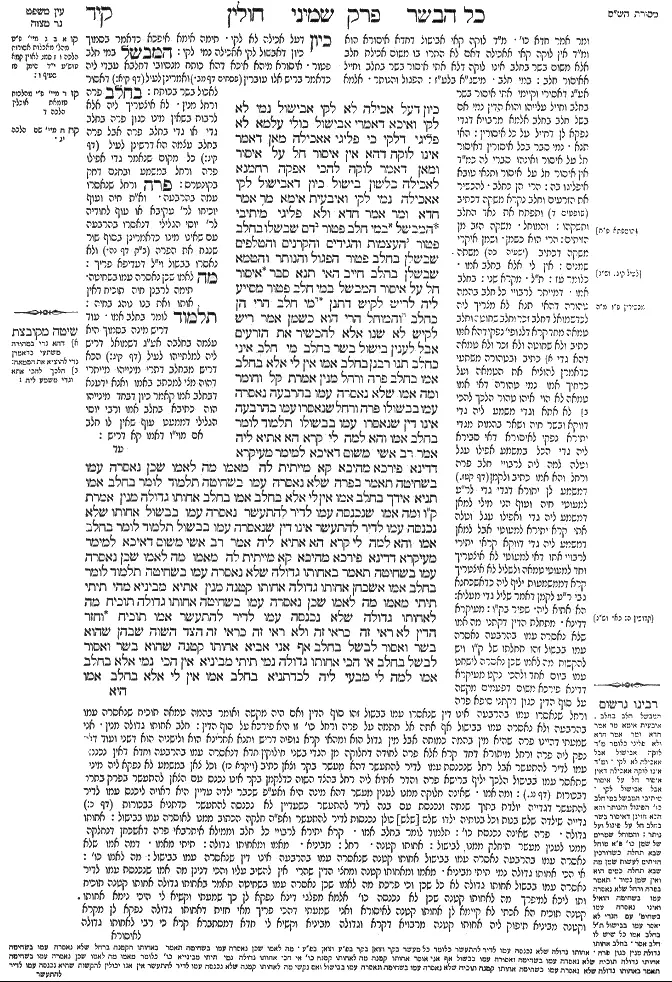
Hullin 114a - Guemara
כיון דעל אכילה לא לקי אבישול נמי לא לקי ואיכא דאמרי אבישול כולי עלמא לא פליגי דלקי כי פליגי אאכילה מאן דאמר אינו לוקה דהא אין איסור חל על איסור ומאן דאמר לוקה להכי אפקה רחמנא לאכילה בלשון בישול כיון דאבישול לקי אאכילה נמי לקי ואיבעית אימא מר אמר חדא ומר אמר חדא ולא פליגי מיתיבי המבשל במי חלב פטור דם שבשלו בחלב פטור העצמות והגידים והקרנים והטלפים שבשלן בחלב פטור הפגול והנותר והטמא שבשלן בחלב חייב האי תנא סבר איסור חל על איסור המבשל במי חלב פטור מסייע ליה לריש לקיש דתנן מי חלב הרי הן כחלב והמוחל הרי הוא כשמן אמר ריש לקיש לא שנו אלא להכשיר את הזרעים אבל לענין בישול בשר בחלב מי חלב אינו כחלב תנו רבנן בחלב אמו אין לי אלא בחלב אמו בחלב פרה ורחל מנין אמרת קל וחומר ומה אמו שלא נאסרה עמו בהרבעה נאסרה עמו בבשולו פרה ורחל שנאסרו עמו בהרבעה אינו דין שנאסרו עמו בבשולו תלמוד לומר בחלב אמו והא למה לי קרא הא אתיא ליה אמר רב אשי משום דאיכא למימר מעיקרא דדינא פירכא מהיכא קא מייתית לה מאמו מה לאמו שכן נאסרה עמו בשחיטה תאמר בפרה שלא נאסרה עמו בשחיטה תלמוד לומר בחלב אמו תניא אידך בחלב אמו אין לי אלא בחלב אמו בחלב אחותו גדולה מנין אמרת ק"ו ומה אמו שנכנסה עמו לדיר להתעשר נאסרה עמו בבשול אחותו שלא נכנסה עמו לדיר להתעשר אינו דין שנאסרה עמו בבשול תלמוד לומר בחלב אמו והא למה לי קרא הא אתיא ליה אמר רב אשי משום דאיכא למימר מעיקרא דדינא פירכא מהיכא קא מייתית לה מאמו מה לאמו שכן נאסרה עמו בשחיטה תאמר באחותו גדולה שלא נאסרה עמו בשחיטה תלמוד לומר בחלב אמו אשכחן אחותו גדולה אחותו קטנה מנין אתיא מביניא מהי תיתי תיתי מאמו מה לאמו שכן נאסרה עמו בשחיטה אחותו גדולה תוכיח מה לאחותו גדולה שלא נכנסה עמו לדיר להתעשר אמו תוכיח וחזר הדין לא ראי זה כראי זה ולא ראי זה כראי זה הצד השוה שבהן שהוא בשר ואסור לבשל בחלב אף אני אביא אחותו קטנה שהוא בשר ואסור לבשל בחלב אי הכי אחותו גדולה נמי תיתי מביניא אין הכי נמי אלא בחלב אמו למה לי מבעי ליה לכדתניא בחלב אמו אין לי אלא בחלב אמו
Comments from Rashi on Masechet Hullin Page 114a
ומר אמר חדא כו' . מ"ד לוקה קאי אבישול דחדא איסורא הוא ומ"ד אין לוקה קאי אאכילה דאם לא התרו בו משום אכילת חלב אלא משום בשר בחלב אינו לוקה דלא אתי איסור בשר בחלב וחייל אאיסור חלב: במי חלב . מישג"א בלע"ז: הפגול והנותר . אלמא אע"ג דאסירי וקיימי אתי איסור בשר בחלב וחייל עלייהו והוא הדין נמי אם בשל חלב בחלב אלמא מרבויא דגדי נפקא לן דחייל על כל איסורין: האי תנא . נמי סבר בכל איסורין דאיסור חל על איסור ואינהו סברי לה כמ"ד אין איסור חל על איסור ותנאי טובא איפליגו בה: הרי הן כחלב . להכשיר את הזרעים וחלב נקרא משקה דכתיב (שופטים ד) ותפתח את נאד החלב ותשקהו: והמוחל . משקה הזב מן הזיתים: הרי הוא כשמן . ושמן איקרי משקה דכתיב (ישעיהו כה) משתה שמנים: אין לי אלא בחלב אמו . כלומר עז: ת"ל . מקרא שני: בחלב אמו . דמייתר לרבויי כל חלב בהמה טהורה דהאי תנא לא מצריך ליה לכדשמואל דחלב זכר וחלב שחוטה וחלב טמאה מחד קרא דלגופי' נפקי דהא אמו כתיב ולא שחוטה ולא זכר ולא טמאה דהא גדי כתיב ובטהורה משתעי כדאמרן להוציא את הטמאה ועל כרחיך אמו נמי טהורה דאי אמו טמאה לא הוי איהו טהור הלכך להכי לא אתא וגדי משמע ליה גדי דווקא ובשר חיה ושאר בהמות מגדי יתירא נפקי לאיסורא דאי סבירא ליה גדי הכל במשמע אפילו עגל וטלה למה ליה לרבויי חלב פרה ורחל והא אמו כתיב ולקמן (חולין דף קטז.) דמשמע לן יתורא דגדי גדי לר"ע למעוטי חיה ועוף הני מילי למאן דמשמע ליה גדי ואפילו עגל וטלה אתי קרא יתירא למעוטי אבל למאן דמשמע ליה גדי דווקא קראי יתירי לרבויי אתו דאי למעוטי לא איצטריך וחד למעוטי טמאה ולשליל לא איצטריך קרא דממשמעות יליף ליה כדאשכחנא גבי ר"ע לקמן דאמר שליל גדי מעליא: הא אתיא ליה . שפיר בק"ו: מעיקרא דדינא . מתחלת הדין דקתני מה אמו שלא נאסרה עמו בהרבעה נאסרה עמו בבשול זהו תחלתו של ק"ו ויש להקשות מה לאמו שכן נאסרה לישחט עמו ביום אחד. ולהכי נקט מעיקרא דדינא פירכא משום דפעמים מקשה על סוף הדין כגון דקתני סיפא פרה ורחל שנאסרו עמו בהרבעה אינו דין שנאסרו עמו בבשול זהו סוף הדין ואם היה מקשה ואומר בהמה טמאה תוכיח שנאסרה עמו בהרבעה ולא נאסרה עמו בבישול אף אתה אל תתמה על פרה ורחל כו' זו היא פירכא על סוף הדין: חלב אחותו גדולה מנין . אני שמעתי דהיינו פרה שהיא מין בהמה כמותה אבל מין גדול הוא ומהאי קרא גופיה דריש ותנא אחרינא הוא ולישניה הוא דשני ועוד דלא נפק ליה פרה ורחל מיתורא דחד קרא אלא פרה לחודה דחלוקה מן הגדי בשני חילוקין חדא דנאסרה עמו בהרבעה וחדא דאין נכנסת עמו לדיר להתעשר אבל רחל שנכנסת עמו לדיר להתעשר דהא מעשר בקר וצאן כתיב (ויקרא כז) וכל צאן במשמע לא נפקא ליה מיניה שתאסר עמו בבישול הלכך יליף ברישא פרה והדר אתיא ליה רחל בהצד השוה כדלקמן. בקר אינו נכנס עם הצאן להתעשר בפרק בתרא דבכורות (דף נג.): ומה אמו . שאינה חלוקה ממנו לענין מעשר דהא מינה היא ואע"פ שכבר ילדה עדיין היא ראויה ליכנס עמו לדיר להתעשר דגדייה יולדת בתוך שנתה ונכנסת עם בנה לדיר להתעשר כשעדיין לא נכנסה להתעשר כדתניא בבכורות (דף כ:) גדייה שילדה שלש בנות וכל בנותיה ילדו שלש [שלש] כולן נכנסות לדיר להתעשר ואפ"ה חלקה הכתוב ממנו לאוסרה עמו בבישול: אחותו גדולה . פרה שאינה נכנסת כו': תלמוד לומר בחלב אמו . קרא יתירא לרבויי כל חלב וממילא איתרבאי פרה דאשכחן דנחלקה ממנו לענין מעשר תיחלק ממנו לבישול: אחותו קטנה . רחל: מביניא . מאמו ומאחותו גדולה: תיתי מאמו . דמה אמו שלא נאסרה עמו בהרבעה נאסרה עמו בבישול אחותו קטנה שנאסרה עמו בהרבעה אינו דין שנאסרה עמו בבישול: מה לאמו כו': אי הכי אחותו גדולה נמי תיתי מביניא . מאמו ומאחותו קטנה ומחצי הדין שהרי אין להשיב עליו והכי דנינן מה אמו שנכנסת עמו לדיר נאסרה עמו בבשול אחותו גדולה לא כל שכן וכי פרכת מה לאמו שכן נאסרה עמו בשחיטה תאמר באחותו גדולה אחותו קטנה תוכיח ותו ליכא למיפרך מה לאחותו קטנה שכן לא נכנסה כו' אלמא מפלגי דינא נפקא לן כך שמעתי וקשיא לי היכי נימא אחותו קטנה תוכיח הא אכתי לא קיימא לן אחותו קטנה לאיסורא. ואני שמעתי דהכי פריך מאי חזית דאחותו גדולה נפקא לן מקרא וקטנה מביניא תיפוק ליה אחותו קטנה מרבויא דקרא וגדולה מביניא וקשיא לי חדא דמסתברא קרא כי רבי לאחותו גדולה לאיסורא רבי שנאסרה עמו במעשר אבל קטנה לא ועוד מאי קא מותיב לקמיה בחלב אמו למאי אתא טובא איצטריך לאחותו קטנה. ורואה אני את דברי ר' יוסף טוב עלם ז"ל שראיתי תשובת כתב ידו דאחותו גדולה ואחותו קטנה אמינו ממש קאמר שהן מין גדי כמותו וגדולה זו היא זקנה שכבר נתעשרה וקטנה זו היא גדייה שלא נתעשרה עדיין והאי תנא היינו תנא גופיה דלעיל דאתיא ליה פרה ורחל מחד מקראי יתירי והשתא קא דריש לאידך וה"ק אחותו גדולה שנתעשרה כבר מנין וע"כ נקט גדולה משום דסופו יליף לה מרבויא וקטנה לא מיתרביא ליה מיניה משום דמסתברא כי רבי קרא לאיסורא גדולה רבי דנאסרה עמו במעשר דאילו מקרא יתירא קמא לא מצי לרבויי דאיכא למימר כי רבי לאיסורא לא רבי אלא פרה ורחל דאסורין עמו בהרבעה אבל אחותו לא ולהכי אשמעינן קרא אחרינא לאחותו גדולה וקטנה אתיא מביניא: אי הכי . דקטנה אתיא לה מביניא: אחותו גדולה נמי . לא תיבעי קרא ותיתי מביניא דאמו ופרה ודרוש הכי מה אמו שנכנסה עמו לדיר נאסרה עמו בבשול אחותו גדולה לא כ"ש מה לאמו שכן נאסרה עמו בשחיטה פרה תוכיח מה לפרה שכן נאסרה עמו בהרבעה ובמעשר אמו תוכיח שמותרת עמו בהרבעה ובמעשר וחזר הדין הצד השוה שבהן שהם חלב כו' ואתיא מביניא בין אחותו גדולה ובין קטנה: אלא . קרא שלישי למאי אתא קמא לגופיה תניינא לפרה ורחל ואידך למאי:
Comments from Tosafot - Hullin 114a
כיון דעל אכילה לא לקי . תימה אימא איפכא כדאמר בסמוך כיון דאבשול לקי אאכילה נמי לקי: המבשל במי חלב פטור . איסורא מיהא איכא דהא כותח מנסיובי דחלבא עבדי ליה כדאמר בריש אלו עוברין (פסחים דף מב.) ואמרינן לעיל (חולין דף קיא:) דאסור לאכול בשר בכותח: בחלב פרה ורחל מנין . לא איצטריך ליה אלא לרבות בשאין מינו כגון פרה בחלב גדי או גדי בחלב פרה אבל פרה בחלב עצמה הא דרשינן לעיל (חולין דף קיג:) כל מקום שנאמר גדי אפילו פרה ורחל במשמע ובחנם דחק בקונטרס: פרה ורחל שנאסרו עמה בהרבעה . וא"ת חיה ועוף יוכיחו לר' עקיבא או עוף לחודיה לר' יוסי הגלילי דנאסרו בהרבעה עם שאינו מינו כדאמרינן בסוף שור שנגח את הפרה (ב"ק דף נה.) ולא נאסרו בבשול וי"ל דעדיפא פריך: מה לאמו שכן נאסרה עמו בשחיטה . תימה לרבנן חיה תוכיח דאין אותו ואת בנו נוהג בחיה: תלמוד לומר בחלב אמו . עוד דריש מינה בסמוך היא עצמה בחלבה אע"ג דשמואל דריש ליה למלתייהו לעיל (חולין דף קיג:) הכא דריש מבחלב דתרי מינייהו מייתרי דהוה מצי למכתב באמו ואנא ידענא דבחלב אמו קאמר כיון דבחד מינייהו הוה כתיבא בחלב אמו ורבי יוסי הגלילי דממעט עוף שאין לו חלב אם מוי"ו דאמו קא דריש:
Hullin 114a - Mishnah translated into english
This link between cooking and eating indicates that since one is not flogged for eating forbidden fat cooked in milk, as agreed upon above, one also is not flogged for cooking the two together.
And some say the opposite: With regard to cooking, everyone agrees that one is flogged for this act, since the principle of a prohibition not taking effect where another prohibition already exists is not relevant. When they disagree, it is with regard to eating. The one who says he is not flogged applies the principle that a prohibition does not take effect where another prohibition already exists, and the fat was already prohibited for consumption in its own right before being cooked with milk. And the one who says he is flogged holds that it was for this reason that the Merciful One expressed the prohibition of eating meat cooked in milk using the language of cooking, to teach that since one is flogged for cooking forbidden fat in milk, one also is flogged for eating the product.
The Gemara suggests a third explanation of the dispute between Rabbi Ami and Rabbi Asi: And if you wish, say that one Sage said one statement and one Sage said another statement, and they do not disagree, as they are referring to different cases. The Sage who said that one is flogged is referring to the transgression of cooking forbidden fat with milk, whereas the one who said one is not flogged is referring to the consumption of forbidden fat with milk. Everyone agrees that a prohibition does not take effect where another prohibition already exists, and therefore one is flogged only for cooking forbidden fat in milk, but not for eating the two together.
The Gemara raises an objection from a Tosefta (8:3): One who cooks meat in whey, the liquid leftover after milk has been curdled, is exempt from lashes, as whey is not defined as milk for purposes of the prohibition. Likewise, for blood that one cooked in milk, he is exempt, as blood is not considered meat. Similarly, with regard to the bones, the tendons, the horns, and the hooves that one cooked in milk, he is exempt.
The Tosefta continues: By contrast, with regard to prohibited piggul meat, i.e., meat from an offering that was sacrificed with the intent to sprinkle its blood or partake of its meat beyond its designated time, and similarly prohibited notar, meat from an offering whose period for consumption has expired, and the prohibited impure meat of an offering, that one cooked in milk, he is liable to be flogged for violating the prohibition of meat cooked in milk. This indicates that the prohibition applies to items already prohibited for consumption, contrary to the above opinion attributed to Rabbi Ami and Rabbi Asi.
The Gemara answers: This tanna of the baraita maintains in general that a prohibition takes effect where another prohibition already exists, whereas Rabbi Ami and Rabbi Asi are of the opposite opinion. It is conceivable that these Sages, who are amora’im, disagree with that tanna, as the issue of whether a prohibition takes effect where another prohibition already exists is a well-known dispute among the tanna’im themselves.
§ It was stated in the above baraita: One who cooks meat in whey is exempt from lashes. The Gemara comments: This ruling supports the opinion of Reish Lakish, as we learned in a mishna, with regard to liquids that render food susceptible to ritual impurity (Makhshirin 6:5): The halakhic status of whey is like that of milk, which is one of the liquids that render food susceptible to impurity, and the halakhic status of olive secretion is like that of oil, which also renders food susceptible to impurity. With regard to this mishna, Reish Lakish says: They taught this halakha only with regard to rendering seeds, i.e., produce, susceptible to impurity. But with regard to cooking meat in milk, the halakhic status of whey is not like that of milk.
§ The Sages taught in a baraita: From the phrase “in its mother’s milk” I have derived only that the prohibition applies to the mother goat’s milk. From where do I derive that it also applies to the milk of a cow and a ewe?
You can say an a fortiori inference: Just as a kid’s mother, which is not prohibited for mating with the kid, as they are of the same species, is nevertheless prohibited for cooking with it, as stated in the verse, is it not right that a cow or a ewe, which are prohibited for mating with it, as they are of different species, should be prohibited for cooking with it? Therefore, the verse states elsewhere: “In its mother’s milk,” a second time, to include a cow and a ewe.
The Gemara challenges the conclusion of the baraita. But why do I need a verse? It was just derived through the a fortiori inference.
Rav Ashi said: It is needed because one can say that the refutation of the a fortiori inference is present from the outset, i.e., there is a difficulty with the comparison: From where do you derive the inference? It is derived from its mother goat, which the baraita presents as being treated more leniently than a cow or ewe since it may be mated with a kid. But there is a stringent aspect of the mother goat not shared by a cow or ewe: What is unique about its mother? It is unique in that it is prohibited for slaughter with it, since one may not slaughter an animal and its mother on the same day (see Leviticus 22:28). Will you say the same about a cow, which is not prohibited for slaughter with it? Therefore, the verse states: “In its mother’s milk,” to include a cow and a ewe.
§ The above baraita accounts for two of the Torah’s three mentions of the phrase “in its mother’s milk.” The Gemara now addresses the third. It is taught in another baraita: From one instance of the phrase “in its mother’s milk” I have derived only that the prohibition applies to the milk of its mother, if the mother is less than a year old and has not yet entered the pen for the purpose of its owner’s separating the annual animal tithe. From where do I derive that it also applies to the milk of its older sister, i.e., one that is more than a year old that has already entered the pen for the animal tithe in the previous year?
You can say an a fortiori inference: Just as a kid’s mother, which enters the pen to be tithed with it, is nevertheless prohibited for cooking with it, is it not right that its sister, which does not enter the pen to be tithed with it, should be prohibited for cooking with it? Therefore, the verse states elsewhere: “In its mother’s milk,” a third time, to include the older sister in the prohibition.
The Gemara asks: But why do I need a verse? It was just derived from the a fortiori inference. Rav Ashi said: It is needed because one can say that the refutation of that a fortiori inference is present from the outset. From where do you derive the inference? It is derived from its mother. But one may respond: What is unique about its mother? It is unique in that it is prohibited for slaughter with it on the same day. Will you say the same halakhot apply to its older sister, which is not prohibited for slaughter with it? Therefore, the verse states: “In its mother’s milk,” including the older sister.
The Gemara continues: We have found a source for the halakha that its older sister is included in the prohibition of meat cooked in milk. From where is it derived that the same applies to its younger sister, one that has not yet entered the pen for the tithe? The Gemara responds: It is derived from between them, i.e., from the combination of the mother and the older sister.
The Gemara elaborates on the need for both cases in order to derive the third: From which of the two cases should it be derived? If it should be derived from its mother, one can claim: What is unique about its mother? It is unique in that it is prohibited for slaughter with it on the same day, unlike the younger sister. One may respond: Its older sister can prove the point, since it is not prohibited for slaughter with the kid, but it is still included in the prohibition of meat cooked in milk. But this can be refuted as well: What is unique about its older sister? It is unique in that it does not enter the pen to be tithed with it, unlike the younger sister. One may respond that its mother can then prove the point, as it can enter the pen to be tithed with the kid and is still included in the prohibition.
And consequently, the inference has reverted to its starting point: The aspect of this case is not like the aspect of that case and the aspect of that case is not like the aspect of this case; their common element is that both the mother and older sister are meat and it is prohibited to cook them in milk. If so, I will also include its younger sister in the prohibition, since it is also meat, and therefore it is prohibited to cook it in milk.
The Gemara challenges: If so, the inclusion of its older sister in the prohibition can also be derived from between them, i.e., from the combination of the kid’s mother and a cow. Although both a cow and the mother possess unique stringencies not shared by the older sister, i.e., the prohibition of mating and of slaughtering with the kid, respectively, neither possesses both stringencies, and the halakha with regard to the older sister can be derived from their common element, i.e., that they are both meat and prohibited to cook in milk, as stated above. If so, what need is there to derive this halakha from the verse?
The Gemara responds: Yes, it is indeed so; the halakha with regard to the older sister is derived from the common denominator of the mother and a cow. Rather, why do I need the verse’s additional mention of the phrase “in its mother’s milk?” It is necessary for that which is taught in a baraita: When the verse states: “In its mother’s milk,” I have derived only the prohibition to cook the kid in its mother’s milk;
Traduction : The William Davidson digital edition of the Koren Noé Talmud, with commentary by Rabbi Adin Even-Israel Steinsaltz.