 Talmud Bavli
Hullin 75a : Youtube
Rabbi Dr. Moshe WeisblumYoutube
1 video class :
Hullin Page 75a
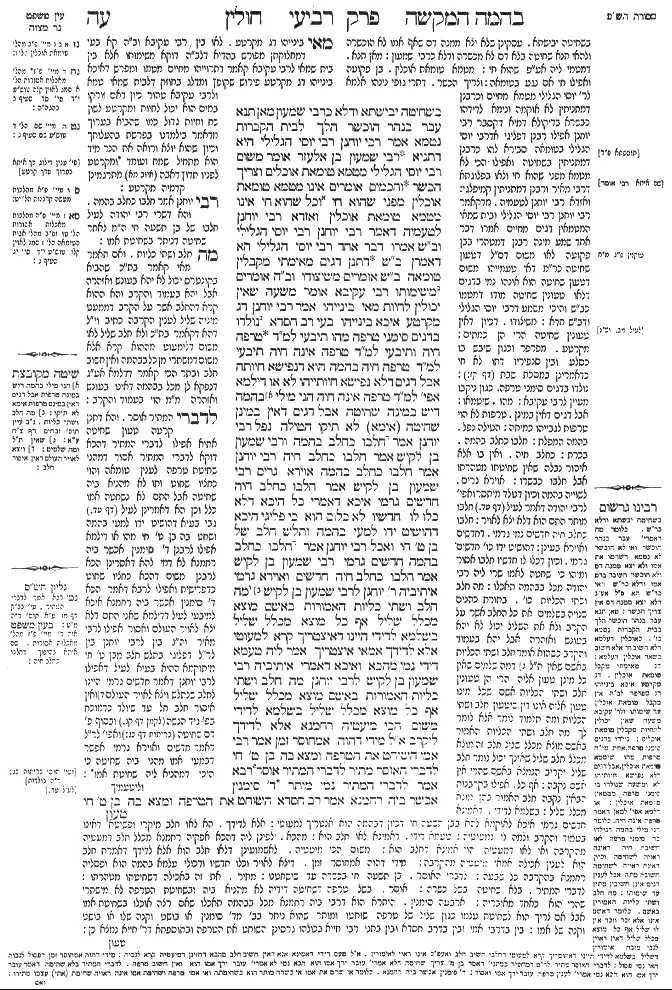
Hullin 75a - Guemara
בשחיטה יבישתא ודלא כרבי שמעון מאן תנא עבר בנהר הוכשר הלך לבית הקברות נטמא אמר רבי יוחנן רבי יוסי הגלילי היא דתניא רבי שמעון בן אלעזר אומר משום רבי יוסי הגלילי מטמא טומאת אוכלים וצריך הכשר וחכמים אומרים אינו מטמא טומאת אוכלין מפני שהוא חי וכל שהוא חי אינו מטמא טומאת אוכלין ואזדא רבי יוחנן לטעמיה דאמר רבי יוחנן רבי יוסי הגלילי וב"ש אמרו דבר אחד רבי יוסי הגלילי הא דאמרן ב"ש דתנן דגים מאימתי מקבלין טומאה ב"ש אומרים משיצודו וב"ה אומרים משימותו רבי עקיבא אומר משעה שאין יכולין לחיות מאי בינייהו אמר רבי יוחנן דג מקרטע איכא בינייהו בעי רב חסדא נולדו בדגים סימני טרפה מהו תיבעי למ"ד טרפה חיה ותיבעי למ"ד טרפה אינה חיה תיבעי למ"ד טרפה חיה בהמה הוא דנפישא חיותה אבל דגים דלא נפישא חיותייהו לא או דילמא אפי' למ"ד טרפה אינה חיה הני מילי בהמה דיש במינה שחיטה אבל דגים דאין במינן שחיטה (אימא) לא תיקו הטילה נפל רבי יוחנן אמר חלבו כחלב בהמה ורבי שמעון בן לקיש אמר חלבו כחלב חיה רבי יוחנן אמר חלבו כחלב בהמה אוירא גרים רבי שמעון בן לקיש אמר חלבו כחלב חיה חדשים גרמי איכא דאמרי כל היכא דלא כלו לו חדשיו לא כלום הוא כי פליגי היכא דהושיט ידו למעי בהמה ותלש חלב של בן ט' חי ואכל רבי יוחנן אמר חלבו כחלב בהמה חדשים גרמי רבי שמעון בן לקיש אמר חלבו כחלב חיה חדשים ואוירא גרמי איתיביה ר' יוחנן לרבי שמעון בן לקיש מה חלב ושתי כליות האמורות באשם מוצא מכלל שליל אף כל מוצא מכלל שליל בשלמא לדידי היינו דאיצטריך קרא למעוטי אלא לדידך אמאי איצטריך אמר ליה טעמא דידי נמי מהכא ואיכא דאמרי איתיביה רבי שמעון בן לקיש לרבי יוחנן מה חלב ושתי כליות האמורות באשם מוצא מכלל שליל אף כל מוצא מכלל שליל בשלמא לדידי משום הכי מיעטיה רחמנא אלא לדידך ליקרב א"ל מידי דהוה אמחוסר זמן אמר רבי אמי השוחט את הטרפה ומצא בה בן ט' חי לדברי האוסר מתיר לדברי המתיר אוסר רבא אמר לדברי המתיר נמי מותר ד' סימנין אכשר ביה רחמנא אמר רב חסדא השוחט את הטרפה ומצא בה בן ט' חי
Comments from Rashi on Masechet Hullin Page 75a
בשחיטה יבישתא . עסקינן שלא יצא ממנה דם שאף אמו לא הוכשרה ולהאי תנא שחיטה בלא דם לא מכשרה ודלא כרבי שמעון: מאן תנא . דמטמי ליה אע"פ שהוא חי: מטמא טומאת אוכלין . בן פקועה ואפילו חי אם נגע בטומאה: וצריך הכשר . דתרי גופי נינהו. אלמא לר' יוסי הגלילי מטמא מחיים וכרבנן דמתניתין לא אוקמה ונימא לדידהו כבשרא בדיקולא דמיא דקסבר רבי יוחנן אפילו רבנן דפליגי אדרבי יוסי הגלילי בטומאה סבירא להו כרבנן דמתניתין בשחיטה ואפילו הכי לא מטמא מפני שהוא חי ולאו בפלוגתא דרבי מאיר ורבנן דמתניתין קמיפלגי: ואזדא רבי יוחנן לטעמיה . מדקאמר רבי יוחנן רבי יוסי הגלילי ובית שמאי המטמאין דגים מחיים אמרו דבר אחד שמע מינה רבנן דמטהרי בבן פקועה לאו משום דס"ל דטעון שחיטה כר"מ דאי טעמייהו משום דטעון שחיטה הוא אינהו נמי בדגים דלאו טעונין שחיטה מודו דמטמו כב"ש והיכי משמע דרבי יוסי הגלילי ודב"ש חדא: משיצודו . דכיון דאין טעונין שחיטה הרי הן כמתים: מקרטע . מפרפר וכגון שיבש בו כסלע ובין סנפיריו דתו לא חי כדאמרינן במסכת שבת (דף קז:): נולדו בדגים סימני טרפה . כגון ניקבו מעיין לרבי עקיבא: מהו . שיטמאו: אבל דגים דאין במינן . טרפות לא הוי טרפות לגבייהו כמיתה: הטילה נפל . בהמה המפלת: חלבו כחלב בהמה . בכרת: כחלב חיה . ואין בו אלא איסור נבלה שאין שחיטתו מטהרתו אבל חלבו כבשרו:
אוירא גרים . לשוייה בהמה וכיון דנולד מיתסר ואפי' לרבי יהודה דאמר לעיל (חולין דף עד.) חלבו מותר התם הוא דלא יצא לאויר: חלבו כחלב חיה חדשים נמי גרמי . דחדשים ואוירא בעינן: דהושיט ידו כו' חדשים גרמי . וכיון דכלו לו חדשיו חלבו אסור ומיהו כי שחטה לאמו שרי ליה רבי יהודה מכל בבהמה תאכלו:
מה חלב ושתי הכליות כו' . בתורת כהנים שנויה בשלמים את כל החלב אשר על הקרב ולא את השליל יכול לא יהא בעונש ואזהרה אבל יהא בעמוד והקרב כשהוא אומר חלב ושתי הכליות באשם שאין ת"ל דמה שלמים שאין כל מינן טעון אליה הרי הן טעונין חלב ושתי הכליות אשם שכל מינו טעון אליה אינו דין שיטעון חלב ושתי הכליות ומה תלמוד לומר אלא לומר לך מה חלב ושתי הכליות האמור באשם מוצא מכלל שליל חלב זה מוצא מכלל חלב שליל שאינך יכול לומר חלב שליל יקריב הנמצא באשם שהרי אין אשם נקבה: אף כל . אפילו בקרבנות הבאין נקבה חלב האמור בהן מוצא מכלל שליל: בשלמא לדידי . דאמינא חדשים גרמי איכא לאוקמא להא בבן תשעה חי דכיון דבהמה הוא אצטריך למעוטי: אלא לדידך . הא לאו חלב מיקרי ופשיטא דאינו בעמוד והקרב ולמה לי למעוטיה: טעמא דידי . דאמינא לאו חלב הוא: מהכא . ילפינן ליה דהכא אפקיה רחמנא מכלל חלב דמעטיה מהקרבה ואי לאו דמעטיה הוי אמינא דחלב הוא: משום הכי מיעטיה . לאשמועינן דלאו חלב הוא אלא לדידך דאמרת חלב הוא לענין אכילה אמאי מיעטיה מהקרבה: מידי דהוה אמחוסר זמן . דיצא לאויר וכלו חדשיו ודכולי עלמא בהמה הוא ופסליה רחמנא בהקרבה כל שבעה: לדברי האוסר . בן תשעה חי בכשרה עד שישחטנו: מתיר . את זה באכילה דשחיטתו מטהרתו: לדברי המתיר . בלא שחיטה בשל כשרה: אוסר . בשל טרפה דשחיטה דידיה לא מהניא ביה ובשחיטת הטרפה לא מישתרי שהרי הוא כאחד מאיבריה: ארבעה סימנין . היתרא הוא דרבי ביה רחמנא מכל בבהמה תאכלו שאם רצה אוכלו בשחיטת אמו אבל אם צריך הוא לשחיטת עצמו כגון שליל של טרפה שוחטו ומותר שהוא
ניתר בב' מד' סימנין או בושט וקנה שלו או בושט וקנה של אמו: בין בדרבי אמי ובין בדרב חסדא ובין בתני רבי חייא בכולהו גרסינן השוחט את הטרפה ובתוספתא דר' חייא נמצא כן:
Comments from Tosafot - Hullin 75a
מאי בינייהו דג מקרטע . לאו בין רבי עקיבא וב"ה קא בעי דמחלוקתן מפורש בהדיא דלב"ה דוקא משימותו אלא בין בית שמאי לרבי עקיבא קאמר דתרוייהו מחיים מטמו ומפרש דאיכא בינייהו דג מקרטע פירוש שקופץ ומדלג בחוזק דלבית שמאי טמא ולרבי עקיבא טהור כיון דאם זורקו במים הוא יכול לחיות ומקרטע לשון כח וחיות גדול כמו שהביא בערוך מדאמר בילמדנו בפרשת בהעלותך וכיון שהוא יוצא ורואה את הנר מיד הוא מתחיל שמח ועומד ומקרטע לפניו תדוץ דאבה (איוב מא) מתרגמינן קדמיה מקרטע: רבי יוחנן אמר חלבו כחלב בהמה . והא דשרי רבי יהודה לעיל חלבו של בן תשעה חי ה"מ לאחר שחיטה דניתר בשחיטת אמו: מה חלב ושתי כליות . ואם תאמר מאי קאמר בת"כ שהביא בקונטרס יכול לא יהא בעונש ואזהרה אבל יהא בעמוד והקרב והא ההוא קרא דהחלב אשר על הקרב דממעט מיניה שליל לענין הקרבה כתיב וי"ל דהא דקאמר בת"כ ולא חלב שליל לאו משום דלימעוט מההוא קרא אלא משום דמשתרי מן כל בבהמה ואין חשוב חלב ובתר הכי קאמר דדלמא אע"ג דנפקא לן מכל בבהמה דאינו בעונש ואזהרה מ"מ הוי בעמוד והקרב: לדברי המתיר אוסר . והא דתנן קרעה טעון שחיטה אתיא אפילו לדברי המתיר דהכא דוקא לדברי המתיר אסור דמהני שחיטת טרפה לענין טומאה והוי כחציו שחוט ותו לא מהניא ביה שחיטה אבל התם לא נשחטה אמו כלל וכן הא דאמרינן לעיל (חולין דף עד.) גבי בעיא דהושיט ידו למעי בהמה ושחט בה בן ט' חי מהו או דילמא אפילו לרבנן ד' סימנין אכשר ביה רחמנא לא דמי להא דאסרינן הכא לרבנן משום דהכא כחציו שחוט כדפרישית ואפילו לרבא דאמר הכא ד' סימנין אכשר ביה רחמנא איכא למיבעי לעיל דדילמא שאני התם דלא יצא לאויר העולם ואסור אפילו לרבי מאיר וה"נ בין לרבי יוחנן בין לר"ל דפליגי בתלש חלב מבן ט' חי מיתוקמא ההיא בעיא לעיל דאפילו לרבי יוחנן דאמר חדשים גרמי היינו לחלב שנתלש ויצא לאויר העולם ואין איסור חלב חל עד שיולד כדמוכח בפ' גיד הנשה (לקמן חולין דף קג.) ובסוף פ' דם שחיטה (כריתות דף כג:) ואפי' לר"ל דאמר חדשים ואוירא גרמי אפשר דבמעי אמו מהני ביה שחיטה כי היכי דמהניא ליה שחיטת אמו:
Hullin 75a - Mishnah translated into english
Rabbi Shimon ben Lakish answers: The baraita is referring to a case where the slaughter of the mother was dry, i.e., where no blood was emitted, and therefore, even the mother was not rendered susceptible to ritual impurity. And the baraita is not in accordance with the opinion of Rabbi Shimon, who maintains that the flesh of a slaughtered animal is rendered susceptible to ritual impurity by virtue of the fact that it is permitted for consumption, regardless of whether or not it came into contact with blood or other liquids.
The Gemara asks: Who is the tanna who taught this baraita: If a ben pekua grew up and passed through a river, it was thereby rendered susceptible to impurity, and therefore if it went from there to a cemetery, it is rendered impure? Rabbi Yoḥanan said: It is the opinion of Rabbi Yosei HaGelili, as it is taught in a baraita that Rabbi Shimon ben Elazar says in the name of Rabbi Yosei HaGelili: The flesh of a ben pekua can become impure with the ritual impurity of food, but it first needs to be rendered susceptible to ritual impurity by coming in contact with liquid. But the Rabbis say: It cannot become impure with the ritual impurity of food because it is alive, and any live animal cannot become impure with the ritual impurity of food, even if it is permitted for consumption.
The Gemara notes: And Rabbi Yoḥanan follows his standard line of reasoning, as Rabbi Yoḥanan says that Rabbi Yosei HaGelili and Beit Shammai said the same thing, i.e., they both hold that even a live animal can become impure with the ritual impurity of food.
The opinion of Rabbi Yosei HaGelili is that which we stated in the baraita. The opinion of Beit Shammai is as we learned in a mishna (Okatzin 3:8): With regard to fish, from when are they susceptible to impurity as food? Beit Shammai say: From when they are caught in a trap, as at this point they are considered food, since they do not require slaughter. And Beit Hillel say: From when they die. Rabbi Akiva says: From when they are no longer able to live.
The Gemara analyzes that mishna: What is the difference between the opinions of Rabbi Akiva and Beit Hillel? Rabbi Yoḥanan said: The difference between them is the case of a convulsing fish. Rabbi Akiva holds that such a fish can already become ritually impure, while Beit Hillel require it to have actually died.
Rav Ḥisda raises a dilemma: According to Rabbi Akiva, if symptoms of a tereifa developed in a fish, e.g., a perforation in the intestines, which will certainly result in the animal’s death (see 42a), what is the halakha? Can it already be rendered ritually impure as if it were now dead? The Gemara clarifies: One can raise this dilemma according to the one who says that an animal that is a tereifa can live, i.e., it will not necessarily die within a year, and one can raise this dilemma according to the one who says that a tereifa cannot live, but will die within a year.
The Gemara elaborates: One can raise this dilemma according to the one who says that a tereifa can live, as perhaps that opinion is limited to an animal, as an animal has a strong life force, and it could live despite such symptoms. But with regard to a fish, whose life force is not strong, all would agree that it will not survive. Or perhaps, even according to the one who says that a tereifa cannot live, it is possible that this matter, that a tereifa is regarded as dead, applies only to an animal, as the requirement to slaughter it in order to permit it for consumption applies to this type of creature, i.e., to animals, and so to invalidate its slaughter, the Torah classifies an animal that is a tereifa as though it is dead. But with regard to fish, where the requirement to slaughter it in order to permit it does not apply to this type of creature, I would say that a fish with symptoms of a tereifa is not considered as though it were dead. The Gemara concludes: The dilemma shall stand unresolved.
§ The Rabbis state in the mishna that a nine-month-old fetus is considered to be part of its mother. Therefore, when the mother is slaughtered, the entire fetus is permitted, including all its fats. The Gemara asks: If an animal expelled a non-viable newborn, what is the status of the fetus’s fat? Rabbi Yoḥanan said: Its fat is like the fat of any other domesticated animal, and one is liable to receive karet if he eats it. And Rabbi Shimon ben Lakish said: Its fat is like the fat of an undomesticated animal, which is not prohibited.
The Gemara elaborates: Rabbi Yoḥanan said: Its fat is like the fat of any other domesticated animal, as he maintains that the exit of a fetus through the airspace of the opening of the womb causes it to be regarded as an independent animal. Rabbi Shimon ben Lakish said: Its fat is like the fat of an undomesticated animal, as he maintains that the completion of the months of gestation causes a fetus to be regarded as an independent animal, and this stillborn did not reach this stage.
Some say that there is another explanation of this dispute: In any case where its months of gestation were not completed, everyone agrees that it is nothing, i.e., it is not an independent animal and its fat is not included in the prohibition of forbidden fats. When they disagree it is with regard to a case where one inserted his hand into the womb of an animal and removed the fat of a live nine-month-old fetus and ate it. Rabbi Yoḥanan said: Its fat is like the fat of any other domesticated animal, as the months of gestation alone cause it to be regarded as an independent animal. Rabbi Shimon ben Lakish said: Its fat is like the fat of an undomesticated animal, as it is the months of gestation and its exit through the airspace of the opening of the womb that together cause it to be regarded as an independent animal. Since this fetus was not yet born, it is not subject to the prohibition of forbidden fats.
Rabbi Yoḥanan raised an objection to Rabbi Shimon ben Lakish from a baraita that discusses the sacrifice of the fat surrounding a fetus inside a pregnant animal: Just as with regard to the requirement to sacrifice the fat and two kidneys (see Leviticus 7:3–4), which is stated with regard to a guilt offering, the fat of a fetus is excluded from the category of fats that one is required to sacrifice because a guilt offering is always a male, so too, with regard to every offering, even in the case of a female offering, the fat of a fetus is excluded from the category of fats that one is required to sacrifice.
Rabbi Yoḥanan explains his objection: Granted, according to my opinion that the fat of a fetus is forbidden for consumption, this is why a verse was necessary to exclude it from being sacrificed on the altar. But according to your opinion that it is not forbidden, why is a verse necessary to exclude it? Rabbi Shimon ben Lakish said to him: My explanation is also derived from the verse here, which serves as the source for the fact that the fat of a fetus is not forbidden.
And some say that there is another version of this objection in which Rabbi Shimon ben Lakish raised an objection to Rabbi Yoḥanan from that baraita: Just as with regard to the requirement to sacrifice “the fat and two kidneys” that is stated with regard to a guilt offering, the fat of a fetus is excluded from the category of fats that one is required to sacrifice, so too, with regard to every offering, the fat of a fetus is excluded from the category of fats that one is required to sacrifice.
Rabbi Shimon ben Lakish explains the objection: Granted, according to my opinion that the fat of the fetus is not prohibited like the other fats, it is due to that reason that the Merciful One excludes it from the requirement of being sacrificed. But according to your opinion, that the fat of the fetus is considered one of the forbidden fats, let it also be sacrificed. Rabbi Yoḥanan said to him: The reason that this fat is not sacrificed is just as it is with regard to an offering whose time has not yet arrived, i.e., it is not yet seven days old, which may not be sacrificed (see Leviticus 22:27) despite being of a species of animal that may be sacrificed. Similarly, with regard to the fat of the fetus, despite being included among those fats that are prohibited, it may not be sacrificed.
§ The Gemara returns to the dispute in the mishna with regard to a nine-month-old fetus found alive inside its slaughtered mother. Rabbi Meir holds that the fetus itself must be slaughtered in order to permit it, whereas the Rabbis hold that it is permitted by virtue of the slaughter of its mother. Rabbi Ami said: With regard to one who slaughtered a tereifa and found inside it a live nine-month-old fetus: According to the statement of Rabbi Meir, who prohibits a nine-month-old fetus found inside a kosher animal until it is slaughtered itself, if it is found inside a tereifa he permits the fetus once it is slaughtered itself. But according to the statement of Rabbi Yehuda, referred to as the Rabbis in the mishna, who permits a nine-month-old fetus found inside a kosher animal by virtue of the slaughter of its mother, if it is found inside a tereifa he prohibits it, even if it is slaughtered itself.
Rava said: According to the statement of Rabbi Yehuda, who permits a nine-month-old fetus found inside a kosher animal by virtue of the slaughter of its mother, he also permits it if it is found inside a tereifa, once the fetus itself is slaughtered. The reason is that the Merciful One considers four simanim to be fit for slaughter, i.e., the windpipe and gullet of the mother and those of the fetus, with the fetus being permitted by the cutting of either pair.
Rav Ḥisda said: With regard to one who slaughtered a tereifa and found inside it a live nine-month-old fetus,
Traduction : The William Davidson digital edition of the Koren Noé Talmud, with commentary by Rabbi Adin Even-Israel Steinsaltz.