 Talmud Bavli
Hullin 116a : Youtube
Rabbi Dr. Moshe WeisblumYoutube
1 video class :
Hullin Page 116a
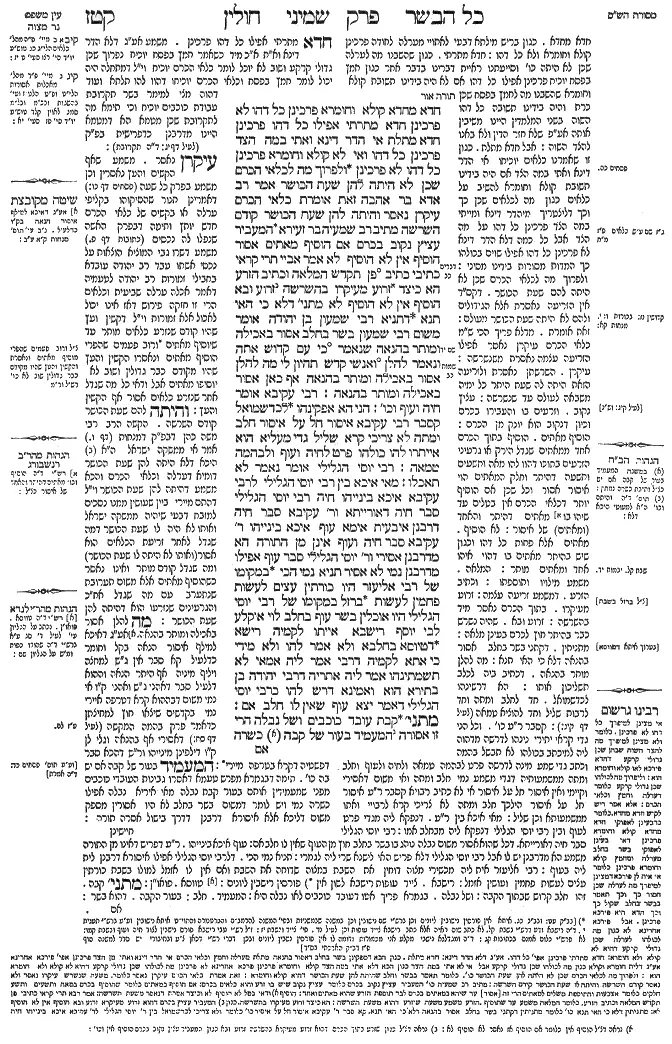
Hullin 116a - Guemara
חדא מחדא קולא וחומרא פרכינן כל דהו לא פרכינן חדא מתרתי אפילו כל דהו פרכינן חדא מתלת אי הדר דינא ואתי במה הצד פרכינן כל דהו ואי לא קולא וחומרא פרכינן כל דהו לא פרכינן ולפרוך מה לכלאי הכרם שכן לא היתה להן שעת הכושר אמר רב אדא בר אהבה זאת אומרת כלאי הכרם עיקרן נאסר והיתה להן שעת הכושר קודם השרשה מתיב רב שמעיה בר זעירא המעביר עציץ נקוב בכרם אם הוסיף מאתים אסור הוסיף אין לא הוסיף לא אמר אביי תרי קראי כתיבי כתיב (דברים כב, ט) פן תקדש המלאה וכתיב הזרע הא כיצד זרוע מעיקרו בהשרשה זרוע ובא הוסיף אין לא הוסיף לא מתני' דלא כי האי תנא דתניא רבי שמעון בן יהודה אומר משום רבי שמעון בשר בחלב אסור באכילה ומותר בהנאה שנאמר (דברים יד, ב) כי עם קדוש אתה ונאמר להלן (שמות כב, ל) ואנשי קדש תהיון לי מה להלן אסור באכילה ומותר בהנאה אף כאן אסור באכילה ומותר בהנאה:
רבי עקיבא אומר חיה ועוף וכו':
הני הא אפקינהו לכדשמואל קסבר רבי עקיבא איסור חל על איסור חלב ומתה לא צריכי קרא שליל גדי מעליא הוא אייתרו להו כולהו פרט לחיה ועוף ולבהמה טמאה:
רבי יוסי הגלילי אומר נאמר לא תאכלו:
מאי איכא בין רבי יוסי הגלילי לרבי עקיבא איכא בינייהו חיה רבי יוסי הגלילי סבר חיה דאורייתא ור' עקיבא סבר חיה דרבנן איבעית אימא עוף איכא בינייהו ר' עקיבא סבר חיה ועוף אינן מן התורה הא מדרבנן אסירי ור' יוסי הגלילי סבר עוף אפילו מדרבנן נמי לא אסיר תניא נמי הכי במקומו של רבי אליעזר היו כורתין עצים לעשות פחמין לעשות ברזל במקומו של רבי יוסי הגלילי היו אוכלין בשר עוף בחלב לוי איקלע לבי יוסף רישבא אייתו לקמיה רישא דטיוסא בחלבא ולא אמר להו ולא מידי כי אתא לקמיה דרבי אמר ליה אמאי לא תשמתינהו אמר ליה אתריה דרבי יהודה בן בתירא הוא ואמינא דרש להו כרבי יוסי הגלילי דאמר יצא עוף שאין לו חלב אם:
מתני׳ קבת עובד כוכבים ושל נבלה הרי זו אסורה המעמיד בעור של קבה כשרה
Comments from Rashi on Masechet Hullin Page 116a
חדא מחדא . כגון בריש מילתא דבעי לאתויי מערלה לחודה פרכינן קולא וחומרא ולא כל דהו: חדא מתרתי . כגון שהשבנו מה לערלה שכן לא היתה כו' וסייעתנו ראיית דברינו בדבר אחר כגון חמץ בפסח יוכיח פרכינן אפילו כל דהו אם לא היה בידינו תשובת קולא וחומרא שהשבנו מה לחמץ בפסח שכן כרת והיה בידינו תשובה כל דהו השוה בשני המלמדין היינו משיבין אותה אע"פ שלא חזר הדין ולא באנו להצד השוה: אבל חדא מתלת . כגון זו שאמרנו כלאים יוכיחו אי הדר דינא ואתי במה הצד אם היה בידינו תשובת קולא וחומרא להשיב על כלאים כגון מה לכלאים שכן כך וכך דליצטריך מיהדר דינא ומייתי במה הצד פרכינן כל דהו על מה הצד אבל כל כמה דלא הדר דינא לא פרכינן כל דהו אפילו שוים בכולהו כך המדות מסורות בידינו מסיני: ולפרוך מה לכלאי הכרם שכן לא היתה להם שעת הכושר . דקס"ד אין הזריעה נאסרת אלא הגידולים ולהם לא היתה שעת הכושר מעולם: זאת אומרת . מדלא פריך הכי ש"מ כלאי הכרם עיקרן נאסר אפילו הזריעה עצמה נאסרת משנשרשה: עיקרן . השרשתן נאסרת ולזריעה הזאת היתה לה שעת היתר כל ימיה משבאה לעולם עד שנשרשה: עציץ נקוב . וזרעים בו והעבירו בכרם וכיון דנקוב הוא יונק מן הכרם: הוסיף מאתים . הוסיף בתוך הכרם אחד ממאתים שגדל הירק או גרעיני הזרעים בתוכו דהוו להו מאה ותשעים ותשעה דהיתר וחלק המאתים הוי איסור אסור וכל שכן אם הוסיף יותר דכלאי הכרם אין בטלים עד שיהו בו מאתים דהיתר והאחד (ומאתים) של איסור: לא הוסיף . מאתים אלא פחות כל דהו וכגון שיש בהיתר מאתים בו דהוי איהו אחד ומאתים מותר: המלאה . משמע מילויו ותוספתו: וכתיב הזרע . דמשמע זריעה עצמה: זרוע מעיקרו . בתוך הכרם נאסר מיד בהשרשה: זרוע ובא . שהיה נשרש כבר בהיתר חוץ לכרם בעינן מלאה: מתניתין . דקתני בשר בחלב אסור בהנאה דלא כי האי תנא: מה להלן מותר בהנאה . דכתיב ביה לכלב תשליכון אותו: הא דרשינהו לכדשמואל . חד לחלב ומתה וחד לרבות שליל וחד להוציא טמאה (לעיל חולין דף קיג:): קסבר ר"ע כו' . וכל הני גדי קראי יתירי נינהו לדרשה מדהוה ליה למיכתב בכולהו לא תבשל בהמה וכתב גדי שמע מינה לדרשה פרט לבהמה טמאה ולחיה ולעוף וחלב ומתה ממשמעותיה דגדי משמע נמי חלב ומתה ואי משום דאסירי וקיימי ואין איסור חל על איסור אי לא כתיב רבויא קסבר ר"ע איסור חל על איסור הילכך חלב ומתה לא צריכי קרא לרבויי ואתו ממשמעותא וכן שליל: מאי איכא בין ר"ע . דנפקא ליה מגדי פרט לעוף ובין רבי יוסי הגלילי דנפקא ליה מבחלב אמו: רבי יוסי הגלילי סבר חיה דאורייתא . דכל שהוא אסור משום נבלה נוהג בו בשר בחלב חוץ מן העוף שאין לו חלב אם: עוף איכא בינייהו . ר"ע דפריש דאינו מן התורה משמע הא מדרבנן יש לו אבל רבי יוסי הגלילי דלא פריש האי לישנא שרי ליה לגמרי: תניא נמי הכי . דלרבי יוסי הגלילי אפילו איסורא דרבנן לית ליה בעוף: רבי אליעזר . אית ליה מכשירי מצוה דוחין את השבת במצוה שדוחה את השבת ואם אין לו אזמל למולו בשבת כורתין עצים לעשות פחמין ועושין אזמל: רישבא . צייד עופות רישבא לשון אין פורסין רישבין ליונים: טווסא . פואו"ן: מתני' קבה . זהו חלב קרוש שבתוך הקבה: ושל נבלה . בגמרא פריך אטו דעובד כוכבים לאו נבלה היא: המעמיד . חלב: בעור הקבה . דהוא בשר:
Comments from Tosafot - Hullin 116a
חדא מתרתי אפילו כל דהו פרכינן . משמע אע"ג דלא הדר דינא וא"ת א"כ מיד כשאמר חמץ בפסח יוכיח נפרוך שכן גדולי קרקע ושוב לא יוכל לומר כלאי הכרם יוכיח וי"ל דמתחלה היה יכול לומר חמץ בפסח וכלאי הכרם יוכיחו דהוו להו תלתא ועוד דהוה מצי למימר בשר תקרובת עבודת כוכבים יוכיח וכי תימא מה לתקרובת שכן מטמא הא דמטמא היינו מדרבנן כדפרישית בפ"ק (לעיל חולין דף יג: ד"ה תקרובת): עיקרן נאסר . משמע שאף הקשים והעץ נאסרין וכן משמע בפרק כל שעה (פסחים דף כו:) דאמרינן תנור שהסיקוהו בקליפי ערלה או בקשים של כלאי הכרם חדש יותץ ותימה דבפרק האשה שנפלו לה נכסים (כתובות דף פ.) משמע דשרו גבי המוציא הוצאות על נכסי אשתו עבד רב יהודה עובדא בחבילי זמורות רב יהודה לטעמיה דאמר אכלה ערלה שביעית וכלאים הרי זו חזקה פירוש דאז אינו יכול לאכול אלא זמורות וי"ל דקשין ועץ שהיו קודם שנזרע כלאים מותר עד שיוסיף מאתים ורוב פעמים שהפרי הוסיף מאתים ונאסרו הקשין והעץ שהיו מקודם כבר גדולין ושוב לא יוסיפו מאתים אבל ודאי כל מה שגדל אחר שנזרע כלאים אסור אף הקשין והעץ: והיתה להם שעת הכושר קודם השרשה . הקשה הרב רבי משה כהן דבפ"ק דמנחות (דף ו.) אמר אי ממשקה ישראל ה"א היכא דלא היתה להן שעת הכושר דומיא דערלה וכלאי הכרם והכא משמע דהיתה להן שעת הכושר וי"ל דהתם מיירי ביין שעושין ממנו נסכים למזבח דבעי שיהיה ממשקה ישראל ואותו לא היה לו שעת הכושר דמה שגדל לאחר זריעת הכלאים הוא אסור (ואותו לא היתה לו שעת הכושר) ומה שגדל קודם מותר ואינו נאסר כשהוסיף מאתים אלא משום תערובת שנתערב עם מה שגדל אח"כ והגרעינים שנזרעו הוא דהיתה להן שעת הכושר: מה להלן אסור באכילה ומותר בהנאה . אע"ג דאיכא למילף איסור הנאה בקל וחומר כדלעיל קא סבר אין ג"ש למחצה ויליף מיניה אף היתר הנאה וההוא דלעיל סבר דאהני ג"ש ואהני ק"ו אי נמי משום דבההוא קרא דטרפה איירי נמי בקדשים שיצאו חוץ למחיצתן כדאמר פרק בהמה המקשה (לעיל חולין דף סח:) דאסירי אף בהנאה וגלי לן ק"ו דילפינן מינייהו ור"ש דהכא סבר דפשטיה דקרא בטרפה מיירי: המעמיד בעור של קבה אם יש בה כו' . תימה דבגמרא מפרש טעמא דאסרו גבינות העובדי כוכבים מפני שמעמידין אותם בעור קבת נבלה מאי איריא נבלה אפילו כשרה נמי ויש לומר דמשום בשר בחלב לא היו אסורין מספק משום דליכא אלא איסורא דרבנן דדרך בישול אסרה תורה:
Hullin 116a - Mishnah translated into english
As stated above, for any a fortiori inference of a single source from a single source, one can refute the derivation by invoking a unique leniency in the supposedly stringent case and a stringency in the lenient one, but one cannot refute it by simply mentioning any aspect unique to the first source. And for inferences of one source from two other sources one can even refute the derivation by mentioning any aspect unique to the first source.
For inferences of one source from three other sources, as suggested here, only if the inference reverts to its starting point, as each source possesses its own unique stringency, and the halakha is then derived by analogy from the common element of all of them, can one refute the inference by mentioning any factor unique to the source cases. But if the inference does not revert, one can refute the derivation only by invoking a leniency and a stringency, but one cannot refute it by mentioning any unique factor. The suggested inference does not revert, since the prohibition of diverse kinds in a vineyard possesses no stringent element that the other sources lack. Therefore, the fact that all the source cases involve produce is immaterial, and the inference from diverse kinds in a vineyard stands.
The Gemara suggests: But let one refute the inference as follows: What is unique about diverse kinds in a vineyard? They are unique in that they had no time that they were fit. The produce is forbidden as soon as it begins to grow, whereas meat and milk are prohibited only when they are cooked together. Rav Adda bar Ahava said: If this suggestion was not employed, that is to say that even the roots of diverse kinds in a vineyard are prohibited, including the seeds and saplings from which the hybrid plants grow. And they too had a time when they were fit, before taking root. Consequently, the premise of the question must be false.
Rav Shemaya bar Zeira raises an objection to this conclusion from a mishna (Kilayim 7:8): If one transfers a perforated pot with seeds in it into a vineyard, if the size of the plant growing in the pot increases by one two-hundredth of its previous size, such that the permitted original plant is less than two hundred times the amount of the prohibited growth and insufficient to nullify it, the produce is prohibited, due to the prohibition against planting diverse kinds in a vineyard. One may infer: If it increases, yes, it is prohibited; but if it does not increase, no, it is permitted. Apparently, only the additional growth is prohibited, not the planted seeds or saplings.
Abaye said: Two verses are written, i.e., two separate terms in one verse indicate two separate prohibitions: The verse states: “You shall not sow your vineyard with two kinds of seed, lest the growth of the seed that you will sow be forfeited together with the increase of the vineyard” (Deuteronomy 22:9). It is written: “Lest the growth be forfeited,” indicating that it is prohibited only if it has grown, and it is written: “Of the seed,” from which it can be inferred that it is prohibited immediately when it is planted and takes root.
How can these texts be reconciled? Abaye explains: If it was planted initially in the vineyard, it becomes prohibited immediately upon taking root. But in a case where it was planted elsewhere and brought into the vineyard later, e.g., in a perforated pot, then one must distinguish: If its size increases in the vineyard, yes, the growth is prohibited; if its size does not increase, no, it is not prohibited.
The Gemara notes: The mishna, which states that meat cooked in milk is prohibited for benefit, is not in accordance with the opinion of this tanna, as it is taught in a baraita: Rabbi Shimon ben Yehuda says in the name of Rabbi Shimon: It is prohibited to eat meat cooked in milk but it is permitted to derive benefit from it, as it is stated: “For you are a holy people to the Lord your God; you shall not cook a kid in its mother’s milk” (Deuteronomy 14:21). And the verse states elsewhere: “And you shall be holy people to Me; therefore you shall not eat any flesh that is torn by animals [tereifa] in the field; you shall throw it to the dogs” (Exodus 22:30).
The use of the word “holy” in both verses indicates that just as there, with regard to a tereifa, it is prohibited to eat it but one is permitted to derive benefit from it, as one may give it to the dogs, so too here, with regard to meat cooked in milk, it is prohibited to eat it but one is permitted to derive benefit from it.
§ The mishna states: Rabbi Akiva says: Cooking the meat of an undomesticated animal or a bird in milk is not prohibited by Torah law, as it is stated: “You shall not cook a kid in its mother’s milk” (Exodus 23:19, 34:26; Deuteronomy 14:21), three times, excluding an undomesticated animal, a bird, and a non-kosher animal. The Gemara raises a difficulty: Other halakhot have already been derived from these mentions of the word “kid,” in accordance with the statement of Shmuel (see 113b).
The Gemara answers: Rabbi Akiva maintains in general that a prohibition takes effect even where another prohibition already exists, and therefore forbidden fat and the meat of a dead animal, which are already prohibited, do not require a verse to teach that the prohibition of meat and milk applies to them. Furthermore, there is no need to derive from a verse that a fetus is included, as it is a full-fledged kid. Consequently, all three mentions of the word remain for him to expound that they serve to exclude an undomesticated animal and a bird and a non-kosher animal.
§ The mishna further teaches that Rabbi Yosei HaGelili says: It is stated: “You shall not eat of any animal carcass” (Deuteronomy 14:21), and in the same verse it is stated: “You shall not cook a kid in its mother’s milk.” This indicates that the meat of an animal that is subject to be prohibited due to the prohibition of eating an unslaughtered carcass is prohibited to cook in milk. Consequently, one might have thought it is prohibited to cook in milk the meat of a bird, which is subject to this prohibition. Therefore, the verse states: “In its mother’s milk,” to exclude a bird, which has no mother’s milk. The Gemara asks: What difference is there between the opinion of Rabbi Yosei HaGelili, who excludes a bird from the prohibition of meat and milk due to the phrase “in its mother’s milk,” and the opinion of Rabbi Akiva, who comes to the same conclusion as Rabbi Yosei HaGelili based upon the phrase “You shall not cook a kid”?
The Gemara explains: There is a difference between them with regard to an undomesticated animal. Rabbi Yosei HaGelili maintains that the prohibition of cooking the meat of an undomesticated animal in milk applies by Torah law, as an undomesticated animal has mother’s milk, but Rabbi Akiva maintains that the prohibition of cooking the meat of an undomesticated animal in milk applies only by rabbinic law, as it is excluded by the phrase: “You shall not cook a kid.”
If you wish, say instead that there is a difference between them with regard to the meat of a bird itself: Rabbi Akiva maintains that the prohibitions of an undomesticated animal and a bird do not apply by Torah law; but it may be inferred from his statement that they are prohibited by rabbinic law. And Rabbi Yosei HaGelili maintains that a bird is not prohibited even by rabbinic law.
The Gemara notes: That distinction is also taught in a baraita: In the locale of Rabbi Eliezer, where his ruling was followed, they would cut down trees on Shabbat to prepare charcoal from them with which to light a fire to fashion iron tools with which to circumcise a child on Shabbat. In Rabbi Eliezer’s opinion, not only does the mitzva of circumcision override Shabbat, but also any action required for the preparation of the tools necessary for the circumcision likewise overrides Shabbat. The baraita adds: In the locale of Rabbi Yosei HaGelili they would eat bird meat cooked in milk. Evidently, Rabbi Yosei HaGelili maintains that the prohibition of meat cooked in milk does not include birds.
The Gemara relates: Levi happened to come to the house of Yosef the bird hunter [rishba]. They served him the head of a peacock [tayvasa] in milk and he did not say anything to them. When Levi came before Rabbi Yehuda HaNasi, Rabbi Yehuda HaNasi said to him: Why did you not excommunicate these people who eat bird meat cooked in milk, contrary to the decree of the Sages?
Levi said to him: It was in the locale of Rabbi Yehuda ben Beteira, and I said: Perhaps he taught them that the halakha is in accordance with the opinion of Rabbi Yosei HaGelili, who said that the phrase “in its mother’s milk” serves to exclude a bird, which does not have mother’s milk. If so, I could not prohibit it to them, and I certainly could not excommunicate them for following their ruling.
MISHNA: The congealed milk in the stomach of the animal of a gentile and of an unslaughtered animal carcass is prohibited. With regard to one who curdled milk by using the skin of the stomach of a kosher animal as a coagulant to make cheese, which may then have the taste of meat cooked in milk,
Traduction : The William Davidson digital edition of the Koren Noé Talmud, with commentary by Rabbi Adin Even-Israel Steinsaltz.