 Talmud Bavli
The learning on the whole site is dedicated : L'ilui Nishmat יוסף בן מושה
The learning on the whole site is dedicated : L'ilui Nishmat Margalit bat Ledicia
The learning on the whole site is dedicated : L'ilui Nishmat אליעזר בן רחל
Sanhedrin 7b : Youtube
Daf TubeYoutube
2 video classes :
Sanhedrin Page 7b
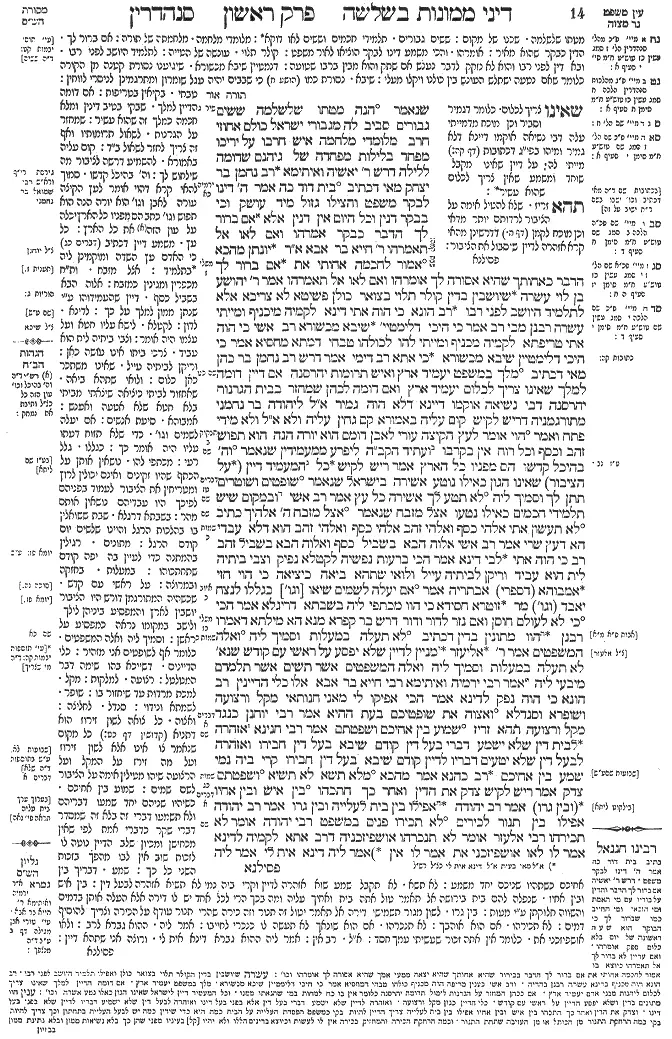
Sanhedrin 7b - Guemara
שנאמר (שיר השירים ג, ז) הנה מטתו שלשלמה ששים גבורים סביב לה מגבורי ישראל כולם אחוזי חרב מלומדי מלחמה איש חרבו על יריכו מפחד בלילות מפחדה של גיהנם שדומה ללילה דרש ר' יאשיה ואיתימא רב נחמן בר יצחק מאי דכתיב (ירמיהו כא, יב) בית דוד כה אמר ה' דינו לבקר משפט והצילו גזול מיד עושק וכי בבקר דנין וכל היום אין דנין אלא אם ברור לך הדבר כבקר אמרהו ואם לאו אל תאמרהו ר' חייא בר אבא א"ר יונתן מהכא (משלי ז, ד) אמור לחכמה אחותי את אם ברור לך הדבר כאחותך שהיא אסורה לך אומרהו ואם לאו אל תאמרהו אמר ר' יהושע בן לוי עשרה שיושבין בדין קולר תלוי בצואר כולן פשיטא לא צריכא אלא לתלמיד היושב לפני רבו רב הונא כי הוה אתי דינא לקמיה מיכניף ומייתי עשרה רבנן מבי רב אמר כי היכי דלימטיי' שיבא מכשורא רב אשי כי הוה אתי טריפתא לקמיה מכניף ומייתי להו לכולהו טבחי דמתא מחסיא אמר כי היכי דלימטיין שיבא מכשורא כי אתא רב דימי אמר דרש רב נחמן בר כהן מאי דכתיב (משלי כט, ד) מלך במשפט יעמיד ארץ ואיש תרומות יהרסנה אם דיין דומה למלך שאינו צריך לכלום יעמיד ארץ ואם דומה לכהן שמחזר בבית הגרנות יהרסנה דבי נשיאה אוקמו דיינא דלא הוה גמיר א"ל ליהודה בר נחמני מתורגמניה דריש לקיש קום עליה באמורא קם גחין עליה ולא א"ל ולא מידי פתח ואמר (חבקוק ב, יט) הוי אומר לעץ הקיצה עורי לאבן דומם הוא יורה הנה הוא תפוש זהב וכסף וכל רוח אין בקרבו ועתיד הקב"ה ליפרע ממעמידין שנאמר (חבקוק ב, כ) וה' בהיכל קדשו הס מפניו כל הארץ אמר ריש לקיש כל המעמיד דיין (על הציבור) שאינו הגון כאילו נוטע אשירה בישראל שנאמר (דברים טז, יח) שופטים ושוטרים תתן לך וסמיך ליה (דברים טז, כא) לא תטע לך אשירה כל עץ אמר רב אשי ובמקום שיש תלמידי חכמים כאילו נטעו אצל מזבח שנאמר (דברים טז, כא) אצל מזבח ה' אלהיך כתיב (שמות כ, כג) לא תעשון אתי אלהי כסף ואלהי זהב אלהי כסף ואלהי זהב הוא דלא עבדי הא דעץ שרי אמר רב אשי אלוה הבא בשביל כסף ואלוה הבא בשביל זהב רב כי הוה אתי לבי דינא אמר הכי ברעות נפשיה לקטלא נפיק וצבי ביתיה לית הוא עביד וריקן לביתיה עייל ולואי שתהא ביאה כיציאה כי הוי חזי אמבוהא (דספרי) אבתריה אמר (איוב כ, ו) אם יעלה לשמים שיאו [וגו'] כגללו לנצח יאבד (וגו') מר זוטרא חסידא כי הוו מכתפי ליה בשבתא דריגלא אמר הכי (משלי כז, כד) כי לא לעולם חוסן ואם נזר לדור ודור דרש בר קפרא מנא הא מילתא דאמרו רבנן הוו מתונין בדין דכתיב (שמות כ, כו) לא תעלה במעלות וסמיך ליה (שמות כא, א) ואלה המשפטים אמר ר' אליעזר מניין לדיין שלא יפסע על ראשי עם קודש שנא' לא תעלה במעלות וסמיך ליה ואלה המשפטים אשר תשים אשר תלמדם מיבעי ליה אמר רבי ירמיה ואיתימא רבי חייא בר אבא אלו כלי הדיינין רב הונא כי הוה נפק לדינא אמר הכי אפיקו לי מאני חנותאי מקל ורצועה ושופרא וסנדלא (דברים א, טז) ואצוה את שופטיכם בעת ההיא אמר רבי יוחנן כנגד מקל ורצועה תהא זריז (דברים א, טז) שמוע בין אחיכם ושפטתם אמר רבי חנינא אזהרה לבית דין שלא ישמע דברי בעל דין קודם שיבא בעל דין חבירו ואזהרה לבעל דין שלא יטעים דבריו לדיין קודם שיבא בעל דין חבירו קרי ביה נמי שמע בין אחיכם רב כהנא אמר מהכא (שמות כג, א) מלא תשא לא תשיא (דברים א, טז) ושפטתם צדק אמר ריש לקיש צדק את הדין ואחר כך חתכהו (דברים א, טז) בין איש ובין אחיו (ובין גרו) אמר רב יהודה אפילו בין בית לעלייה ובין גרו אמר רב יהודה אפילו בין תנור לכירים (דברים א, יז) לא תכירו פנים במשפט רבי יהודה אומר לא תכירהו רבי אלעזר אומר לא תנכרהו אושפיזכניה דרב אתא לקמיה לדינא אמר לו לאו אושפיזכני את אמר לו אין אמר ליה דינא אית לי אמר ליה
Comments from Rashi on Masechet Sanhedrin Page 7b
מטתו שלשלמה . שכנו של מקום: ששים גבורים . תלמידי חכמים וששים לאו דוקא: מלומדי מלחמה . מלחמתה של תורה: אם ברור לך . הדין כבקר שהוא מאיר: אומרהו . והכי משמע דינו לבקר הוציאו לאור משפט: קולר תלוי . עונשה של הטייה: לתלמיד היושב לפני רבו . ובא דין לפני רבו והוא לא נזקק לדבר נענש אם שתק והוא מבין ברבו שטועה: דנמטיין שיבא מכשורא . שיגיענו נסורת קטנה מן הקורה כלומר שאם נטעה ישתלש העונש בין כולנו ויקלו מעלי: שיבא . נסורת כמו (הושע ח) כי שבבים יהיה עגל שומרון ומתרגמינן לניסרי לווחין: טבחי . בקיאין בטריפות: אם דומה הדיין למלך . שבקי בטיב דינין ומלא חכמה כמלך זה שהוא עשיר: שמחזר על הגרנות . לשאול תרומותיו ואף זה צריך לחזר לשאול ב"ד: קום עליה באמורא . להשמיע דרשה לציבור מה שילחוש לך: וה' בהיכל קדשו . סמוך להאי קרא דהוי אומר לעץ הקיצה עורה לאבן וגו' הוא יורה הנה הוא תפוש וגו' כתב הס מפניו כל הארץ יכלה על עון הזה את כל הארץ: כל עץ . משמע דיין דכתיב (דברים כג) כי האדם עץ השדה ומוקמינן ליה בתלמיד: אצל מזבח . ות"ח מכפרין ומגינין כמזבח: אלוה הבא בשביל כסף . דיין שהעמידוהו ע"י שנתן ממון למלך על כך: לדינא . לדון: לקטלא . לישא עליו חטא ועל עצמו היה אומר: וצבי ביתיה לית הוא עביד . צרכי ביתו אינו עושה כאן: וריקן לביתיה עייל . שאינו משתכר כאן כלום: ולואי שתהא ביאה . שאחזור לביתי כיציאה שיצאתי מביתי בלא חטא שלא אטעה ואענש: אמבוהא . סיעת אנשים: אם יעלה לשמים וגו' . כדי שלא תזוח דעתו עליו היה אומר כך: כגללו . גלל רעי: מכתפי להו . נושאין אותן על הכתף שהיו זקינים ואינם יכולין לרוץ ומטריחין את הציבור לעמוד בפניהם לפיכך היו עבדיהם נושאין אותם מהר: בשבתא דרגלא . שבת ששואלין בו בהלכות הרגל והיינו שלשים יום קודם הרגל: מתונים . רגילין בהמתנה כדי לעיין בה יפה קודם שתחתכוהו: במעלות . בחזקה ובמרוצה: על ראשי עם קדש . שכשהיה המתורגמן דורש היו הציבור יושבין לארץ והמפסיע ביניהן לילך ולישב במקומו נראה כמפסיע על ראשן: וסמיך ליה ואלה המשפטים . כלומר אף לשופטים אני מזהיר: כלי הדיינים . דשייכא בהו שימה דבר המטלטל: רצועה . למלקות: מקל . למכת מרדות עד שיחזור בו: שופר . לשמתא ונידוי: סנדל . לחליצה: ואצוה . כל צואה לשון זירוז הוא דתניא (קדושין דף כט:) כל מקום שנאמר צו אינו אלא לשון זירוז ועל מה זירז על המקל ועל הרצועה שיהו מטילין אימה על הציבור לשם שמים: שמוע בין אחיכם . כשיהיו שניהם יחד שמעו דבריהם ולא תשמעו דברי זה בלא זה שמסדר דברי שקר כדברי אמת לפי שאין מכחישן ומכיון שלב הדיין נוטה לו לזכות שוב אין לבו מהפך בזכות השני כל כך: שמע . דבריך בין אחיכם כשתהיו שניכם יחד משמע: לא תשא . לא תקבל שמע שוא אזהרה לדיין וקרי ביה נמי לא תשיא אזהרה לבעל דין: בין איש ובין אחיו . שנפלה להם בית בירושה אל תאמר טול אתה בית ואחיך עליה ומה בכך הרי לכל אחד יש לו דירה אלא העלה אותן בדמים והשווה חלוקתן ע"י מעות: בין גרו . לשון מגור תשמישי דירה אל תאמר יטול זה תנור וזה כירה שהרי תנור עודף על הכירה וצריך להוסיף דמים: לא תכירהו . אם הוא אוהבך: לא תנכרהו . אם הוא שונאך לא תעשה לו כנכרי לחייבו: אמר ליה . ההוא גברא לרב: ולאו אושפיזכני את . כלומר אין אתה זכור שעשיתי עמך חסד: א"ל . רב אין: אמר ליה ההוא גברא דינא אית לי . ורוצה אני שתהא דיין:
Comments from Tosafot - Sanhedrin 7b
שאינו צריך לכלום . כלומר דגמיר וסביר וכן מוכח מדמייתי עלה דבי נשיאה אוקמו דיינא דלא גמיר ומיהו בפי"ג דכתובות (דף קה:) מייתי לה על דיין שאינו מקבל שוחד ומשמע שאין צריך לכלום שהוא עשיר: תהא זריז . שלא להטיל אימה על הציבור לרדותם יותר מדאי וכן מוכח לקמן (סנהדרין דף ח.) דדרשינן מהאי קרא אזהרה לדיין שיסבול את הציבור:
Sanhedrin 7b - Mishnah translated into english
as it is stated: “Behold, it is the bed of Solomon; sixty mighty men are around it, of the mighty men of Israel. They all handle the sword, and are expert in war; every man has his sword upon his thigh due to dread in the night” (Song of Songs 3:7–8). The words “due to dread in the night” mean due to the dread of Gehenna, which is similar to the night. Rabbi Shmuel bar Naḥmani interprets this verse as referring to judges, who are called: Mighty men of Israel, as they preside in the Temple, which is termed: The bed of God. In this verse, God is referred to as: Solomon [Shlomo], the King to Whom peace [shalom] belongs.
Rabbi Yoshiya, and some say Rav Naḥman bar Yitzḥak, interpreted a verse homiletically. What is the meaning of that which is written: “House of David, so says the Lord: Execute justice in the morning, and deliver the spoiled out of the hand of the oppressor” (Jeremiah 21:12)? And is it so that a court may judge in the morning, and all the rest of the day a court may not judge? Why does the verse specifically relate to judging in the morning? Rather, the meaning is: If the matter is as clear to you as the morning, state the verdict; and if not, do not state it. Rabbi Ḥiyya bar Abba says that Rabbi Yonatan says this principle may be derived from here: “Say to wisdom: You are my sister” (Proverbs 7:4). If the matter is as clear to you as the fact that your sister is forbidden to you, state it, and if not, do not state it.
Rabbi Yehoshua ben Levi says: If ten judges are sitting in judgment, a prisoner’s collar [kolar], referring to responsibility for the consequences of an incorrect verdict, hangs around all of their necks. The Gemara asks: Isn’t it obvious that all of the judges bear joint responsibility for the verdict? The Gemara answers: It is necessary only in order to include a student who is sitting in front of his teacher in the court, and notices that his teacher erred. Although he is not formally part of the court, he nevertheless bears responsibility if he remains silent.
The Gemara relates concerning Rav Huna that when a case would come before him for judgment, he would gather and bring ten rabbis from Rav’s study hall. He would say: I do this so that only a small part of the responsibility, comparable to a splinter from a beam, will reach each of us. The greater the number of judges, the less responsibility each one assumes for the verdict. Similarly, with Rav Ashi, when a person would come before him with meat suspected to be from an animal with a wound that will cause it to die within twelve months [tereifta], he would gather and bring together all the butchers of Mata Meḥasya and consult with them before ruling on the status of the meat. He would say to them: I do this so that only a small part of the responsibility, comparable to a splinter from a beam, will reach each of us.
When Rav Dimi came from Eretz Yisrael, he said: Rav Naḥman bar Kohen interpreted a verse homiletically: What is the meaning of that which is written: “The king by justice establishes the land; but he who exacts gifts [terumot] overthrows it” (Proverbs 29:4)? This teaches that if the judge is like a king in that he does not need anything and is not dependent on anyone, he establishes the land, i.e., he can serve as a judge. But if he is like a priest who seeks out his terumot from various granaries, as he is dependent on others, he overthrows the land.
In the house of the Nasi, they appointed a judge who was not learned. This judge said to Yehuda bar Naḥmani, who was the interpreter of Reish Lakish and whose role was to repeat and explain the Sage’s lectures: Stand over me as an interpreter, and I will lecture. Yehuda bar Naḥmani arose and bent over him in the conventional manner, to hear the judge’s words. And, being ignorant, the judge did not say anything to him.
The interpreter began and said: The verse states: “Woe to him who says to the wood: Awake, to the dumb stone: Arise. Can this teach? Behold, it is overlaid with gold and silver, and there is no breath at all in the midst of it” (Habakkuk 2:19). So is this judge, appointed to teach the public for gold, i.e., for payment, but no more qualified than wood and stone. And in the future, the Holy One, Blessed be He, will punish those who appoint such judges, as it is stated in the next verse: “But the Lord is in His holy Sanctuary; let all the earth be silent before Him” (Habakkuk 2:20). God, Who is above everything, will judge those responsible for such appointments.
Reish Lakish says: With regard to anyone who appoints over the community a judge who is not fit, it is as though he plants a tree used as part of idolatrous rites [ashera] among the Jewish people, as it is stated: “You shall make judges and officers for yourself” (Deuteronomy 16:18), and juxtaposed to it, it is written: “You shall not plant yourself an ashera of any kind of tree” (Deuteronomy 16:21). By implication, appointing unfit judges is akin to planting a tree for idolatry. Rav Ashi says: And in a place where there are Torah scholars, it is as though he planted the tree next to the altar, as it is stated: “You shall not plant yourself an ashera…beside the altar of the Lord your God.”
It is written: “You shall not make with Me gods of [elohei] silver and gods of gold” (Exodus 20:20). The Gemara asks: It is gods of silver and gods of gold that you may not make, but are gods of wood permitted? Rather, Rav Ashi says: This verse discusses a judge, called elohim, who comes, i.e., is appointed, due to payment of silver, and a judge who comes due to payment of gold.
The Gemara relates that Rav, when he would come to court to judge a case, would say this about himself: By his own will he goes out to danger of death, as a judge who misjudges a case is liable to receive the punishment of death at the hand of Heaven; and he does not do what is necessary to provide for the needs of his house, and he enters his home empty-handed, because a judge does not receive a salary. He said: If only it should be so that his entry into his home will be the same as his departure, without sin or transgression.
In a similar demonstration of humility, when Rav would see a convoy [ambuha] of scribes following after him to honor him, he would say: “Though his excellency mount up to the heavens and his head reach the clouds, yet he shall perish forever like his own dung; they who have seen him shall say: Where is he?” (Job 20:6–7). It is said of Mar Zutra the Pious that when the people would carry him to his lectures on their shoulders during Shabbat of the Festival, he would say this to avoid becoming arrogant: “For power is not forever, and does the crown endure for all generations?” (Proverbs 27:24).
Bar Kappara taught, based on a homiletical interpretation of a verse: From where is this matter that the Sages stated derived: Be temperate in judgment (Avot 1:1)? As it is written: “Neither shall you go up by steps onto My altar” (Exodus 20:23), i.e., do not ascend hurriedly, and juxtaposed to it, it is written: “Now these are the ordinances that you shall set before them” (Exodus 21:1). Rabbi Eliezer says: From where is it derived that a judge may not step over the heads of the sacred nation, walking among those assembled for the lecture, who would sit upon the floor, in such a manner that he has the appearance of stepping on them? It is derived from that which is stated: “Neither shall you go up by steps,” and juxtaposed to it is an introduction to civil laws and courtroom regulations: “Now these are the ordinances.” This indicates that the prohibition against ascending upon steps applies to judges.
The Gemara interprets the second part of the verse cited above: “Now these are the ordinances that you shall set before them.” The verse should have stated: That you shall teach them. What is indicated by the phrase: “Set before them”? Rabbi Yirmeya, and some say Rabbi Ḥiyya bar Abba, says: These are the judges’ tools. To illustrate this, the Gemara relates that Rav Huna, when he would go out to a judgment, would say this: Take out for me tools from my shop: A rod and strap, with which to flog transgressors; and a shofar, necessary in the event that someone must be excommunicated; and a sandal, necessary in the event of ḥalitza, the procedure by which a levirate marriage is rejected.
The Gemara interprets other verses related to the topic of adjudicating cases. “And I charged your judges at that time, saying: Hear the causes between your brethren, and judge righteously between a man and his brother, and the stranger who is with him” (Deuteronomy 1:16). Understanding that the word “charged” indicates alacrity, Rabbi Yoḥanan says: Moses urged the judges: With regard to the rod and the strap, be vigilant. With regard to the clause “Hear the causes between your brethren, and judge,” Rabbi Ḥanina says: This is a warning to a court that it may not hear the statement of one litigant before the other litigant comes, and it is a warning to a litigant that he may not explain his statement to the judge before the other litigant comes. Read into the phrase in the verse: “Hear the causes between your brethren,” that it is also concerning the litigant. Although he is not the judge, he is also required to assure that the case is conducted in the presence of both parties.
Rav Kahana says the litigant’s responsibility may be derived from here: From “you shall not bear [tissa] a false report” (Exodus 23:1). Although conjugated in this manner the verb would seem to be addressed to the judges, commanding them not to lend credence to a false report, the term may also be read as: You shall not deliver [tassi] a false report, conjugated so that it addresses the litigants and the witnesses.
The Gemara returns to the verse in Deuteronomy cited above: “And I charged your judges at that time, saying: Hear the causes between your brethren, and judge righteously.” Reish Lakish says: Verify the judgment by meticulously examining the particulars of the case, and only afterward, implement it. The verse continues: “Between a man and his brother, and the stranger who is with him.” Rav Yehuda says: The judge must distinguish even between the merits of a house and the upper story when dividing a two-floor property among inheriting brothers.
With regard to the clause in the verse: “And the stranger who is with him [gero],” the word gero resembles the word: Dwell [gur], and Rav Yehuda says: This word teaches that the judge must distinguish even between the merits of an oven and a stove. The judge must carefully weigh how to divide even these domestic items in a case of inheritance, to ensure that the distribution of property is absolutely equitable.
The next verse states: “You shall not respect [takiru] people in judgment; you shall hear the small and the great alike; you shall not be afraid before any man, for the judgment is God’s; and the cause that is too hard for you, you shall bring to me, and I will hear it” (Deuteronomy 1:17). Rabbi Yehuda says: Do not recognize him [takirehu], i.e., do not acknowledge the litigant as a friend in your role as a judge. Rabbi Elazar says: Even if he is your opponent, do not estrange him [tenakerehu] in such a way as to prejudge him as liable, but treat him as though you do not know him at all.
Rav’s host [ushpizekhaneih], with whom he would stay occasionally, came before him for a judgment. Rav said to the host: Are you not my host? He said to him: Yes, I am. The host then said to him: I have a dispute with another that needs a judgment. Rav said to him:
Traduction : The William Davidson digital edition of the Koren Noé Talmud, with commentary by Rabbi Adin Even-Israel Steinsaltz.