 Talmud Bavli
Bava Metzia 85b : Youtube
Daf TubeYoutube
1 video class :
Bava Metzia Page 85b
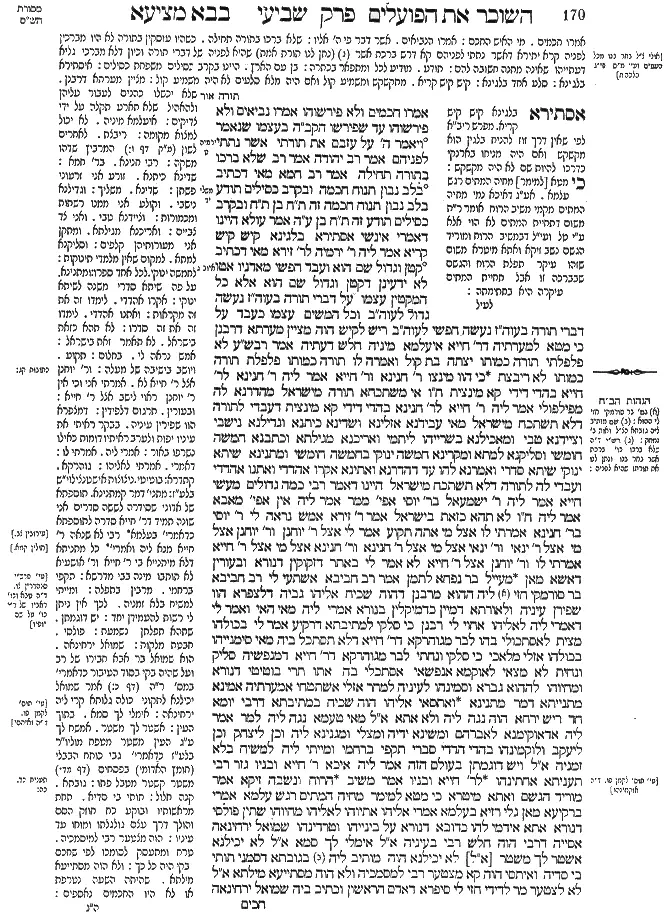
Bava Metzia 85b - Guemara
אמרו חכמים ולא פירשוהו אמרו נביאים ולא פירשוהו עד שפירשו הקב"ה בעצמו שנאמר (ירמיהו ט, יב) ויאמר ה' על עזבם את תורתי אשר נתתי לפניהם אמר רב יהודה אמר רב שלא ברכו בתורה תחילה אמר רב חמא מאי דכתיב (משלי יד, לג) בלב נבון תנוח חכמה ובקרב כסילים תודע בלב נבון תנוח חכמה זה ת"ח בן ת"ח ובקרב כסילים תודע זה ת"ח בן ע"ה אמר עולא היינו דאמרי אינשי אסתירא בלגינא קיש קיש קריא אמר ליה ר' ירמיה לר' זירא מאי דכתיב (איוב ג, יט) קטן וגדול שם הוא ועבד חפשי מאדניו אטו לא ידעינן דקטן וגדול שם הוא אלא כל המקטין עצמו על דברי תורה בעוה"ז נעשה גדול לעוה"ב וכל המשים עצמו כעבד על דברי תורה בעוה"ז נעשה חפשי לעוה"ב ריש לקיש הוה מציין מערתא דרבנן כי מטא למערתיה דר' חייא איעלמא מיניה חלש דעתיה אמר רבש"ע לא פלפלתי תורה כמותו יצתה בת קול ואמרה לו תורה כמותו פלפלת תורה כמותו לא ריבצת כי הוו מינצו ר' חנינא ור' חייא אמר ליה ר' חנינא לר' חייא בהדי דידי קא מינצית ח"ו אי משתכחא תורה מישראל מהדרנא לה מפילפולי אמר ליה ר' חייא לר' חנינא בהדי דידי קא מינצית דעבדי לתורה דלא תשתכח מישראל מאי עבידנא אזלינא ושדינא כיתנא וגדילנא נישבי וציידנא טבי ומאכילנא בשרייהו ליתמי ואריכנא מגילתא וכתבנא חמשה חומשי וסליקנא למתא ומקרינא חמשה ינוקי בחמשה חומשי ומתנינא שיתא ינוקי שיתא סדרי ואמרנא להו עד דהדרנא ואתינא אקרו אהדדי ואתנו אהדדי ועבדי לה לתורה דלא תשתכח מישראל היינו דאמר רבי כמה גדולים מעשי חייא אמר ליה ר' ישמעאל בר' יוסי אפי' ממר אמר ליה אין אפי' מאבא אמר ליה ח"ו לא תהא כזאת בישראל אמר ר' זירא אמש נראה לי ר' יוסי בר' חנינא אמרתי לו אצל מי אתה תקוע אמר לי אצל ר' יוחנן ור' יוחנן אצל מי אצל ר' ינאי ור' ינאי אצל מי אצל ר' חנינא ור' חנינא אצל מי אצל ר' חייא אמרתי לו ור' יוחנן אצל ר' חייא לא אמר לי באתר דזקוקין דנורא ובעורין דאשא מאן מעייל בר נפחא לתמן אמר רב חביבא אשתעי לי רב חביבא בר סורמקי חזי ליה ההוא מרבנן דהוה שכיח אליהו גביה דלצפרא הוו שפירן עיניה ולאורתא דמיין כדמיקלין בנורא אמרי ליה מאי האי ואמר לי דאמרי ליה לאליהו אחוי לי רבנן כי סלקי למתיבתא דרקיע אמר לי בכולהו מצית לאסתכולי בהו לבר מגוהרקא דר' חייא דלא תסתכל ביה מאי סימנייהו בכולהו אזלי מלאכי כי סלקי ונחתי לבר מגוהרקא דר' חייא דמנפשיה סליק ונחית לא מצאי לאוקמא אנפשאי אסתכלי בה אתו תרי בוטיטי דנורא ומחיוהו לההוא גברא וסמינהו לעיניה למחר אזלי אשתטחי אמערתיה אמינא מתנייתא דמר מתנינא ואתסאי אליהו הוה שכיח במתיבתא דרבי יומא חד ריש ירחא הוה נגה ליה ולא אתא א"ל מאי טעמא נגה ליה למר אמר ליה אדאוקימנא לאברהם ומשינא ידיה ומצלי ומגנינא ליה וכן ליצחק וכן ליעקב ולוקמינהו בהדי הדדי סברי תקפי ברחמי ומייתי ליה למשיח בלא זמניה א"ל ויש דוגמתן בעולם הזה אמר ליה איכא ר' חייא ובניו גזר רבי תעניתא אחתינהו לר' חייא ובניו אמר משיב הרוח ונשבה זיקא אמר מוריד הגשם ואתא מיטרא כי מטא למימר מחיה המתים רגש עלמא אמרי ברקיעא מאן גלי רזיא בעלמא אמרי אליהו אתיוהו לאליהו מחיוהו שתין פולסי דנורא אתא אידמי להו כדובא דנורא על בינייהו וטרדינהו שמואל ירחינאה אסייה דרבי הוה חלש רבי בעיניה א"ל אימלי לך סמא א"ל לא יכילנא אשטר לך משטר [א"ל] לא יכילנא הוה מותיב ליה בגובתא דסמני תותי בי סדיה ואיתסי הוה קא מצטער רבי למסמכיה ולא הוה מסתייעא מילתא א"ל לא לצטער מר לדידי חזי לי סיפרא דאדם הראשון וכתיב ביה שמואל ירחינאה
Comments from Rashi on Masechet Bava Metzia Page 85b
אמרו חכמים . מי האיש החכם: אמרו הנביאים . אשר דבר פי ה' אליו: שלא ברכו בתורה תחילה . כשהיו עוסקין בתורה לא היו מברכין לפניה קרא יתירא דאשר נתתי לפניהם קא דרש ברכת אשר (נתן לנו תורת אמת) שהיא לפניה של דברי תורה וכיון דלא מברכי גליא דעתייהו שאינה מתנה חשובה להם: תודע . מודיע לכל ומתפאר בכתרה: בן עם הארץ . היינו בקרב כסילים משפחת כסילים: איסתירא בלגינא . סלע אחד בלגינא: קיש קיש קריא . מתקשקש ומשמיע קול ואם היה מלא סלעים לא היה משמיע קול: מציין מערתא דרבנן . שלא יכשלו כהנים לעבור עליהן ולהאהיל שלא תארע תקלה על ידי צדיקים: איעלמא מיניה . לא יכול למצוא מקומה: ריבצת . לאחרים לשון (מ"ק דף ו:) המרביץ שדהו משקה: רבי חנינא . בר' חמא: שדינא כיתנא . זורע אני זרעוני פשתן: שדינא . משליך: וגדילנא נישבי . וקולע אני ממנו רשתות ומכמורות: וציידנא טבי . ואני צד צביים: ואריכנא מגילתא . ומתקן אני מעורותיהן קלפים: וסליקנא למתא . למקום שאין מלמדי תינוקות: לחמשה ינוקי . לכל אחד ספרו: ומתנינא . על פה שיתא סדרי משנה לשיתא ינוקי: אקרו אהדדי . לימדו זה את זה מקראות: ואתנו אהדדי . לימדו זה את זה סדרו: לא תהא כזאת בישראל . לא תאמר זאת בישראל: אמש נראה לי . בחלום: תקוע . ויושב בישיבה של מעלה: ור' יוחנן אצל ר' חייא לא . אמרתי אני וכי אין ר' יוחנן ראוי לישב אצל ר' חייא: ובעורין . תרגום דלפידין: דמצפרא הוו שפירין עיניה . בבקר ראיתי את עיניו יפות ולערב ראיתיו דומות כאילו נשרפו באור: אמרי ליה . אמרתי לו: דאמרי . אמרתי לאליהו: גוהרקא . קתדרא: בוטיטי . ניצוצות אישטנצילוי"ש בלע"ז: מתני' דמר קמתנינא . תוספתא של אדוני שסידרה לששה סדרים אני שונה תמיד דר' חייא סדרה לתוספתא כדאמרי' בעלמא רבי לא שנאה ר' חייא מנא ליה ואמרי' כל מתניתא דלא מיתנייא בי רבי חייא ורבי אושעיא לא תותבו מינה בבי מדרשא: תקפי ברחמי . מרבין בתפלה: ומייתי למשיח בלא זמניה . לכך אין ניתן לי רשות להעמידן יחד: יש דוגמתן . שתהא תפלתן נשמעת: פולסי . חבטת מלקות: שמואל ירחינאה . הוא שמואל בר אבא חבירו של רב ועל שהיה בקי בסוד העיבור כדאמרי' במס' ר"ה (דף כ:) אמר שמואל יכילנא לתקוני כולה גלותא קרי ליה ירחינאה: אימלי לך סמא . בתוך העין: אשטר לך משטר . אמשח לך ע"ג העין משטר מטפח מוליו"ר בלע"ז כדאמרי' גבי כותח הבבלי (חומץ האדומי) בפסחים (דף מד.) משטר קשטר מטבל פתו: גובתא . קנה חלול: תותי בי סדיא . תחת מראשותיו ובוקע כח חוזק הסם והולך דרך עצם גולגלתו ומוחו עד עיניו: הוה מצטער רבי למיסמכיה . טרח ומתעסק לסומכו לפי שחכם בקי היה כל כך: ולא הוה מסתייעא מילתא . שהיתה השעה נטרפת או לא היו החכמים נאספים:
Comments from Tosafot - Bava Metzia 85b
אסתירא בלגינא קיש קיש קריא . מפרש ריב"א לפי שאין דרך זוז להניח בלגין הוא מקשקש ואם היה מניחו בארנקי כדרכו להיות שם לא היה מקשקש: אוקמינהו לפני התיבה שלשתן כדדריש במדרש דבתענית צבור יורדין לפני התיבה שלשה כדכתיב (שמות יז) וידי משה כבדים ואהרן וחור וגו': אחתינהו לרבי חייא ובניו. ואע"ג דתני במגילה (דף כד: ושם ד"ה כשאתה) אין מורידין לפני התיבה לא מאנשי חיפא ולא מאנשי בית שאן שקורין לאלפין עיינין ולעיינין אלפין ור' חייא לא היה יכול לומר וחכיתי כדאמר התם ה"מ היכא דאפשר באחר הכא לא הוה אפשר באחר.: כי מטא [למימר] מחיה המתים רגש עלמא . אע"ג דאיכא נמי מחיה המתים מקמי משיב הרוח אומר ר"ת משום דתחיית המתים לא הוי אלא ע"י טל ועי"ל דבמשיב הרוח ומוריד הגשם נשב זיקא ואתא מיטרא משום שזהו עיקר תפלת הרוח והגשם שבברכה זו אבל תחיית המתים עיקרה היא בחתימתה: ואיתסי . והא דחזינהו לעיניה דהוו מחרכן לפי שעדיין היה ניכר אי נמי לאחר זמן סיפר לו כך:
Bava Metzia 85b - Mishnah translated into english
was stated by the Sages, i.e., the wise man mentioned in the verse, and yet they could not explain it. It was stated by the prophets, i.e., those to whom the mouth of the Lord has spoken, and yet they could not explain it, until the Holy One, Blessed be He, Himself explained it, as it is stated in the next verse: “And the Lord says: Because they have forsaken My Torah which I set before them” (Jeremiah 9:12). Rav Yehuda says that Rav says: This does not mean that the Jewish people ceased Torah study altogether; rather, they did not recite a blessing on the Torah prior to its study, as they did not regard Torah study as a sacred endeavor.
Rav Ḥama says: What is the meaning of that which is written: “In the heart of him that has discernment wisdom rests; but in the inward part of fools it makes itself known” (Proverbs 14:33)? “In the heart of him who has discernment wisdom rests”; this is a Torah scholar, son of a Torah scholar. “But in the inward part of fools it makes itself known”; this is a Torah scholar, son of an ignoramus, as his wisdom stands out in contrast to the foolishness of the rest of his family. Ulla said: This explains the adage that people say: A small coin in an empty barrel calls: Kish, kish, i.e., it rattles loudly, whereas a coin in a barrel full of coins is not heard.
Rabbi Yirmeya said to Rabbi Zeira: What is the meaning of that which is written with regard to the World-to-Come: “The humble and great are there; and the servant is free from his master” (Job 3:19)? Is that to say that we do not know that the humble and the great are there in the World-to-Come? Rather, this is the meaning of the verse: Anyone who humbles himself over matters of Torah in this world becomes great in the World-to-Come; and anyone who establishes himself as a servant over matters of Torah in this world becomes free in the World-to-Come.
§ The Gemara continues discussing the greatness of the Sages. Reish Lakish was demarcating burial caves of the Sages. When he arrived at the cave of Rabbi Ḥiyya, the precise location of his grave eluded him. Reish Lakish became distressed, as he was apparently unworthy of finding the grave. He said: Master of the Universe! Did I not analyze the Torah like Rabbi Ḥiyya? A Divine Voice emerged and said to him: You did analyze the Torah like him, but you did not disseminate Torah like him.
The Gemara relates: When Rabbi Ḥanina and Rabbi Ḥiyya would debate matters of Torah, Rabbi Ḥanina would say to Rabbi Ḥiyya: Do you think you can debate with me? Heaven forbid! If the Torah were forgotten from the Jewish people, I could restore it with my powers of analysis and intellectual acumen. Rabbi Ḥiyya said to Rabbi Ḥanina: Do you think you can debate with me? You cannot compare yourself to me, as I am acting to ensure that the Torah will not be forgotten by the Jewish people.
Rabbi Ḥiyya elaborated: What do I do to this end? I go and sow flax seeds and twine nets with the flax, and then I hunt deer and feed their meat to orphans. Next I prepare parchment from their hides and I write the five books of the Torah on them. I go to a city and teach five children the five books, one book per child, and I teach six other children the six orders of the Mishna, and I say to them: Until I return and come here, read each other the Torah and teach each other the Mishna. This is how I act to ensure that the Torah will not be forgotten by the Jewish people.
The Gemara notes that this is what Rabbi Yehuda HaNasi said: How great are the deeds of Rabbi Ḥiyya! Rabbi Yishmael, son of Rabbi Yosei, said to Rabbi Yehuda HaNasi: Are his deeds even greater than the Master’s, i.e., yours? Rabbi Yehuda HaNasi said to him: Yes. Rabbi Yishmael persisted: Are they even greater than those of my father, Rabbi Yosei? Rabbi Yehuda HaNasi said to him: Heaven forbid! Such a statement shall not be heard among the Jewish people, that someone is greater than your father, Rabbi Yosei.
The Gemara continues discussing the greatness of Rabbi Ḥiyya. Rabbi Zeira said: Last night, Rabbi Yosei, son of Rabbi Ḥanina, appeared to me in a dream. I said to him: Near whom are you placed in the upper realms? He said to me: Near Rabbi Yoḥanan. I asked: And Rabbi Yoḥanan is near whom? He replied: Near Rabbi Yannai. And Rabbi Yannai is near whom? Near Rabbi Ḥanina. And Rabbi Ḥanina is near whom? Near Rabbi Ḥiyya. Rabbi Zeira added: I said to Rabbi Yosei: But isn’t Rabbi Yoḥanan worthy of being placed near Rabbi Ḥiyya? He said to me: In a place of fiery sparks and burning fires, who can bring Rabbi Yoḥanan, son of Nappaḥa, there?
Rav Ḥaviva said: Rav Ḥaviva bar Surmakei told me: I once saw one of the Sages whom Elijah the prophet would visit, and his eyes looked beautiful and healthy in the morning, but appeared to be charred by fire in the evening. I said to him: What is this phenomenon? And he said to me: I said to Elijah: Show me the Sages upon their ascension to the heavenly academy. Elijah said to me: You may gaze at all of them except for those in the chariot [miguharka] of Rabbi Ḥiyya, upon whom you may not gaze. I asked Elijah: What are the signs of Rabbi Ḥiyya’s chariot, so I will know when not to look? He said: Angels accompany all of the other Sages’ chariots as they ascend and descend, except for the chariot of Rabbi Ḥiyya, which ascends and descends of its own accord, due to his greatness.
The Sage relating this story continued: I was unable to restrain myself, and I gazed upon Rabbi Ḥiyya’s chariot. Two fiery flames came and struck that man, i.e., me, and blinded his eyes. The next day, I went and prostrated on Rabbi Ḥiyya’s burial cave in supplication. I said: I study the baraitot of the Master, Rabbi Ḥiyya; please pray on my behalf. And my vision was healed, but my eyes remained scorched.
The Gemara relates another incident involving Elijah the prophet. Elijah was often found in the academy of Rabbi Yehuda HaNasi. One day it was a New Moon, the first of the month, and Elijah was delayed and did not come to the academy. Later, Rabbi Yehuda HaNasi said to Elijah: What is the reason that the Master was delayed? Elijah said to him: I had to wake up Abraham, wash his hands, and wait for him to pray, and then lay him down again. And similarly, I followed the same procedure for Isaac, and similarly for Jacob in turn. Rabbi Yehuda HaNasi asked Elijah: And let the Master wake them all together. Elijah responded: I maintain that if I were to wake all three to pray at the same time, they would generate powerful prayers and bring the Messiah prematurely.
Rabbi Yehuda HaNasi said to Elijah: And is there anyone alive in this world who is comparable to them and can produce such efficacious prayers? Elijah said to him: There are Rabbi Ḥiyya and his sons. Rabbi Yehuda HaNasi decreed a fast, and the Sages brought Rabbi Ḥiyya and his sons down to the pulpit to pray on behalf of the congregation. Rabbi Ḥiyya recited the phrase in the Amida prayer: Who makes the wind blow, and the wind blew. Rabbi Ḥiyya recited the next phrase: Who makes the rain fall, and rain fell. When he was about to say the phrase: Who revives the dead, the world trembled.
They said in heaven: Who is the revealer of secrets in the world? They said in response: It is Elijah. Elijah was brought to heaven, whereupon he was beaten with sixty fiery lashes. Elijah came back down to earth disguised as a bear of fire. He came among the congregation and distracted them from their prayers, preventing Rabbi Ḥiyya from reciting the phrase: Who revives the dead.
§ The Gemara relates: Shmuel Yarḥina’a was the physician of Rabbi Yehuda HaNasi. One time, Rabbi Yehuda HaNasi felt a pain in his eye. Shmuel said to him: I will place a medication in your eye. Rabbi Yehuda HaNasi said to him: I cannot have the medication placed directly in my eye, as I am afraid it will cause me too much pain. Shmuel said to him: I will apply a salve above your eye, not directly in it. Rabbi Yehuda HaNasi said to him: Even that I cannot bear. Shmuel placed the medication in a tube of herbs beneath his pillow, and Rabbi Yehuda HaNasi was healed.
Rabbi Yehuda HaNasi made efforts to ordain Shmuel Yarḥina’a as a rabbi but was unsuccessful, as Shmuel always demurred. Shmuel Yarḥina’a said to him: The Master should not be upset about my refusal, as I know that I am not destined to be ordained as a rabbi. I myself saw the book of Adam the first man, which contains the genealogy of the human race, and it is written in it that Shmuel Yarḥina’a
Traduction : The William Davidson digital edition of the Koren Noé Talmud, with commentary by Rabbi Adin Even-Israel Steinsaltz.