 Talmud Bavli
Shabbat 118b : Youtube
Daf TubeYoutube
2 video classes :
Shabbat Page 118b
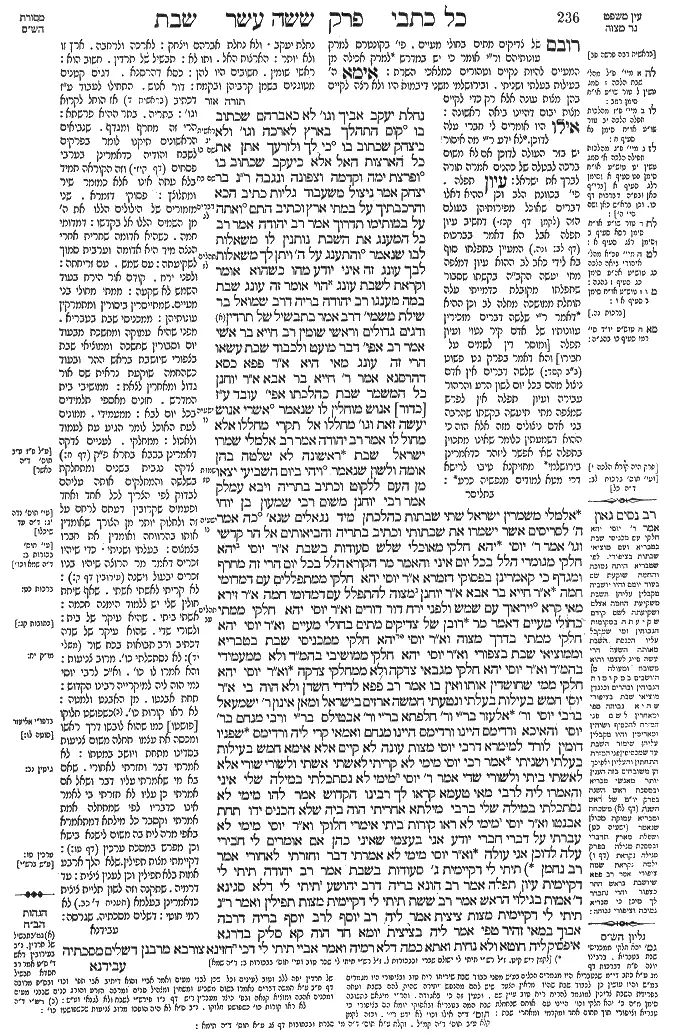
Shabbat 118b - Guemara
נחלת יעקב אביך וגו' לא כאברהם שכתוב בו (בראשית יג, יז) קום התהלך בארץ לארכה וגו' ולא כיצחק שכתוב בו (בראשית כו, ג) כי לך ולזרעך אתן את כל הארצות האל אלא כיעקב שכתוב בו (בראשית כח, יד) ופרצת ימה וקדמה וצפונה ונגבה ר"נ בר יצחק אמר ניצול משעבוד גליות כתיב הכא והרכבתיך על במתי ארץ וכתיב התם (דברים לג, כט) ואתה על במותימו תדרוך אמר רב יהודה אמר רב כל המענג את השבת נותנין לו משאלות לבו שנאמר (תהלים לז, ד) והתענג על ה' ויתן לך משאלות לבך עונג זה איני יודע מהו כשהוא אומר וקראת לשבת עונג הוי אומר זה עונג שבת במה מענגו רב יהודה בריה דרב שמואל בר שילת משמי' דרב אמר בתבשיל של תרדין ודגים גדולים וראשי שומין רב חייא בר אשי אמר רב אפי' דבר מועט ולכבוד שבת עשאו הרי זה עונג מאי היא א"ר פפא כסא דהרסנא אמר ר' חייא בר אבא א"ר יוחנן כל המשמר שבת כהלכתו אפי' עובד ע"ז [כדור] אנוש מוחלין לו שנאמר (ישעיהו נו, ב) אשרי אנוש יעשה זאת וגו' מחללו אל תקרי מחללו אלא מחול לו אמר רב יהודה אמר רב אלמלי שמרו ישראל שבת ראשונה לא שלטה בהן אומה ולשון שנאמר (שמות טז, כז) ויהי ביום השביעי יצאו מן העם ללקוט וכתיב בתריה ויבא עמלק אמר רבי יוחנן משום רבי שמעון בן יוחי אלמלי משמרין ישראל שתי שבתות כהלכתן מיד נגאלים שנא' (ישעיהו נו, ד) כה אמר ה' לסריסים אשר ישמרו את שבתותי וכתיב בתריה והביאותים אל הר קדשי וגו' אמר ר' יוסי יהא חלקי מאוכלי שלש סעודות בשבת א"ר יוסי יהא חלקי מגומרי הלל בכל יום איני והאמר מר הקורא הלל בכל יום הרי זה מחרף ומגדף כי קאמרינן בפסוקי דזמרא א"ר יוסי יהא חלקי ממתפללים עם דמדומי חמה א"ר חייא בר אבא א"ר יוחנן מצוה להתפלל עם דמדומי חמה א"ר זירא מאי קרא (תהלים עב, ה) ייראוך עם שמש ולפני ירח דור דורים וא"ר יוסי יהא חלקי ממתי בחולי מעיים דאמר מר רובן של צדיקים מתים בחולי מעיים וא"ר יוסי יהא חלקי ממתי בדרך מצוה וא"ר יוסי יהא חלקי ממכניסי שבת בטבריא וממוציאי שבת בצפורי וא"ר יוסי יהא חלקי ממושיבי בהמ"ד ולא ממעמידי בהמ"ד וא"ר יוסי יהא חלקי מגבאי צדקה ולא ממחלקי צדקה וא"ר יוסי יהא חלקי ממי שחושדין אותו ואין בו אמר רב פפא לדידי חשדן ולא הוה בי א"ר יוסי חמש בעילות בעלתי ונטעתי חמשה ארזים בישראל ומאן אינון ר' ישמעאל ברבי יוסי ור' אלעזר בר"י ור' חלפתא בר"י ור' אבטילס בר"י ורבי מנחם בר' יוסי והאיכא ורדימס היינו ורדימס היינו מנחם ואמאי קרי ליה ורדימס שפניו דומין לורד למימרא דרבי יוסי מצות עונה לא קיים אלא אימא חמש בעילות בעלתי ושניתי אמר רבי יוסי מימי לא קריתי לאשתי אשתי ולשורי שורי אלא לאשתי ביתי ולשורי שדי אמר ר' יוסי מימי לא נסתכלתי במילה שלי איני והאמרו ליה לרבי מאי טעמא קראו לך רבינו הקדוש אמר להו מימי לא נסתכלתי במילה שלי ברבי מילתא אחריתי הוה ביה שלא הכניס ידו תחת אבנטו וא"ר יוסי מימי לא ראו קורות ביתי אימרי חלוקי וא"ר יוסי מימי לא עברתי על דברי חברי יודע אני בעצמי שאיני כהן אם אומרים לי חבירי עלה לדוכן אני עולה וא"ר יוסי מימי לא אמרתי דבר וחזרתי לאחורי אמר רב נחמן) תיתי לי דקיימית ג' סעודות בשבת אמר רב יהודה תיתי לי דקיימית עיון תפלה אמר רב הונא בריה דרב יהושע תיתי לי דלא סגינא ד' אמות בגילוי הראש אמר רב ששת תיתי לי דקיימית מצות תפילין ואמר ר"נ תיתי לי דקיימית מצות ציצית אמר ליה רב יוסף לרב יוסף בריה דרבה אבוך במאי זהיר טפי אמר ליה בציצית יומא חד הוה קא סליק בדרגא איפסיק ליה חוטא ולא נחית ואתא כמה דלא רמיה ואמר אביי תיתי לי דכי חזינא צורבא מרבנן דשלים מסכתיה
Comments from Rashi on Masechet Shabbat Page 118b
נחלת יעקב . ולא נחלת אברהם ויצחק: לארכה ולרחבה . ארץ זו ולא יותר: הארצות האל . ותו לא: תבשיל של תרדין . חשוב הוא: ראשי שומין . חשובים היו להן: כסא דהרסנא . דגים קטנים מטוגנים בשמן קרביהן ובקמח: דור אנוש . התחילו לעבוד ע"ז דכתיב (בראשית ד) אז הוחל לקרוא וגו': בתריה . בתר ההיא פרשתא: הרי זה מחרף ומגדף . שנביאים הראשונים תיקנו לומר בפרקים לשבח והודיה כדאמרינן בערבי פסחים (דף קיז.) וזה הקוראה תמיד בלא עתה אינו אלא כמזמר שיר ומתלוצץ: פסוקי דזמרא . שני מזמורים של הילולים הללו את ה' מן השמים הללו אל בקדשו: דמדומי חמה . כשהיא אדומה שחרית אחרי הנצה מיד היא אדומה וערבית סמוך לשקיעתה: עם שמש . עם זריחתה: ולפני ירח . קודם אור הירח בעוד השמש לא שקעה: ממתי מחולי בני מעיים . שמתייסרין ביסורין ומתמרקין עונותיהן: ממכניסי שבת בטבריא . מפני שהיא עמוקה ומחשכת מבעוד יום וסבורין שחשכה וממוציאי שבת בצפורי שיושבת בראש ההר ובעוד כשהחמה שוקעת נראית שם אור גדול ומאחרין לצאת: ממושיבי בית המדרש . חזנים מאספי תלמידים בכל יום לבא: ממעמידי . ממונים לעת האוכל לומר הגיע עת לעמוד ולאכול: ממחלקי . לעניים צדקה דאמרינן בבבא בתרא פ"ק (דף ח:) צדקה נגבית בשנים ומתחלקת בשלשה והמחלקים אותה עליהם לבדוק לפי הצריך לכל אחד ואחד ופעמים שקרובין דעתם לרחם על זה ולחלוק יותר מן הצורך שאומדין אותו בהרווחה ואומדין את חברו בצמצום: בעלתי ושניתי . כדי שיהיו זכרים דאמר מר הרוצה שיהיו בניו זכרים יבעול וישנה (עירובין דף ק:): לא קריתי לאשתי אשתי . שאף שיחת חולין שלי יש ללמוד הימנה חכמה: אשתי ביתי . שהיא עיקר של בית: ולשורי שדי . שהוא עיקר של שדה דכתיב ורב תבואות בכח שור (משלי יד): לא נסתכלתי כו' . מרוב צניעות: והא אמרו לו כו' . וא"כ לרבי יוסי נמי הוה ליה למיקרייה רבינו הקדוש: תחת אבנטו . מן האבנט ולמטה: לא ראו קורות כו' . כשפושט חלוקו [פושטו] כמו שהוא לובשו דרך ראשו ומכסה את עצמו תחלה משום צניעות בסדינו מתחת ויושב במטתו: לא אמרתי דבר וחזרתי לאחורי . שאם בא מי שאמרתי עליו דבר ושאל אם אמרתי כן עליו לא חזרתי בי לאמר אינו כדבריו לפי שמתחלה אמת אמרתי וקסבר כל מילתא דמתאמרא באפי מרה לית בה משום לישנא בישא וכן מפרש במסכת ערכין (דף טו:): דקיימתי מצות תפילין . שלא הלך ארבע אמות בלא תפילין וכן לענין ציצית: עד דרמיה . שתקנה וזה לשון תליית ציצית כדאמרינן בעלמא (תענית ד' כב.) לא רמי חוטי: דשלים מסכתיה . שגרסה:
Comments from Tosafot - Shabbat 118b
רובם של צדיקים מתים בחולי מעיים . פי' בקונטרס למרק עונותיהם ור"י אומר כי יש במדרש למרק אכילה מן המעיים להיות נקיים וטהורים כמלאכי השרת: אימא ה' בעילות בעלתי ושניתי . ובירושלמי משני דיבמות היו ולא רצה לקיים בהן מצות עונה אלא רק כדי לקיים מצות יבום דהיינו ביאה ראשונה: אילו היו אומרים לי חברי עלה לדוכן . לא ידע ר"י מה איסור יש בזר העולה לדוכן אם לא משום ברכה לבטלה של כהנים אמרה תורה לברך את ישראל: עיון תפלה . פי' בכוונת הלב וכן ההיא דאלו דברים שאוכל מפירותיהן בעולם הזה (לקמן שבת דף קכז.) דחשיב עיון תפלה אבל הא דאמר בברכות (דף לב: ונה.) המעיין בתפלתו סוף בא לידי כאב לב ההוא עיון דמצפה מתי יעשה הקב"ה בקשתו שסבור שתפלתו מקובלת כדמייתי עלה תוחלת ממושכה מחלה לב וכן ההיא דאמר ר"י שלשה דברים מזכירין עוונותיו של אדם קיר נטוי ועיון תפלה [ומוסר דין לשמים על חבירו] והא דאמר בפרק גט פשוט (ב"ב קסד:) שלשה דברים אין אדם ניצול מהם בכל יום לשון הרע והרהור עבירה ועיון תפלה אין לפרש שמצפה מתי תיעשה בקשתו שהרבה בני אדם ניצולים מזה אלא הוה כי ההוא דשמעתין כלומר שאינו מתכוין בתפלה שאי אפשר ליזהר כדאמרינן בירושלמי מחזיקנא טיבו לרישא דכי מטא למודים מנפשיה כרע:
Shabbat 118b - Mishnah translated into english
on the inheritance of Jacob your father, as the mouth of God has spoken” (Isaiah 58:13–14). The reward for delighting in Shabbat is specifically the portion of Jacob. Not that of Abraham, about whom it is written, “Rise, walk through the land through its length and its width because I have given it to you” (Genesis 13:17), i.e., only this land alone in its borders. And not that of Isaac, about whom it is written, “Dwell in this land and I will be with you and I will bless you because I will give all of these lands to you and your offspring” (Genesis 26:3), meaning these lands and no others. Rather, that of Jacob, about whom it is written, “And your offspring will be like the dust of the earth, and you will spread out to the west and to the east and to the north and to the south, and all of the families of the land will be blessed through you and your offspring” (Genesis 28:14). There are no boundaries for Jacob’s portion.
Rav Naḥman bar Yitzḥak said: One who delights in Shabbat is rescued from the oppression of exile. He derives it by means of a verbal analogy. It is written here, with regard to Shabbat: “And I will cause you to ride on the heights [bamotei] of the world” (Isaiah 58:14), and it is written there: “You are fortunate Israel, who is like you? A nation redeemed by God, the shield that aids you and the sword of your triumph. Your enemies will try to defeat you and you will trample their high places [bamoteimo]” (Deuteronomy 33:29). Rav Yehuda said that Rav said: With regard to anyone who delights in the Shabbat, God grants him his heart’s desires, as it is stated: “And you shall delight in God and He will grant you your heart’s desires” (Psalms 37:4). This delight in God, which is mentioned in the verse, I do not know what it is. When it says: “And you shall call the Shabbat delight,” one must say: It is the delight of Shabbat. The Gemara asks: With what does one delight in the day of Shabbat? Rav Yehuda, son of Rav Shmuel bar Sheilat, said in the name of Rav: With a dish of beets, and large fish, and heads of garlic. Rav Ḥiyya bar Ashi said that Rav said: Even with regard to a small item and one prepared it in deference to Shabbat, it is a delight. The Gemara asks: What is the small item mentioned? Rav Pappa said: Small fried fish.
Rabbi Ḥiyya bar Abba said that Rabbi Yoḥanan said: With regard to anyone who observes Shabbat in accordance with its halakhot, even if he worships idolatry as in the generation of Enosh, God forgives him his sins, as it is stated: “Fortunate is the man [enosh] who does this and the person who holds strong to it, one who guards the Shabbat from desecrating it [meḥallelo], and guards his hand from doing any evil” (Isaiah 56:2). Do not read it as: From desecrating it [meḥallelo], but rather: He is forgiven [maḥul lo]. With regard to the generation of Enosh it is written: “And to Seth, to him also there was born a son; and he called his name Enosh. Then they began [huḥal] to call upon the Name of God” (Genesis 4:26), meaning to desecrate [leḥallel] His name.
Rav Yehuda said that Rav said: Had the Jewish people properly observed the first Shabbat that was commanded them, no nation or tongue would have ever ruled them, as it is stated: “And it happened on the seventh day, some people went out from the nation to collect and they did not find” (Exodus 16:27). And it is written after they went out to collect manna: “And Amalek came and fought with Israel in Refidim” (Exodus 17:8). Rabbi Yoḥanan said in the name of Rabbi Shimon ben Yoḥai: If only the Jewish people would keep two Shabbatot in accordance with their halakhot, they would be immediately redeemed, as it is stated: “So said God to the eunuchs who will keep My Shabbatot” (Isaiah 56:4), and it is written after that: “And I will bring them to My holy mountain and will let them rejoice in My house of prayer” (Isaiah 56:7).
Rabbi Yosei said: May my portion be among those who eat three meals on Shabbat. Apropos this statement of Rabbi Yosei, the Gemara cites additional declarations. Rabbi Yosei said: May my portion be among those who complete hallel every day. The Gemara is surprised at this: Is that so? Didn’t the Master say: One who reads hallel every day is tantamount to one who curses and blasphemes God. He displays contempt for hallel by not reserving it for days on which miracles occurred. The Gemara answers: When we say this statement of Rabbi Yosei, we are referring to the verses of praise [pesukei dezimra], recited during the morning service, not to hallel (Psalms 113–118) recited on special days.
And furthermore, Rabbi Yosei said: May my portion be among those who pray the morning and afternoon prayers with the reddening of the sun, i.e., the morning prayer at sunrise and the afternoon prayer adjacent to nightfall. Rabbi Ḥiyya bar Abba said that Rabbi Yoḥanan said: It is a mitzva to pray with the reddening of the sun. Rabbi Zeira said: What verse alludes to this? “They will fear You with the sun and before the moon, generation upon generation” (Psalms 72:5). Fear of God, prayer, should be with the sun and before the moon.
And Rabbi Yosei said: May my portion be among those who die from intestinal disease, as the Master said: Most righteous people die of intestinal disease. It is a very harsh disease through which the sins of righteous people are cleansed before their death and also, as a result, they die with a clean body. And Rabbi Yosei said: May my portion be among those who die on the path to perform a mitzva. And Rabbi Yosei said: May my portion be among those who accept Shabbat in Tiberias, which is in a valley where day turns to evening earlier, and among those who see Shabbat out in Tzippori, which is located on a mountain top where the sun is visible for longer, and Shabbat ends later. And Rabbi Yosei said: May my portion be among those who seat others in the study hall, i.e., who cause others to come sit and study, and not among those who cause others to stand in the study hall, i.e., who announce that it is time to leave the study hall and go to eat.
And Rabbi Yosei said: May my portion be among the collectors of charity and not the distributors of charity. One who collects charity collects fixed amounts, whereas distributors may inadvertently fail to give the poor person enough to cover his needs. And Rabbi Yosei said: May my portion be with one whom others suspect of sin and there is no basis for suspecting him. Rav Pappa said: They suspected me, and there was no basis for suspecting me.
Furthermore, Rabbi Yosei said: I engaged in relations five times, and I planted five cedars in Eretz Yisrael. And who are these cedars? The sons of Rabbi Yosei, who were great Sages of Israel: Rabbi Yishmael, son of Rabbi Yosei, and Rabbi Elazar, son of Rabbi Yosei, and Rabbi Ḥalafta, son of Rabbi Yosei, and Rabbi Avtilas, son of Rabbi Yosei, and Rabbi Menaḥem, son of Rabbi Yosei. The Gemara asks: Isn’t there Vardimas, who was also Rabbi Yosei’s son? The Gemara answers: Vardimas is the same as Menaḥem. And why did they call him Vardimas? Because his face was as beautiful as a rose [vered]. The Gemara asks: Is that to say based on this statement that Rabbi Yosei did not fulfill the mitzva of his wife’s conjugal rights, but only had relations with her five times? Rather, say it this way: I engaged in relations five times and I did so again, and the Sages said that one who seeks to father male offspring should engage in relations and do so again.
Furthermore, Rabbi Yosei said that he always spoke euphemistically: In all my days, I did not call my wife, my wife, nor my ox, my ox. Rather, I called my wife, my home, because she is the essence of the home, and my ox, my field, because it is the primary force in the fields.
Rabbi Yosei said: In all my days, due to modesty, I never looked at my circumcision. The Gemara asks: Is that so? Didn’t they say to Rabbi Yehuda HaNasi: Why did they call you our holy Rabbi? He said to them: It is because in all my days I never looked at my circumcision. If so, why wasn’t Rabbi Yosei also called our holy Rabbi? The Gemara replies: In the case of Rabbi Yehuda HaNasi, another matter of modesty was present in him, as he did not insert his hand below his belt due to his great modesty. And Rabbi Yosei said: In all my days, the walls of my house never saw the seams of my robe due to modesty, as he would only undress under his bed sheets.
And Rabbi Yosei said: In all my days I never violated the words of my friends. I know about myself that I am not a priest, and nevertheless, if my friends say to me: Go up to the platform with the priests, I go up. And Rabbi Yosei said: In all my days I never said something and then retreated from it. Rabbi Yosei never said something positive or negative about a specific person and then denied it.
Rav Naḥman said: May I receive my reward because I fulfilled the obligation to eat three meals on Shabbat magnificently. Rav Yehuda said: May I receive my reward because I fulfilled the obligation of consideration during prayer. Rav Huna, son of Rav Yehoshua, said: May I receive my reward because I never walked four cubits with my head uncovered. Rav Sheshet said: May I receive my reward because I fulfilled the mitzva of phylacteries magnificently. And Rav Naḥman said: May I receive my reward because I fulfilled the mitzva of ritual fringes magnificently.
Rav Yosef said to Rav Yosef, son of Rabba: In what area was your father, Rabba, especially vigilant? He said to him: It was in the mitzva of ritual fringes. The Gemara relates: One day he was climbing the stairs when a string from his ritual fringes was severed, and he would not descend until he placed a new string on the garment. And Abaye said: May I receive my reward because when I see a young Torah scholar who has completed a tractate that he studied
Traduction : The William Davidson digital edition of the Koren Noé Talmud, with commentary by Rabbi Adin Even-Israel Steinsaltz.
Shabbat 118b : Significance
Next step
Finished studying Shabbat 118b? Carry on with the rest of the tractate.
Study Shabbat 119aFrequently asked questions: Shabbat 118b
Where is Shabbat 118b in tractate Shabbat?
Shabbat 118b is page 234 of 312 in tractate Shabbat (Seder Moed).
When is daf 118 of Shabbat studied in Daf Yomi?
Daf Yomi covers one daf a day, both sides. Daf 118 of Shabbat will be studied on December 4, 2027.
Is there a video class on Shabbat 118b?
Yes, by Daf Tube, Rabbi Dr. Moshe Weisblum. These classes were published on YouTube by their authors and are gathered on this site.
What is tractate Shabbat about?
The Masechet Shabbat is the first tractate of the Seder Moed. The Gemara Shabbat is the study of the laws concerning the Shabbat day during which one must suspend all work according to what is written in the Torah. The preparations before the start of Shabbos, the 39 Melachot that the Torah forbids to be performed on Shabbos, as well as the rabbinical decrees intended to avoid transgressing them. The Shabbat tractate has 24 chapters.
Your study is also dedicated to them
- L'ilui Nishmat רינה בת לדיסיה
- L'ilui Nishmat Yechayahou ben Moche
- L'ilui Nishmat Avraham Ben Simha