 Talmud Bavli
Hullin 86b : Youtube
Rabbi Dr. Moshe WeisblumYoutube
1 video class :
Hullin Page 86b
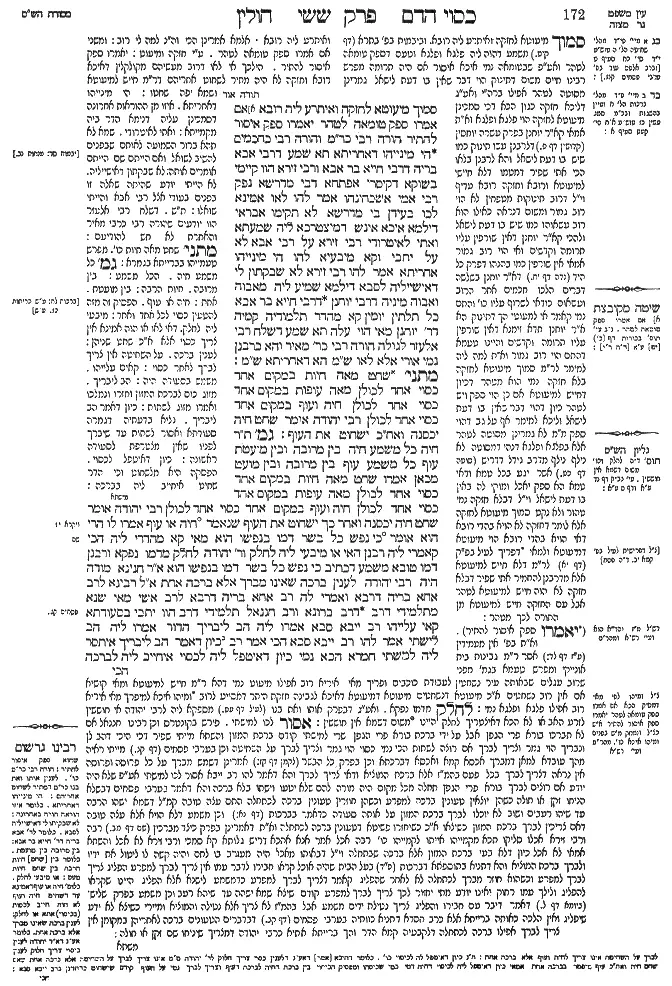
Hullin 86b - Guemara
סמוך מיעוטא לחזקה ואיתרע ליה רובא אם אמרו ספק טומאה לטהר יאמרו ספק איסור להתיר הורה רבי כר"מ והורה רבי כחכמים הי מינייהו דאחריתא תא שמע דרבי אבא בריה דרבי חייא בר אבא ורבי זירא הוו קיימי בשוקא דקיסרי אפתחא דבי מדרשא נפק רבי אמי אשכחינהו אמר להו לאו אמינא לכו בעידן בי מדרשא לא תקימו אבראי דילמא איכא אינש דמיצטרכא ליה שמעתא ואתי לאיטרודי רבי זירא על רבי אבא לא על יתבי וקא מיבעיא להו הי מינייהו אחריתא אמר להו רבי זירא לא שבקתון לי דאישייליה לסבא דילמא שמיע ליה מאבוה ואבוה מיניה דרבי יוחנן דרבי חייא בר אבא כל תלתין יומין קא מהדר תלמודיה קמיה דר' יוחנן מאי הוי עלה תא שמע דשלח רבי אלעזר לגולה הורה רבי כר' מאיר והא כרבנן נמי אורי אלא לאו ש"מ הא דאחריתא ש"מ:
מתני׳ שחט מאה חיות במקום אחד כסוי אחד לכולן מאה עופות במקום אחד כסוי אחד לכולן חיה ועוף במקום אחד כסוי אחד לכולן רבי יהודה אומר שחט חיה יכסנה ואח"כ ישחוט את העוף:
גמ׳ ת"ר חיה כל משמע חיה בין מרובה ובין מועטת עוף כל משמע עוף בין מרובה ובין מועט מכאן אמרו שחט מאה חיות במקום אחד כסוי אחד לכולן מאה עופות במקום אחד כסוי אחד לכולן חיה ועוף במקום אחד כסוי אחד לכולן רבי יהודה אומר שחט חיה יכסנה ואחר כך ישחוט את העוף שנאמר (ויקרא יז, יג) חיה או עוף אמרו לו הרי הוא אומר (ויקרא יז, יד) כי נפש כל בשר דמו בנפשו הוא מאי קא מהדרי לי הכי קאמרי ליה רבנן האי או מיבעי ליה לחלק ור' יהודה לחלק מדמו נפקא ורבנן דמו טובא משמע דכתיב כי נפש כל בשר דמו בנפשו הוא א"ר חנינא מודה היה רבי יהודה לענין ברכה שאינו מברך אלא ברכה אחת א"ל רבינא לרב אחא בריה דרבא ואמרי לה רב אחא בריה דרבא לרב אשי מאי שנא מתלמידי דרב דרב ברונא ורב חננאל תלמידי דרב הוו יתבי בסעודתא קאי עלייהו רב ייבא סבא אמרו ליה הב ליבריך הדור אמרו ליה הב לישתי אמר להו רב ייבא סבא הכי אמר רב כיון דאמר הב ליבריך איתסר ליה למשתי חמרא הכא נמי כיון דאיטפל ליה לכסוי איחייב ליה לברכה
Comments from Rashi on Masechet Hullin Page 86b
ואיתרע ליה רובא . אלמא אמרינן הכי וה"נ למה לי רוב: ומשני אם אמרו ספק טומאה לטהר . ע"י חזקה ומיעוט: יאמרו ספק איסור להתיר . הילכך אי לאו דרוב מעשיהם מקולקלין דאיכא רובא וחזקה לא היה מתיר לשחוט אחריהם דר"מ חייש למיעוטא ושמא יפה שחטו: הי מינייהו דאחריתא . איזו מן ההוראות אחרונה דסמכינן עליה דנימא הדר ביה מקמייתא: ואתי לאיטרודי . שמא לא תהא ברור השמועה לאותם שבפנים להשיב לשואל ואם הייתם שם הייתם אומרים אותה: לא שבקתון דאישייליה . לא הייתי יודע שהיתה שאלה זו בפנים בעודי אצל רבי אבא והייתי שואלו: ת"ש דשלח רבי אלעזר . הוו יודעים שהורה רבי כרבי מאיר והאחרת לא חש להודיעם: מתני' שחט מאה חיות כו' . מפרש טעמייהו בברייתא בגמרא: גמ' כל משמע חיה . הכל משמע: בין מרובה . חיות הרבה: בין מועטת . אחת: חיה או עוף . הפסיק זה מזה להטעין כסוי לכל אחד ואחד: מיבעי ליה לחלק . דאי לאו או הוה אמינא אין צריך כסוי אלא א"כ שחט שניהן: לענין ברכה . על השחיטה אין צריך לברך לאחר כסוי: קאים עלייהו . משמש בסעודה היה: הב ליבריך . מזוג כוס לברכת המזון וחזרו ונמלכו ואמרו מזוג לשתות: כיון דאמר הב ליבריך . גליא בדעתיה דגמרה סעודתא ואסור לשתות עד שיברך לפניו שאין מצטרפת לסעודה ראשונה: כיון דאיטפל לכסוי . הפסקה היא מלשחוט וכי הדר שחיט איחייב ליה בברכה:
Comments from Tosafot - Hullin 86b
סמוך מיעוטא לחזקה ואיתרע ליה רובא . וביבמות בפ' בתרא (דף קיט.) משמע דהוה ליה פלגא ופלגא וטעם דספק טומאה לטהר ואע"פ שבטומאה נמי איכא איסור אם היה תרומה מפרש רבינו חיים משום דתינוק הוי דבר שאין בו דעת לישאל גמרינן מסוטה לטהר אפילו ברה"י ואע"ג דליכא חזקה כגון הכא דכי סמכינן מיעוטא לחזקה הוי פלגא ופלגא וא"ת אמאי קא"ר יוחנן בפרק עשרה יוחסין (קדושין דף פ.) דלרבנן עשו תינוק כמו שיש בו דעת לישאל והא לרבנן בלאו הכי אתי שפיר דמטמו דלא חיישי למיעוטא ורובא וחזקה רובא עדיף וי"ל דרוב תינוקות מטפחין לא הוי רוב גמור ומשום דנראה כאילו הוא רוב עשאוהו כמו שיש בו דעת לישאל ולהכי קא"ר יוחנן דאין שורפין עליו תרומה וקדשים ואי הוי רוב גמור אמאי אין שורפין כמו בהנהו דפרק כל היד (נדה דף יח.) דא"ר יוחנן בשלשה דברים הלכו חכמים אחר הרוב ועשאום כודאי לשרוף עליו כו' והתם נמי קאמר אי למעוטי הך דתינוק הא א"ר יוחנן חדא זימנא דאין שורפין עליו תרומה וקדשים והיינו טעמא דהתם הוי רוב גמור וא"ת למה ליה למימר לר"מ סמוך מיעוטא לחזקה בלא חזקה נמי הוא מטהר דכיון דחייש למיעוטא אם כן הוי ספק ויש לטהר כיון דהוי דבר שאין בו דעת לישאל וליכא למימר אף על גב דהוי ספק מ"מ לא גמרינן מסוטה לטהר אלא בפלגא ופלגא דנהי דמסוטה לא נילף נילף מדרב גידל דדריש (סוטה דף כט.) אשר יגע בכל טמא ודאי טמא הא ספק יאכל ומוקי לה באין בו דעת לישאל וי"ל דבלא חזקה נמי טהור ולא נקט סמוך מיעוטא לחזקה אלא לומר דחזקה לא הויא בהדי רובא דאי הויא בהדי רובא הוי מיעוטא דמיעוטא ולמאי דפריך לעיל בפ"ק (חולין דף יא) לר"מ דלא חייש למיעוטא אלא מדרבנן להחמיר אתי שפיר דבלא חזקה לא הוה חייש למיעוטא לטהר אבל עם החזקה חייש למיעוטא מן התורה לכך מטהר: (יאמרו ספק איסור להתיר) . וא"ת בפ' אין מעמידין (ע"ז דף לד:) אסר ר"מ גבינות בית אונייקי ומפרש טעמא בגמ' מפני שרוב עגלים שבאותה עיר נשחטין לעבודת כוכבים ופריך מאי איריא רוב אפילו מיעוט נמי דהא ר"מ חייש למיעוטא ומאי קושיא אם אין רוב נשחטים א"כ מיעוטא דנשחטים מיעוטא דמיעוטא דאיכא לגבינה חזקת היתר דמסייע לרוב ומיהו איכא למיפרך מאי איריא רוב אפילו פלגא ופלגא נמי: לחלק מדמו נפקא . ואע"ג דבפרק אותו ואת בנו (לעיל חולין דף עט.) מספקא ליה לרבי יהודה אי חוששין לזרע האב או לא הכא דאיצטריך לחלק היינו משום דשמא אין חוששין: אסור לכו למישתי . פירש בקונטרס וכן רבינו חננאל אם לא תברכו בורא פרי הגפן אבל על ידי ברכת בורא פרי הגפן שרי למישתי קודם ברכת המזון והשתא מייתי שפיר דכי היכי דהב לן ונבריך הוי גמר וצריך לברך אם רוצה לשתות הכי נמי כסוי הוי גמר וצריך לברך על השחיטה וכן בערבי פסחים (דף קג.) מייתי ראיה מהך עובדא למאן דמברך אכסא קמא ואכסא דברכתא וכן בפרק כל הבשר (לקמן חולין דף קז:) אמרינן דשמש מברך על כל פרוסה ופרוסה אין נראה דצריך לברך בכל פעם בהמ"ז אלא ברכת המוציא ודאי צריך לברך והא דאמר להו רב ייבא אסור לכו למישתי אע"פ שלא היה יודע אם רוצים לברך בורא פרי הגפן תחלה מכל מקום היה מורה להם שלא יטעו וישתו בלא ברכה והא דאמר בערבי פסחים דבשלא הניחו זקן או חולה כשהן יוצאין טעונין ברכה למפרע וכשהן חוזרין טעונין ברכה לכתחלה התם עצה טובה קמ"ל דשמא ישהו הרבה עד שיהו רעבים ושוב לא יוכלו לברך ברכת המזון על אותה סעודה כדאמר בברכות (דף נא:) וכן משמע דלא הויא אלא עצה טובה דאם צריכין לברך ברכת המזון כשיצאו א"כ כשיחזרו פשיטא דטעונין ברכה לכתחלה וא"ת דאמרינן בפרק כיצד מברכין (שם דף מב.) רבה ורבי זירא אכלו סליקו תכא מקמייהו אייתו לקמייהו כו' רבה אכל אמר אנא אתכא דריש גלותא קא סמכי ורבי זירא לא אכל והשתא אמאי לא אכל כיון דלא בעי ברכת המזון אלא ברכה שבתחלה וי"ל דבאותו מאכל היה מעורב בו לחם והיה קשה לו ליטול את ידיו ולברך ברכת המוציא והא דתניא בתוספתא דברכות (פ"ד) בעל הבית שהיה אוכל קראו חבירו לדבר עמו אין צריך לברך למפרע הפליג צריך לברך למפרע וכשהוא חוזר מברך לכתחלה לא לאחר שהפליג קאמר דצריך לברך למפרע כדמשמע לישנא אלא הפליג היינו שקראו להפליג ולילך עמו רחוק ואינו יודע מתי יחזור לכך צריך לברך למפרע קודם שיצא שמא ישהה עד שיהא רעב וכן משמע בפרק שלישי (ביומא דף ל.) דאמר דיבר עם חבירו והפליג צריך נטילת ידים משמע אבל בהמ"ז לא צריך אלא נטילה והמוציא ומיירי כשיצא לא ידע שיפליג ואין הלכה כאותה ברייתא אלא כרב חסדא דתניא כוותיה בערבי פסחים (דף קב.) דבדברים הטעונים ברכה לאחריהן במקומן אין צריך לברך אפילו ברכה לכתחלה דלקבעיה קמא הדר והך ברייתא אתיא כרבי יהודה דמצריך שיניחו שם זקן או חולה:
Hullin 86b - Mishnah translated into english
One appends the minority of children who do not handle items within reach to the presumptive status of purity of the dough, and consequently the force of the majority of children who handle items within reach is weakened. Therefore, the dough is considered pure. Similarly, with regard to slaughter performed by inept people, why does Rabbi Ami state that the reason behind Rabbi Meir’s opinion is due to a majority? Let even a minority of bungled acts of slaughter join with the presumptive prohibited status of the animal to render this animal a carcass.
The Gemara responds that the two cases are not comparable: If they said one may append the minority to the presumptive status with regard to a case of uncertain ritual impurity in order to render the dough pure, will they say that one may rely on a minority in the case of an uncertain prohibition in order to permit it? In other words, without the fact that a majority of the acts of slaughter of a deaf-mute, an imbecile, or a minor are bungled, Rabbi Meir could neither deem one exempt from covering the blood nor allow one to slaughter the offspring immediately. Consequently, it is due only to the majority that Rabbi Meir deems one liable for violation of the prohibition against consuming an animal carcass when consuming meat from their slaughter.
§ With regard to the dispute in the mishna, the Gemara notes: Rabbi Yehuda HaNasi ruled in accordance with the opinion of Rabbi Meir, who held that if a deaf-mute, an imbecile, or a minor slaughtered a mother animal, one may subsequently slaughter its offspring; and Rabbi Yehuda HaNasi also ruled in accordance with the opinion of the Rabbis, who held that it is prohibited to slaughter it. The Gemara asks: Which of these two rulings is the later, definitive ruling, and which ruling is the retracted one?
The Gemara suggests: Come and hear a proof from an incident: Rabbi Abba, son of Rabbi Ḥiyya bar Abba, and Rabbi Zeira were standing in the marketplace of Caesarea, at the entrance to the study hall. Rabbi Ami exited the study hall and found the two of them standing there. Rabbi Ami said to them: Have I not told you that at the time when the study hall is in session you should not stand outside, as perhaps there is a person inside the study hall who requires clarification of a halakha, and he will become bothered by it because you will not be inside to assist in offering the proper explanation?
Rabbi Zeira entered the study hall, whereas Rabbi Abba did not enter. The students were sitting and raising a dilemma: Which of Rabbi Yehuda HaNasi’s two rulings is the later one? Rabbi Zeira said to them: You did not let me know that this is your dilemma while I was outside, which would have allowed me to ask the elder one, i.e., Rabbi Abba, son of Rabbi Ḥiyya bar Abba, since perhaps he heard the answer from his father, Rabbi Ḥiyya bar Abba. And perhaps his father heard it from Rabbi Yoḥanan, as Rabbi Ḥiyya bar Abba would review his studies in front of Rabbi Yoḥanan every thirty days.
The Gemara asks: What conclusion was reached about it? The Gemara suggests: Come and hear a proof: Rabbi Elazar sent a message to the Jews in exile, i.e., Babylonia: Rabbi Yehuda HaNasi ruled in accordance with the opinion of Rabbi Meir. The Gemara challenges: But Rabbi Yehuda HaNasi also ruled in accordance with the opinion of the Rabbis. Why did Rabbi Elazar disregard that ruling? The Gemara concludes: Rather, isn’t it correct to conclude from Rabbi Elazar’s message that this ruling of Rabbi Yehuda HaNasi, which is in accordance with Rabbi Meir, is the later one? The Gemara affirms: One may in fact conclude from here that this is so.
MISHNA: If one slaughtered one hundred undomesticated animals in one place, one covering of the blood suffices for all the animals and there is no obligation to cover the blood of each animal separately. Likewise, if one slaughtered one hundred birds in one place, one covering of the blood suffices for all the birds. If one slaughtered an undomesticated animal and a bird in one place, one covering for all of the blood is sufficient. Rabbi Yehuda says: If one slaughtered an undomesticated animal, he should cover its blood immediately and only thereafter he should slaughter the bird.
GEMARA: The Sages taught in a baraita: The verse states with regard to the mitzva of covering the blood: “An undomesticated animal or bird” (Leviticus 17:13). “Undomesticated animal” is inclusive, i.e., any number of animals is included in the term undomesticated animal, whether many or few. Likewise, “bird” is inclusive, i.e., any amount is included in the term bird, whether many or few. From here the Rabbis stated: If one slaughtered one hundred undomesticated animals in one place, one covering of the blood suffices for all the animals. Likewise, if one slaughtered one hundred birds in one place, one covering of the blood suffices for all the birds. If one slaughtered an undomesticated animal and a bird in one place, one covering for all of the blood is sufficient.
The baraita continues: Rabbi Yehuda says: If one slaughtered an undomesticated animal, he should cover its blood immediately and only thereafter he should slaughter the bird, as it is stated: “An undomesticated animal or bird” (Leviticus 17:13). The term “or” indicates that each type must be attended to separately.
The Rabbis said to Rabbi Yehuda: But the next verse states: “For as to the life of all flesh, the blood thereof is all one with the life thereof.” The Gemara asks: What are the Rabbis responding to Rabbi Yehuda with this statement? The Gemara explains: This is what the Rabbis are saying to him: This term “or” that interposes between an undomesticated animal and a bird is needed to separate them, in order to indicate that the obligation to cover the blood applies after slaughtering either an undomesticated animal or a bird. If not for the term “or” one might have thought the obligation to cover the blood takes effect only after slaughtering both an undomesticated animal and a bird. Accordingly, one cannot derive from this term that the blood of an undomesticated animal and a bird must be covered separately.
And Rabbi Yehuda responds to this: The source for separating the obligations with regard to an undomesticated animal and a bird is derived from the verse: “And he shall pour out its blood” (Leviticus 17:13). The verse makes reference to the blood of only one animal, indicating that the obligation applies after slaughtering either a bird or an undomesticated animal. And the Rabbis respond that “its blood” also indicates many, as the term: Blood, can refer to any amount of blood. This is demonstrated by that which is written: “For as to the life of all flesh, the blood thereof is all one with the life thereof” (Leviticus 17:14).
§ Rabbi Ḥanina says: Although Rabbi Yehuda holds that one first covers the blood of an undomesticated animal before slaughtering the bird, Rabbi Yehuda would concede with regard to the matter of the blessing over their slaughter, i.e., that one recites only one blessing. The Gemara questions this assertion: Ravina said to Rav Aḥa, son of Rava, and some say that Rav Aḥa, son of Rava, said to Rav Ashi: In what way is this case different from the incident that occurred with the students of Rav?
As it occurred that Rav Beruna and Rav Ḥananel, the students of Rav, were sitting together at a meal, and Rav Yeiva the Elder stood over them to serve them. They said to him: Give us a cup of wine over which to recite the blessings of Grace after Meals. They then changed their mind and said to him: Give us a cup of wine to drink. Rav Yeiva the Elder said to them that this is what Rav said: Once someone at a meal says: Give me a cup over which to recite the blessings of Grace after Meals, it is prohibited for him to drink any more wine, since he has expressed his desire to conclude his meal. If he now wishes to drink more wine, he must recite a blessing before drinking it. Ravina asks: Here too, since he is required to cover the blood of the undomesticated animal before slaughtering the bird, there is an interruption between the acts of slaughter, and he has therefore become obligated to recite a new blessing before slaughtering the bird.
Traduction : The William Davidson digital edition of the Koren Noé Talmud, with commentary by Rabbi Adin Even-Israel Steinsaltz.