 Talmud Bavli
The learning on the whole site is dedicated : L'ilui Nishmat Nissim ben Barukh Malka
The learning on the whole site is dedicated : L'ilui Nishmat Reuven ben Rivka SEBBAG
The learning on the whole site is dedicated : L'ilui Nishmat Yechayahou ben Moche
Bava Kamma 35b : Youtube
Daf TubeYoutube
2 video classes :
Bava Kamma Page 35b
Bava Kamma 35b - Guemara
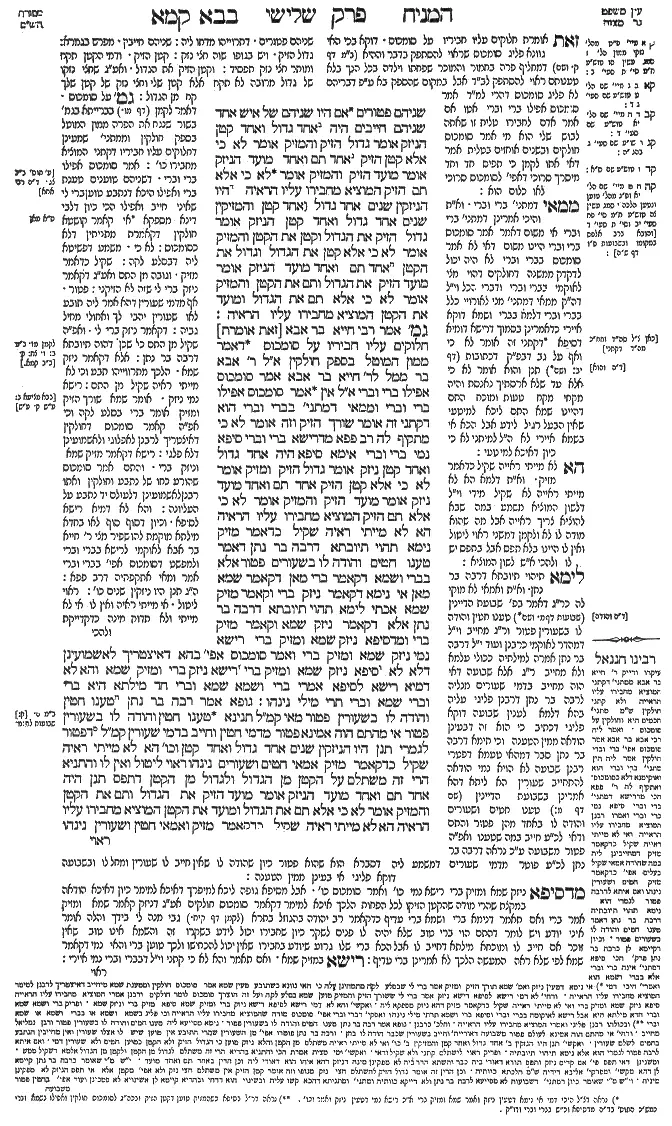
שניהם פטורים אם היו שניהם של איש אחד שניהם חייבים היה אחד גדול ואחד קטן הניזק אומר גדול הזיק והמזיק אומר לא כי אלא קטן הזיק אחד תם ואחד מועד הניזק אומר מועד הזיק והמזיק אומר לא כי אלא תם הזיק המוציא מחבירו עליו הראיה היו הניזקין שנים אחד גדול ואחד קטן והמזיקין שנים אחד גדול ואחד קטן הניזק אומר גדול הזיק את הגדול וקטן את הקטן והמזיק אומר לא כי אלא קטן את הגדול וגדול את הקטן אחד תם ואחד מועד הניזק אומר מועד הזיק את הגדול ותם את הקטן והמזיק אומר לא כי אלא תם את הגדול ומועד את הקטן המוציא מחבירו עליו הראיה:
גמ׳ אמר רבי חייא בר אבא [זאת אומרת] חלוקים עליו חביריו על סומכוס דאמר ממון המוטל בספק חולקין א"ל ר' אבא בר ממל לר' חייא בר אבא אמר סומכוס אפילו ברי וברי א"ל אין אמר סומכוס אפילו ברי וברי וממאי דמתני' בברי וברי הוא דקתני זה אומר שורך הזיק וזה אומר לא כי מתקיף לה רב פפא מדרישא ברי וברי סיפא נמי ברי וברי אימא סיפא היה אחד גדול ואחד קטן ניזק אומר גדול הזיק ומזיק אומר לא כי אלא קטן הזיק אחד תם ואחד מועד ניזק אומר מועד הזיק והמזיק אומר לא כי אלא תם הזיק המוציא מחבירו עליו הראיה הא לא מייתי ראיה שקיל כדאמר מזיק נימא תהוי תיובתא דרבה בר נתן דאמר טענו חטים והודה לו בשעורים פטור אלא בברי ושמא דקאמר ברי מאן דקאמר שמא מאן אי נימא דקאמר ניזק ברי וקאמר מזיק שמא אכתי לימא תהוי תיובתא דרבה בר נתן אלא דקאמר ניזק שמא וקאמר מזיק ברי ומדסיפא ניזק שמא ומזיק ברי רישא נמי ניזק שמא ומזיק ברי ואמר סומכוס אפי' בהא דאיצטריך לאשמועינן דלא לא סיפא ניזק שמא ומזיק ברי רישא ניזק ברי ומזיק שמא והא לא דמיא רישא לסיפא אמרי ברי ושמא שמא וברי חד מילתא היא ברי וברי שמא וברי תרי מילי נינהו:
גופא אמר רבה בר נתן טענו חטין והודה לו בשעורין פטור מאי קמ"ל תנינא טענו חטין והודה לו בשעורין פטור אי מהתם הוה אמינא פטור מדמי חטין וחייב בדמי שעורין קמ"ל דפטור לגמרי תנן היו הניזקין שנים אחד גדול ואחד קטן וכו' הא לא מייתי ראיה שקיל כדקאמר מזיק אמאי חטים ושעורים נינהו ראוי ליטול ואין לו והתניא הרי זה משתלם על הקטן מן הגדול ולגדול מן הקטן דתפס תנן היה אחד תם ואחד מועד הניזק אומר מועד הזיק את הגדול ותם את הקטן והמזיק אומר לא כי אלא תם את הגדול ומועד את הקטן המוציא מחבירו עליו הראיה הא לא מייתי ראיה שקיל כדקאמר מזיק ואמאי חטין ושעורין נינהו
Comments from Rashi on Masechet Bava Kamma Page 35b
שניהם פטורים . דתרוייהו מדחו ליה: שניהם חייבין . מפרש בגמרא: גדול הזיק . ויש בגופו שוה חצי נזק: קטן הזיק . ודמי הקטן תקח ומותר חצי נזק תפסיד: וקטן הזיק את הגדול . ואע"ג שחצי נזקו של גדול מרובה לא תקח אלא קטן שלי וחצי נזק של קטן שלך קח מן הגדול: גמ' על סומכוס . דאמר לקמן (בבא קמא דף מו.) בברייתא בגמ' בשור שנגח את הפרה ממון המוטל בספק חולקין וממתני' שמעינן דחלוקים עליו חביריו דקתני המוציא מחבירו כו': אמר סומכוס אפילו ברי וברי . דשניהם טוענים טענת ברי ואפילו היכא דנתבע טוען ברי לי שאיני חייב ואפילו הכי כיון דלבי דינא מספקא אי קאמר קושטא חולקין דקאמרת מתניתין דלא כסומכוס: לא כי . משמע דפשיטא ליה דבסלע לקה: שקיל כדאמר מזיק . וגובה מן התם ואע"ג דקאמר ניזק ברי לי שזה לא הזיקני: פטור . אף מדמי שעורין דהא אמר ליה תובע לאו שעורין יהבי לך ואחולי מחיל גביה: דקאמר ניזק ברי לי . ואפ"ה שקיל מן התם כל שכן דהוה תיובתא דרבה בר נתן: אלא דקאמר ניזק שמא . הלכך מתרווייהו תבע וכי לא מייתי ראיה שקיל מן התם: רישא נמי ניזק . אומר שמא שורך הזיק ומזיק אומר ברי בסלע לקה וכי אפ"ה קאמר סומכוס דחולקין דאיצטריך לרבנן לאפלוגי ולאשמועינן דלא פלגי: רישא דקאמר מזיק שמא וניזק ברי . והתם אמר סומכוס שהורע כחו של נתבע וחולקין ואתו רבנן לאשמועינן דלעולם יד נתבע על העליונה: והא לא דמיא רישא לסיפא . וכיון דסוף סוף לאו בחדא מילתא מוקמת להו שפיר מצי ר' חייא בר אבא לאוקמי לרישא בברי וברי ולמפשט דסומכוס אפי' בברי וברי אמר ומאי אתקפתיה דרב פפא: רישא דקאמר מזיק שמא וניזק ברי . והתם אמר סומכוס שהורע כחו של נתבע וחולקין ואתו רבנן לאשמועינן דלעולם יד נתבע על העליונה: פטור . אף מדמי שעורין דהא אמר ליה תובע לאו שעורין יהבי לך ואחולי מחיל גביה: ראוי ליטול . אי מייתי ראיה ואין לו אי לא מייתי ולא תדוק מינה כדקדייקת ולהכי מוקים לה הכי ולא מוקים לה כדאוקים למציעתא לעיל בניזק שמא ומזיק ברי דאם כן היינו הך וסיפא אמאי אצטריך ורבה דאוקמא למציעתא דניזק שמא ומזיק ברי ולא אוקמה בברי וברי ולישני ראוי ליטול ואין לו משום דס"ל דסומכוס לא אמר חולקין בברי וברי הלכך רישא דקתני לא כי אלא בסלע לקה לא אצטריך למיתני' בברי וברי לאשמועינן דמוציא מחבירו כו' להכי אוקמה למציעתא בשמא וברי דתיקו נמי רישא בברי ושמא:
Comments from Tosafot - Bava Kamma 35b
זאת אומרת חלוקים עליו חביריו על סומכוס . דוקא בכי האי גוונא פליג סומכוס שראוי להסתפק בדבר וההיא (ב"מ דף ק. ושם) דמחליף פרה בחמור והמוכר שפחתו וילדה בכל הנך בלא טענותם ראוי להסתפק לב"ד אבל במקום שהספק בא ע"פ דבריהם לא פליג סומכוס דהרי למ"ד אמר סומכוס אפילו ברי וברי אטו אם אמר אדם לחבירו טלית זו שאתה לבוש שלי הוא מי אמר סומכוס חולקים ובשנים אוחזים בטלית אמר דאי אתו לקמן כי תפיס חד וחד מיסרך סרוכי דאפי' לסומכוס סרוכי לאו כלום הוא: ממאי דמתני' ברי וברי . וא"ת והיכא אמרינן דמתני' ברי וברי אי משום דאמר אמר סומכוס ברי וברי היינו משום דאי לא אמר סומכוס בברי וברי לא היה יכול לדקדק ממשנה דחולקים דהוי מצי לאוקמי בברי וברי ודברי הכל וי"ל דה"ק ממאי דמתני' מצי לאורויי כלל בברי וברי דלמא בברי ושמא דוקא איירי כדאמרינן בסמוך דרישא דומיא דסיפא דקתני זה אומר לא כי ואף על גב דבפ"ק דכתובות (דף יב: ושם) תנן והוא אומר לא כי אלא עד שלא ארסתיך נאנסת והיה מקחי מקח טעות ומוכח התם דהיינו שמא התם ליכא למיטעי שאין הבעל רגיל לידע אבל הכא אי בשמא איירי לא ה"ל למיתני לא כי כיון דאיכא למיטעי: הא לא מייתי ראייה שקיל כדאמר מזיק . וא"ת דלמא הא לא מייתי ראייה לא שקיל מידי וי"ל דלשון המוציא משמע במה שבא להוציא צריך ראייה אבל מה שהוא מודה לו לא ולקמן דמשני ראוי ליטול ואין לו היינו בלא תפס אבל בתפס יש לו ולהכי א"ש לשון המוציא: לימא תיהוי תיובתא דרבה בר נתן . וא"ת ואמאי לא מוקי לה כר"ג דאמר בפ' שבועת הדיינין (שבועות דף מ. ושם) טענו חטין והודה לו בשעורין פטור ור"ג מחייב וי"ל דמהדר לאוקמי כרבנן ועוד י"ל דרבה בר נתן אמרה למילתיה ככולי עלמא ולא מחייב ר"ג אלא שבועה דאי הוה מחייב בדמי שעורים מנליה לרבה בר נתן דרבנן פליגי עליה בהא דלמא לענין שבועה דוקא פליגי דכתיב כי הוא זה דבעינן הודאה ממין הטענה וכי תימא דרבה בר נתן סבר דמהאי טעמא דפטרי רבנן שבועה לא הויא נמי הודאה להתחייב שעורין הא ליתא דהא אמרינן בשבועת הדיינין (שם דף מ:) טענו חטים ושעורים והודה לו באחד מהן פטור והתם ודאי לכ"ע חייב במה שטענו ואפ"ה פטור משבועה ע"כ נראה דרבה בר נתן לכ"ע פוטר מדמי שעורים דמשמע ליה דסברא הוא שהוא פטור כיון שהודה לו שאין חייב לו שעורין ומחל לו ובשבועה דוקא פליגי אי בעינן ממין הטענה: מדסיפא ניזק שמא ומזיק ברי רישא נמי כו' ואמר סומכוס כו' . אבל מסיפא גופה ליכא למיפרך דאיכא למימר כיון דאיכא הודאה במקצת שהרי מודה שהקטן הזיקו לכל הפחות הלכך איכא למימר דקאמר סומכוס חולקים אע"ג דניזק קאמר שמא ומזיק אמר ברי ואם תאמר דנימא ברי ושמא ברי עדיף כדקאמר רב יהודה בהגוזל בתרא (לקמן בבא קמא דף קיח.) גבי מנה לי בידך והלה אומר איני יודע ויש לומר דהתם הוי ברי טוב שלא יהיה לו פנים לשקר כיון שחבירו יכול לידע בשקרו זה והשמא אינו טוב שאין זוכר אם חייב לו ומוכחא מילתא דחייב לו אבל הכא ברי שלו גרוע שיודע בחבירו שאין יכול להכחישו ולכך טוען ברי והאי נמי דקאמר שמא לפי שלא ראה המעשה הלכך לא אמרינן ברי עדיף: רישא במזיק שמא . ואם תאמר והא לא כי קתני וי"ל דבברי וברי נמי איירי:
Bava Kamma 35b - Mishnah translated into english
the two of them are exempt, since each of them rejects the claim of the injured party that his ox caused the injury. If both oxen belonged to one person, both are liable, as will be explained in the Gemara.
If the pursuing oxen both belonged to one person, and were both innocuous, so that restitution is paid exclusively from proceeds of the sale of the belligerent ox, and one was large and the other one small, in this case, if the injured party says that the large ox caused the damage, and he is therefore entitled to receive restitution for half the damage from the value of the large ox, but the one liable for damage says: No; rather, the small ox caused the damage, and half of its value is not sufficient to cover half the damage; or, similarly, in a case where one ox is innocuous and one is forewarned, and the injured party says: The forewarned ox caused the damage, and the injured party is therefore eligible to receive full damages, but the one liable for damage says: No; rather, the innocuous ox caused the damage, in which case he is liable to pay only half the damage; in both of the above cases, the principle is that the burden of proof rests upon the claimant.
If the injured animals were two oxen, one large and the other one small, and the ones that caused the damage were also two oxen, one large and one small, and the injured party says: The large one injured the large one and the small one injured the small one, and the one liable for damage says: No; rather, the small one injured the large one, in which case, if half the value of the belligerent ox does not cover half the damage, he is not required to pay more, and the large one injured the small one; or, similarly, if one of the belligerent oxen was innocuous and one forewarned, and the injured party says: The forewarned ox injured the large one, and the innocuous ox injured the small one, and the one liable for damage says: No; rather, the innocuous ox injured the large one and the forewarned ox injured the small one; here too, the burden of proof rests upon the claimant.
GEMARA: The mishna rules that in a case where there is uncertainty with regard to whether it was the pursuing ox that caused the injury to the other ox, the burden of proof rests upon the claimant. Rabbi Ḥiyya bar Abba says: That is to say that the colleagues of Sumakhos, who says that property of uncertain ownership is divided, disagree with his opinion.
Rabbi Abba bar Memel said to Rabbi Ḥiyya bar Abba: Does Sumakhos state this principle even in the case of a certain claim and a certain claim, i.e., where both parties maintain the certainty of their claims, as appears to be the case in the mishna? Rabbi Ḥiyya bar Abba said to him: Yes, Sumakhos says this even in a case of a certain claim and a certain claim.
The Gemara asks: And from where is it inferred that the mishna is referring to a case of a certain claim and a certain claim? As it teaches that this one, the owner of the injured ox, says: Your ox injured my ox, and that one, the owner of the pursuing ox, says: No, rather etc., indicating that both make their claims with certainty.
Rav Pappa objects to this interpretation of the case: From the suggestion that the case in the first clause of the mishna is one where there is a certain claim and a certain claim, it may be inferred that the latter clause, the subsequent clause in the mishna, also is referring to a case where there is a certain claim and a certain claim.
If so, say the latter clause: If one was large and the other one small, and the injured party says that the large ox caused the damage, and the one liable for damage says: No; rather, the small ox caused the damage; or if one ox is innocuous and one is forewarned, and the injured party says: The forewarned ox caused the damage, but the one liable for damage says: No; rather, the innocuous ox caused the damage, the burden of proof rests upon the claimant.
This indicates that if he does not bring proof, he takes compensation according to what the one liable for damage says. If it is a case where both parties maintain certainty of their claims, let us say that this mishna is a conclusive refutation of the statement of Rabba bar Natan, who says that if one claims that another owes him wheat, which he claims he deposited with him, and the other concedes that he owes him barley, which is less expensive than wheat, he is exempt from any payment, since he did not admit to what was claimed, and what he did admit was not claimed. Similarly, here, the injured party claims that it was the large ox that injured his ox, and the defendant admits that his small ox caused the injury, but not the large ox. His admission does not correspond to the claim. Yet, he is apparently liable to pay according to his admission, contrary to the ruling of Rabba bar Natan.
Rather, this clause must be referring to a case where there is a certain claim and an uncertain claim, i.e., one party maintains certainty of his claim, while the other merely states his claim as a possibility.
The Gemara asks: Who is the one who states a certain claim, and who is the one who states an uncertain claim? If we say that it is the injured party who states with a certain claim that the large ox caused the injury, and it is the one liable for damage who states an uncertain claim that it was the small one, let us still say that the mishna is a conclusive refutation of the opinion of Rabba bar Natan, since the defendant does not admit to the claim of the injured party, and nevertheless he is liable to pay compensation from the small one.
Rather, it must be a case where the injured party states an uncertain claim that it was the large ox that caused the injury, and the one liable for damage states a certain claim that it was the small one. Since the claimant does not contradict the defendant’s admission, the latter is liable to pay the amount that he admitted he owes.
The Gemara notes: And from the fact that the latter clause of the mishna is referring to a case where the injured party states an uncertain claim and the one liable for damage states a certain claim, it may be inferred that the first clause is also referring to a case where the injured party states an uncertain claim that it was the defendant’s ox that injured his ox, and the one liable for damage states a certain claim that it was injured by a stone. It is not referring to a case of two certain claims as inferred above.
The Gemara asks: And does Sumakhos state his ruling that the disputed property is divided between the two parties even with regard to this case, where the claimant states an uncertain claim, so that it was necessary for the mishna to teach us that according to the other Rabbis it is not divided? Certainly Sumakhos would concede that in this case the burden of proof rests upon the claimant.
The Gemara answers: No; although the latter clause is referring to a case where the injured party states an uncertain claim and the one liable for damage states a certain claim, the first clause is referring to a case where the injured party states a certain claim and the one liable for damage states an uncertain claim. It is with regard to this case that the Rabbis disagree with the opinion of Sumakhos that the property is divided.
The Gemara questions this interpretation: But according to this interpretation, the first clause is not similar to the last clause. Why not explain the first clause as referring to a case of two certain claims?
The Sages said in response: A case of a certain claim and an uncertain claim, and a case of an uncertain claim and a certain claim, are one matter. Therefore, the two clauses are congruent. By contrast, a case of a certain claim and a certain claim, and a case of an uncertain claim and a certain claim, are two matters. Therefore, the first clause of the mishna cannot be referring to a case of two certain claims.
§ The Gemara returns to discuss the matter itself that was mentioned above. Rabba bar Natan says: If one claims that another owes him wheat, and the other concedes that he owes him barley, the latter is exempt from payment. The Gemara asks: What novel element is this teaching us? We already learned it in a mishna: If one claims that another owes him wheat, and the other concedes that he owes him barley, he is exempt (Shevuot 38b).
The Gemara answers: If it had been taught only from there, I would say the mishna means that he is exempt from payment of the value of the wheat but liable to pay the value of the barley, which he conceded that he owes. Therefore, Rabba bar Natan teaches us that the mishna means that he is completely exempt, even from paying for the barley.
The Gemara raises an objection to this statement: We learned in the mishna here that if the injured animals were two oxen, one large and the other one small, and the ones that caused the damage were also two oxen, one large and one small, and the injured party claims that the large one injured the large one, and the small one injured the small one, and the liable party claims that the small one injured the large one, and the large one injured the small one, the burden of proof rests upon the claimant. This indicates that if the injured party does not bring proof for his claim, he takes compensation according to what the one liable for damage says. According to Rabba bar Natan’s statement, why does he receive compensation at all? The case is parallel to the case of wheat and barley, and the defendant should be entirely exempt.
The Gemara answers: The mishna does not indicate that the injured party receives compensation, rather, that it is fitting for him to take compensation. But in practice he does not receive any compensation.
The Gemara asks: But isn’t it taught in a baraita that the injured party receives payment for his small ox from the liable party’s large ox, and for his large ox from the liable party’s small ox? Evidently he does receive payment.
The Gemara answers: The baraita is referring to a case where the injured party seized the defendant’s ox, in which case the court allows it to remain in his possession, since his taking it was appropriate, although the court cannot compel the defendant to pay him ab initio.
The Gemara raises an objection to Rabba bar Natan’s statement from the last clause of the mishna as well: We learned in the mishna that if one of the belligerent oxen was innocuous and the other one was forewarned, and the injured party says: The forewarned ox injured the large one and the innocuous ox injured the small one, and the one liable for damage says: No; rather, the innocuous ox injured the large one and the forewarned ox injured the small one, in this case, the burden of proof rests upon the claimant. This indicates that if he does not bring proof for his claim, he takes compensation according to what the one liable for damage says. Why does he receive compensation at all? The case is parallel to the case of wheat and barley.
Traduction : The William Davidson digital edition of the Koren Noé Talmud, with commentary by Rabbi Adin Even-Israel Steinsaltz.