 Talmud Bavli
Bava Kamma 108a : Youtube
Daf TubeYoutube
2 video classes :
Bava Kamma Page 108a
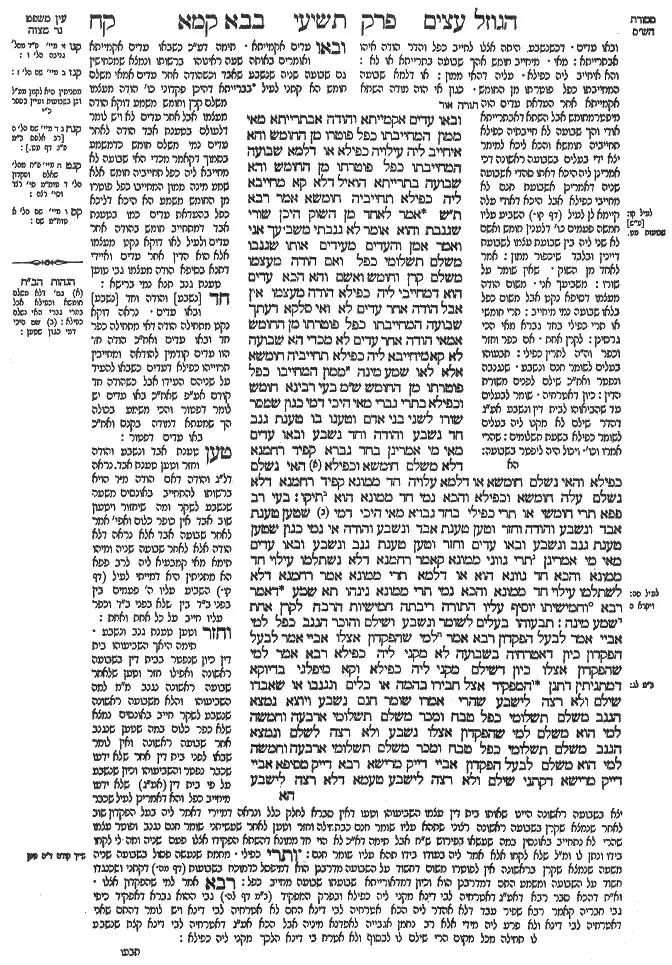
Bava Kamma 108a - Guemara
ובאו עדים אקמייתא והודה אבתרייתא מאי ממון המחייבתו כפל פוטרו מן החומש והא איחייב ליה עילויה כפילא או דלמא שבועה המחייבתו כפל פוטרתו מן החומש והא שבועה בתרייתא הואיל דלא קא מחייבא ליה כפילא תחייביה חומשא אמר רבא ת"ש אמר לאחד מן השוק היכן שורי שגנבת והוא אומר לא גנבתי משביעך אני ואמר אמן והעדים מעידים אותו שגנבו משלם תשלומי כפל ואם הודה מעצמו משלם קרן וחומש ואשם והא הכא עדים הוא דמחייבי ליה כפילא הודה מעצמו אין אבל הודה אחר עדים לא ואי סלקא דעתך שבועה המחייבתו כפל פוטרתו מן החומש אמאי הודה אחר עדים לא מכדי הא שבועה לא קא מיחייבא ליה כפילא תחייביה חומשא אלא לאו שמע מינה ממון המחייבו כפל פוטרתו מן החומש ש"מ בעי רבינא חומש וכפילא בתרי גברי מאי היכי דמי כגון שמסר שורו לשני בני אדם וטענו בו טענת גנב חד נשבע והודה וחד נשבע ובאו עדים מאי מי אמרינן בחד גברא קפיד רחמנא דלא משלם חומשא וכפילא האי נשלם כפילא והאי נשלם חומשא או דלמא עלויה חד ממונא קפיד רחמנא דלא נשלם עלה חומשא וכפילא והכא נמי חד ממונא הוא תיקו:
בעי רב פפא תרי חומשי או תרי כפילי בחד גברא מאי היכי דמי שטען טענת אבד ונשבע והודה וחזר וטען טענת אבד ונשבע והודה אי נמי כגון שטען טענת גנב ונשבע ובאו עדים וחזר וטען טענת גנב ונשבע ובאו עדים מאי מי אמרינן תרי גווני ממונא קאמר רחמנא דלא נשתלמו עילוי חד ממונא והכא חד גוונא הוא או דלמא תרי ממונא אמר רחמנא דלא לשתלמו עילוי חד ממונא והכא נמי תרי ממונא נינהו תא שמע דאמר רבא (ויקרא ה, כד) וחמישיתו יוסיף עליו התורה ריבתה חמישיות הרבה לקרן אחת שמע מינה:
תבעוהו בעלים לשומר ונשבע ושילם והוכר הגנב כפל למי אביי אמר לבעל הפקדון רבא אמר למי שהפקדון אצלו אביי אמר לבעל הפקדון כיון דאטרחיה בשבועה לא מקני ליה כפילא רבא אמר למי שהפקדון אצלו כיון דשילם מקני ליה כפילא וקא מיפלגי בדיוקא דמתניתין דתנן המפקיד אצל חבירו בהמה או כלים ונגנבו או שאבדו שילם ולא רצה לישבע שהרי אמרו שומר חנם נשבע ויוצא נמצא הגנב משלם תשלומי כפל טבח ומכר משלם תשלומי ארבעה וחמשה למי הוא משלם למי שהפקדון אצלו נשבע ולא רצה לשלם ונמצא הגנב משלם תשלומי כפל טבח ומכר משלם תשלומי ארבעה וחמשה למי הוא משלם לבעל הפקדון אביי דייק מרישא רבא דייק מסיפא אביי דייק מרישא דקתני שילם ולא רצה לישבע טעמא דלא רצה לישבע
Comments from Rashi on Masechet Bava Kamma Page 108a
ובאו עדים . דכשנשבע היתה אצלו לחייב כפל והדר הודה איהו אבתרייתא: מאי . מיחייב חומש אהך שבועה בתרייתא או לא: והא איחייב ליה כפילא . עליה דהאי ממון: או דלמא שבועה המחייבתו כפל פוטרתו מן החומש . כגון אי הוה מודה השתא אקמייתא אחר העדאת עדים הוה מיפטר מחומש אבל השתא דאבתרייתא אודי והך שבועה לא חייבתיה כפילא תחייביה חומשא והכא ליכא למימר יצא ידי בעלים בשבועה ראשונה דכי אמרינן ליה היכא דאתו סהדי אשבועה שניה דאמרינן אשבועת חנם לא מחייבי כפילא אבל היכא דאודי עלה קיימא לן לעיל (בבא קמא דף קו.) השביע עליו חמשה פעמים כו' דלענין חומש ואשם לא שני ליה בין שבועת עצמו לשבועת דיינין ובלבד שיכפור ממון: אמר לאחד מן השוק . שאין שומר על שורו: משביעך אני . משום הודה מעצמו דסיפא נקט אבל משום כפל בלאו שבועה נמי מיחייב: תרי חומשי או תרי כפילי בחד גברא מאי . הכי גרסינן: לקרן אחת . אם כפר וחזר וכפר וה"ה לתרין כפילי: תבעוהו בעלים לשומר חנם ונשבע . שנגנבה ונפטר ואח"כ שילם לפנים משורת הדין: כיון דאטרחיה . שומר לבעלים עד שהביאוהו לבית דין ונשבע אע"ג דהדר שילם לא מקנו ליה בעלים לשומר כפילא בשעת תשלומים: שהרי אמרו וכו' . ויכול היה ליפטר בשבועה:
Comments from Tosafot - Bava Kamma 108a
ובאו עדים אקמייתא . תימה דע"כ כשבאו עדים אקמייתא ואומרים באותה שעה ראינוהו ברשותו ונמצא שמכחישין גם שבועה שניה שנשבע שאבד וכשהודה אחר עדים אמאי משלם חומש הא קתני לעיל בברייתא דהיכן פקדוני כו' הודה מעצמו משלם קרן וחומש משמע דוקא הודה מעצמו אבל אחר עדים לא ויש לומר דלעולם בטענת אבד הודה לאחר עדים נמי משלם חומש כדמשמע בסמוך דקאמר מכדי האי שבועה לא מחייבא ליה כפל תחייביה חומש אלא שמע מינה ממון המחייבו כפל פוטרו מן החומש משמע הא היכא דליכא כפל בהעדאת עדים כמו בטענת אבד דמתחייב חומש בהודה אחר עדים ולעיל לאו דוקא נקט מעצמו אלא הוא הדין אחר עדים ואיידי דתנא בסיפא הודה מעצמו גבי טוען טענת גנב תנא נמי ברישא: חד [נשבע] והודה וחד [נשבע] ובאו עדים . נראה דוקא נקט מתחילה הודה דאי מתחילה כפר חד ובאו עדים ואח"כ הודה חד הוו עדים קודמין להודאה ומחייבין תרוייהו כפילא דעדים כשבאו להעיד על שניהם העידו אבל כשהודה חד קודם אע"פ שאח"כ באו עדים יש לומר דפטור והכי משמע בכולה הך שמעתא דמודה בקנס ואח"כ באו עדים דפטור: ותרי כפילי . מחמת שנעשה פסול בשבועה שניה משעה שנמצא לא שקרן בראשונה אין לפוטרו משום דחשוד על השבועה מדרבנן הוא דמיפסל כדמוכח בשבועות (דף מה.) דקתני ושכנגדו חשוד על השבועה ומשמע התם דמדרבנן הוא וכיון דמדאורייתא שבועתו שבועה מחייב כפל: טען טענת אבד ונשבע והודה וחזר וטען טענת אבד . נראה דל"ג והודה דאם הודה מיד הויא ברשותו להתחייב באונסים משעה שנשבע לשקר ומה שיחזור ויטעון שוב אבד אין כופר כלום ואפי' אמר לאחר שבועה אבד אלא נראה דלא הודה אלא לאחר שבועה שניה ומיהו תימא מאי קמבעיא ליה לרב פפא הא מתניתין היא דמייתי לעיל (בבא קמא דף קו.) השביע עליו ה' פעמים בין בפני ב"ד בין שלא בפני ב"ד וכפר עליו חייב על כל אחת ואחת: וחזר וטען טענת גנב ונשבע . תימה היאך השביעוהו בית דין כיון שנפטר בבית דין בשבועה ראשונה ואפילו חזר וטען שלאחר שבועה ראשונה נגנב מ"מ למה השביעוהו והלא משבועה ראשונה שנשבע לשקר חייב באונסים נמצא שלא כפר כלום במה שטען שנגנב אחר שבועה ראשונה ואין לומר שבאו לפני בית דין אחר שלא ידעו שכבר נפטר והשביעוהו וכיון שנשבע על פי בית דין (אע"ג) שלא ידעו מיחייב כפל והא דאמרינן לעיל שכבר יצא בשבועה ראשונה היינו שאותו בית דין עצמו השביעוהו וטעו דאין סברא לחלק כלל ונראה דמיירי דאמר ליה בעל הפקדון שוב לאחר שנמצא שקרן בשבועה ראשונה רצוני שתהא עליו שומר חנם כבתחילה וחזר וטען לאחר שעשיתני שומר חנם נגנב ופוטר עצמו שהרי לא נתחייב באונסין במה שעשאו בפירוש ש"ח אבל תימה דא"כ לא הוי חד ממונא דהשתא הפקידו אצלו פעם שניה ומה לי לקחו בידו ונתן לו ומ"ל שלא לקחו אלא אמר ליה בעודו בידו תהא עליו שומר חנם: רבא אמר למי שהפקדון אצלו . וא"ת דהכא סבר רבא דאע"ג דאטרחיה לבי דינא מקני ליה כפילא ובפרק המפקיד (ב"מ דף לה.) גבי ההוא גברא דאפקיד כיפי גבי חבריה קאמר רבא שפיר עבד דלא אהדר ליה הכא אטרחיה לבי דינא התם לא אטרחיה לבי דינא ויש לומר דהתם שאני דאטרחיה לבי דינא ולא פרע ליה מידי אלא רב נחמן אגבייה לאפדנא מיניה אבל הכא אע"ג דאטרחיה לבי דינא קצת שנשבע לו תחילה מכל מקום הרי שילם לו לבסוף ולא אטרח בי דינא הלכך מקני ליה כפילא: רבא אמר למי שהפקדון אצלו. וא"ת דהכא סבר רבא דאע"ג דאטרחיה לבי דינא מקני ליה כפילא ובפרק המפקיד (ב"מ דף לה.) גבי ההוא גברא דאפקיד כיפי גבי חבריה קאמר רבא שפיר עבד דלא אהדר ליה הכא אטרחיה לבי דינא התם לא אטרחיה לבי דינא ויש לומר דהתם שאני דאטרחיה לבי דינא ולא פרע ליה מידי אלא רב נחמן אגבייה לאפדנא מיניה אבל הכא אע"ג דאטרחיה לבי דינא קצת שנשבע לו תחילה מכל מקום הרי שילם לו לבסוף ולא אטרח בי דינא הלכך מקני ליה כפילא:
Bava Kamma 108a - Mishnah translated into english
and witnesses come and testify with regard to his first claim that at the time he took an oath that the deposit had been stolen, it was actually in his possession; and he admits with regard to his second claim that it had been a lie and that it had not actually been lost, what is the halakha: Is he obligated to pay the additional one-fifth payment?
The Gemara explains the two possibilities: Is it being obligated in a monetary obligation that renders him liable for double payment which exempts him from the additional one-fifth payment, and in this case he is liable for the double payment for the deposit due to the witness testimony and would therefore be exempt from the additional one-fifth payment? Or perhaps is it admitting to a false oath that renders him liable for double payment which exempts him from the additional one-fifth payment, and with regard to this latter oath that the item was lost, since it does not render him liable for the double payment, as he took an oath that it had been lost, not stolen, will it render him liable for the additional one-fifth payment?
Rava said: Come and hear a solution to this dilemma from a mishna (Shevuot 49b): In a scenario where one said to someone from the marketplace: Where is my ox that you stole? And the accused says in response: I did not steal it; whereupon the owner of the ox said: I administer an oath to you, and the accused said: Amen, accepting the oath; and the witnesses testify about the accused that he stole it, he must pay double payment. And if he admitted of his own accord that he stole it, then he must pay the principal and the additional one-fifth payment, and bring a guilt-offering.
Rava explains the proof: But here, it is witnesses who render him liable for the double payment, as since the accused was not a bailee, the oath does not render him liable, and yet the mishna teaches that if he admitted of his own accord that he stole it, then yes, he must pay the additional one-fifth payment, but if he admitted after witnesses testified, then no, he is not required to pay the additional one-fifth.
Rava continues: And if it enters your mind to say that it is an oath that renders him liable for double payment which exempts him from the additional one-fifth payment, why does he not pay the additional one-fifth payment if he admitted that it was a false oath after witnesses testified? After all, this oath does not render him liable to pay the double payment, as the halakha that one who falsely takes an oath that the item was stolen pays double payment applies only in the case of a bailee; therefore, the oath should render him liable to pay the additional one-fifth payment, as does any false oath taken with regard to a monetary claim.
Rava completes the proof: Rather, must one not conclude from this mishna that it is the monetary obligation that renders him liable to pay the double payment which exempts him from the additional one-fifth payment? The Gemara affirms: Conclude from the mishna that the additional one-fifth payment is dependent upon the type of monetary obligation, and not an oath, resolving Rami bar Ḥama’s dilemma.
§ Concerning the additional one-fifth payment, Ravina raises a dilemma: If the additional one-fifth payment and the double payment are split among two men, what is the halakha? The Gemara explains the dilemma: What are the circumstances? This is referring to a case where one transferred his ox to two people to safeguard, and they stated the claim that a thief stole it from them; one of them took an oath that it had been stolen and subsequently admitted of his own accord that he had lied, and one of them took an oath that it had been stolen and subsequently witnesses came and testified that he had lied. What is the halakha in this case?
Ravina clarifies the possibilities: Do we say that the Merciful One is particular with regard to one man that he does not pay both the additional one-fifth payment and the double payment, whereas in this case, this one about whom the witnesses testified will pay the double payment and that one who admitted of his own accord will pay the additional one-fifth payment? Or perhaps the Merciful One is particular that the additional one-fifth payment and the double payment will not be paid for one monetary obligation, and here too, it is one monetary obligation? The Gemara comments: The dilemma shall stand unresolved.
§ Concerning the additional one-fifth payment, Rav Pappa raises a dilemma: In a case of two additional one-fifth payments or two double payments with regard to one man, what is the halakha; must he pay twice for the same monetary obligation? The Gemara explains: What are the circumstances? This is referring to a case where one stated the claim that the deposit was lost and took an oath and then admitted that it was not lost, and returned and again stated the claim that the same deposit was lost, and took another oath supporting this claim and again admitted that it was not lost. Alternatively, this is referring to a case where one stated the claim that a thief stole the deposit and took an oath and then witnesses came and testified that he had taken it, and he returned and again stated the claim that a thief stole the same deposit and again took an oath and then witnesses came and again testified that he had taken it; what is the halakha?
Rav Pappa clarifies the possibilities: Do we say that the Merciful One states concerning two types of monetary restitution, e.g., double payment and the additional one-fifth payment, that they will not be paid for one monetary obligation, but here, it is only one type, merely doubled; or perhaps the Merciful One states concerning two payments of monetary restitution that they will not be paid for one monetary obligation, and here too, they are two payments of monetary restitution, whether in the case of two additional one-fifth payments or two double payments?
The Gemara suggests a resolution to Rav Pappa’s dilemma. Come and hear, as Rava says: The verse states: “Or anything about which he has sworn falsely, he shall restore it in full, and shall add the fifth part [ḥamishitav] more thereto” (Leviticus 5:24). By employing a plural term, ḥamishitav, and not the singular ḥamishito, the Torah added many additional one-fifths for one principal, meaning that one can become obligated in multiple one-fifth payments for the same principal. The Gemara affirms: Conclude from Rava’s statement that this is the halakha.
§ The Gemara discusses an amoraic dispute concerning a similar case: If an owner demanded of an unpaid bailee that he return a deposit, and he claimed that it had been stolen from him and took an oath to that effect, and despite being exempt from payment, he paid of his own volition, and subsequently the thief was identified, to whom is double payment paid, the owner or the bailee? Abaye says: To the owner of the deposit. Rava says: To the one in whose possession the deposit was when it was stolen, i.e., the bailee.
The Gemara explains their opinions: Abaye says that the double payment is paid to the owner of the deposit; since the bailee troubled him by taking an oath instead of paying immediately, the owner is not willing to grant acquisition of the double payment to the bailee, so it is paid to the owner. Rava says that the double payment is paid to the one in whose possession the deposit was when it was stolen; once he paid, the owner grants acquisition of the double payment to the bailee.
The Gemara explains: And they disagree with regard to the deductive inference to be drawn from the wording of the mishna, as we learned in a mishna (Bava Metzia 33b): In the case of one who deposits with another, i.e., an unpaid bailee, an animal or vessels, and they were stolen or lost, and the bailee paid the owner and did not wish to take an oath, which he may decide to do, as the Sages said that an unpaid bailee takes an oath that he is exempt and is released from the obligation to pay the owner, but may also opt to pay; in such a case the halakha is that if the thief was found he pays double payment, or if the deposited item was a sheep or an ox and the thief slaughtered or sold it he pays the fourfold or fivefold payment. To whom does the thief pay those payments? He pays them to the one in whose possession the deposit was when it was stolen or lost. When the bailee paid the owner for the stolen item, he acquired it and therefore is entitled to any payment of principal or fine paid by the thief.
The mishna continues: If the bailee took an oath and did not wish to pay, and the thief was later found and was required to pay double payment, or he slaughtered or sold the sheep or ox and was required to pay the fourfold or fivefold payment, to whom does the thief pay the money? He pays it to the owner of the deposit, not to the bailee.
The Gemara explains the dispute: Abaye inferred the halakha from the wording of the first clause, and Rava inferred the halakha from the wording of the latter clause. Abaye inferred it from the wording of the first clause, as it teaches: If the bailee paid the owner and did not wish to take an oath, the thief pays the double, fourfold, or fivefold payment to the bailee. Abaye infers from here that the reason the thief pays the bailee is specifically that he did not wish to take an oath,
Traduction : The William Davidson digital edition of the Koren Noé Talmud, with commentary by Rabbi Adin Even-Israel Steinsaltz.