 Talmud Bavli
Bava Kamma 34b : Youtube
Daf TubeYoutube
2 video classes :
Bava Kamma Page 34b
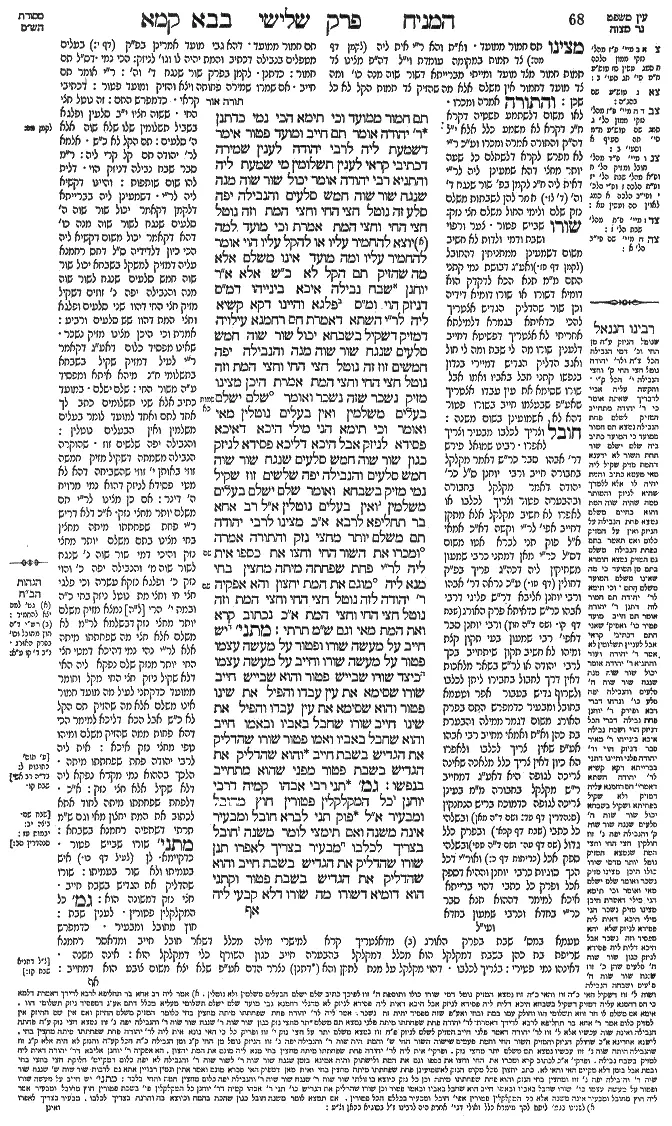
Bava Kamma 34b - Guemara
תם חמור ממועד וכי תימא הכי נמי כדתנן ר' יהודה אומר תם חייב ומועד פטור אימר דשמעת ליה לרבי יהודה לענין שמירה דכתיבי קראי לענין תשלומין מי שמעת ליה והתניא רבי יהודה אומר יכול שור שוה מנה שנגח שור שוה חמש סלעים והנבילה יפה סלע זה נוטל חצי החי וחצי המת וזה נוטל חצי החי וחצי המת אמרת וכי מועד למה יוצא להחמיר עליו או להקל עליו הוי אומר להחמיר עליו ומה מועד אינו משלם אלא מה שהזיק תם הקל לא כ"ש אלא א"ר יוחנן שבח נבילה איכא בינייהו דמ"ס דניזק הוי ומ"ס פלגא והיינו דקא קשיא ליה לר"י השתא דאמרת חס רחמנא עילויה דמזיק דשקיל בשבחא יכול שור שוה חמש סלעים שנגח שור שוה מנה והנבילה יפה חמשים זוז זה נוטל חצי החי וחצי המת וזה נוטל חצי החי וחצי המת אמרת היכן מצינו מזיק נשכר שזה נשכר ואומר (שמות כא, לו) שלם ישלם בעלים משלמין ואין בעלים נוטלין מאי ואומר וכי תימא הני מילי היכא דאיכא פסידא לניזק אבל היכא דליכא פסידא לניזק כגון שור שוה חמש סלעים שנגח שור שוה חמש סלעים והנבילה יפה שלשים זוז שקיל נמי מזיק בשבחא ואומר שלם ישלם בעלים משלמין ואין בעלים נוטלין א"ל רב אחא בר תחליפא לרבא א"כ מצינו לרבי יהודה תם משלם יותר מחצי נזק והתורה אמרה (שמות כא, לה) ומכרו את השור החי וחצו את כספו אית ליה לר"י פחת שפחתה מיתה מחצין בחי מנא ליה (שמות כא, לה) מוגם את המת יחצון והא אפקיה ר' יהודה לזה נוטל חצי החי וחצי המת וזה נוטל חצי החי וחצי המת א"כ נכתוב קרא ואת המת מאי וגם ש"מ תרתי:
מתני׳ יש חייב על מעשה שורו ופטור על מעשה עצמו פטור על מעשה שורו וחייב על מעשה עצמו כיצד שורו שבייש פטור והוא שבייש חייב שורו שסימא את עין עבדו והפיל את שינו פטור והוא שסימא את עין עבדו והפיל את שינו חייב שורו שחבל באביו ובאמו חייב והוא שחבל באביו ואמו פטור שורו שהדליק את הגדיש בשבת חייב והוא שהדליק את הגדיש בשבת פטור מפני שהוא מתחייב בנפשו:
גמ׳ תני רבי אבהו קמיה דרבי יוחנן כל המקלקלין פטורין חוץ מחובל ומבעיר א"ל פוק תני לברא חובל ומבעיר אינה משנה ואם תימצי לומר משנה חובל בצריך לכלבו מבעיר בצריך לאפרו תנן שורו שהדליק את הגדיש בשבת חייב והוא שהדליק את הגדיש בשבת פטור וקתני הוא דומיא דשורו מה שורו דלא קבעי ליה
Comments from Rashi on Masechet Bava Kamma Page 34b
תם חמור ממועד . דהא גבי מועד אמרינן בפ"ק (דף י:) בעלים מטפלים בנבילה דכתיב והמת יהיה לו וגו' לניזק: הכי נמי . דס"ל תם חמור: כדתנן . לקמן בפרק שור שנגח ד' וה': ר"י אומר תם חייב . אם שמרו שמירה פחותה ויצא והזיק ומועד פטור: דכתיבי קראי . כדמפרש התם: זה נוטל חצי החי . ששוה חציו י"ב סלעין ופלגא בשביל תשלומין שלו שלא שוה אלא ה' סלעים: תם הקל לא כ"ש . אלמא לר' יהודה תם קל קרי ליה: ר"מ סבר שבח נבילה דניזק הוי . דלית להו שום שותפות: והיינו דקשיא ליה לר"י . דשמעינן ליה בברייתא דלקמן דקאמר יכול שור שוה ה' סלעים שנגח לשור שוה מנה כו' דהא דקאמר יכול משום דקשיא ליה הכי כיון דלדידיה ס"ל דחס רחמנא עליה דמזיק למשקל בשבחא יכול שור שוה חמש סלעים שנגח לשור שוה מנה והנבילה יפה נ' זוזים דשקיל מזיק חצי החי דהוו שני סלעים ופלגא וחצי המת דהוו שש סלעים ורביע: אמרת וכי היכן מצינו מזיק נשכר . שאינו מפסיד כלום דאע"ג דקאמר ר"י לעיל דמזיק שקיל בשבחא בתשלומי ח"נ מיהא איתא ומפסיד ע"ה משור החי: שלם ישלם . במועד כתיב אלא שני תשלומים כתב לך אחד לתם ואחד למועד לומר בעלים משלמין ואין הבעלים נוטלין: והנבילה יפה שלשים זוז . שהוקרה הנבילה משמתה דשקיל מזיק חמשה זוזי באותן י' זוזי שהשביחה דהא לא מטי פסידא לניזק דהוא נמי מרויח ה' דינר: אם כן מצינו לר"י תם משלם יותר מחצי נזק . א"כ דלא דריש ר"י פחת שפחתתו מיתה מחצין בחי מצינו בתם משלם יותר מחצי נזק והיכי דמי שור שוה נ' שנגח לשור שוה מ' והנבילה יפה כ' והוי נזק כ' ופלגא נזקא עשרה וכי פלגי חצי חי וחצי מת נוטל ניזק בחי כ"ה ובמת י' הרי [ל"ה] נמצא מזיק משלם יותר מחצי נזק דבשלמא לר"מ לא משלם אלא חצי מה שפחתתו מיתה אלא לר"י נהי נמי דהיכא דמטי חצי החי יותר מנזק שלם נפקא ליה האי דלא שקיל ניזק חצי החי מקל וחומר ממועד כדקתני לעיל מה מועד חמור אינו משלם אלא מה שהזיק תם הקל לא כ"ש אבל הכא דליכא למימר הכי דהא פחות ממה שהזיק משלם ומיהו טפי מחצי נזק איכא: אית ליה לרבי יהודה פחת שפחתתו מיתה . הלכך בההוא נמי מקרא נפקא ליה דלא שקיל אלא חצי נזק: א"כ . דלפחת שפחתתו מיתה לחוד אתא לכתוב את המת יחצון מאי וגם ש"מ תרתי דשתפיה רחמנא בשבחא: מתני' שורו שבייש פטור . כדקיימא לן (לעיל בבא קמא דף כו.) איש בעמיתו ולא שור בעמיתו: שורו שהדליק את הגדיש בשבת חייב . חצי נזק דמשונה הוא: גמ' כל המקלקלין פטורין . לענין שבת: חוץ מחובל ומבעיר . כדמפרש טעמא במס' שבת בפרק האורג מדאצטריך קרא למישרי מילה מכלל דשאר חובל חייב ומדאסר רחמנא שריפת בת כהן בשבת דמקלקל הוא מכלל דמקלקל בהבערה חייב כגון השורף כלי דמקלקל הוא: אינה משנה . דאינהו נמי פטירי: בצריך לכלבו . דהוי מקלקל על מנת לתקן והא (דתנן) נצרר הדם אע"פ שלא יצא משום צובע הוא דמחייב:
Comments from Tosafot - Bava Kamma 34b
מצינו תם חמור ממועד . וא"ת והא ר"י אית ליה (לקמן בבא קמא דף מה:) צד תמות במקומה עומדת וי"ל דה"פ מצינו צד תמות חמור מצד מועד ומייתי מברייתא דשור שוה מנה כו' ומה צד מועד דחמור אין משלם אלא מה שהזיק צד תמות הקל לא כל שכן: והתורה אמרה ומכרו . לאו משום דלשתמע פשטיה דקרא ח"נ דקרא לא משמע כלל אלא י"ל דה"ק והתורה אמרה ומכרו וע"כ ר"י לא מפרש לקרא דלשתלם כל שעה יותר מחצי דהא שמעינן ליה לר"י דאית ליה ח"נ לקמן בפ' שור שנגח ד' וה' (בבא קמא ד' לז.) אמר להן לשבתות משלם נזק שלם ולימי החול משלם חצי נזק: שורו שבייש פטור . צער ורפוי ושבת ודמי ולדות לא חשיב משום דשמעינן ממתניתין דהחובל (לקמן בבא קמא דף פז.) ואע"ג דבושת נמי קתני התם מ"מ תנא הכא לדקדק הוא דומיא דשורו או שורו דומיא דידיה וכן שור שהדליק הגדיש אצטריך להכי כדאיתא בגמרא דלמילתא אחריתי לא אצטריך דפשיטא דחייב דלענין שורו מה לי שבת ומה לי חול ואגב הדליק הגדיש דמיירי בנדון בנפשו קתני חבל באביו ואמו אבל שורו שסימא את עין עבדו אצטריך שאע"פ שבעצמו חייב בשורו פטור דהא לא אשמועינן בשום משנה: חובל וצריך לכלבו מבעיר וצריך לאפרו . רבינו שמואל פירש דר' אבהו סבר כר"ש דאמר מקלקל בחבורה חייב ורבי יוחנן ס"ל כר' יהודה דאמר מקלקל בחבורה ובהבערה פטור וצריך לכלבו או לאפרו לא חשיב מקלקל אלא מתקן דחייב אפי' לר"י וקשה דא"כ אמאי א"ל פוק תני לברא אטו משום דס"ל כר"י מאן דמתני כרבי שמעון משתיקין ליה דכה"ג פריך בפ"ק דחולין (דף טו.) ע"כ נראה דר' אבהו ורבי יוחנן אליבא דר"ש פליגי דרבי אבהו כר"ש כדאיתא פרק האורג (שבת דף קו. ושם ד"ה חוץ) ורבי יוחנן סבר דאפי' רבי שמעון בעי תקון קצת ומיהו לא חשיב תקון שיתחייב בכך לרבי יהודה או לר"ש בשאר מלאכות דאין דרך לחבול בחבירו ליתן לכלבו ולשרוף גדיש בעבור אפר וטעמא בחובל ומבעיר כדמפרש התם בפרק האורג משום דגמר ממילה והבערת בת כהן וא"ת ואמאי מחייב רבי אבהו אע"פ שאין צריך לכלבו ולאפרו הא כיון דאין צריך כלל מלאכה שאינה צריכה לגופה היא דאע"ג דמחייב ר"ש מקלקל בחבורה מ"מ בעינן צריכה לגופה כדמוכח בריש הנחנקין (סנהדרין דף פד: ושם ד"ה מאן) ובשלהי כל כתבי (שבת דף קכא.) ובפרק כלל גדול (שם דף עה. ושם ד"ה טפי) ובשלהי ספק אכל (כריתות דף כ:) ואור"י דכל הנך סוגיות כרבי יוחנן וההיא דספק אכל ופרק כל כתבי דהוי ברייתא איכא למימר דההוא תנא סבר כר"י בחדא וכרבי שמעון בחדא ועי"ל דאפי' במקלקל גמור משכחת לה דהיא צריכה לגופה כגון חובל באיסורי הנאה שסבור שיכול ליהנות ליתן לכלבו וכן מבעיר באיסורי הנאה שסובר שיכול לבשל בו קדירה וא"ת ורבי יוחנן מאי טעמא דלא מחייב מקלקל גמור דהא טעמא דמקלקלין פטורין היינו משום דבעינן מלאכת מחשבת כדמוכח בספ"ק דחגיגה (דף י:) ולענין חבורה לא חיישינן אמלאכת מחשבת כדמוכח בס"פ ספק אכל (כריתות דף יט:) דאמר הנח לחבורה הואיל ומקלקל חייב מתעסק נמי מחייב ומתעסק לא מפטר אלא מטעם מלאכת מחשבת וי"ל נהי דלא בעינן מלאכת מחשבת מיהו כיון דגמרינן ממילה ומהבערת בת כהן לא מחייבינן אלא דומיא דהנהו דלא הוי מקלקל גמור אלא תקון במקצת ור' אבהו נהי דצורך מצוה לא משוי ליה תקון מ"מ צריכה לגופה משוי ליה מה שהוא צריך למצוה וא"ת צריך לכלבו ולאפרו היכי חשיב צריכה לגופה מ"ש מחופר גומא ואין צריך אלא לאפרה וי"ל דלא דמי דהכא צריך הוא לנטילת נשמה דהיינו הדם כי הדם הוא הנפש כדי לתת לכלבו ומבעיר נמי להבערה כדי לעשות אפר כמו מבעיר לבשל קדירה ולא דמי לחופר גומא דממילא ואין נהנה כלל ממנו וא"ת הא דאמר בפ"ק דיבמות (דף ו:) דאצטריך קרא למיסר הבערת בת כהן משום דהוה ס"ד למשרי מקל וחומר דעבודה דדחיא שבת תיפוק ליה דאי לא כתיב הבערת בת כהן הוה שרינן כל המקלקלין בהבערה וי"ל דהתם כר' יהודה דחשיב ליה תקון:
Bava Kamma 34b - Mishnah translated into english
a case where the halakha with regard to an innocuous ox that causes damage is more stringent than with regard to a forewarned ox, since according to all opinions, in a case where a forewarned ox kills another ox, the carcass belongs exclusively to the injured party, and he sustains any subsequent decrease in its value.
And if you would say that indeed, Rabbi Yehuda holds that the halakha with regard to an innocuous ox is more stringent than with regard to a forewarned ox, as we learned in a mishna that Rabbi Yehuda says: If a bailee did not safeguard an ox properly, and it escaped and caused damage, if it was an innocuous ox he is liable, and if it was a forewarned ox he is exempt (45b), that mishna cannot serve as proof for the issue under discussion. Say that you heard Rabbi Yehuda express this opinion, that the halakha with regard to an innocuous ox is more stringent, with regard to the halakhot of safeguarding, as verses are written in the Torah from which this halakha is derived. But with regard to compensation, did you ever hear him express this opinion?
On the contrary; but isn’t it taught in a baraita that Rabbi Yehuda says: One might have thought that in the case of an ox worth one hundred dinars that gored an ox worth five sela, i.e., twenty dinars, and the carcass is worth one sela, i.e., four dinars, the halakha is that this party takes half the living ox and half the dead ox, and that party takes half the living ox and half the dead ox. Accordingly, the injured party receives fifty-two dinars in value, which is much more than his ox was worth before it was killed.
Instead, continues Rabbi Yehuda, you should say: For what purpose is the case of a forewarned ox singled out by the halakha? Is it to render it more stringent than the case of an innocuous ox, or to render it more lenient? Clearly, you must say that it is to render it more stringent. And therefore, if in the case of a forewarned ox, its owner pays only the value of what he damaged and no more, in the case of an innocuous ox, which is more lenient, all the more so is it not clear that the owner is not liable to pay more than the value of the damage? Evidently, Rabbi Yehuda does not allow for liability in the case of an innocuous ox to be more stringent than in the case of a forewarned ox.
Rather, Rava’s explanation, that Rabbi Meir and Rabbi Yehuda disagree with regard to a case where the carcass depreciated in value, should be rejected. Instead, their dispute should be explained according to what Rabbi Yoḥanan said, i.e., that the practical difference between them is with regard to the appreciation of the carcass in value after the ox’s death; as one Sage, Rabbi Meir, holds that the entire increased value of the carcass belongs to the injured party, since the owner of the belligerent ox has no share in the carcass, and one Sage, Rabbi Yehuda, holds that half of the increased value belongs to the injured party and half goes to the one liable for the damage.
And this explains what was difficult for Rabbi Yehuda in another baraita. Now that you say that the Merciful One has mercy on the one liable for damage, as he takes a share of the increased value of the carcass, can it be that in the case of an ox worth five sela, i.e., twenty dinars, that gored an ox worth one hundred dinars, and the carcass is worth fifty dinars, this party takes half the live ox and half the dead ox, and that party takes half the live ox and half the dead ox? Accordingly, the owner of the belligerent ox receives thirty-five dinars in value, which is more than his ox was worth.
Rather, you should say: Where do we find a case where the one liable for damage gains from the damage, comparable to this case, where this owner of the belligerent ox gains, receiving more than the value of his ox? Clearly there is no such case, as one who is liable for damage does not gain from it. And in addition, it says: “He shall pay” (Exodus 21:36), indicating that the owner of the belligerent ox pays, and the owner does not take more than the amount his animal was worth at the time of the damage.
The Gemara asks: For what reason was it necessary to add the claim: And it says: “He shall pay”? The Gemara answers: Lest you say that this matter, that the one liable for damage does not gain, applies specifically where there is a loss sustained by the injured party, as in this case, where the decrease in the ox’s value is fifty dinars, and if the carcass is shared by the liable party, the injured party receives only thirty-five dinars, thereby sustaining a loss. But in a case where there is no loss sustained by the injured party, for example, the case of an ox worth five sela, i.e., twenty dinars, that gored another ox worth five sela, and the carcass appreciated in value and is now worth thirty dinars, more than the ox was worth when it was alive, in this case the one liable for damage also takes a share of the increased value, since the injured party ends up not having sustained any financial loss, as he receives a share of ten dinars in the belligerent ox and another fifteen in the carcass, gaining five dinars over the value of his ox.
It is to counter this claim that Rabbi Yehuda adds: And it says: “He shall pay,” indicating that the owner of the belligerent ox pays, and the owner does not take more than the amount his animal was worth at the time of the damage.
§ With regard to Rabbi Yehuda’s opinion that the two owners split the value of both the belligerent ox and the dead ox between them, Rav Aḥa bar Taḥalifa said to Rava: If so, we find that according to Rabbi Yehuda, when an innocuous ox gores an ox that is worth less than it, its owner pays more than half the damage. But the Torah stated: “Then they shall sell the live ox, and divide its monetary value” (Exodus 21:35).
Rava answered him: Rabbi Yehuda also holds that only the diminished value of the dead ox that was diminished by its death is compensated for by dividing the live ox between the two parties. The liable party never pays more than half the damage.
The Gemara asks: From where does Rabbi Yehuda derive this halakha? Is it from the verse: “And the carcass they shall also divide” (Exodus 21:35), from which Rabbi Meir derived it? But didn’t Rabbi Yehuda already derive from this verse that this party takes the value of half the live ox and half the dead ox, and that party takes the value of half the live ox and half the dead ox?
The Gemara answers: If so, if that is the only halakha indicated by this clause, let the verse simply write: And the carcass they shall divide. What is the reason that the word “also” is added? It is added so that one may conclude two conclusions from the clause: That the carcass is also divided between the two parties, and that the liable party is never required to pay more than half the damage.
MISHNA: There are cases where one is liable for an act of damage caused by his ox, but exempt from liability for the same action if he performed it himself. Conversely, there are also cases where one is exempt from liability for the action of his ox, but liable for his own action.
How so? If his ox caused a person humilation, he is exempt from paying compensation, but if he himself humiliated another, he is liable. Similarly, if his ox blinded the eye of his slave or knocked out his slave’s tooth, he is exempt from having to emancipate the slave for this mutilation. But if he himself blinded his slave’s eye or knocked out his tooth, he is liable to emancipate him, as stated in the Torah (Exodus 21:26–27).
By contrast, if his ox injured the owner’s father or his mother, he is liable to pay damages, but if he himself injured his father or his mother, he is exempt from paying compensation. Similarly, if his ox set fire to a haystack on Shabbat, he is liable to pay damages. But if he himself set fire to a haystack on Shabbat, he is exempt from paying damages. He is exempt from payment in these cases due to the fact that he is liable to receive the death penalty for injuring his father or mother or for desecrating Shabbat.
GEMARA: Rabbi Abbahu taught the following baraita before Rabbi Yoḥanan: Anyone who performs labor destructively on Shabbat is exempt, except for one who injures another or kindles a fire. Rabbi Yoḥanan said to him: Go out and teach it outside; this baraita is not fit for discussion in the study hall. The opinion that deems one liable for injuring another or kindling a fire on Shabbat is not a mishna and should be ignored. And if you say that it is a mishna, one who injures another would be liable only in a case where he requires the blood to give to his dog, and one who kindles a fire would be liable only in a case where he requires its ashes. In these cases, the act is not purely destructive but has some constructive purpose.
We learned in the mishna: If his ox set fire to a haystack on Shabbat, he is liable. But if he himself set fire to a haystack on Shabbat, he is exempt. And the mishna is presumably teaching a case where he set the fire in a scenario that is similar to the case where his ox did so. Just as in the case where his ox set the fire it clearly does not need the ashes, as an ox does not act with such intentions,
Traduction : The William Davidson digital edition of the Koren Noé Talmud, with commentary by Rabbi Adin Even-Israel Steinsaltz.