 Talmud Bavli
The learning on the whole site is dedicated : L'ilui Nishmat רינה בת לדיסיה
The learning on the whole site is dedicated : L'ilui Nishmat יוסף בן מושה
The learning on the whole site is dedicated : L'ilui Nishmat Ledicia bat David Banoun
Bava Kamma 33a : Youtube
Daf TubeYoutube
2 video classes :
Bava Kamma Page 33a
Bava Kamma 33a - Guemara
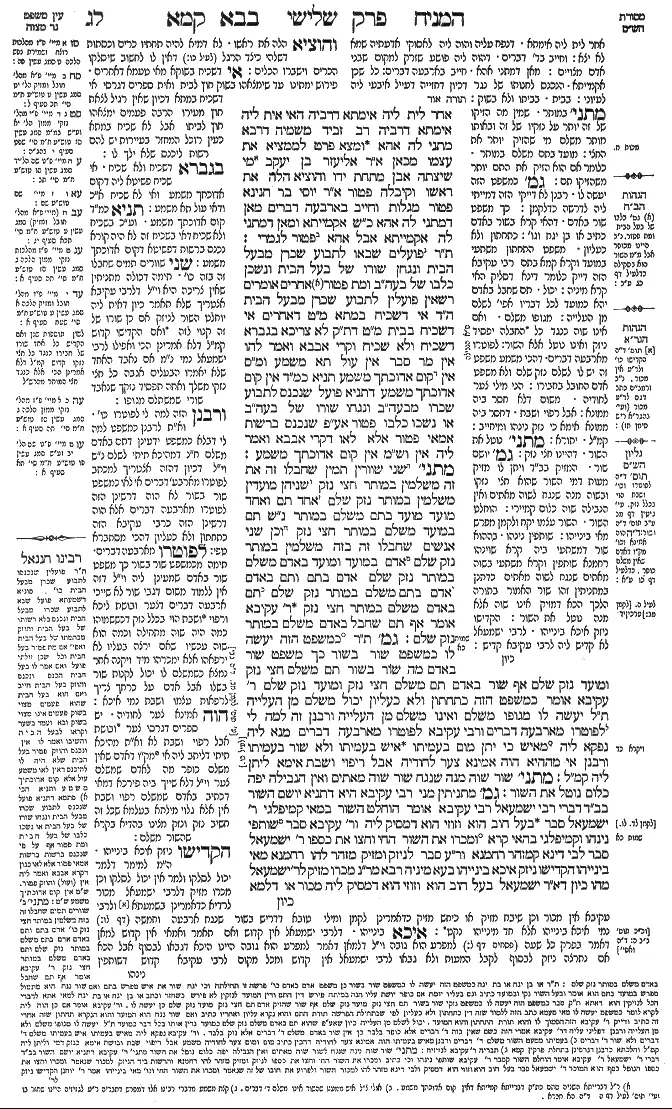
אחר לית ליה אימתא דרביה האי אית ליה אימתא דרביה רב זביד משמיה דרבא מתני לה אהא ומצא פרט לממציא את עצמו מכאן א"ר אליעזר בן יעקב מי שיצתה אבן מתחת ידו והוציא הלה את ראשו וקיבלה פטור א"ר יוסי בר חנינא פטור מגלות וחייב בארבעה דברים מאן דמתני לה אהא כ"ש אקמייתא ומאן דמתני לה אקמייתא אבל אהא פטור לגמרי:
ת"ר פועלים שבאו לתבוע שכרן מבעל הבית ונגחן שורו של בעל הבית ונשכן כלבו של בעה"ב ומת פטור אחרים אומרים רשאין פועלין לתבוע שכרן מבעל הבית ה"ד אי דשכיח במתא מ"ט דאחרים אי דשכיח בבית מ"ט דת"ק לא צריכא בגברא דשכיח ולא שכיח וקרי אבבא ואמר להו אין מר סבר אין עול תא משמע ומ"ס אין קום אדוכתך משמע תניא כמ"ד אין קום אדוכתך משמע דתניא פועל שנכנס לתבוע שכרו מבעה"ב ונגחו שורו של בעה"ב או נשכו כלבו פטור אע"פ שנכנס ברשות אמאי פטור אלא לאו דקרי אבבא ואמר ליה אין וש"מ אין קום אדוכתך משמע:
מתני׳ שני שוורין תמין שחבלו זה את זה משלמין במותר חצי נזק שניהן מועדין משלמין במותר נזק שלם אחד תם ואחד מועד מועד בתם משלם במותר נ"ש תם במועד משלם במותר חצי נזק וכן שני אנשים שחבלו זה בזה משלמין במותר נזק שלם אדם במועד ומועד באדם משלם במותר נזק שלם אדם בתם ותם באדם אדם בתם משלם במותר נזק שלם תם באדם משלם במותר חצי נזק ר' עקיבא אומר אף תם שחבל באדם משלם במותר נזק שלם:
גמ׳ ת"ר (שמות כא, לא) כמשפט הזה יעשה לו כמשפט שור בשור כך משפט שור באדם מה שור בשור תם משלם חצי נזק ומועד נזק שלם אף שור באדם תם משלם חצי נזק ומועד נזק שלם ר' עקיבא אומר כמשפט הזה כתחתון ולא כעליון יכול משלם מן העלייה ת"ל יעשה לו מגופו משלם ואינו משלם מן העלייה ורבנן זה למה לי לפוטרו מארבעה דברים ורבי עקיבא לפוטרו מארבעה דברים מנא ליה נפקא ליה (ויקרא כד, יט) מאיש כי יתן מום בעמיתו איש בעמיתו ולא שור בעמיתו ורבנן אי מההיא הוה אמינא צער לחודיה אבל ריפוי ושבת אימא ליתן ליה קמ"ל:
מתני׳ שור שוה מנה שנגח שור שוה מאתים ואין הנבילה יפה כלום נוטל את השור:
גמ׳ מתניתין מני רבי עקיבא היא דתניא יושם השור בב"ד דברי רבי ישמעאל רבי עקיבא אומר הוחלט השור במאי קמיפלגי ר' ישמעאל סבר בעל חוב הוא וזוזי הוא דמסיק ליה ור' עקיבא סבר שותפי נינהו וקמיפלגי בהאי קרא (שמות כא, לה) ומכרו את השור החי וחצו את כספו ר' ישמעאל סבר לבי דינא קמזהר רחמנא ור"ע סבר לניזק ומזיק מזהר להו רחמנא מאי בינייהו הקדישו ניזק איכא בינייהו בעא מיניה רבא מר"נ מכרו מזיק לר' ישמעאל מהו כיון דא"ר ישמעאל בעל חוב הוא וזוזי הוא דמסיק ליה מכור או דלמא
Comments from Rashi on Masechet Bava Kamma Page 33a
אחר לית ליה אימתא . דנפח עליה והוה ליה לאסוקי אדעתיה שמא לא יצא: וחייב בד' דברים . דהוה ליה פושע שזרק למקום שבני אדם מצויים: מאן דמתני אהא . חייב בארבעה דברים: כל שכן אקמייתא . הנכנס לחנותו של נגר דכיון דחזייה דעייל איבעי ליה לעיוני: בבית . בביתו ולא בשוק: מתני' במותר . שמין מה הזיקו של זה יותר על נזקיו של זה ובאותו מותר משלם מי שהזיק יותר את החצי: מועד בתם משלם במותר . כלומר אם הוא הזיק את התם יותר משהזיקו תם: גמ' כמשפט הזה יעשה לו . רבנן לא דייקי הזה דמייתי ליה לדרשה כדלקמן: כך משפט שור באדם . דהאי קרא בשור באדם כתיב או בן יגח וגו': כתחתון ולא כעליון . משפט התחתון משתעי במועד וקרא קמא בתם רבי עקיבא הזה דייק כלומר דינא דסליק האי קרא מיניה: יכול . תם שחבל באדם יהא כמועד לכל דבריו אפי' לשלם מן העלייה: מגופו משלם . ואם אינו שוה כנגד כל החבלה יפסיד ניזק ואינו נוטל אלא השור: לפוטרו מארבעה דברים . דהכי משמע משפט זה יש לו לשלם נזק שלם ולא משפט אדם החובל בחבירו: הני מילי צער לחודיה . משום דלא חסר ביה ממונא: אבל רפוי ושבת . דחסר ביה ממונא אימא כי נזק נינהו ומיחייב: קמ"ל . יתורא: מתני' נוטל את השור . דהיינו חצי נזק: גמ' יושם שור . המזיק בב"ד ויתן לו מזיק מעות דמי השור שהוא חצי נזקו ובשוה מנה שנגח לשוה מאתים ואין הנבילה שוה כלום קמיירי: הוחלט השור . השור עצמו יקח ולקמן מפרש מאי בינייהו: שותפין נינהו . בההוא שור דמשתעי ביה קרא שוינהו רחמנא שותפים וקרא משתעי בשוה מאתים שנגח לשוה מאתים כדתנן במתניתין זהו שור האמור בתורה הלכך הכא דמזיק אינו שוה אלא מנה נוטל את השור: הקדישו ניזק איכא בינייהו . לרבי ישמעאל לא קדיש ליה לרבי עקיבא קדיש:
Comments from Tosafot - Bava Kamma 33a
והוציא הלה את ראשו . לא דמיא להיה תחתיו כרים וכסתות דשלהי כיצד הרגל (לעיל בבא קמא כו:) דאין לו לחשוב שיסלקו הכרים וישברו הכלים: אי דשכיח בשוקא מאי טעמא דאחרים . פירוש ימתינו עד שימצאהו בשוק חוץ לבית ואית ספרים דגרסי אי דשכיח במתא דכיון שאין רגיל לצאת חוץ מעירו הרבה פעמים ימצאהו חוץ לביתו אבל לא שכיח במתא כעין רוכל המחזר בעיירות יש להם רשות ליכנס שלא ילך לו: בגברא דשכיח ולא שכיח . אי שכיח פשיטא ליה דקום אדוכתך משמע ואי לא שכיח א"כ ודאי עול תא משמע: תניא כמ"ד קום אדוכתך משמע . וע"כ בשכיח ולא שכיח דאי בשכיח זה לא היה קורא נכנס ברשות דפשיטא דקום אדוכתך משמע: שני שוורים תמים שחבלו זה בזה כו' . תימה דכולה מתניתין שאין צריכה היא וי"ל דלרבי עקיבא אצטריך שלא תאמר כיון דאית ליה יוחלט השור לניזק אם כן שורו של זה קנוי לזה. ואם הקדישו קדוש קמ"ל דלא אמרינן הכי ואפילו לרבי ישמעאל נמי נ"מ אם נאבד האחד שלא יאמרו הבעלים אגבה כל חצי נזקי משלך ואתה תפסיד נזקך שנאבד שורי שמשתלם מגופו: ורבנן הזה למה לי לפוטרו כו' . וא"ת לרבנן כמשפט למה לי דבלא כמשפט ידעינן דתם באדם משלם ח"נ דמהיכא תיתי לשלם נ"ש וי"ל דכיון דהזה אצטריך למכתב לפוטרו מארבע' דברים אי לאו כמשפט שור בשור לא הוה דרשינן הזה לפוטרו מארבעה דברים אלא הוה דרשינן הזה כרבי עקיבא הזה כתחתון ולא כעליון דהכי מסתברא טפי: הוה אמינא צער לחודיה . יש ספרים דגרסי צער ובושת אבל רפוי ושבת לא וא"ת מהיכא תיתי דליתב ליה אי מק"ו דאדם שאין משלם כופר מה לאדם שמשלם צער וי"ל דלא שייך ביה פירכא דמאי דכתיב באדם שמשלם רפוי ושבת אין אלא גלוי מילתא בעלמא שכל זה חשיב נזק ונזק מצינו בהדיא בקרא שהשור משלם: הקדישו ניזק איכא בינייהו . ה"מ למימר דלמר יכול לסלקו ולמר אין יכול לסלקו וכן מכרו מזיק דלרבי ישמעאל מכור לרדיא כדאמרינן בשמעתא ולרבי עקיבא אין מכור וכן שיבח מזיק או כיחש מזיק כדאמרינן לקמן ומילי טובא דדריש בשור שנגח ארבעה וחמשה (דף לו:) נמי איכא בינייהו אלא חד מינייהו נקט.: איכא בינייהו . דלרבי ישמעאל אין קדוש ואם תאמר ואמאי אין קדוש למאן דאמר בפרק כל שעה (פסחים דף ל:) למפרע הוא גובה וי"ל דלמאן דאמר למפרע הוא גובה היינו היכא דגבאו לבסוף אבל הכא אם נתרצה ניזק לבסוף לקבל המעות ולא גבאו לרבי ישמעאל אין קדוש ומכל מקום לרבי עקיבא קדוש דשותפין נינהו ועוד דלרבי עקיבא קדוש הגוף והשבח משהקדיש אבל לרבי ישמעאל אפילו למ"ד למפרע הוא גובה שבח דמזיק הוי ולא קדיש עד שיגבנו ונראה דאע"ג דלרבי עקיבא קיימא ליה ברשותיה משעת הנזק קודם העמדה בדין וחשבינן כאילו בא חצי נזק לידו מאותה שעה ואע"ג דקי"ל פלגא נזקא קנסא מכל מקום אם העידו עדים ששורו נגח ביום א' ואתו עדים אחריני ואמרו ביום א' הייתם עמנו אלא בע"ש נגח דמשלמין דבעידנא דקמסהדי גברא לאו בר תשלומין הוא דכל זמן דלא נתגלה הדבר שלא העידו עליו חשיב לאו בר תשלומין אע"ג דקם ברשותו דניזק בשעת הנזק כדמוכח במרובה (לקמן בבא קמא דף עד. ושם) גבי מעידנו באיש פלוני שהפיל שן עבדו (של פלוני) וסימא את עינו ואתו סהדי ואפכינהו ואזמינהו ומוקים לה דקדמי אקדומי ואפ"ה פריך אי דלא עמד בדין דמי כולו עבד בעי לשלומי דאכתי לא מחייב גברא אלמא לא חשבינן גברא בר תשלומין כל זמן שלא נודע אע"פ שהעבד זוכה בשחרורו לאלתר כדדרשינן תחת עינו ולא תחת עינו ושינו וא"ת דבפרק נערה (כתובות דף מא: ושם) תנן לא הספיק לעמוד בדין עד שבגרה קנסה לעצמה ואמאי והא משעת פתוי זכה בה האב אלמא משמע דבקנס לא זכי עד שעת העמדה בדין והכא סבר רבי עקיבא דזכי משעת הנזק וכן במרובה (דף עד: ושם) משמע דאי לא כתיב תחת עינו דמשמע ולא תחת עינו ושינו הוה אמרינן דסימא עינו והפיל שינו דיוצא בעינו ושינו אלמא לא זכי עד שיעמוד בדין והכא סבר רבי עקיבא דזכי משעת הנזק ועוד דר' עקיבא אית ליה בהשולח (גיטין מב:) דיוצא בשן ועין דצריך גט שחרור והתם אמר דמ"ד דצריך גט שחרור קסבר שיוצא בשינו ועינו ושמא י"ל דהיינו טעמא דזוכה משעת נגיחה משום דגלי לן קרא דמשמע לרבי עקיבא דמכרו אמזיק ואניזק קאי וההיא דמרובה (דף עד:) נמי גלי קרא למאן דאית ליה: איכא בינייהו . דלרבי עקיבא קדוש אף על גב דאי מודה מפטר דקנס הוא מכל מקום השתא מיהא לא הודה:
Bava Kamma 33a - Mishnah translated into english
The Gemara answers: Another person does not have awe of his mentor. Therefore, even if the welder urges another person to leave, he must ascertain that that person actually did so, and otherwise he is liable to be exiled. By contrast, this apprentice has awe of his mentor, and so the welder may assume that if he instructed him to leave, he certainly did. Therefore, if in reality the apprentice did not leave and is killed by the sparks, the welder is not liable to be exiled, as he is not held accountable.
Rav Zevid taught in the name of Rava that this aforementioned statement of Rabbi Yosei bar Ḥanina is in reference not to the above baraita but is in reference to this baraita: It is stated in the verse concerning one who kills unintentionally: “And the head slips off the helve, and finds his neighbor, and he dies” (Deuteronomy 19:5); this serves to exclude one who introduces himself into an area of danger, in which case the one who kills unintentionally is exempt from exile. From here Rabbi Eliezer ben Ya’akov says: With regard to one whom a stone departed from his hand, and another person stuck out his head and received a blow from it and died, the one who threw the stone is exempt from exile. It is in reference to this statement that Rabbi Yosei bar Ḥanina says: He is exempt from exile for killing him. But if the victim was merely injured, he is liable to pay four types of indemnity.
The Gemara comments: The one who teaches this statement in reference to this baraita, all the more so he would teach it in reference to the first baraita, where one entered the workshop of the carpenter. But the one who teaches it with regard to the first baraita teaches it only in reference to that baraita. But in this baraita he is entirely exempt from liability for injury, as one could claim that he is completely blameless.
§ The Sages taught: With regard to salaried laborers who came into their employer’s courtyard to claim their wages from the homeowner, and the homeowner’s ox gored them, or the homeowner’s dog bit them, and a laborer died, the homeowner is exempt. Others say that he is liable, as salaried laborers are allowed to enter their employer’s property to claim their wages from the homeowner.
The Gemara asks: What are the circumstances? If the employer can be found in the city, what is the reason of the others, who hold him liable? The laborers could have met him in the city to claim their wages and did not need to enter his courtyard. If he can be found only at home, what is the reason of the first tanna, who exempts him? Clearly they are entitled to claim their wages.
The Gemara answers: No, these are not the circumstances under discussion. This halakha is necessary only with regard to a man who can sometimes be found in town and sometimes cannot be found in town, and the laborers called to him at the gate of his courtyard, and he said to them: Yes. One Sage, referred to as the others, holds that the term yes in this context indicates: Come in. Therefore, he is liable for their death. And one Sage, the first tanna, holds that the term yes in this context indicates: Stand in your place and I will come out to you. Since he did not give them permission to enter, he is exempt.
It is taught in a baraita in accordance with the opinion of the one who says that yes in this context indicates: Stand in your place. As it is taught in a baraita: With regard to a salaried laborer who entered his employer’s courtyard to claim his wages from the homeowner, and the homeowner’s ox gored him, or his dog bit him, the homeowner is exempt, although the laborer entered with permission. The Gemara asks: Why is he exempt if the laborer entered with permission? Rather, is it not because it is a case where the laborer called him at the gate, and he said to him: Yes? Conclude from it that yes in this context indicates: Stand in your place.
MISHNA: With regard to two innocuous oxen that injured each other, the respective damages are evaluated, and if one amount is more than the other, the owner pays half the damages with regard to the difference. In other words, the owner of the ox that caused the greater damage pays the other owner half the difference. If both oxen were forewarned, the owner of the ox that caused the greater damage pays the full cost of the damage with regard to the difference.
In a case where one of the oxen was innocuous and the other one was forewarned, if the forewarned ox caused greater damage to the innocuous ox than the reverse, the owner of the forewarned ox pays the full cost of the damage with regard to the difference. If the innocuous ox caused greater damage to the forewarned ox, its owner pays half the damage with regard to the difference.
And similarly, with regard to two people who injured each other, the one who did greater damage pays the full cost of the damage with regard to the difference, since one is always considered forewarned with regard to damage he causes.
If a person caused damage to a forewarned ox and the forewarned ox caused damage to the person, whichever side caused the greater damage pays the full cost of the damage with regard to the difference. In a case where a person caused damage to an innocuous ox and the innocuous ox caused damage to the person, if the person caused greater financial damage to the innocuous ox he pays the full cost of the damage with regard to the difference. If the innocuous ox caused greater damage to the person, its owner pays only half the damage with regard to the difference. Rabbi Akiva says: The owner of the innocuous ox that injured a person also pays the full cost of the damage with regard to the difference. Rabbi Akiva does not distinguish between an innocuous and a forewarned ox in a case where an ox injures a person.
GEMARA: With regard to the dispute between Rabbi Akiva and the Rabbis about a case where an ox injures a person, the Sages taught: It is derived from the verse: “Whether it has gored a son, or has gored a daughter, according to this judgment shall it be done to him” (Exodus 21:31), that as is the judgment concerning an ox that causes damage to an ox, so is the judgment with regard to an ox that causes damage to a person. Just as with regard to an ox that causes damage to an ox, if it is innocuous its owner pays half the cost of the damage and if it is forewarned he pays the full cost of the damage, so too, with regard to an ox that causes damage to a person, if it is an innocuous ox its owner pays half the cost of the damage and if it is a forewarned ox the owner pays the full cost of the damage.
Rabbi Akiva says: It is derived from the phrase “according to this judgment” that the halakha with regard to an ox that gores a person is judged like the case that appears in the lower verse, i.e., the case of a forewarned ox, which appears in Exodus 21:29, and not like the case that appears in the upper verse, i.e., the case of an innocuous ox, which appears in Exodus 21:28.
One might have thought that since the case of an ox that gored a person is compared to the case of a forewarned ox, the owner also pays from his superior-quality property. Therefore, the verse states: “Shall it be done to him [lo],” indicating he pays restitution exclusively from the proceeds of the sale of the body of his belligerent ox and does not pay from his superior-quality property, as the word lo can also be understood as referring to the ox. In this manner the case of an innocuous ox that gores a person is compared to the halakha of an innocuous ox that gores another ox, whereas with regard to the amount of restitution, it is compared to the case of a forewarned ox.
The Gemara asks: And according to the opinion of the Rabbis, who do not differentiate between an ox that gores a person and one that gores an animal, inasmuch as the distinction between an innocuous and a forewarned ox applies in both cases, why do I need the seemingly superfluous word “this”? The Gemara answers: The word is stated to exempt him from the four types of indemnity that one who injures another person is liable to pay, thereby emphasizing the comparison to the case of an ox that gores an ox.
The Gemara asks: And from where does Rabbi Akiva derive the halakha exempting him from paying these four types of indemnity? The Gemara answers: He derives it from the verse: “And if a man maims his neighbor, as he has done, so shall be done to him” (Leviticus 24:19). Rabbi Akiva derives from here that only when a man injures his neighbor is he liable to pay these four types of indemnity, but not when an ox injures his neighbor.
The Gemara asks: And why do the Rabbis not derive this halakha from that verse? The Gemara answers: If it would have been derived from that verse, I would have said that he is exempt only from paying for pain, but for medical costs and loss of livelihood, I would say that he is liable to give him compensation. Therefore, the phrase “according to this judgment” teaches us that he is not liable to pay compensation for anything other than the damage itself.
MISHNA: With regard to an innocuous ox worth one hundred dinars that gored an ox worth two hundred dinars, and the carcass of the dead ox is not worth anything, its owner takes the entire ox that gored it, since it is worth half the value of the damage.
GEMARA: Whose opinion is expressed in the mishna, which rules that the injured party takes the ox immediately? It is the opinion of Rabbi Akiva, as it is taught in a baraita: After it gores another ox, the belligerent ox shall be appraised in court before it is taken by the injured party, this is the statement of Rabbi Yishmael. Rabbi Akiva says: The ox was already assigned to the owner of the dead ox as payment, and if the amount of damages is not contested by the owner of the goring ox, no further legal steps are required.
The Gemara explains: With regard to what principle do they disagree? Rabbi Yishmael holds that the owner of the dead ox is considered a creditor of the owner of the belligerent ox, and it is money that he is claiming from him, but he has no ownership of the body of the belligerent ox. And Rabbi Akiva holds that they are partners, i.e., from the time the innocuous ox killed the other ox, the owner of the dead ox has a share of ownership in the belligerent ox.
And they disagree with regard to the meaning of this verse: “Then they shall sell the live ox, and divide its monetary value” (Exodus 21:35). Rabbi Yishmael holds that the Merciful One is commanding the court to evaluate the damages in this manner, and Rabbi Akiva holds that the Merciful One is commanding the injured party and the one liable for damage to split ownership of the live ox, without the involvement of the court.
The Gemara asks: What is the practical difference between the two opinions as to whether or not they are considered partners? The Gemara answers: There is a practical difference between them in a case where the injured party consecrated the ox to the Temple. According to the opinion of Rabbi Yishmael, until the court transfers the ox to the injured party, it still belongs to its owner, and therefore the injured party cannot consecrate it. According to the opinion of Rabbi Akiva, the injured party owns the ox from the time the damage was inflicted, and he can therefore consecrate it.
Rava asked Rav Naḥman: If the one liable for damage sold the ox, what is the halakha according to Rabbi Yishmael? Is it that since Rabbi Yishmael says that the injured party is considered a creditor, and it is merely money that he is claiming from him, it is sold? Or perhaps
Traduction : The William Davidson digital edition of the Koren Noé Talmud, with commentary by Rabbi Adin Even-Israel Steinsaltz.