 Talmud Bavli
The learning on the whole site is dedicated : L'ilui Nishmat Amram ben Itshak Loubaton
The learning on the whole site is dedicated : L'ilui Nishmat Yechayahou ben Moche
The learning on the whole site is dedicated : L'ilui Nishmat Chemouel Eliezer ben Batcheva
Bava Kamma 16a : Youtube
Daf TubeYoutube
2 video classes :
Bava Kamma Page 16a
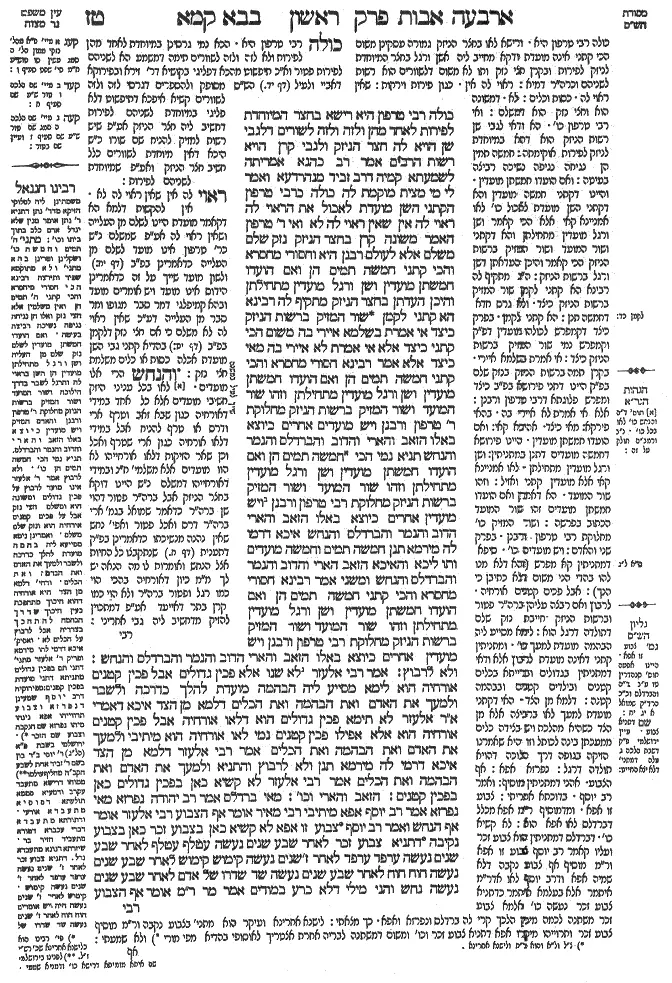
Bava Kamma 16a - Guemara
כולה רבי טרפון היא רישא בחצר המיוחדת לפירות לאחד מהן ולזה ולזה לשורים דלגבי שן הויא לה חצר הניזק ולגבי קרן הויא רשות הרבים אמר רב כהנא אמריתה לשמעתא קמיה דרב זביד מנהרדעא ואמר לי מי מצית מוקמת לה כולה כרבי טרפון הקתני השן מועדת לאכול את הראוי לה ראוי לה אין שאין ראוי לה לא ואי ר' טרפון האמר משונה קרן בחצר הניזק נזק שלם משלם אלא לעולם רבנן היא וחסורי מחסרא והכי קתני חמשה תמים הן ואם הועדו חמשתן מועדין ושן ורגל מועדין מתחילתן והיכן העדתן בחצר הניזק מתקיף לה רבינא הא קתני לקמן שור המזיק ברשות הניזק כיצד אי אמרת בשלמא איירי בה משום הכי קתני כיצד אלא אי אמרת לא איירי בה מאי כיצד אלא אמר רבינא חסורי מחסרא והכי קתני חמשה תמים הן ואם הועדו חמשתן מועדין ושן ורגל מועדין מתחילתן וזהו שור המועד ושור המזיק ברשות הניזק מחלוקת ר' טרפון ורבנן ויש מועדים אחרים כיוצא באלו הזאב והארי והדוב והברדלס והנמר והנחש תניא נמי הכי חמשה תמים הן ואם הועדו חמשתן מועדין ושן ורגל מועדין מתחילתן וזהו שור המועד ושור המזיק ברשות הניזק מחלוקת רבי טרפון ורבנן ויש מועדין אחרים כיוצא באלו הזאב והארי הדוב והנמר והברדלס והנחש איכא דרמו לה מירמא תנן חמשה תמים וחמשה מועדים ותו ליכא והאיכא הזאב הארי והדוב והנמר והברדלס והנחש ומשני אמר רבינא חסורי מחסרא והכי קתני חמשה תמים הן ואם הועדו חמשתן מועדין ושן ורגל מועדין מתחילתן וזהו שור המועד ושור המזיק ברשות הניזק מחלוקת רבי טרפון ורבנן ויש מועדין אחרים כיוצא באלו הזאב והארי הדוב והנמר והברדלס והנחש ולא לרבוץ אמר רבי אלעזר לא שנו אלא פכין גדולים אבל פכין קטנים אורחיה הוא לימא מסייע ליה הבהמה מועדת להלך כדרכה ולשבר ולמעך את האדם ואת הבהמה ואת הכלים דלמא מן הצד איכא דאמרי א"ר אלעזר לא תימא פכין גדולים הוא דלאו אורחיה אבל פכין קטנים אורחיה הוא אלא אפילו פכין קטנים נמי לאו אורחיה הוא מיתיבי ולמעך את האדם ואת הבהמה ואת הכלים אמר רבי אלעזר דלמא מן הצד איכא דרמי לה מירמא תנן ולא לרבוץ והתניא ולמעך את האדם ואת הבהמה ואת הכלים אמר רבי אלעזר לא קשיא כאן בפכין גדולים כאן בפכין קטנים הזאב והארי וכו' מאי ברדלס אמר רב יהודה נפרזא מאי נפרזא אמר רב יוסף אפא מיתיבי רבי מאיר אומר אף הצבוע רבי אלעזר אומר אף הנחש ואמר רב יוסף צבוע זו אפא לא קשיא כאן בצבוע זכר כאן בצבוע נקיבה דתניא צבוע זכר לאחר שבע שנים נעשה עטלף עטלף לאחר שבע שנים נעשה ערפד ערפד לאחר ז' שנים נעשה קימוש קימוש לאחר שבע שנים נעשה חוח חוח לאחר שבע שנים נעשה שד שדרו של אדם לאחר שבע שנים נעשה נחש והני מילי דלא כרע במודים אמר מר ר"מ אומר אף הצבוע
Comments from Rashi on Masechet Bava Kamma Page 16a
כולה רבי טרפון היא . ורישא לאו בחצר הניזק גמורה עסקינן משום הכי קתני אינה מועדת ודקא מחייב ליה אשן ורגל בחצר המיוחדת לניזק לפירות ובקרן חצי נזק ותו לא משום דלשוורים הוא רשות לשניהם וכרה"ר דמיא: ראוי לה אין . כגון פירות וירקות: שאין ראוי לה . כסות וכלים: לא . דמשונה הוא וחצי נזק הוא דמשלם: ואי רבי טרפון כו' . הא ודאי לגבי שן רשות הניזק הוא דהא במיוחדת לניזק לפירות אוקימתה: חמשה תמין הן . נגיחה נגיפה נשיכה רביצה בעיטה: ואם הועדו חמשתן מועדין . והיינו דקתני חמשה מועדין והא דקתני השן מועדת לאכול כו' לאו אמניינא קאי אלא הכי קאמר ושן ורגל מועדין מתחילתן והא דקתני ושור המועד ושור המזיק ברשות הניזק הכי קאמר והיכן העדאתן דשן ורגל ברשות הניזק: ה"ג מתקיף לה רבינא הא קתני לקמן שור המזיק ברשות הניזק כיצד. ולא גרס חדא דחמשה תנן: הא קתני לקמן . בפרק כיצד דקמפרש לכולהו מועדין דפ"ק וקמפרש נמי שור המזיק ברשות הניזק כיצד: אי אמרת בשלמא איירי . בקרן תמה ברשות הניזק בנזק שלם בפ"ק היינו דתני פירושא בפ"ב כיצד ומפרש פלוגתא דרבי טרפון ורבנן: אלא אי אמרת לא איירי בה . בהאי פירקא: מאי כיצד . אהיכא קאי: ואם הועדו חמשתן מועדין . היינו פירושא דחמשה מועדים דתנן במתניתין: ושן ורגל מועדין מתחילתן . לאו אמניינא קאי אלא מועדין קתני ואזיל: וזהו שור המועד . הא דאמרן ואם הועדו חמשתן מועדים זהו שור המועד הכתוב בפרשה: ושור המזיק כו' מחלוקת רבי טרפון ורבנן . בפרק שני והאדם: ויש מועדים כו' . סיפא דמתניתין קא מפרש (והא דלא מנו להו בהדי הני משום דלא כתיבן כי הנך): אבל פכים קטנים אורחיה . לרבוץ ואם רבצה עליהן ברה"ר פטור וברשות הניזק חייבת נזק שלם דתולדה דרגל הוא: לימא מסייע ליה הבהמה מועדת למעך כו' . ומתניתין קתני דאינה מועדת לרבוץ אלא ודאי דמתניתין בגדולים וברייתא בכלים קטנים ובילדים קטנים ובבהמה קטנה: דלמא מן הצד . האי דקתני מועדת למעך לאו ברביצה אלא מן הצד כשהיא מהלכת ויש בצידה כלים ממעכתן בינה לכותל וזו היא שאמרנו הזיקה בגופה דרך הלוכה דהויא תולדה דרגל: נפרזא . אפא: אף הצבוע . אהני דמתניתין מוסיף: ואמר רב יוסף . בדוכתא אחריתי: צבוע זו אפא . ומדמוסיף ר"מ אפא מכלל דברדלס לאו אפא הוא: לא קשיא כו' . דברדלס דמתניתין הוא צבוע זכר ועליו קאמר רב יוסף צבוע זו אפא ור"מ מוסיף אף צבוע נקבה דלא שמיה אפא ודרב יוסף לאו אדר"מ איתמר אלא בעלמא איתמר כדתניא צבוע זכר נעשה כו' אלמא צבוע זכר משתנה לכמה מינין הלכך קרי לה ברדלס ונפרזא ואפא כך מצאתי: לישנא אחרינא ועיקר הוא מתני' בצבוע נקבה . ור"מ מוסיף צבוע זכר ותרוייהו מיקרו אפא דתניא צבוע זכר וכו' ומשום דמשתנה לבריה אחרת אצטריך לאוסופי בהדיא מפי מורי ולא שמעתי:
Comments from Tosafot - Bava Kamma 16a
כולה רבי טרפון היא . הכא נמי גרסינן במיוחדת לאחד מהן לפירות ולא לזה ולזה לשוורים תימה דמשמע הא לשניהם לפירות פטור וא"כ תיפשוט מהכא דפליגי בקושיא דר' זירא ובפירוקא דאביי ולעיל (בבא קמא דף יד.) הש"ס מסופק ולהספרים דגרסי לזה ולזה לשוורים קשיא איפכא דתיפשוט דלא פליגי במיוחדת לשניהם לפירות דחשיב ליה חצר הניזק אע"פ שיש רשות למזיק להניח שם שורו כ"ש. היכא דאין מיוחדת לשוורים כלל חשיב חצר הניזק ואע"פ שמיוחדת לשניהם לפירות: ראוי לה אין שאין ראוי לה לא . אין להקשות דלמא הא דקאמר מועדת היינו לשלם מן העלייה ושאין ראוי לה אע"פ שמשלם נ"ש כר' טרפון אינו מועד לשלם מן העלייה כדאמרינן בפ"ב (דף יח:) ולשון מועד שייך על זה כדאמרינן הידוס אינו מועד ויש אומרים מועד ובהא קמיפלגי דמר סבר מגופו ומר סבר מן העלייה דע"כ שאין ראוי לה לא משלם כי אם חצי נזק דלקמן בפ"ב (בבא קמא דף יט:) בהדיא קתני גבי השן מועדת אכלה כסות או כלים משלמת חצי נזק: והוא דלא כרע במודים. לפי שמצוה לכרוע וכי זקיף זקיף כחויא כדאשכחן ברב ששת במסכת ברכות (דף יב: ושם) מדה כנגד מדה ונעשה נחש זהו עונשו שגנאי הוא לו במה שנעשה נחש: גליון. ויש מפרשים משום דאמרינן במדרש. שיש עצם בשדרו של אדם שממנו נוצר לעתיד לבא ואותו עצם חזק וקשה כל כך שאין האש יכול לשורפו והשתא כשאותו עצם נעשה נחש אינו חי לעתיד לבא ואין סברא לומר שיהא עונש גדול כל כך. בשביל עון זה דהא כל ישראל יש להם חלק לעולם הבא:
Bava Kamma 16a - Mishnah translated into english
The entire mishna is in accordance with the opinion of Rabbi Tarfon; the first part of the latter clause is stated with regard to a jointly owned courtyard, which under the terms of their partnership is designated for the use of one of them, i.e., the injured party, to keep his produce there, and for this one and for that one to keep their oxen there. Accordingly, with regard to damage of the category of Eating caused by one partner’s ox to the injured party’s produce in that courtyard, it is equivalent to the case of a courtyard owned exclusively by the injured party, and the ox’s owner is liable for all the damage. But with regard to damage of the category of Goring, since they are both allowed to keep oxen there, the courtyard is equivalent to a public domain, and if one’s innocuous ox causes damage there, one is liable for only half the cost of the damage.
Rav Kahana said: I stated this teaching of Rabbi Elazar before Rav Zevid of Neharde’a, and he said to me: Are you really able to interpret that the entire mishna is in accordance with the opinion of Rabbi Tarfon? But doesn’t the mishna teach: Concerning acts of damage performed with the tooth, the animal is considered forewarned with regard to eating that which is fitting for it to eat. This indicates that only if what it eats is fitting for it, then yes, one is liable for the full cost of the damage, but if it eats something that is not fitting for it, the owner would not be liable for the full cost of the damage, but only for half the cost of the damage.
Rav Kahana explains his difficulty: And if the mishna is in accordance with the opinion of Rabbi Tarfon, the owner should be liable to pay the full cost of the damage even if his animal ate something not fitting for it, as doesn’t Rabbi Tarfon say: The halakha of cases of Goring performed by an innocuous animal, which is atypical, done in the courtyard of the injured party, is that the owner of the ox pays the full cost of the damage even if the ox is innocuous.
Rather, Rav Kahana said: Actually it must be that the entire mishna is in accordance with the opinion of the Rabbis and the mishna is incomplete and this is what it is teaching: The opening clause should be understood as saying: There are five damage-causing acts that animals can perform twice and remain innocuous, but if they were warned for performing those acts three times, with regard to the five acts they are considered forewarned, i.e., the mishna is not referring to two different sets of damages, five acts for which the animal is considered innocuous and five for which it is considered forewarned. Rather, both statements in the initial clause of the mishna are referring to the same five acts of Goring, and they teach that although the animal is initially considered innocuous with regard to these five acts, it can become forewarned.
The next part of the mishna then provides another halakha: But for damage of the categories of Eating and Trampling, an animal is considered forewarned from the outset. The next two items in the mishna: A forewarned ox and an ox that causes damage on the property of the injured party, should be understood as a question and an answer: And where does their forewarned status with regard to these acts apply? It applies in the courtyard of the injured party. According to Rav Kahana’s explanation, the statement: In the courtyard of the injured party, refers only to cases of Eating or Trampling, not to acts classified as Goring, and therefore it is true even according to the opinion of the Rabbis.
Ravina objects to this explanation: Doesn’t the mishna below (24b) teach: With regard to the case of an ox that causes damage to the property of the injured party on the property of the injured party, stated in the mishna here (15b), how so, i.e., what are the circumstances in which one is liable to pay the full cost of the damage? The mishna below (24b) proceeds to list acts of damage classified as Goring. Ravina states his objection: Granted, if you say that the mishna here (15b) discusses that case, i.e., that it is referring to Goring, it is due to that ruling that the mishna below teaches: How so, and proceeds to discuss one’s liability for Goring, as it is elucidating the case mentioned in the mishna here. But if you say, as Rav Zevid suggests, that the mishna here (15b) does not discuss Goring, what is the meaning of the mishna below when it asks: How so, and then proceeds to discuss one’s liability for Goring?
Rather, Ravina said: The mishna is incomplete and this is what it is teaching: There are five damage-causing acts that animals can perform twice and remain innocuous, but if they were warned for performing those acts three times with regard to the five acts, they are considered forewarned.
The next part of the mishna then provides another halakha: But for damage of the categories of Eating and Trampling, an animal is considered forewarned from the outset, and this is a case in which all agree that the animal is classified as a forewarned ox. And there is the case of an ox that causes damage to the property of the injured party, on the property of the injured party, which is subject to a dispute between Rabbi Tarfon and the Rabbis. And there are other cases similar to these in which animals are considered forewarned from the outset, namely: The wolf, the lion, the bear, the leopard, the bardelas, and the snake.
The Gemara notes: This interpretation of the mishna is also taught in a baraita: There are five damage-causing acts that animals can perform twice and remain innocuous, but if they were warned for performing those acts three times with regard to the five acts, they are considered forewarned. The next part of the mishna then provides another halakha: But for damage of the categories of Eating and Trampling, an animal is considered forewarned from the outset, and this is a case in which all agree that the animal is classified as a forewarned ox. And there is the case of an ox that causes damage to the property of the injured party, on the property of the injured party, which is subject to a dispute between Rabbi Tarfon and the Rabbis. And there are other cases similar to these in which animals are considered forewarned from the outset, namely: The wolf, the lion, the bear, the leopard, the bardelas, and the snake.
There are those who raise this issue as a contradiction and through doing so arrived at the same conclusions, as follows: We learned in the opening clause of the mishna: There are five damage-causing acts that animals can perform twice and remain innocuous, and there are five damage-causing acts for which an animal is considered forewarned. With regard to this, one can ask: But is there nothing else? But aren’t there the cases mentioned in the continuation of the mishna: The wolf, the lion, the bear, the leopard, the bardelas, and the snake? These are considered to be forewarned even if they had never caused damage before.
And they resolve the contradiction through that which Ravina said: The mishna is incomplete and this is what it is teaching: There are five damage-causing acts that animals can perform twice and remain innocuous, but if they were warned for performing those acts three times with regard to the five acts, they are considered forewarned. The next part of the mishna then provides another halakha: But for damage of the categories of Eating and Trampling, an animal is considered forewarned from the outset, and this is a case in which all agree that the animal is classified as a forewarned ox. And there is the case of an ox that causes damage to the property of the injured party, on the property of the injured party, which is subject to a dispute between Rabbi Tarfon and the Rabbis. And there are other cases similar to these in which animals are considered forewarned from the outset, namely: The wolf, the lion, the bear, the leopard, the bardelas, and the snake.
§ The mishna teaches: An animal is not considered forewarned with regard to Goring, i.e., not for goring with its horns, nor for pushing with its body, nor for biting, nor for crouching upon items in order to damage them. Rabbi Elazar says: They taught this only with regard to large vessels, as it is atypical for an animal to crouch upon them, and therefore the act is classified as a subcategory of Goring. But if the animal crouched upon small vessels, since that is its typical manner of behavior, it is classified as a subcategory of Trampling, for which the animal is considered forewarned from the outset.
The Gemara suggests: Let us say that the following baraita supports the opinion of Rabbi Elazar: An animal is considered forewarned, from the outset, to walk in its typical manner and to break or crush a person, or an animal, or vessels. The baraita indicates that an animal’s typical manner is to crush vessels, presumably by crouching down upon them. This would seem to contradict the mishna that states that such behavior is atypical. It would appear the only resolution to this contradiction is if one accepts the distinction made by Rabbi Elazar that the mishna concerns large vessels and the baraita concerns small vessels.
The Gemara rejects this: Perhaps the baraita concerns a case where the animal pushed against the utensils from the side and crushed them against a wall, but it does not concern a case where it crouched upon them.
There are those who say a different version of this discussion, as follows: Rabbi Elazar says: Do not say that the mishna’s ruling refers only to large vessels, as it is atypical for an animal to crouch upon them, but if the animal crouched upon small vessels, that is its typical manner and for that type of damage the animal is considered forewarned. Rather, the mishna refers even to small vessels, as it is atypical for an animal to crouch upon them.
The Gemara raises an objection from a baraita: An animal is considered forewarned, from the outset, to walk in its typical manner and to break or crush a person, or an animal, or vessels.
Rabbi Elazar said: Perhaps the baraita concerns only a case where the animal pushed against the utensils from the side and crushed them against a wall.
There are those who raise this issue as a contradiction: We learned in the mishna: An animal is not considered forewarned with regard to Goring, i.e., not for goring with its horns, nor for pushing with its body, nor for biting, nor for crouching upon items in order to damage them. But isn’t it taught in a baraita: An animal is considered forewarned, from the outset, to walk in its typical manner and to break or crush a person, or an animal, or vessels? In order to resolve this contradiction, Rabbi Elazar said: It is not difficult; here, in the mishna, the reference is to large vessels, while there, in the baraita, the reference is to small vessels.
§ The mishna teaches: The wolf, the lion, the bear, the leopard, the bardelas, and the snake; these are considered to be forewarned even if they had never caused damage before. The Gemara asks: What is a bardelas? Rav Yehuda said: It is a nafreza. The Gemara asks: What is a nafreza? Rav Yosef said: It is an appa.
The Gemara raises an objection from a baraita: In addition to the list of animals that are considered forewarned, Rabbi Meir says: Also the hyena [tzavo’a]. Rabbi Elazar says: Also the snake. And Rav Yosef said in explanation of the baraita: The hyena mentioned by Rabbi Meir, this is the animal called an appa. If Rav Yosef understands a hyena to be an appa, how could he also claim, above, that it is a bardelas?
The Gemara explains: It is not difficult: Here, in the baraita, Rabbi Meir is referring to a male hyena, and there, in the mishna, the reference is to a female hyena.
And it is apparent that a male hyena is distinct from a female one, as it is taught in a baraita: A male hyena after seven years metamorphoses into an insectivorous bat [atalef ]; an insectivorous bat after seven years metamorphoses into a herbivorous bat [arpad]; a herbivorous bat after seven years metamorphoses into a thistle [kimosh]; a thistle after seven years metamorphoses into a briar [ḥo’aḥ]; and a briar after seven years metamorphoses into a demon. Similarly, a person’s spine, seven years after his death, metamorphoses into a snake. The Gemara qualifies the last statement: And this matter applies only to a case where that person did not bow during the blessing of thanksgiving, the eighteenth blessing of the Amida prayer.
The Gemara analyzes the baraita: The Master says above: In addition to the list of animals that are considered forewarned, Rabbi Meir says: Also the hyena.
Traduction : The William Davidson digital edition of the Koren Noé Talmud, with commentary by Rabbi Adin Even-Israel Steinsaltz.