 Talmud Bavli
Bava Kamma 14a : Youtube
Daf TubeYoutube
2 video classes :
Bava Kamma Page 14a
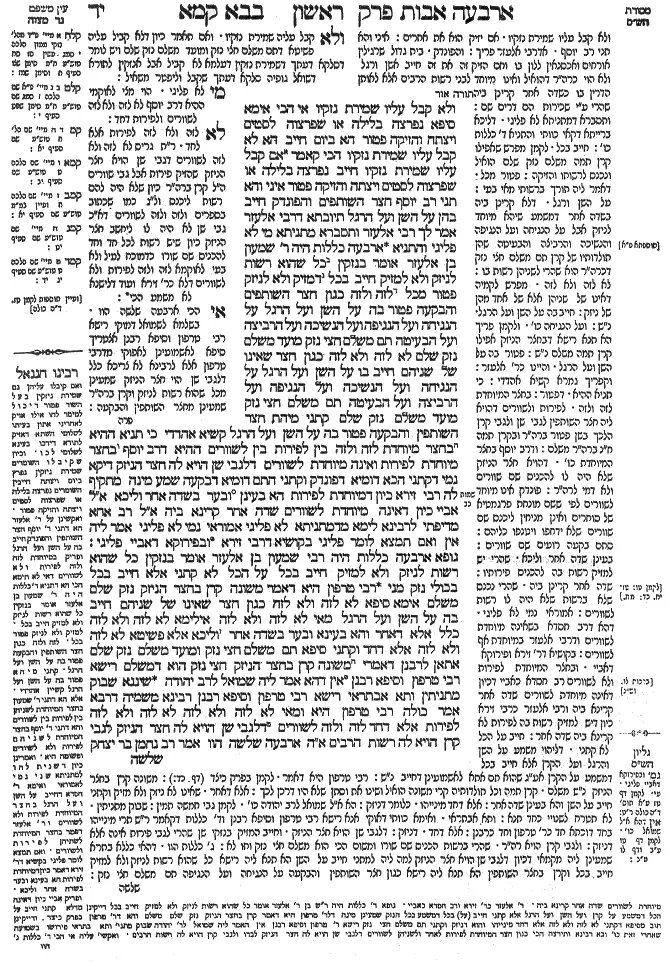
Bava Kamma 14a - Guemara
ולא קבל עליו שמירת נזקיו אי הכי אימא סיפא נפרצה בלילה או שפרצוה לסטים ויצתה והזיקה פטור הא ביום חייב הא לא קבל עליו שמירת נזקיו הכי קאמר אם קבל עליו שמירת נזקיו חייב נפרצה בלילה או שפרצוה לסטים ויצתה והזיקה פטור איני והא תני רב יוסף חצר השותפים והפונדק חייב בהן על השן ועל הרגל תיובתא דרבי אלעזר אמר לך רבי אלעזר ותסברא מתניתא מי לא פליגי והתניא ארבעה כללות היה ר' שמעון בן אלעזר אומר בנזקין כל שהוא רשות לניזק ולא למזיק חייב בכל דמזיק ולא לניזק פטור מכל לזה ולזה כגון חצר השותפים והבקעה פטור בה על השן ועל הרגל על הנגיחה ועל הנגיפה ועל הנשיכה ועל הרביצה ועל הבעיטה תם משלם חצי נזק מועד משלם נזק שלם לא לזה ולא לזה כגון חצר שאינו של שניהם חייב בו על השן ועל הרגל על הנגיחה ועל הנשיכה ועל הנגיפה ועל הרביצה ועל הבעיטה תם משלם חצי נזק מועד משלם נזק שלם קתני מיהת חצר השותפין והבקעה פטור בה על השן ועל הרגל קשיא אהדדי כי תניא ההיא בחצר מיוחדת לזה ולזה בין לפירות בין לשוורים ההיא דרב יוסף בחצר מיוחדת לפירות ואינה מיוחדת לשוורים דלגבי שן הויא לה חצר הניזק דיקא נמי דקתני הכא דומיא דפונדק וקתני התם דומיא דבקעה שמע מינה מתקיף לה רבי זירא כיון דמיוחדת לפירות הא בעינן (שמות כב, ד) ובער בשדה אחר וליכא א"ל אביי כיון דאינה מיוחדת לשוורים שדה אחר קרינא ביה א"ל רב אחא מדיפתי לרבינא לימא מדמתניתא לא פליגי אמוראי נמי לא פליגי אמר ליה אין ואם תמצא לומר פליגי בקושיא דרבי זירא ובפירוקא דאביי פליגי גופא ארבעה כללות היה רבי שמעון בן אלעזר אומר בנזקין כל שהוא רשות לניזק ולא למזיק חייב בכל על הכל לא קתני אלא חייב בכל בכולי נזק מני רבי טרפון היא דאמר משונה קרן בחצר הניזק נזק שלם משלם אימא סיפא לא לזה ולא לזה כגון חצר שאינו של שניהם חייב בה על השן ועל הרגל מאי לא לזה ולא לזה אילימא לא לזה ולא לזה כלל אלא דאחר והא בעינא ובער בשדה אחר וליכא אלא פשיטא לא לזה ולא לזה אלא דחד וקתני סיפא תם משלם חצי נזק ומועד משלם נזק שלם אתאן לרבנן דאמרי משונה קרן בחצר הניזק חצי נזק הוא דמשלם רישא רבי טרפון וסיפא רבנן אין דהא אמר ליה שמואל לרב יהודה שיננא שבוק מתניתין ותא אבתראי רישא רבי טרפון וסיפא רבנן רבינא משמיה דרבא אמר כולה רבי טרפון היא ומאי לא לזה ולא לזה לא לזה ולא לזה לפירות אלא דחד לזה ולזה לשוורים דלגבי שן הויא לה חצר הניזק לגבי קרן הויא לה רשות הרבים א"ה ארבעה שלשה הוו אמר רב נחמן בר יצחק
Comments from Rashi on Masechet Bava Kamma Page 14a
ולא קבל עליו שמירת נזקיו . אם יזיק הוא את אחרים: אלא דחד מינייהו . כלומר דניזק: והפונדק . בית גדול שרגילין אורחים ואכסנאין ללון בו ואם הזיק זה את זה חייב אשן ורגל ולא הוי כרה"ר דהואיל ואינו מיוחד לבני רשות הרבים אלא לאותן הדרין בו כשדה אחר קרינן ביה שהרי ע"י שכירות הם דרים שם: ותסברא דמתניתא לא פליגי . דליכא ברייתא דקאי כוותי והתניא ד' כללות כו': חייב בכל . לקמן מפרש שאפילו קרן תמה משלם נזק שלם הואיל ונכנס לרשותו והזיקה: פטור מכל . דאמר ליה תורך ברשותי מאי בעי: על השן ורגל . דלא קרינן ביה בשדה אחר דמשמע שיהא מיוחד לניזק אבל על הנגיחה ועל הנגיפה והנשיכה והרביצה והבעיטה שהן תולדותיו של קרן תם משלם חצי נזק דכרה"ר הוא שהרי לשניהן רשות בו: לא לזה ולא לזה . מפרש לקמיה דאינו של שניהן אלא של אחד מהן של ניזק: כי תניא ההיא . דפטור: בחצר המיוחדת לזה ולזה . לפירות ולשוורים דהויא ליה חצר השותפים לגבי שן ולגבי קרן הלכך בשן פטור ברה"ר ובקרן תמה ח"נ ברה"ר משלם: ודרב יוסף בחצר המיוחדת כו' . דהויא חצר הניזק שלא היה לו להכניס שם שוורים ולא דמי לרה"ר: פונדק אינו מיוחד לשוורים לפי ששם מונחת פרגמטיא של סוחרים ואינן מניחין ליכנס שם שוורים שלא ידחפו ויטנפו כליהם: סתם בקעה רועים שם שוורים: בעינן שדה אחר וליכא . שהרי יש למזיק רשות בה להכניס פירותיו: שדה אחר קרינן ביה . שהרי נכנס שלא ברשות שלא היה לו רשות לשוורים: אמוראי נמי לא פליגי . דהא דרב חסדא בשאינה מיוחדת לשוורים ודרבי אלעזר במיוחדת אף לשוורים: בקושיא דר' זירא ופירוקא דאביי . ובחצר המיוחדת לפירות ולא לשוורים רב חסדא כאביי דכיון דאינה מיוחדת לשוורים שדה אחר קרינא ביה ורבי אלעזר כרבי זירא כיון דיש למזיק רשות בה לפירות לא קרינא ביה שדה אחר: חייב על הכל לא קתני . דליהוי משמע על השן והרגל ועל הקרן אלא חייב בכל דמשמע על הקרן אע"ג שהוא תם אתא לאשמועינן דחייב נ"ש: רבי טרפון היא דאמר . לקמן בפרק כיצד (בבא קמא דף כד:): משונה קרן בחצר הניזק נ"ש משלם . קרן תמה וכל תולדותיה קרי משונה הואיל ושינו את וסתן שלא היו דרכן לכך: חייב בה על השן ועל הרגל . נ"ש: אלא דאחר . שאינו לא ניזק ולא מזיק וקתני חייב על השן והא בעינן שדה אחר: אלא דחד מינייהו . כלומר דניזק: הא א"ל שמואל לרב יהודה כו' . לקמן גבי חמשה תמין: שבוק מתניתין . לא תטרח לשנויי כחד תנא: ותא אבתראי . ואימא כוותי דאוקי אנא רישא רבי טרפון וסיפא רבנן וד' כללות דקאמר ר"ש תרי מינייהו בחד דוכתא חד כר' טרפון וחד כרבנן: אלא דחד . דניזק: דלגבי שן הויא חצר הניזק . וחייב המזיק בנזקי שן שהרי לגבי פירות אינה אלא דניזק: ולגבי קרן הויא רה"ר . שהרי ברשות הכניס שם שורו ומשום הכי הוא משלם חצי נזק ותו לא: ג' כללות הוו . דהאי כללא בתרא שמעינן ליה מקמאי דכיון דלגבי שן הויא חצר הניזק למה ליה למתני חייב על השן הא תנא ליה רישא כל שהוא רשות לניזק ולא למזיק חייב בכל וקרן בחצר השותפין הא תנא ליה רישא כגון חצר השותפין והבקעה על הנגיחה ועל הנגיפה תם משלם חצי נזק:
Comments from Tosafot - Bava Kamma 14a
ולא קבל עליה שמירת נזקיו . ואם תאמר כיון דלא קביל עליה פשיטא דתם משלם חצי נזק ומועד משלם נזק שלם ויש לומר דסלקא דעתך דשמירת נזקין דעלמא לא קביל אבל אנזקין לתורא דשואל גופיה סלקא דעתך שקבל וליפטר משאיל: מי לא פליגי . הוי מצי לאוקמי ההיא דרב יוסף לא לזה ולא לזה לשוורים ולפירות דחד: לא לזה ולא לזה לפירות אלא לחד . ר"ת גריס לא לזה ולא לזה לשוורים דגבי שן הויא חצר הניזק שהזיק פירות אבל גבי שוורים ה"ל קרן ברה"ר כיון שלא היה להם רשות ליכנס ול"ג כמו שכתוב בספרים ולזה ולזה לשוורים דא"כ גבי שן לא היה לו ליחשב חצר הניזק כיון שיש רשות לכל חד וחד להכניס שם שורו כדמוכח לעיל ולא בעי לאוקמא לזה ולזה לפירות ולא לשוורים דלא כר' זירא ועוד דלישנא לא משמע הכי.: אי הכי ארבעה שלשה הוו . בשלמא לשמואל דמוקי רישא רבי טרפון וסיפא רבנן אצטריך סיפא לאשמועינן לאפוקי מדרבי טרפון אלא לרבינא לא צריכא כלל דלגבי שן הוי חצר הניזק שמעינן מכל שהוא רשות לניזק וקרן ברה"ר שמעינן מחצר השותפין והבקעה:
Bava Kamma 14a - Mishnah translated into english
but he did not undertake the responsibility of safeguarding the lender’s ox to prevent it from causing damage. Accordingly, the lender remains responsible for his ox, and if it caused damage to the borrower’s ox the lender is liable, as in any other case in which his ox caused damage.
The Gemara asks: If that is so, say, and try to explain accordingly, the latter clause of the baraita: If the ox was safely enclosed and a wall broke open at night, or if bandits broke it open and the ox went out and caused damage, the bailee is exempt from liability. The Gemara infers: If it broke open during the day and then caused damage, he is liable. The Gemara asks: According to the interpretation offered in explanation of the previous clause, the baraita concerns a case in which one borrowed an ox but did not undertake the responsibility to prevent it from causing damage. If so, how can the latter clause imply that there are cases in which he is liable? If he did not undertake the responsibility of safeguarding the lender’s ox to prevent it from causing damage, he should never be liable for the damage that it caused.
The Gemara answers that the latter clause of the baraita concerns a different case than that of the previous clause. This is what the latter clause of the baraita is saying: If, by contrast, the borrower did undertake the responsibility of safeguarding the lender’s ox to prevent it from causing damage, if it causes damage, the borrower is liable. But if the ox was safely enclosed and the wall enclosing it broke open at night, or if bandits broke it open and the ox went out and caused damage, he is exempt.
The Gemara returns to its prior discussion of the mishna’s statement concerning property designated for the joint use of the injured party and the one liable for the damage. The Gemara cited Rabbi Elazar’s opinion that each partner is exempt from liability for any damage that falls within the categories of Trampling or Eating that their ox caused to the other partner’s property. The Gemara challenges his opinion: Is that so? But didn’t Rav Yosef teach in a baraita: In a courtyard designated for the joint use of partners, or in an inn [pundak], one is liable for Eating and for Trampling caused by an ox of one partner to the property of the other. It would appear that this baraita is a conclusive refutation of the opinion of Rabbi Elazar.
The Gemara answers: Rabbi Elazar could have said to you: But how can you understand that this baraita provides a refutation of my opinion? Are there not baraitot that disagree with regard to this issue? And it is taught in accordance with my opinion in a baraita in the Tosefta (1:9): Rabbi Shimon ben Elazar would state four principles with regard to the liability incurred based on where the damage occurs. With regard to any location that is the property of the injured party and is not the property of the one liable for the damage, the owner of an animal that causes damage is liable for all the damage caused there. If a place is the property of the one liable for the damage and is not the property of the injured party, the owner of an animal that causes damage is exempt for all the damage caused there.
If a place is the property of both this one and that one, e.g., a courtyard designated for the joint use of partners or a field in the valley that is used by the public, the owner of an animal that causes damage is exempt for Eating and for Trampling performed by his animal in that place. But for goring, and for pushing, and for biting, and for crouching upon items in order to damage them, and for kicking, which are all subcategories of the primary category of Goring, if the ox is innocuous, the owner pays half the value of the damage, and if it is forewarned, he pays the full cost of the damage.
If a place where the damage occurs is the property of neither this one nor that one, e.g., a courtyard that is not owned by either of the two of them, the owner of an animal that causes damage is liable for Eating and for Trampling performed by his animal in that place. But for goring, and for pushing, and for biting, and for crouching upon items in order to damage them, and for kicking, which are all subcategories of the primary category of Goring, if the ox is innocuous, the owner pays half the value of the damage, and if it is forewarned, he pays the full cost of the damage.
The Gemara notes that in any event the baraita teaches that in a courtyard designated for the joint use of partners or a field in the valley that is jointly owned, the owner of an animal that causes damage is exempt for Eating and for Trampling performed by his animal in that place. This baraita supports Rabbi Elazar’s opinion.
The Gemara comments: These baraitot are difficult, as they seem to contradict one another.
The Gemara explains: When that baraita is taught, it is with regard to a jointly owned courtyard, which under the terms of their partnership is designated for the use of both this one and that one, i.e., as partners, for bringing both produce and oxen there. Since both partners have a right to keep their oxen there, they are not liable for any damage their oxen cause in the jointly owned space. That baraita of Rav Yosef is taught with regard to a jointly owned courtyard, which under the terms of their partnership is designated for the purpose of bringing their produce there, but it is not designated for bringing oxen there. Accordingly, with regard to damage of the category of Eating caused by one partner’s ox to the other’s produce, it is equivalent to a courtyard owned exclusively by the injured party, and therefore he is liable.
The Gemara notes: In accordance with this explanation, the language of each of these baraitot is also precise, as it teaches here, in the baraita of Rav Yosef, the case of a courtyard that is similar to an inn, where oxen are usually not allowed to be brought, and it teaches there, in the second baraita, the case of a courtyard that is similar to a field in the valley, where oxen are usually allowed to enter. Conclude from it that the Gemara’s distinction between the two baraitot is correct.
Rabbi Zeira objects to this interpretation of Rav Yosef’s baraita: Since the courtyard is designated for both of them to keep their produce there, they should not be liable for damage caused by their oxen there, as in order for one to be liable don’t we need a case that fits the depiction of the verse: “And it consumed in a field of another” (Exodus 22:4), and since they both have the right to use the courtyard it does not fulfill this condition.
Abaye said to him: Since it is not designated for them to keep oxen there, that is sufficient for it to be termed “a field of another.”
Given the distinction between the cases discussed in the baraitot, the Gemara reconsiders the dispute between Rav Ḥisda and Rabbi Elazar concerning the mishna’s statement about property whose use is designated for both the injured party and the one liable for the damage. Rav Aḥa of Difti said to Ravina: Let us say that from the fact that the baraitot do not disagree, as they are referring to different cases, so too, the amora’im, i.e., Rav Ḥisda and Rabbi Elazar, also do not disagree, as they are similarly referring to these different cases.
Ravina said to him: Yes, that is correct. And even if you say that they disagree, their dispute does not concern every case of a jointly owned courtyard, as the Gemara had assumed; rather, their dispute concerns specifically a courtyard designated for the use of their produce, but not the use of their oxen. And they disagree whether to accept the difficulty raised by Rabbi Zeira, that such a courtyard cannot be considered “a field of another,” or whether to accept the resolution of Abaye, that it can be considered “a field of another.”
§ The Gemara returns to the matter itself and analyzes the baraita in the Tosefta cited above. It states: Rabbi Shimon ben Elazar would state four principles with regard to the liability incurred based on where the damage was caused. With regard to any location that is the property of the injured party and is not the property of the one liable for the damage, the owner of an animal that causes damage is liable for all the damage caused there.
The Gemara infers: The baraita does not teach: One is liable for any [al hakkol] damage caused there, which would suggest that one is liable for all types of damage. Rather, it teaches: One is liable for all [bakkol] the damage caused, which can be translated as: For the full cost of the damage. This indicates that even were one’s ox considered to be innocuous and caused damage of the category of Goring, which would generally incur liability for half the value of the damage, in this case the owner is liable for the full cost of the damage.
Whose opinion is this? It is in accordance with the opinion of Rabbi Tarfon, who says: The halakha of cases of Goring performed by an innocuous animal, which is atypical, done in the courtyard of the injured party, is that the owner of the ox pays the full cost of the damage even if the ox is innocuous.
If this is so, say, and try to explain accordingly, the latter clause of the baraita: If a place where the damage occurs is the property of neither this one nor that one, e.g., a courtyard that is not owned by either of the two of them, the owner of an animal that causes damage is liable for Eating and for Trampling performed by his animal in that place.
The Gemara asks: What does the baraita mean by saying the property is of neither this one nor that one? If we say the intention of the baraita is that the property is of neither this one nor that one at all, but rather it belongs to another person, why should either partner be liable? But don’t I need a case that fits the depiction of the verse: “And it consumed in a field of another” (Exodus 22:4), which is understood to mean that the consumed produce belongs to the owner of the field in which the act of consumption occurred; and since the injured party does not have any rights to this place it does not fulfill this condition?
Rather, it is obvious that the intention of the baraita is that the property is of neither this one nor that one together; rather, it belongs to only one of them, i.e., the injured party, and the latter clause teaches: If the ox is innocuous, the owner pays half the value of the damage, and if it is forewarned, he pays the full cost of the damage.
If so, in the latter clause we arrive at the opinion of the Rabbis, who say: The halakha of cases of Goring performed by an innocuous animal, which is atypical, occurring in the courtyard of the injured party, is that the owner of the ox pays half the value of the damage.
The Gemara asks: Could it be that the first clause of the baraita is in accordance with the opinion of Rabbi Tarfon and the last clause is in accordance with the opinion of the Rabbis?
The Gemara answers: Yes, that is as Shmuel said to Rav Yehuda with regard to another mishna (15b): Shinnana, leave the mishna and follow after me and my interpretation that the first clause of the mishna is in accordance with the opinion of Rabbi Tarfon and the last clause is in accordance with the opinion of the Rabbis. In this baraita as well, the different clauses are taught in accordance with different Sages’ opinions.
The Gemara presents a different interpretation of the baraita: Ravina said in the name of Rava: The entire baraita is in accordance with the opinion of Rabbi Tarfon, and what does it mean by saying that the property is of neither this one nor that one? The property does not belong both to this one and that one; rather, it is designated for the use of only one of them, for him to keep his produce there. Only the injured party has the right to keep his produce there. But it is designated both for this one and for that one, for them to keep their oxen there, as both have this right.
Accordingly, with regard to damage of the category of Eating, the property is considered to be the courtyard of the injured party; therefore, the one responsible for the damage is liable to pay for the damage. By contrast, with regard to damage of the category of Goring, since they both have the right to keep their oxen there, the property is considered to be like a public domain, and therefore even Rabbi Tarfon agrees that if one’s innocuous ox causes damage there one is liable for only half the value of the damage.
The Gemara asks: If that is so, does the baraita list four principles? There are only three. In other words, according to the way Ravina explains the latter clause, i.e., the fourth principle, it does not teach anything that is not already known from the first three principles, as the fact that one is liable for Eating and Trampling in property designated for the use of the injured party is explicitly stated in the first principle, and the fact that one is liable for only half the cost of the damage in a case of Goring in a jointly owned courtyard is expressed in the third principle.
Rav Naḥman bar Yitzḥak said:
Traduction : The William Davidson digital edition of the Koren Noé Talmud, with commentary by Rabbi Adin Even-Israel Steinsaltz.