 Talmud Bavli
The learning on the whole site is dedicated : L'ilui Nishmat Rav Chlomo Ben Jamilla
The learning on the whole site is dedicated : L'ilui Nishmat Yaakov ben Myriam
The learning on the whole site is dedicated : L'ilui Nishmat Reuven ben Rivka SEBBAG
Bava Kamma 115a : Youtube
Daf TubeYoutube
2 video classes :
Bava Kamma Page 115a
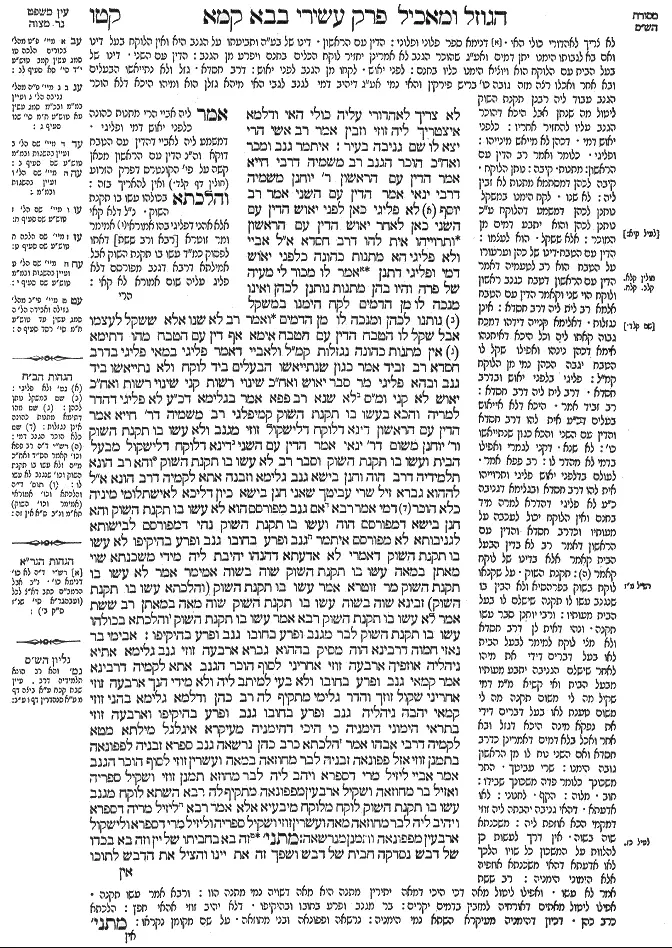
Bava Kamma 115a - Guemara
לא צריך לאהדורי עליה כולי האי ודלמא איצטריך ליה זוזי וזבין אמר רב אשי הרי יצא לו שם גניבה בעיר:
איתמר גנב ומכר ואח"כ הוכר הגנב רב משמיה דרבי חייא אמר הדין עם הראשון ר' יוחנן משמיה דרבי ינאי אמר הדין עם השני אמר רב יוסף לא פליגי כאן לפני יאוש הדין עם השני כאן לאחר יאוש הדין עם הראשון ותרוייהו אית להו דרב חסדא א"ל אביי ולא פליגי הא מתנות כהונה כלפני יאוש דמי ופליגי דתנן אמר לו מכור לי מעיה של פרה והיו בהן מתנות נותנן לכהן ואינו מנכה לו מן הדמים לקח הימנו במשקל נותנו לכהן ומנכה לו מן הדמים ואמר רב לא שנו אלא ששקל לעצמו אבל שקל לו הטבח הדין עם הטבח אימא אף דין עם הטבח מהו דתימא אין מתנות כהונה נגזלות קמ"ל ולאביי דאמר פליגי במאי פליגי בדרב חסדא רב זביד אמר כגון שנתייאשו הבעלים ביד לוקח ולא נתייאשו ביד גנב ובהא פליגי מר סבר יאוש ואח"כ שינוי רשות קני שינוי רשות ואח"כ יאוש לא קני ומ"ס לא שנא רב פפא אמר בגלימא דכ"ע לא פליגי דהדר למריה והכא בעשו בו תקנת השוק קמיפלגי רב משמיה דר' חייא אמר הדין עם הראשון דינא דלוקח דלישקול זוזי מגנב ולא עשו בו תקנת השוק ור' יוחנן משום דר' ינאי אמר הדין עם השני דינא דלוקח דלישקול מבעל הבית ועשו בו תקנת השוק וסבר רב לא עשו בו תקנת השוק והא רב הונא תלמידיה דרב הוה וחנן בישא גנב גלימא וזבנה אתא לקמיה דרב הונא א"ל לההוא גברא זיל שרי עביטך שאני חנן בישא כיון דליכא לאישתלומי מיניה כלא הוכר דמי אמר רבא אם גנב מפורסם הוא לא עשו בו תקנת השוק והא חנן בישא דמפורסם הוה ועשו בו תקנת השוק נהי דמפורסם לבישותא לגניבותא לא מפורסם איתמר גנב ופרע בחובו גנב ופרע בהיקיפו לא עשו בו תקנת השוק דאמרי לא אדעתא דהנהו יהיבת ליה מידי משכנתא שוי מאתן במאה עשו בו תקנת השוק שוה בשוה אמימר אמר לא עשו בו תקנת השוק מר זוטרא אמר עשו בו תקנת השוק (והלכתא עשו בו תקנת השוק) זבינא שוה בשוה עשו בו תקנת השוק שוה מאה במאתן רב ששת אמר לא עשו בו תקנת השוק רבא אמר עשו בו תקנת השוק והלכתא בכולהו עשו בו תקנת השוק לבר מגנב ופרע בחובו גנב ופרע בהיקיפו:
אבימי בר נאזי חמוה דרבינא הוה מסיק בההוא גברא ארבעה זוזי גנב גלימא אתיא ניהליה אוזפיה ארבעה זוזי אחריני לסוף הוכר הגנב אתא לקמיה דרבינא אמר קמאי גנב ופרע בחובו ולא בעי למיתב ליה ולא מידי הנך ארבעה זוזי אחריני שקול זוזך והדר גלימי מתקיף לה רב כהן ודלמא גלימא בהני זוזי קמאי יהבה ניהליה גנב ופרע בחובו גנב ופרע בהיקיפו וארבעה זוזי בתראי הימוני הימניה כי היכי דהימניה מעיקרא איגלגל מילתא מטא לקמיה דרבי אבהו אמר הלכתא כרב כהן נרשאה גנב ספרא זבניה לפפונאה בתמנן זוזי אזל פפונאה זבניה לבר מחוזאה במאה ועשרין זוזי לסוף הוכר הגנב אמר אביי ליזיל מרי דספרא ויהב ליה לבר מחוזא תמנן זוזי ושקיל ספריה ואזיל בר מחוזאה ושקיל ארבעין מפפונאה מתקיף לה רבא השתא לוקח מגנב עשו בו תקנת השוק לוקח מלוקח מיבעיא אלא אמר רבא ליזיל מריה דספרא ויהיב ליה לבר מחוזאה מאה ועשרין זוזי ושקיל ספריה וליזיל מרי דספרא ולישקול ארבעין מפפונאה ותמנן מנרשאה:
מתני׳ זה בא בחביתו של יין וזה בא בכדו של דבש נסדקה חבית של דבש ושפך זה את יינו והציל את הדבש לתוכו
Comments from Rashi on Masechet Bava Kamma Page 115a
לא צריך לאהדורי כולי האי . דנימא ספר פלוני ופלוני: הדין עם הראשון . דינו של בע"ה ותביעתו על הגנב היא ואין הלוקח בעל דינו ואם בא לגבותו הימנו יתן דמים ואע"ג שהוכר הגנב לא אמרינן יחזיר לוקח הכלים בחנם ויפרע מן הגנב: הדין עם השני . דינו של בעל הבית עם הלוקח הוא ויוציא הימנו כליו בחנם: לפני יאוש . לקחו מן הגנב לפני יאוש: דרב חסדא . גזל ולא נתייאשו הבעלים ובא אחר ואכלו רצה מזה גובה כו' בריש פירקין והאי נמי אע"ג דיהיב דמי לגנב לגבי האי מיהא גזלן הוא ומיהו היכא דלא הוכר הגנב עבוד ליה רבנן תקנת השוק ליטול מה שנתן אבל היכא דהוכר הגנב עליו להחזיר אחריו: כלפני יאוש דמי . דכהן לא מייאש מינייהו: ופליגי . כלומר ואמר רב הדין עם הראשון: מתנות . קיבה: נותן הלוקח . קיבה לכהן דמסתמא מתנות לא זבין ליה: לא שנו . לקח הימנו במשקל נותנן לכהן דמשמע דהלוקח ע"כ נותנן לכהן והוא יתבע דמים מן המוכר: אלא ששקל . הוא לעצמו: הדין עם הטבח . דינו של כהן וערעורו על הטבח הוא רב לטעמיה דאמר הדין עם הראשון דטבח כגנב ראשון ולוקח הוי שני וקאמר הדין עם הטבח אלמא רב לית ליה דרב חסדא: אינן נגזלות . דאלימא קנייה דידהו דמכח גבוה קאתו ליה וכל היכא דאיתנהו אימא דכהן נינהו ואפילו שקל לו הטבח יגבה הכהן נמי מן הלוקח קמ"ל: פליגי בלפני יאוש ובדרב חסדא . דרב לית ליה דרב חסדא: רב זביד אמר . היכא דלא אייאוש בעלים דכ"ע אית להו דרב חסדא והדין עם השני והכא כגון שנתייאשו כו': לא שנא . דקני לגמרי ואפילו בדמי לא מהדר לו: רב פפא אמר . לעולם בדלפני יאוש פליגי ותרוייהו אית להו דרב חסדא ובגלימא דגניבה כ"ע לא פליגי דהדרא למרה מיד בחנם ואין הלוקח יכול לעכבה על מעותיו וכדרב חסדא והדין עם הראשון דאמר רב לא בדין הבעל הבית קאמר אלא בדינו של לוקח קאמר: תקנת השוק . על שקנאו לוקח בשוק בפרהסיא ולא הבין בו שנגנב עשו לו תקנה שישלם לו בעל הבית מעותיו: ורבי יוחנן סבר עשו תקנה . ונהי דאית לן דרב חסדא ולא מצי לוקח למימר לבעל הבית לאו בעל דברים דידי את מיהו לאחר שישלם הגניבה יתבע מעותיו מבעל הבית ואי קשיא מ"מ דמי שקיל מה לי משום תקנה מה לי משום טענת לאו בעל דברים דידי את נפקא מינה היכא דגזל ובא אחר ואכל בלא דמים דאמרינן כדרב חסדא ואם השני נוח לו מן הראשון גובה הימנו: שרי עביטך . התר משכונך כלומר פדה משכונך שבידו: חוב . מלוה: הקף . לחנוני: לאו אדעתא . דהאי גניבה יהבתה ליה זוזי דמקמי הכא אוזפת ליה: משכנתא שוה בשוה . אין דרך לעשות כן להלוות על המשכון כל שויו הלכך לאו אדעתא דהאי משכנתא אוזפיה אלא הימוני הימניה: רב ששת אמר לא עשו . ואפילו ליטול מאה דכי היכי דמאה יתירין מתנה היא מאה דשויה נמי מתנה הוו: ורבא אמר עשו תקנה . אפילו ליטול מאתים דאורחיה למזבין בדמים יקרים: בר מגנב ופרע בחובו ובהיקיפו . דלא יהיב זוזי אהאי חפץ: הלכתא כרב כהן . דכיון דהימניה מעיקרא השתא נמי הימניה: נרשאה ופפונאה ובני מחוזאה . על שם מקומן נקראו: מתני'
Comments from Tosafot - Bava Kamma 115a
אמר ליה אביי הרי מתנות כהונה כלפני יאוש דמי ופליגי . דמשמע ליה לאביי דהדין עם הטבח דוקא וה"נ הדין עם הראשון מכאן קשה על פי' הקונטרס דפרק הזרוע (חולין דף קלד.) ואין להאריך בזה: והלכתא בכולהו עשו בו תקנת השוק . נ"ל דלא קאי אלא אהני דפליגי בהו אמוראי אמימר ומר זוטרא [רבא ורב ששת] דאתו לפסוק כמ"ד עשו בו תקנת השוק אבל אמילתא דרבא דגנב מפורסם דלא פליג עליה שום אמורא לא קאי:
Bava Kamma 115a - Mishnah translated into english
one does not need to pursue the matter in all this detail.
The Gemara questions this ruling: Perhaps he needed money, and he therefore sold the items despite the fact that he does not generally sell his personal belongings. The Gemara answers that Rav Ashi said: A rumor spread in the city that he had been a victim of theft. It is reasonable to assume that he is the rightful owner, as he does not usually sell his belongings and it is common knowledge that he was the victim of theft.
§ Having assessed the mishna’s ruling with regard to a case where the thief remained unidentified, the Gemara discusses a case where the thief was found. It was stated: In a case where a thief stole an item and sold it, and later the thief was identified, Rav says in the name of Rabbi Ḥiyya: The homeowner’s claim can be pursued only with the first one, i.e., the thief, but he has no claim against the purchaser. Rabbi Yoḥanan says in the name of Rabbi Yannai: The homeowner’s claim can also be pursued with the second one, i.e., with the purchaser.
Rav Yosef said: Rav and Rabbi Yoḥanan do not disagree. Here, in the case about which Rabbi Yoḥanan issues his ruling, the item was purchased from the thief before the victim of the theft despaired of recovering the stolen item. Consequently, the claim can be pursued even with the second one, i.e., the purchaser. Conversely, there, in the case about which Rav issues his ruling, the item was purchased after the victim despaired, and therefore the claim can be pursued only with the first one, i.e., the thief.
Rav Yosef continues: And both Rav and Rabbi Yoḥanan have accepted as halakha the ruling of Rav Ḥisda (111b), that if the owner had not yet despaired of retrieving his item, he can press his claim against either the thief or the purchaser.
Abaye said to Rav Yosef: And is it so that Rav and Rabbi Yoḥanan do not disagree? Isn’t a case involving gifts to which members of the priesthood are entitled comparable to a case of a stolen item that was sold before the onset of the owner’s despair, as the priest still hopes to receive the gifts, and yet Rav and Rabbi Yoḥanan disagree with regard to their legal status? This is as we learned in a mishna (Ḥullin 132a): If one said to a butcher: Sell me the innards of a cow, and the gifts of the priesthood were in them, the purchaser must give the gifts to a priest, and he may not deduct the value of the gifts from the money he agreed to pay the butcher. By contrast, if he purchased the innards from the butcher by weight, he must give the gifts to a priest and he may deduct the value of the gifts from the money he agreed to pay the butcher.
And Rav says: They taught this halakha only where the purchaser weighed the innards for himself, but if the butcher weighed the innards for him, the priest’s claim may be pursued only with the butcher. The butcher is comparable to a thief when he sells the gifts of the priesthood to a non-priest, and Rav holds that the priest can press his claim only against the butcher. Similarly, in the case of the mishna he would hold that the owner can press his claim only against the thief and not against the purchaser.
The Gemara refutes Abaye’s objection: Say that Rav meant that the priest can even pursue his claim with the butcher, although he is certainly able to claim the gifts from the purchaser. And Rav had to teach this lest you say that gifts of the priesthood are not considered to have been stolen even if the butcher sells them, because wherever they are they remain the legal property of the priests. Rav therefore teaches us that they are considered to have been stolen in this case, and therefore the priest can press his claim against the butcher.
The Gemara asks: And according to Abaye, who said that Rav and Rabbi Yoḥanan disagree, with regard to what do they disagree? The Gemara answers: They disagree with regard to the ruling of Rav Ḥisda. Rav disagrees with Rav Ḥisda and rules that one is entitled to collect only from the thief, while Rabbi Yoḥanan accepts the ruling of Rav Ḥisda and allows one to collect from either the thief or the purchaser.
The Gemara presents another explanation of the dispute between Rav and Rabbi Yoḥanan: Rav Zevid said that both agree that if the owner has not yet despaired of retrieving his item, he can press his claim against either party. They disagree in a case where the owners despaired of retrieving it only after the item was already in the possession of the purchaser, but they did not yet despair when it was in the possession of the thief.
And it is with regard to this that they disagree: One Sage, Rabbi Yoḥanan, holds that if there is despair on the part of the owner and afterward there is a change in possession of a stolen item, e.g., it leaves the possession of the thief and enters the possession of a purchaser, the purchaser acquires the item. By contrast, if there is first a change in possession of a stolen item and afterward there is despair on the part of the owner, then the purchaser does not acquire the item. Since in this case the owner did not despair until after the change of possession from the thief to the purchaser, the purchaser did not legally acquire the item, and the owner can press his claim against him. And one Sage, Rav, holds that there is no difference whether the despair or change of possession came first. As long as the owner has despaired of recovering his item, it becomes the property of the purchaser, and the owner cannot demand that he return it.
The Gemara presents a third explanation of the dispute: Rav Pappa said that with regard to a stolen cloak itself, everyone agrees that it must be returned by the purchaser to its owner. But here, it is with regard to whether the Sages implemented the provision ensuring the integrity of the marketplace in this case that Rav and Rabbi Yoḥanan disagree.
Rav says in the name of Rabbi Ḥiyya that the claim can be pursued only with the first one, i.e., the thief, meaning that the law with regard to the purchaser is that, after returning the item to its owner, he can collect money only from the thief, and the Sages did not implement the provision ensuring the integrity of the marketplace in this case. And Rabbi Yoḥanan says in the name of Rabbi Yannai that the claim of the purchaser can be pursued with the second one, meaning that the law with regard to the purchaser is that he can also collect the money from the owner when he returns the item to him, and the Sages did implement the provision ensuring the integrity of the marketplace in this case.
The Gemara questions this answer: And did Rav hold that the Sages did not implement the provision ensuring the integrity of the marketplace in this case? But wasn’t Rav Huna a student of Rav, and yet when a certain thief known as Ḥanan the Wicked stole a cloak and then sold it, and the case came before Rav Huna, he said to that man from whom the cloak was stolen: Go redeem your pledge from the purchaser, i.e., reimburse the purchaser for the garment that he returned to you. Evidently, Rav’s own student held that the Sages did allow a purchaser to claim reimbursement from the owner.
The Gemara answers that Ḥanan the Wicked is different. Since he has no money, there is no way for the purchaser to collect payment from him, and the case is therefore comparable to a case where the thief was not identified, with regard to which case the Sages implemented the provision ensuring the integrity of the marketplace.
Rava says: If he is a well-known thief, the Sages did not implement the provision ensuring the integrity of the marketplace in this case. The purchaser should have been aware that the item may be stolen and should not have purchased it. The Gemara asks: But wasn’t Ḥanan the Wicked well known, and yet, according to Rav Huna, the Sages implemented the provision ensuring the integrity of the marketplace in this case? The Gemara answers: Although he was well known for villainy, he was not well known for theft.
§ The Gemara continues to examine the provision ensuring the integrity of the marketplace. It was stated: With regard to one who stole and repaid his debt with the stolen item, or one who stole and repaid his debt from credit that was extended to him with the stolen item, the Sages did not implement the provision ensuring the integrity of the marketplace in this case, as they say to the creditor: It was not with the expectation of receiving these stolen items that you gave the debtor anything.
With regard to the integrity of the marketplace, it was also stated that if a thief provided a stolen item worth two hundred dinars as collateral for a loan of one hundred dinars, the Sages implemented the provision ensuring the integrity of the marketplace in this case. Consequently, the creditor is entitled to reimbursement from the owner for returning the collateral. If the collateral and the loan were of equal value, Ameimar said: The Sages did not implement the provision ensuring the integrity of the marketplace in this case, while Mar Zutra said: The Sages did implement the provision ensuring the integrity of the marketplace in this case.
The Gemara comments: And the halakha is in accordance with the opinion of Mar Zutra that the Sages did implement the provision ensuring the integrity of the marketplace in this case.
The Gemara examines other applications of this provision: In a sale, if the stolen item was purchased for an amount equal to its actual market value, the Sages implemented the provision ensuring the integrity of the marketplace in this case. If a stolen item worth one hundred dinars was purchased at the price of two hundred dinars, Rav Sheshet says: The Sages did not implement the provision ensuring the integrity of the marketplace in this case, while Rava says: The Sages did implement the provision ensuring the integrity of the marketplace in this case.
The Gemara states: And the halakha is that in all these cases the Sages implemented the provision ensuring the integrity of the marketplace, except with regard to one who stole and repaid his debt with the stolen item and one who stole and repaid his debt from credit that was extended to him with the stolen item.
The Gemara recounts a related incident: Avimi bar Nazi, the father-in-law of Ravina, was owed four dinars by a certain man, who then stole a cloak and brought it to Avimi as repayment for the loan. Avimi then lent him four additional dinars. In the end, the thief was identified as the debtor, and the case came before Ravina to determine whether or not the owner would have to pay Avimi for returning the cloak.
Ravina said to Avimi: With regard to the first four dinars that were lent, the thief is viewed as one who stole and repaid his debt, and the owner is not required to give anything in exchange for the garment’s return as the Sages’ ordinance ensuring the integrity of the marketplace does not apply in such a case. With regard to those four additional dinars, take your money from the owner of the cloak and return the cloak to him. Since Avimi lent the second set of dinars only because he had received the cloak, Ravina ruled that the Sages’ ordinance applied to him.
Rav Kohen objects to this: But perhaps the cloak was given to Avimi only in payment for these first four dinars, and it was a case of a thief who stole and repaid his debt or who stole and repaid his debt from credit that was extended to him with the stolen item. And the latter four dinars were loaned because Avimi trusted the debtor, just as he trusted him initially, when he lent the first four dinars. The cloak was not collateral for the second loan, and therefore the Sages’ ordinance should not apply. The matter circulated until it came before Rabbi Abbahu, who said: The halakha is in accordance with the opinion of Rav Kohen.
The Gemara recounts another incident: A resident of Naresh stole a scroll and sold it to a resident of Pappunya for eighty dinars. The resident of Pappunya then went and sold it to a resident of Meḥoza for one hundred and twenty dinars. In the end, the thief was identified and Abaye said: The original owner of the scroll should go and give the resident of Meḥoza eighty dinars and take his scroll in return. And afterward, the resident of Meḥoza should go and take the remaining forty dinars from the resident of Pappunya.
Rava objects to this: Now that it has been established that with regard to one who purchases from a thief, the Sages implemented the provision ensuring the integrity of the marketplace in this case despite the fact that he dealt with the thief directly, is it necessary to teach that the same would apply to one who purchased a stolen item from a purchaser? Accordingly, the final purchaser is entitled to receive from the original owner the full amount that he paid for the item.
Rather, Rava said that the original owner of the scroll should go and give the resident of Meḥoza one hundred and twenty dinars and take his scroll in return. And afterward the original owner of the scroll should go and collect forty dinars from the resident of Pappunya and eighty dinars from the resident of Naresh, as each profited from the sale in these amounts, respectively.
MISHNA: In a situation where this individual came with his barrel of wine, and that individual came with his jug of honey, if the barrel of honey cracked and this first individual poured out his wine and salvaged the other’s honey, which is worth more than the wine, by collecting it into his wine barrel,
Traduction : The William Davidson digital edition of the Koren Noé Talmud, with commentary by Rabbi Adin Even-Israel Steinsaltz.