 Talmud Bavli
Bava Kamma 28a : Youtube
Daf TubeYoutube
2 video classes :
Bava Kamma Page 28a
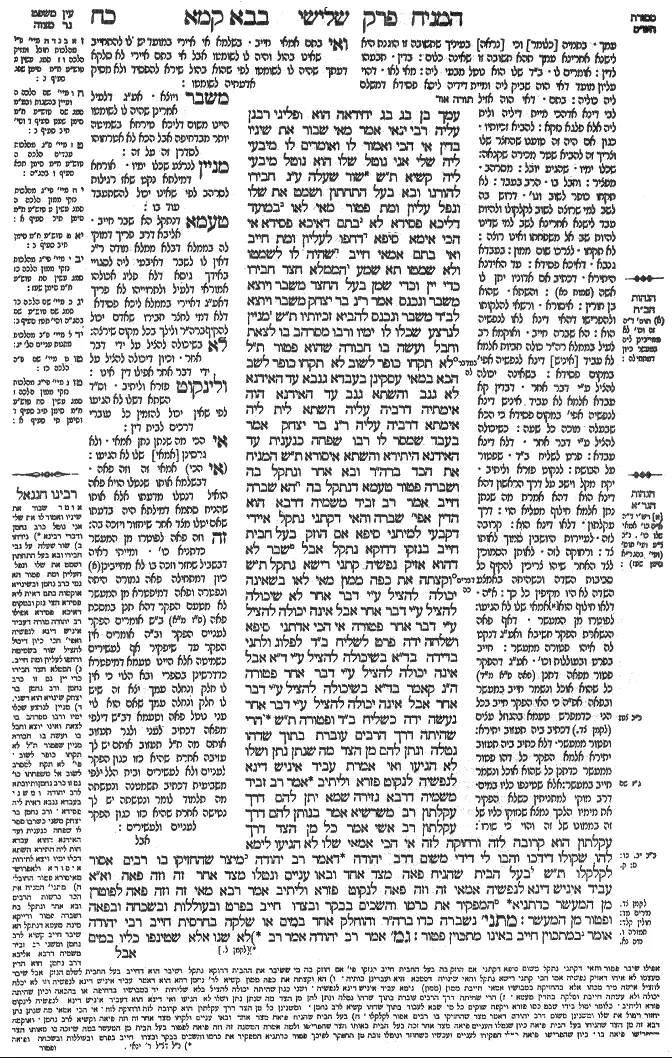
Bava Kamma 28a - Guemara
עמך בן בג בג יחידאה הוא ופליגי רבנן עליה רבי ינאי אמר מאי שבור את שיניו בדין אי הכי ואמור לו ואומרים לו מיבעי ליה שלי אני נוטל שלו הוא נוטל מיבעי ליה קשיא ת"ש שור שעלה ע"ג חבירו להורגו ובא בעל התחתון ושמט את שלו ונפל עליון ומת פטור מאי לאו במועד דליכא פסידא לא בתם דאיכא פסידא אי הכי אימא סיפא דחפו לעליון ומת חייב ואי בתם אמאי חייב שהיה לו לשמטו ולא שמטו תא שמע הממלא חצר חבירו כדי יין וכדי שמן בעל החצר משבר ויוצא משבר ונכנס אמר ר"נ בר יצחק משבר ויוצא לב"ד משבר ונכנס להביא זכיותיו ת"ש מניין לנרצע שכלו לו ימיו ורבו מסרהב בו לצאת וחבל ועשה בו חבורה שהוא פטור ת"ל (במדבר לה, לב) לא תקחו כופר לשוב לא תקחו כופר לשב הכא במאי עסקינן בעבדא גנבא עד האידנא לא גנב והשתא גנב עד האידנא הוה אימתיה דרביה עליה השתא לית ליה אימתא דרביה עליה ר"נ בר יצחק אמר בעבד שמסר לו רבו שפחה כנענית עד האידנא היתירא והשתא איסורא ת"ש המניח את הכד ברה"ר ובא אחר ונתקל בה ושברה פטור טעמא דנתקל בה הא שברה חייב אמר רב זביד משמיה דרבא הוא הדין אפי' שברה והאי דקתני נתקל איידי דקבעי למיתני סיפא אם הוזק בעל חבית חייב בנזקו דדוקא נתקל אבל שבר לא דהוא אזיק נפשיה קתני רישא נתקל ת"ש (דברים כה, יב) וקצתה את כפה ממון מאי לאו בשאינה יכולה להציל ע"י דבר אחר לא שיכולה להציל ע"י דבר אחר אבל אינה יכולה להציל ע"י דבר אחר פטורה אי הכי אדתני סיפא ושלחה ידה פרט לשליח ב"ד לפלוג ולתני בדידה בד"א בשיכולה להציל ע"י ד"א אבל אינה יכולה להציל ע"י דבר אחר פטורה ה"נ קאמר בד"א בשיכולה להציל ע"י דבר אחר אבל אינה יכולה להציל ע"י דבר אחר נעשה ידה כשליח ב"ד ופטורה ת"ש הרי שהיתה דרך הרבים עוברת בתוך שדהו נטלה ונתן להם מן הצד מה שנתן נתן ושלו לא הגיעו ואי אמרת עביד איניש דינא לנפשיה לנקוט פזרא וליתיב אמר רב זביד משמיה דרבא גזירה שמא יתן להם דרך עקלתון רב משרשיא אמר בנותן להם דרך עקלתון רב אשי אמר כל מן הצד דרך עקלתון הוא קרובה לזה ורחוקה לזה אי הכי אמאי שלו לא הגיעו לימא להו שקולו דידכו והבו לי דידי משום דרב יהודה דאמר רב יהודה מיצר שהחזיקו בו רבים אסור לקלקלו ת"ש בעל הבית שהניח פאה מצד אחד ובאו עניים ונטלו מצד אחר זה וזה פאה וא"א עביד איניש דינא לנפשיה אמאי זה וזה פאה לנקוט פזרא וליתיב אמר רבא מאי זה וזה פאה לפוטרן מן המעשר כדתניא המפקיר את כרמו והשכים בבקר ובצרו חייב בפרט ובעוללות ובשכחה ובפאה ופטור מן המעשר:
מתני׳ נשברה כדו ברה"ר והוחלק אחד במים או שלקה בחרסית חייב רבי יהודה אומר במתכוין חייב באינו מתכוין פטור:
גמ׳ אמר רב יהודה אמר רב לא שנו אלא שטינפו כליו במים
Comments from Rashi on Masechet Bava Kamma Page 28a
עמך . בתמיה [כלומר] וכי [נראה] בעינים שתשובה זו הוגנת היא לישנא אחרינא עמך תהא תשובה זו שאינה כלום: בדין . תבעהו לדין: אומרים לו . ב"ד שלו הוא נוטל מבעי ליה: מאי לאו . דהוי עליון מועד דאי הוה שביק ליה ומיית דידיה ליכא פסידא דמשלם ליה כוליה: בתם . דאי הוה אזיל לבי דינא אדהכי מיית דיליה ולית ליה אלא פלגא נזקא: להביא זכיותיו . כגון אם היה זה טוענו שהחצר שלו וצריך זה להביא שטר מכירה שקנאה: שכלו ימיו . שהגיע יובל: מסרהב . מפציר: וחבל בו . הרב בעבד: לא תקחו כופר לשוב וגו' . דרוש בה לשב למי שרוצה לשוב לקלקולו ולהיות עבד לישנא אחרינא לשב למי שדינו. להיות שב אל משפחתו ואינו רוצה: לא תקחו . לצרכו שום ממון: בעבדא גנבא . דאיכא פסידא: עד האידנא היתירא . דכתיב אם אדוניו יתן לו אשה (שמות כא): והשתא . שהוא בן חורין: איסורא . ורשאי להלקותו ולהפרישו דהאי דינא לאו לנפשיה הוא: הא שברה חייב . ואוקמא רב לעיל בממלא רה"ר כולה חביות אלמא לא עביד [איניש] דינא לנפשיה אפי' במקום פסידא: בשאינה יכולה להציל ע"י דבר אחר . דבדין קא עבדא אלמא לא עביד איניש דינא לנפשיה אפי' במקום פסידא כי הכא שבעלה מוכה כל שעה: כשיכולה להציל ע"י דבר אחר . דלא דינא עבדא: פרט לשליח ב"ד . שפטור על הבושת: לנקוט פזרא וליתיב . יקח מקל וישב על דרך הראשון דהא דינא הוא דהא אמרת מה שנתן נתן אלמא חילוף מעליא הוי: דרך עקלתון . דלאו דינא הוא: קרובה לזה . לעיירות היושבין סמוך לאותו צד: ורחוקה לזה . לאותן הסמוכין לצד האחר שיהו צריכין להקיף כל סביבות השדה וכשהיתה באמצע השדה לא היו מקיפין כל כך: א"ה . דלאו חילוף הוא אמאי שלו לא הגיעו: חייב בפרט ובעוללות וכו' . אע"ג דהפקר פטור מפאה דתנן (פאה פ"א מ"ד) כל שהוא אוכל ונשמר חייב במעשר ובפאה אפ"ה כי האי הפקר חייב בכל הני כדמפרש טעמא בהגוזל עצים (לקמן בבא קמא צד.) דכתיב ביה תעזוב יתירא ופטור ממעשר. דלא כתיב ביה תעזוב יתירא אלמא הפקר כל דהו פטור ממעשר כדתנן כל שהוא אוכל ונשמר חייב במעשר: אלא שטינפו כליו במים דרב מוקי למתניתין כשלא הפקיר את מימיו הלכך נמצא שנזוקו כליו של זה בממונו של זה והוי כי שורו: לפוטרו מן המעשר . דאף פאה הנשארת הפקר חשיבא ואע"ג דנקט לה איהו פטורה ממעשר:
Comments from Tosafot - Bava Kamma 28a
ואי בתם אמאי חייב . בשלמא אי איירי במועד יש לו להתחייב שאינו בהול והיה לו לשומטו אבל אי בתם איירי לא סלקא דעתך שהיה לו לשומטו לפי שהוא בהול שירא להפסיד ולא מסיק אדעתיה לשומטו: משבר ויוצא . אע"ג דלעיל אמרינן שהיה לו לשומטו היינו משום דליכא טירחא בשמיטה יותר מבדחיפה אבל הכא לא אטרחוהו לסדרן זה על זה: מניין לנרצע שכלו ימיו . אורחא דמילתא נקט שאז רגילות לסרהב לפי שאינו יכול להשתעבד עוד בו: טעמא דנתקל הא שבר חייב . אליבא דרב פריך דמוקי לה בממלא דבלא ממלא מודה ר"נ דאין לו לשבר דאיבעי ליה לסגויי באידך גיסא דלא פליג אכולהו אמוראי דלעיל ולתרוייהו לא פריך דאע"ג דאיירי בממלא ליכא פסידא דלא דמי לחצר חבירו שאדם יכול להקיף ברה"ר ולילך בכל מקום שירצה: לא בשיכולה להציל על ידי דבר אחר . וכיון דיכולה להציל על ידי דבר אחר אפילו דין אינו: אי הכי מה שנתן נתן אמאי . ולא גרסינן [אמאי] שלו לא הגיעו: ולינקוט פזרא וליתיב . וס"ד השתא דשלו לא הגיעו לפי שאין יכול להזמין כל עוברי דרכים לבית דין: (אי הכי) אמאי זה וזה פאה . דבשלמא אותו שנטלו הויא פאה הואיל דנטלו מדעתו אלא אותו שהניח סתמא דמילתא היה בדעתו שאם יטלו מצד אחר שיחזור ויזכה בה: זה וזה פאה לפוטרו מן המעשר כדתניא כו' . ומייתי ראיה דבשביל שחזר וזכה בו לא מחייבינן כיון דמתחילה פאה גמורה היתה ונפטרה ופאה דמיפטרא מן המעשר לא מטעם הפקר דהא תנן במסכת פאה (פ"ו מ"א) ב"ש אומרים הפקר לעניים הפקר וב"ה אומרים אין הפקר עד שיפקיר אף לעשירים כשמיטה אלא היינו טעמא דמיפטרא כדדרשינן בספרי ובא הלוי כי אין לו חלק ונחלה עמך יצא זה שיש לו חלק ונחלה עמך שאם הוא לוי עני נוטל פאה וטעמא דב"ש דילפי מפאה דכתיב לעני ולגר תעזוב אותם מה ת"ל תעזוב אותם יש לך עזיבה אחרת שהיא כזו כגון הפקר לעניים ולא לעשירים ובית הלל ילפי משביעית דכתיב תשמטנה ונטשתה מה תלמוד לומר ונטשתה יש לך נטישה אחרת שהיא כזו כגון הפקר לעניים ולעשירים:
Bava Kamma 28a - Mishnah translated into english
You can keep this question to yourself, as it poses no difficulty at all. Ben Bag Bag states an individual opinion in this regard, and the Rabbis disagree with him.
Rabbi Yannai says an alternative response to Rav Kahana’s objection: What does the baraita mean by the phrase: Break his teeth? It means sue him in judgment.
The Gemara asks: If so, the subsequent statement in the baraita: And say to him, is inaccurate. It should have stated: And they, the court, say to him. Likewise, the wording: I am taking what is mine, is inaccurate. Since it is the court who makes this statement, the baraita should have stated: He is taking what is his. The Gemara concludes: Indeed, this poses a difficulty for Rav Yehuda’s version of the response.
The Gemara suggests: Come and hear an alternative proof for Rav Naḥman’s opinion. It is stated in a baraita: With regard to an ox that climbed on the back of another ox to kill it, and the owner of the ox on the bottom came and removed his ox, and the ox on top consequently fell and died, the owner of the ox on the bottom is exempt from paying for the dead ox. What, is this ruling not stated with regard to a case where the attacker is a forewarned ox, where there is no loss to the owner of the bottom ox, since even if the owner of the ox on the bottom does not remove his ox, he will eventually receive full restitution from the owner of the belligerent ox? Yet he is exempt from paying restitution for causing the death of the belligerent ox. Evidently, he had the right to take justice into his own hands.
The Gemara rejects this proof: No, the ruling is with regard to a case where the attacker is an innocuous ox, where there is a loss for the owner of the ox on the bottom if he does not save it, since the owner of an innocuous ox pays for only half the damages resulting from his ox’s attack.
The Gemara asks: If so, say the latter clause of that baraita: If, instead of removing his own ox, the owner of the ox on the bottom pushed the one on top and it died, he is liable. And if it is referring to an innocuous ox, why is he liable? He is defending his property so as not to incur a loss.
The Gemara answers: He is liable because he should have removed his ox from underneath the belligerent ox, and he did not remove it. Instead, he pushed the belligerent ox and caused it to die. Although one may take justice into his own hands, if he damages another person’s property when he could have protected his own property in a harmless manner he is liable.
The Gemara suggests: Come and hear a proof for Rav Naḥman’s opinion from a baraita: With regard to one who fills another’s courtyard with jugs of wine and jugs of oil, the owner of the courtyard may break his way through them and exit his courtyard or he may break his way through them and enter his courtyard. Since the one who put the jugs there had no right to do so, the owner of the courtyard may take justice into his own hands. This is apparently the ruling even where there is no loss involved to the owner of the courtyard.
Rav Naḥman bar Yitzḥak said in response that the baraita can be explained as follows: The owner of the courtyard may break the jugs and exit to court, and he may break the jugs and enter his house to bring proof of his rights, i.e., documents proving that the courtyard belongs to him. Since by refraining from doing so he would sustain a loss, he may break the jugs when exiting and entering. He may not take justice into his own hands beyond this extent. Therefore, no proof for Rav Naḥman’s opinion can be inferred from this baraita.
The Gemara suggests: Come and hear an alternative proof from a baraita: From where is it derived with regard to a Hebrew slave who had his ear pierced with an awl to extend his tenure as a slave, but whose days of servitude have now ended with the arrival of the Jubilee Year; and his master is urging [mesarhev] him to leave but he insists on remaining; and the master injured the slave and inflicted an injury on him in the process of forcing him out, that the master is exempt from paying for this injury?
To counter this, the verse states: “You shall take no ransom…that he should return” (Numbers 35:32). Although this verse is referring to the prohibition against an unintentional killer paying a ransom instead of going to a city of refuge, this verse is also interpreted to mean that you shall take no ransom for a Hebrew slave who is obligated to return to his family. In other words, if the slave refuses to return to his family and is injured in the process of his eviction, he does not receive compensation. This seems to indicate that the master may take justice into his own hands even for a matter that involves no loss to him.
The Gemara responds to this proof: With what are we dealing here? We are dealing with a slave who is a thief, and consequently, if he remains a slave, his master will sustain a loss. Therefore, it is permitted for the master to take justice into his own hands and evict the slave by force.
The Gemara questions this explanation: Until now he did not steal, and now he will begin to steal? Why would the master be worried about this just when the slave’s tenure ends? The Gemara answers: Until now, while he was still a slave, the awe of his master was upon him, so he did not steal from him. Now that he may go free he does not have the awe of his master upon him, and the master is therefore worried that he might steal from him.
Rav Naḥman bar Yitzḥak said an alternative explanation: The baraita is referring to a slave whose master provided a Canaanite maidservant to him as a wife and he wishes to remain with her. Until now, it was permitted for him to engage in sexual intercourse with her, but now that he is free, it is prohibited for him to do so. In this case, his master may evict him forcefully, assuming the role of an emissary of the court, to prevent him from violating the prohibition. Therefore, this is not considered taking justice into his own hands.
The Gemara suggests a proof for Rav Yehuda’s opinion from the mishna. Come and hear: In the case of one who places a jug in the public domain and another person comes and stumbles on it and breaks it, he is exempt. It may be inferred that the reason he is exempt is that he stumbled on it. But if he broke it intentionally, he is liable. This indicates that one may not take justice into his own hands.
Rav Zevid said in the name of Rava: That is not a proof, as the same is true even if he broke the barrel intentionally. And as for this fact that the tanna of the mishna teaches a case where he stumbled, it is because he wants to teach in the last clause: And if he incurred damage due to the vessel, the owner of the ḥavit is liable to pay for his damages. As this ruling applies specifically when he stumbled, but if he broke the barrel intentionally and incurred damage in the process, the owner of the barrel is not required to compensate him. Although the pedestrian had the right to break the barrel, it is he who damaged himself, by not being careful while breaking it. Therefore, in the first clause the mishna teaches a case where he stumbled.
The Gemara suggests: Come and hear a proof from a baraita, which relates to the case of a woman who, during a fight between her husband and another man, grabs the other man’s genitals: The verse that states: “Then you shall cut off her hand” (Deuteronomy 25:12), should not be taken literally; rather, it is referring to monetary restitution. What, is it not referring to a case where she cannot save her husband from his attacker by a means other than grabbing the attacker’s genitals, and nevertheless she is punished? This indicates that one may not take justice into his own hands. The Gemara answers: No, the verse is referring to a case where she can save him by other means. Otherwise she is exempt from paying restitution.
The Gemara asks: But if she cannot save him by other means, is it possible that she is exempt? If so, instead of teaching in the latter clause of that baraita that the expression mentioned in the previous verse: “And extended her hand” (Deuteronomy 25:11), excludes an emissary of the court, who is authorized to act in this manner and is therefore exempt from paying restitution, let the baraita distinguish and teach within the case under discussion in the verse itself, as follows: In what case is this statement that the wife is liable said? It is in a case where she can save her husband by another means. But if she cannot save him by other means, she is exempt.
The Gemara answers: That is also what the baraita is saying: In what case is this statement said? It is said in a case where she can save him by other means. But if she cannot save him by other means, her hand is rendered like an emissary of the court, and she is exempt.
The Gemara suggests: Come and hear a proof for Rav Yehuda’s opinion from a mishna (Bava Batra 99b): In a case where a public thoroughfare would pass through one’s field, and he appropriated it and instead gave the public an alternative route on the side of his property, the halakha is that the route that he has given is the route that he gave them, and they may use it. But his property, which he appropriated, has not reached him, i.e., he cannot appropriate it for his personal use since it was already in public use.
And if you say that a person may take justice into his own hands, why does the owner of the field not have the right to close the thoroughfare? Since it is his property and he gave the public an alternative route, let him take a stick [pazra] in his hand and sit by the side of the road, preventing the public from passing through.
Rav Zevid said in the name of Rava: It is a rabbinic decree, lest he give them a circuitous route. Since the public has the right to pass through his field, as the Gemara will soon explain, the owner cannot appropriate their thoroughfare without giving the public a similar alternative route. Therefore, the Sages decreed that he cannot appropriate it without their consent, lest he provide an inadequate route.
Rav Mesharshiyya said: The mishna is referring to a case where he actually gave them a circuitous route. If one in fact gives the public a straight path, he need not surrender his rights, and he may take justice into his own hands by blocking the original thoroughfare.
Rav Ashi said: Any route on the side that the property owner might give them is necessarily considered a circuitous route, as it is close for this person, and it is far for that person. While some will benefit from the change, it will be detrimental for others.
The Gemara asks: If so, why has his property not reached him? If he cannot make the change, why can he not reclaim the path that he intended to turn over to the public? Let him say to them: Take your original route and give me back my property, so that he will not lose both pieces of land.
The Gemara answers that he cannot reclaim it due to Rav Yehuda’s statement, as Rav Yehuda says: With regard to a path that the masses established as a public thoroughfare, it is prohibited to destroy it for them. Therefore, since the public already began using the alternative route, the owner cannot appropriate it from them.
The Gemara suggests: Come and hear an alternative proof from a baraita: With regard to the owner of a field who left produce in the corner of the field, which is given to the poor [pe’a], on one side of the field, and poor people came and took from another side, this produce and that produce are both considered pe’a. And if you say that a person may take justice into his own hands, why are this and that both considered pe’a? Let him take a stick and sit in his field on the side from which the poor people are taking produce without his permission, and let him warn them to take only from the side that he allocated.
Rava said: In terms of monetary law he can prevent them from taking pe’a from the side that he did not allocate. What is meant by the ruling of: This produce and that produce are both considered pe’a? It means that they are considered pe’a with regard to exempting both portions of produce from tithes. Just as the portion that the poor people took is exempt from tithes, so is the portion that he allocated initially.
This is as it is taught in a baraita: In the case of one who renounces ownership of his vineyard and arose early in the morning before anyone else took possession of it and harvested it, the one who renounces ownership is obligated in the mitzva of individual fallen grapes left for the poor [peret], and in the mitzva of incompletely formed clusters of grapes left for the poor [olelot], and in the mitzva of forgotten clusters of grapes left for the poor, and in the mitzva of pe’a, the four gifts to the poor that the Torah requires one to give from a vineyard (see Leviticus 19:9–10). But he is exempt from the mitzva to tithe his produce, because this requirement does not apply to an ownerless field. Likewise, in the above case the portion of the field that was allocated for pe’a is exempt from tithes even after the owner reclaims it, as pe’a is considered ownerless property in this regard.
MISHNA: If one’s jug broke in the public domain and another person slipped in the water from the jug and was injured from the fall, or if he was injured by the shards of the broken jug, the owner of the jug is liable. Rabbi Yehuda says: In a case where the owner of the jug acted with intent, he is liable, and in a case where he acted without intent, he is exempt.
GEMARA: Rav Yehuda says that Rav says: They taught that the owner of the jug is liable only when the clothes of the one who slipped were soiled by the dirty water.
Traduction : The William Davidson digital edition of the Koren Noé Talmud, with commentary by Rabbi Adin Even-Israel Steinsaltz.