 Talmud Bavli
Bava Kamma 102a : Youtube
Daf TubeYoutube
2 video classes :
Bava Kamma Page 102a
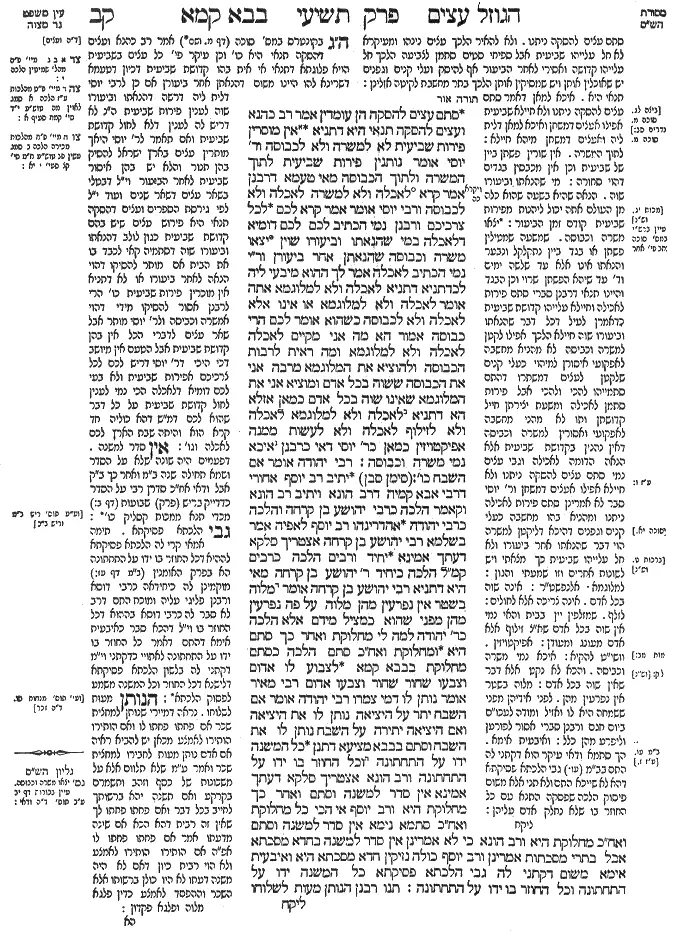
Bava Kamma 102a - Guemara
סתם עצים להסקה הן עומדין אמר רב כהנא ועצים להסקה תנאי היא דתניא אין מוסרין פירות שביעית לא למשרה ולא לכבוסה ור' יוסי אומר נותנין פירות שביעית לתוך המשרה ולתוך הכבוסה מאי טעמא דרבנן אמר קרא (ויקרא כה, ו) לאכלה ולא למשרה לאכלה ולא לכבוסה ורבי יוסי אומר אמר קרא לכם לכל צרכיכם ורבנן נמי הכתיב לכם לכם דומיא דלאכלה במי שהנאתו וביעורו שוין יצאו משרה וכבוסה שהנאתן אחר ביעורן ור"י נמי הכתיב לאכלה אמר לך ההוא מיבעי ליה לכדתניא דתניא לאכלה ולא למלוגמא אתה אומר לאכלה ולא למלוגמא או אינו אלא לאכלה ולא לכבוסה כשהוא אומר לכם הרי כבוסה אמור הא מה אני מקיים לאכלה לאכלה ולא למלוגמא ומה ראית לרבות הכבוסה ולהוציא את המלוגמא מרבה אני את הכבוסה ששוה בכל אדם ומוציא אני את המלוגמא שאינו שוה בכל אדם כמאן אזלא הא דתניא לאכלה ולא למלוגמא לאכלה ולא לזילוף לאכלה ולא לעשות ממנה אפיקטויזין כמאן כר' יוסי דאי כרבנן איכא נמי משרה וכבוסה:
רבי יהודה אומר אם השבח כו':
(סימן סבן) יתיב רב יוסף אחורי דרבי אבא קמיה דרב הונא ויתיב רב הונא וקאמר הלכה כרבי יהושע בן קרחה והלכה כרבי יהודה אהדרינהו רב יוסף לאפיה אמר בשלמא רבי יהושע בן קרחה אצטריך סלקא דעתך אמינא יחיד ורבים הלכה כרבים קמ"ל הלכה כיחיד ר' יהושע בן קרחה מאי היא דתניא רבי יהושע בן קרחה אומר מלוה בשטר אין נפרעין מהן מלוה על פה נפרעין מהן מפני שהוא כמציל מידם אלא הלכה כר' יהודה למה לי מחלוקת ואחר כך סתם היא ומחלוקת ואח"כ סתם הלכה כסתם מחלוקת בבבא קמא לצבוע לו אדום וצבעו שחור שחור וצבעו אדום רבי מאיר אומר נותן לו דמי צמרו רבי יהודה אומר אם השבח יתר על היציאה נותן לו את היציאה ואם היציאה יתירה על השבח נותן לו את השבח וסתם בבבא מציעא דתנן כל המשנה ידו על התחתונה וכל החוזר בו ידו על התחתונה ורב הונא אצטריך סלקא דעתך אמינא אין סדר למשנה וסתם ואחר כך מחלוקת היא ורב יוסף אי הכי כל מחלוקת ואח"כ סתמא נימא אין סדר למשנה וסתם ואח"כ מחלוקת היא ורב הונא כי לא אמרינן אין סדר למשנה בחדא מסכתא אבל בתרי מסכתות אמרינן ורב יוסף כולה נזיקין חדא מסכתא היא ואיבעית אימא משום דקתני לה גבי הלכתא פסיקתא כל המשנה ידו על התחתונה וכל החוזר בו ידו על התחתונה:
תנו רבנן הנותן מעות לשלוחו
Comments from Rashi on Masechet Bava Kamma Page 102a
סתם עצים להסקה ניתנו . ולא להאיר הלכך עצים נינהו ומעיקרא לא חל עלייהו שביעית אבל ספיחי סטים סתמן לצביעה הלכך חל עלייהו קדושה ואסירי לאחר הביעור אף להיסק ועלי קנים וגפנים יש שאוכלין אותן ויש שמסיקין אותן הלכך בתר מחשבת לקיטה אזלינן: תנאי היא . איכא למאן דאמר סתם עצים להסקה ניתנו ולא חיילא שביעית אפילו אעצים דמשחן ואיכא למאן דלית ליה ואעצים דמשחן מיהא חיילא: לתוך המשרה . אין שורין פשתן ביין של שביעית וכן אין מכבסין בגדים דהוי סחורה: מי שהנאתו וביעורו שוה . הנאה שהיא בשעה שהוא כלה מן העולם אתה יכול ליהנות מפירות שביעית קודם זמן הביעור: יצאו משרה וכבוסה . שמשעה שמטילין פשתן או בגד ביין נתקלקל ונבער והנאתו אינו אלא עד שלשה ימים וד' עד שיהא הפשתן שרוי וכן הבגד והיינו תנאי דרבנן סברי סתם פירות לאכילה וחיילא עלייהו קדושת שביעית כדאמרן לעיל דכל דבר שהנאתו וביעורו שוה חיילא הלכך אפילו לקטן למשרה וכביסה לא מהניא מחשבה לאפקועי איסורן למיהוי כעלי קנים שלקטן לעצים דמשתרו דהתם סתמייהו להכי ולהכי אבל פירות סתמן לאכילה ומשעת יצירתן חייל קדושתן ותו לא מהני מחשבה לאפקועי ואסורין למשרה וכביסה דאין נהנין בקדושת שביעית אלא הנאה הדומה לאכילה וגבי עצים נמי סתם עצים להסקה ניתנו ולא חיילא אפילו אעצים דמשחן ור' יוסי סבר לא אמרינן סתם פירות לאכילה ניתנו ומהניא בהו מחשבה כעלי קנים וגפנים דהיכא דליקטן למשרה הוי דבר שהנאתו אחר ביעורו ולא חל עלייהו שביעית כך מצאתי. ויש לשונות אחרים וזו שמעתי והגון: למלוגמא . אלנפשט"ר: אינה שוה בכל אדם . אינה צריכה אלא לחולים: לזלף . שמזלפין יין בבית והאי נמי אין שוה בכל אדם שא"צ זילוף אלא אדם מעונג ומעודן: אפיקטויזין . וושי"ט להקיא: איכא נמי משרה וכביסה . והכא לא נקט אלא דבר שאין שוה בכל אדם: מלוה בשטר אין נפרעין מהן . לפני אידיהן מפני ששמחה היא לו ואזיל ומודה לעכו"ם ביום חגם ורבנן סברי אסור לפורען וליפרע מהן כלל: ואיבעית אימא . הך סתמא ודאי עיקר הוא דקתני לה התם בב"מ (עו.) גבי הלכתא פסיקתא דהא לא שייכא התם ולא תני אלא משום פיסוק הלכה שפסקה התנא עם כל החוזר בו שלא נחלק אדם עליהן:
Comments from Tosafot - Bava Kamma 102a
ה"ג בקונטרס במס' סוכה (דף מ. ושם) אמר רב כהנא ועצים דהסקה תנאי היא כו' וכן עיקר פי' כל עצים בשביעית הויא פלוגתא דתנאי אי אית בהו קדושת שביעית דכיון דטעמא דשרינא להו היינו משום דהנאתן אחר ביעורן אם כן לרבי יוסי דלית ליה דרשה דהנאתו וביעורו שוה לענין פירות שביעית ה"נ. לא דריש לה לענין דלא לחול קדושת שביעית ואם תאמר לר' יוסי היאך מותרין עצים בארץ ישראל להסיק בהן תנור והלא יש בהן איסור שביעית לאחר הביעור וי"ל דבטלי בשאר עצים דשאר שנים ועוד י"ל לפי גירסת הספרים ועצים דהסקה תנאי היא פירוש עצים שיש בהם קדושת שביעית כגון לולב דהנאתו וביעורו שוה דסתמיה קאי לכבד בו את הבית אם מותר להסיקו דהוי הנאה לאחר ביעורו או לא דתניא אין מוכרין פירות שביעית כו' הרי לרבנן אסור להסיקו מידי דהוי אמשרה וכביסה ולר' יוסי מותר אבל שאר עצים לדברי הכל אין בהן קדושת שביעית אבל הטעם אין מיושב דכי היכי דר' יוסי דריש לכם לכל צרכיכם אפירות שביעית ולא בעי לכם דומיא דלאכלה הכי נמי לענין לחול קדושת שביעית על כל דבר שהוא לכם דמ"ש דהא כוליה חד קרא הוא והיתה שבת הארץ לכם לאכלה וגו': אין סדר למשנה . דפעמים היה שונה שלא על הסדר ושמא תחילה שנה ב"מ ואחר כך ב"ק אבל ודאי אח"כ סדרן רבי על הסדר כדדייק בריש (פרק) שבועות (דף ב:) מכדי תנא ממכות קסליק כו': גבי הלכתא פסיקתא . תימה אמאי קרי לה הלכתא פסיקתא לההיא דכל החוזר בו ידו על התחתונה הא בפרק האומנין (ב"מ דף עז:) מוקמינן לה כיחידאה כרבי דוסא ורבנן פליגי עליה ומוכח התם דרב לא סבר לה כרבי דוסא בההוא דכל החוזר בו וי"ל דהכא סבר כאיבעית אימא דהתם דאמר כל החוזר בו ידו על התחתונה לאתויי כדקתני וי"מ דקתני לה בלשון הלכתא פסיקתא דלישנא דכל החוזר וכל המשנה משמע לפסוק הלכתא: הנותן מעות לשלוחו . נראה דמיירי שנותן למחצית שכר אם פחתו פחתו לו ואם הותירו הותירו לאמצע מכאן יש להביא ראיה אם אדם נותן מעות לחבירו למחצית שכר ואמר ע"מ שלא תלוום אלא על משכונות של כסף וזהב ותשמרם בקרקע ואם תשנה יהא ברשותך לחייב בכל דבר ואם פחתו פחתו לך שאין זה רבית דהא הכא אם שינה מדעתו אמר אם פחתו פחתו לו אפ"ה אם הותירו הותירו לאמצע ולא הוי רבית כיון דאם לא היה משנה דעתו לא היו כולן ברשותו אלא השכר וההפסד לאמצע כדין פלגא מלוה ופלגא פקדון:
Bava Kamma 102a - Mishnah translated into english
Unspecified wood exists for fuel, i.e., charcoal, so its benefit follows its consumption.
Rav Kahana says: And the matter of whether kindling wood, whose benefit follows its consumption, is subject to the sanctity of the Sabbatical Year is a dispute among the tanna’im, as it is taught in the Tosefta (Shevi’it 6:25): One may not transfer Sabbatical Year produce, e.g., wine, to another person; neither for soaking flax to prepare it for spinning, as the benefit derived from the flax follows its soaking, when the soaked and spun thread is woven into a garment; nor for laundering with it, as the benefit derived follows the laundering when one wears the clean clothes. Soaking the flax or laundering the garment in wine is considered the consumption of the wine, as it is no longer potable. And Rabbi Yosei says: One may transfer to another Sabbatical Year produce for soaking and for laundering.
The Gemara asks: What is the reasoning for the statement of the Rabbis? The verse states with regard to Sabbatical Year produce: “For food” (Leviticus 25:6), from which it is inferred: But not for soaking; “for food,” but not for laundering. And Rabbi Yosei says that it is permitted, as the verse also states: “For you,” from which it is inferred: For you, for all your needs, even for soaking and for laundering.
The Gemara asks: And according to the Rabbis as well, isn’t it written: “For you”? How do they explain that term? The Gemara answers: From that term “for you” it is derived: “For you,” similar to “for food,” i.e., the sanctity of the Sabbatical Year takes effect with regard to those items whose benefit and whose consumption coincide, which excludes soaking and laundering, where the items’ benefit follows their consumption.
The Gemara asks: And according to Rabbi Yosei as well, isn’t it written: “For food”? Rabbi Yosei could have said to you: That term is necessary for that which is taught in a baraita, as it is taught: The verse states: “For food,” but not for a poultice [melogema]. The baraita continues: Do you say “for food” but not for a poultice, or perhaps it is only “for food” but not for laundering? When the verse says: “For you,” laundering is already stated as permitted since it includes all of one’s bodily needs. How do I realize the meaning of that which the verse states: “For food”? It is “for food” but not for a poultice.
The baraita continues. Should one ask: And what did you see that led you to include the use of Sabbatical Year produce for laundering and to exclude the use of Sabbatical Year produce as a poultice? Perhaps the opposite should be said. The baraita answers: I include the use for laundering, which applies equally to every person, as everyone needs clean clothes, and I exclude the use as a poultice, which does not apply equally to every person; it is only for the ill or wounded.
In accordance with whose opinion is that which is taught in a baraita with regard to Sabbatical Year produce: “For food,” but not for a poultice; “for food,” but not for sprinkling wine in one’s house to provide a pleasant fragrance; “for food,” but not to make an emetic [apiktevizin] from it to induce vomiting? In accordance with whose opinion is this baraita? It is in accordance with the opinion of Rabbi Yosei, as, if it were in accordance with the opinion of the Rabbis, is there not also soaking and laundering that should have been excluded from the baraita, as in the Rabbis’ opinion the use of Sabbatical Year produce for those purposes is forbidden?
§ The mishna (100b) teaches that if the owner gave wool to a dyer to dye it red and instead he dyed it black, Rabbi Meir says: The dyer gives the owner of the wool the value of his wool. Rabbi Yehuda says: If the value of the enhancement exceeds the dyer’s expenses, the owner of the wool gives the dyer the expenses. If the expenses exceed the enhancement, he gives him the value of the enhancement. The Gemara provides a mnemonic device, the acrostic saban, for the names of the Sages involved in the following incident; each letter in the acrostic represents the middle letter of one of the names: Samekh, Rav Yosef; beit, Rabbi Abba; nun, Rav Huna.
The Gemara relates: Rav Yosef was sitting behind Rabbi Abba, and they were both sitting before Rav Huna. And Rav Huna was sitting and saying: The halakha is in accordance with the opinion of Rabbi Yehoshua ben Korḥa and the halakha is in accordance with the opinion of Rabbi Yehuda.
Rav Yosef turned his face in disdain of Rav Huna’s statement. He said: Granted, stating that the halakha is in accordance with the opinion of Rabbi Yehoshua ben Korḥa is necessary, as it would enter your mind to say that there is a principle that when there is a dispute between an individual and the many, the halakha is in accordance with the opinion of the many. Rav Huna therefore teaches us that in this case the halakha is in accordance with the opinion of Rabbi Yehoshua ben Korḥa, despite the fact that he is an individual.
The Gemara interrupts Rav Yosef’s remark and asks: What is the ruling of Rabbi Yehoshua ben Korḥa to which Rav Huna is referring? It is as it is taught in a baraita: Rabbi Yehoshua ben Korḥa says that with regard to a loan with a promissory note, one may not collect the loan from gentiles near the time of their holidays, but with regard to a loan by oral agreement, one may collect from gentiles even near the time of their holidays, because the creditor is considered as one who salvages money from their possession.
But with regard to the statement that the halakha is in accordance with the opinion of Rabbi Yehuda, why do I need it? This is an example of the Mishna recording a dispute, and afterward recording only one side of that dispute as an unattributed opinion. And the principle is that when the Mishna records a dispute, and afterward records only one side of that dispute as an unattributed opinion, then the halakha is in accordance with the unattributed opinion.
The Gemara identifies the dispute and the unattributed mishna. The dispute is found in tractate Bava Kamma: If one gave wool to a dyer to dye it red for him and instead he dyed it black, or to dye it black and he dyed it red, Rabbi Meir says: The dyer gives the owner of the wool the value of his wool. Rabbi Yehuda says: If the value of the enhancement exceeds the expenses, the owner of the wool gives the expenses to the dyer. And if the expenses exceed the enhancement, he gives him the value of the enhancement. And the unattributed mishna appears in tractate Bava Metzia, as we learned in a mishna there (76a): Whoever changes from the terms of an agreement is at a disadvantage, and whoever reneges from an agreement is at a disadvantage. This unattributed mishna accords with the opinion of Rabbi Yehuda, who holds that a craftsman who deviates from his assignment receives either the expenses or the enhancement, whichever is of lesser value.
The Gemara asks: And being that this is a dispute and afterward an unattributed opinion, why did Rav Huna find it necessary to state that the halakha follows the opinion of Rabbi Yehuda? It is necessary, as it would enter your mind to say that the Mishna is not sequential and, in fact, this is a case of an unattributed ruling followed by a dispute. And why does Rav Yosef disagree? He disagrees because if that is so, then with regard to every case where a dispute is recorded and afterward an unattributed opinion is recorded, let us say: The Mishna is not sequential, and this is a case of an unattributed ruling followed by a dispute.
And Rav Huna would respond: The situation where we do not say that the Mishna is not sequential, i.e., where we say that the Mishna is sequential, is only when both mishnayot appear in one tractate, but when they appear in two different tractates we say that the Mishna is not sequential. Since these mishnayot are found in two different tractates, Bava Kamma and Bava Metzia, the assumption is that the Mishna is not sequential. And Rav Yosef would respond: All of Nezikin, i.e., Bava Kamma, Bava Metzia, and Bava Batra, is one tractate.
And if you wish, say that even if Bava Kamma and Bava Metzia are to be considered two separate tractates, Rav Yosef would still hold that Rav Huna’s statement was unnecessary because it is taught as one of a pair of established halakhot: Whoever changes from the terms of an agreement is at a disadvantage, and whoever reneges on an agreement is at a disadvantage. Since this ruling was taught with another, established halakha, it is apparent that this is also an established halakha.
§ The Gemara notes another dispute concerning one who deviates from the terms of an agreement. The Sages taught in the Tosefta (Bava Metzia 4:20): One who gives money to his agent
Traduction : The William Davidson digital edition of the Koren Noé Talmud, with commentary by Rabbi Adin Even-Israel Steinsaltz.