 Talmud Bavli
The learning on the whole site is dedicated : L'ilui Nishmat Chemouel Eliezer ben Batcheva
The learning on the whole site is dedicated : L'ilui Nishmat אסתר בת חיים
The learning on the whole site is dedicated : L'ilui Nishmat Nissim ben Barukh Malka
Bava Kamma 91a : Youtube
Daf TubeYoutube
2 video classes :
Bava Kamma Page 91a
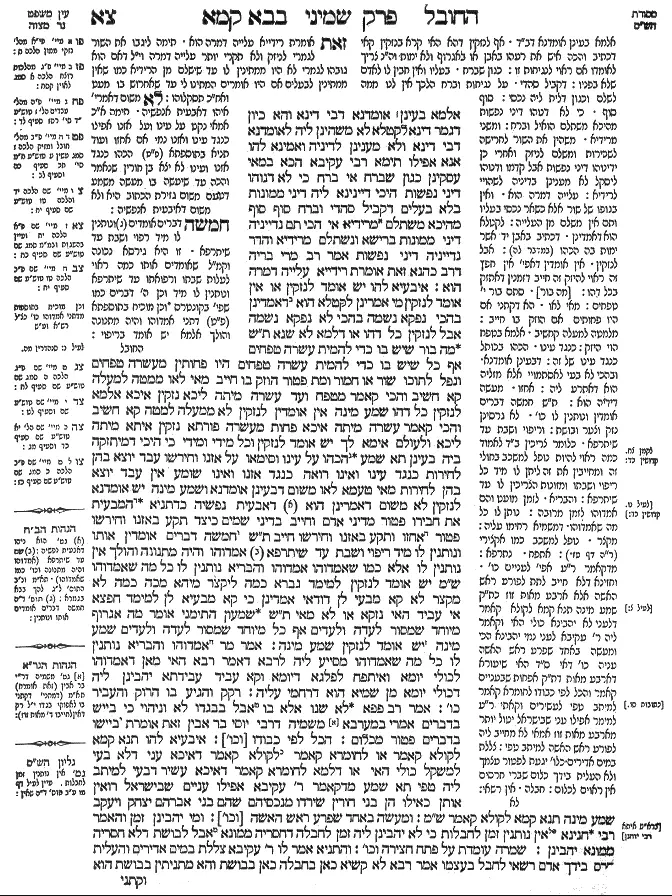
Bava Kamma 91a - Guemara
אלמא בעינן אומדנא דבי דינא והא כיון דגמר דינא לקטלא לא משהינן ליה לאומדנא דבי דינא ולא מענינן לדיניה ואמינא להו אנא אפילו תימא רבי עקיבא הכא במאי עסקינן כגון שברח אי ברח כי לא דנוהו דיני נפשות היכי דיינינא ליה דיני ממונות בלא בעלים דקביל סהדי וברח סוף סוף מהיכא משתלם מרידיא אי הכי תם נדייניה דיני ממונות ברישא ונשתלם מרידיא והדר נדייניה דיני נפשות אמר רב מרי בריה דרב כהנא זאת אומרת רידייא עלייה דמרה הוא:
איבעיא להו יש אומד לנזקין או אין אומד לנזקין מי אמרינן לקטלא הוא דאמדינן בהכי נפקא נשמה בהכי לא נפקא נשמה אבל לנזקין כל דהו או דלמא לא שנא ת"ש מה בור שיש בו כדי להמית עשרה טפחים אף כל שיש בו כדי להמית עשרה טפחים היו פחותין מעשרה טפחים ונפל לתוכו שור או חמור ומת פטור הוזק בו חייב מאי לאו ממטה למעלה קא חשיב והכי קאמר מטפח ועד עשרה מיתה ליכא נזקין איכא אלמא לנזקין כל דהו שמע מינה אין אומדין לנזקין לא ממעלה למטה קא חשיב והכי קאמר עשרה מיתה איכא פחות מעשרה פורתא נזקין איתא מיתה ליכא ולעולם אימא לך יש אומד לנזקין וכל מידי ומידי כי היכי דמיתזקה ביה בעינן תא שמע הכהו על עינו וסימאו על אזנו וחירשו עבד יוצא בהן לחירות כנגד עינו ואינו רואה כנגד אזנו ואינו שומע אין עבד יוצא בהן לחירות מאי טעמא לאו משום דבעינן אומדנא ושמע מינה יש אומדנא לנזקין לא משום דאמרינן הוא דאבעית נפשיה כדתניא המבעית את חבירו פטור מדיני אדם וחייב בדיני שמים כיצד תקע באזנו וחירשו פטור אחזו ותקע באזנו וחירשו חייב ת"ש חמשה דברים אומדין אותו ונותנין לו מיד ריפוי ושבת עד שיתרפא אמדוהו והיה מתנונה והולך אין נותנין לו אלא כמו שאמדוהו אמדוהו והבריא נותנין לו כל מה שאמדוהו ש"מ יש אומד לנזקין למימד גברא כמה ליקצר מיהא מכה כמה לא מקצר לא קא מבעי לן דודאי אמדינן כי קא מבעיא לן למימד חפצא אי עביד האי נזקא או לא מאי ת"ש שמעון התימני אומר מה אגרוף מיוחד שמסור לעדה ולעדים אף כל מיוחד שמסור לעדה ולעדים שמע מינה יש אומד לנזקין שמע מינה:
אמר מר אמדוהו והבריא נותנין לו כל מה שאמדוהו מסייע ליה לרבא דאמר רבא האי מאן דאמדוהו לכולי יומא ואיתפח לפלגא דיומא וקא עביד עבידתא יהבינן ליה דכולי יומא מן שמיא הוא דרחמי עליה:
רקק והגיע בו הרוק והעביר כו':
אמר רב פפא לא שנו אלא בו אבל בבגדו לא וניהוי כי בייש בדברים אמרי במערבא משמיה דרבי יוסי בר אבין זאת אומרת ביישו בדברים פטור מכלום:
הכל לפי כבודו [וכו']:
איבעיא להו תנא קמא לקולא קאמר או לחומרא קאמר לקולא קאמר דאיכא עני דלא בעי למשקל כולי האי או דלמא לחומרא קאמר דאיכא עשיר דבעי למיתב ליה טפי תא שמע מדקאמר ר' עקיבא אפילו עניים שבישראל רואין אותן כאילו הן בני חורין שירדו מנכסיהם שהם בני אברהם יצחק ויעקב שמע מינה תנא קמא לקולא קאמר ש"מ:
ומעשה באחד שפרע ראש האשה [וכו']:
ומי יהבינן זמן והאמר רבי חנינא אין נותנין זמן לחבלות כי לא יהבינן ליה זמן לחבלה דחסריה ממונא אבל לבושת דלא חסריה ממונא יהבינן:
שמרה עומדת על פתח חצירה וכו':
והתניא אמר לו ר' עקיבא צללת במים אדירים והעלית חרס בידך אדם רשאי לחבל בעצמו אמר רבא לא קשיא כאן בחבלה כאן בבושת והא מתניתין בבושת הוא
Comments from Rashi on Masechet Bava Kamma Page 91a
אלמא בעינן אומדנא דב"ד . אף לנזקין דהא האי קרא בנזקין קאי דכתיב והכה איש את רעהו באבן או באגרוף ולא ימות וה"נ צריך לאומדו אם ראוי לנגיחות זו: כגון שברח . בעליו ואין חבין לו לאדם שלא בפניו: דקביל סהדי . על נגיחות וברח הלכך אין לנו ממה לשלם וכגון דלית ליה נכסי: סוף סוף . כי לא דנוהו דיני נפשות מהיכא משתלם הואיל וברח: ומשני מרידיא . משהין את השור לחרישה לשכירות ומשלם לניזק ואחרי כן ידינוהו דיני נפשות אבל קדמו ודנוהו ליסקל לא מענינן בדיניה לשהויי לרידיא: עלייה דמרה הוא . ואין בגופו של שור אלא כשאר נכסי בעליו ותם אין משלם מן העלייה: לקטלא הוא דאמדינן . דכתיב באבן יד אשר ימות בה הכהו (במדבר לה): אבל לנזקין . אין אומדין דאפי' אין חפץ זה ראוי להיזק זה חייב דזמנין דאתזק בכל דהו: [מה בור] . סתם בור י' טפחים: מאי לאו . הא דקתני אם היו פחותים אם הוזק בו חייב: מלמטה למעלה קחשיב . אלמא בטפח הוי היזק: כנגד עינו . הכהו בכותל כנגד עינו של זה: דבעינן אומדנא . ובהכי לא בעי לאסתמויי אלא מזליה הוא דאתרע ליה: אחזו . מעשה דידיה הוא: ת"ש חמשה דברים אומדין ונותנין לו כו' . לא גרסינן נזק וצער ובושת: וריפוי ושבת עד שיתרפא . כלומר צריכין ב"ד לאמוד כמה ראוי להיות נופל למשכב בחולי זה ומחייבין את זה ליתן לו מיד כל ריפוי ושבתו ומזונות הצריכין לו עד שיתרפא: והבריא . לזמן מועט והם אמדוהו לזמן מרובה: נותן לו כל מה שאמדוהו . דמשמיא רחימו עליה: מקצר . נופל למשכב כמו אקצירי (ר"ה דף טז.): אתפח . נתרפא: מדקאמר ר"ע אפי' לעניים כו' . וחזינא דלא חייב לתת לפורע ראש האשה אלא ארבע מאות זוז כת"ק שמע מינה תנא קמא לקולא קאמר דלעני לא יהבינא כולי האי וקאמר ליה ר' עקיבא לעני נמי יהבינא הכי ומעשה באחד שפרע ראש האשה עניה כו' דאי ס"ד האי שיעורא דארבע מאות דת"ק אפחות שבעניים קאמר והכל לפי כבודו לחומרא קאמר למיתב טפי לעשירים וקאתי ר"ע למימר אפילו עני שבישראל יטול יותר מארבע מאות זוז אמאי לא מחייב ליה לפורע ראש האשה למיתב טפי: צללת במים אדירים . כלו' יגעת לפטור עצמך ולא העלית בידך כלום שברי חרסים אין ראוים לכלום: חבלה . אין רשאי:
Comments from Tosafot - Bava Kamma 91a
זאת אומרת רידייא עלייה דמרה הוא . תימה ליגבו את השור לגמרי לניזק ולא תקרי יותר עלייה דמרה וי"ל דאם הוא גובהו לגמרי לא היו ממתינין לו עד שישלם מן הרידיא כמו שאין ממתינין לבעלים אם היו אומרים המתינו לי עד שאחרוש בו מעט ואח"כ תסקלוהו: לא משום דאמרי' איהו דאבעית אנפשיה . תימה א"כ אמאי נקט על עינו ועל אזנו אפילו כנגד עינו ואזנו נמי אם אחזו ועוד תניא בתוספתא (פ"ט) הכהו כנגד אזנו ועינו לא יצא בן חורין שנאמר והכה עד שיעשה בו מעשה משמע דטעם משום גזירת הכתוב היא ולא משום דאיבעית אנפשיה: חמשה דברים אומדים ונותנין לו מיד רפוי ושבת עד שיתרפא . זו היא גירסא נכונה וקמ"ל שאומדים אותו כמה ראוי לעלות שבתו ורפואתו עד שיתרפא ונותנין לו מיד וכן ה' דברים כמו שפי' בקונטרס וכן מוכיח בתוספתא (פ"ט) דתני אמדוהו והיה מתנונה והולך אלמא יש אומד בריפוי:
Bava Kamma 91a - Mishnah translated into english
Rava continues the report in their name: Apparently, we require the evaluation of the court in order to render him liable to pay for the damage. And with regard to this ox that killed, once the verdict was given that it to be put to death, we do not delay the implementation of the verdict in order to wait for the evaluation of the court, and we do not delay its judgment. Therefore, the monetary case is not judged.
And I, Rava, said to the Sages of the school of Rav: Even if you say that this halakha is in accordance with the opinion of Rabbi Akiva, who does not require assessment by the court, one could explain that here we are dealing with a case where the owner of the ox fled, and the court cannot judge his case in his absence and cannot render him liable to pay for the damage caused by his ox.
The Gemara asks: If the baraita is discussing a case where the owner fled, then in the case where they did not yet judge it as a case of capital law, how does the court judge it as a case of monetary law without the owner of the ox being present? The Gemara answers: The baraita is discussing a case where the court accepted the testimony of the witnesses in the presence of the owner, and he subsequently fled.
The Gemara asks: Ultimately, from where are the damages paid in a situation where the owner fled, as he is not here to pay the damages? The Gemara answers: They are paid from plowing. The ox is rented out to plow fields, and the fees generated are used to pay the damages. Afterward, the ox is judged for the killing as a case of capital law. The Gemara asks: If so, with regard to an innocuous ox, why did the baraita rule that the court does not judge it as a case of monetary law? The court should judge it as a case of monetary law first, and the damages will be paid from fees generated from renting out the animal for plowing, and then the court should judge it as a case of capital law.
Rav Mari, son of Rav Kahana, said in answer to this last question: That is to say that the money gained from plowing is considered like the superior-quality property of its owner. In other words, that money is like the rest of the owner’s estate, and is not considered to be part of the value of the ox itself. Since payment for damage caused by an innocuous ox is taken only from the value of the ox itself, it follows that money received from renting out the ox to plow cannot be used to pay damages.
§ In connection with the ruling of the baraita that the court must assess whether the death can be attributed directly to the action of the assailant, the Gemara notes: A dilemma was raised before the Sages: Is there an evaluation performed with regard to damage as well, to determine whether the act was sufficient to inflict that damage, or is there no evaluation performed with regard to damage?
Do we say that specifically in a case of killing is where we perform an evaluation? The assessment is to determine whether a soul departs with this assault and the assailant will be held liable or whether a soul doesn’t depart with this assault and the death is attributed to other factors. But in a case of damage, perhaps we say that he is liable for whatever caused the damage. Or perhaps there is no difference between the two, and with regard to damage as well, the court evaluates whether the act was sufficient to inflict that damage, and if it was not, he will be exempt.
The Gemara says: Come and hear a proof from what was taught in a mishna (50b) concerning the halakhot of a pit: Just as a pit that has sufficient depth to cause death when falling into it is at least ten handbreadths deep, so too, any other excavations that have sufficient depth to cause death may be no less than ten handbreadths. If any of the types of excavations were less than ten handbreadths deep, and an ox or a donkey fell into one of them and died, the digger of the excavation is exempt. But if it was injured in it but did not die he is liable to pay damages.
What, is it not the case that the mishna is counting the handbreadths from below to above, and this is what it is saying: From one handbreadth deep until ten handbreadths deep, there is no liability for death but there is liability for damage? Apparently, with regard to damage he is liable for whatever caused the damage, even a fall into an excavation having the depth of one handbreadth. Learn from the mishna that the court does not perform an evaluation with regard to damage.
The Gemara rejects this: No, the mishna is counting from above to below, and this is what it is saying: If the excavation is ten handbreadths deep then there is liability for death. If the excavation is slightly less than ten, there is liability for damage but there is no liability for death. And actually, I will say to you that there is an evaluation performed for damage, and for each and every circumstance, we require that there be conditions whereby the injured party could reasonably be damaged by whatever caused the damage.
The Gemara suggests another proof: Come and hear a proof from what was taught in a baraita (Tosefta 9:26): If a slave owner struck his Canaanite slave on his eye and blinded him, or on his ear and deafened him, the slave is emancipated by means of these wounds. If he struck near his eye and as a result he does not see, or near his ear and he does not hear, the slave is not emancipated by means of these wounds. What is the reason that the slave is not emancipated? Isn’t it due to the fact that we require an evaluation of the damage, and in such a case the assumption is that the owner’s action did not suffice to cause the injury? And learn from the baraita that there is an evaluation performed with regard to damage.
The Gemara rejects this: No; the slave is not emancipated, because we say that it is possible that it was the slave who frightened himself, resulting in his blindness or deafness, but it was not the actual strike that caused it. An injury can result from being frightened, as it is taught in a baraita (Tosefta 6:16): One who frightens another and thereby causes him injury is exempt according to human laws but liable according to the laws of Heaven. How so? If one shouted into another’s ear and deafened him, he is exempt according to human laws but liable according to the laws of Heaven. But if he held him and shouted into his ear and deafened him, he is liable according to human laws as well, as he physically took hold of him.
The Gemara suggests another proof: Come and hear a proof from what was taught in a baraita (Tosefta 9:3): With regard to the five types of indemnity that one who injures another must pay, the court evaluates the victim as to the value of the damage that he suffered, and the assailant gives this payment to him immediately. Payment for medical costs and loss of livelihood is evaluated from the moment of injury until he is healed. If the court evaluated that a certain sum would be needed to pay for his medical costs and loss of livelihood, and subsequently the victim’s condition began progressively deteriorating and the sum proved to be inadequate, they give him payment only as they had evaluated him.
The baraita continues: If they evaluated him as requiring a certain sum for medical costs and loss of livelihood and he healed sooner than expected, they nevertheless give him the entire sum as they had evaluated him. Learn from the baraita that there is an evaluation performed with regard to damage. The Gemara clarifies: With regard to evaluating an injured man to determine how long he will suffer from this injury and how long he will not suffer, we do not raise a dilemma, since it is obvious that we certainly evaluate this element. When we raise the dilemma of whether the court performs an evaluation or not, it is with regard to evaluating an item, i.e., determining if it is capable of causing this damage or if it is not capable of causing this damage. With regard to this issue, what is the halakha?
The Gemara suggests: Come and hear a proof from what was taught in a baraita (Tosefta, Sanhedrin 12:3): Shimon HaTimni says: Just as a fist is unique in that it is submitted to the assembly of judges to assess its ability to injure and to the witnesses who attest that this was the fist used to strike, so too, a ruling can be issued in the case of any item that is submitted to the assembly of judges to identify its ability to injure and to the witnesses who attest that this was the item used to strike. Learn from the baraita that there is an evaluation performed with regard to damage. The Gemara affirms: Learn from the baraita that this is so.
The Master said above: If they evaluated him as requiring a certain sum for medical costs and loss of livelihood and he healed sooner than expected, they nevertheless give him the entire sum as they had evaluated him. This supports the opinion of Rava, as Rava said: With regard to this man whom they evaluated, concluding that he would not be able to perform labor for the entire day, and his wounds healed [ve’itpaḥ] at midday and he was performing labor, we give him compensation for the entire day. The injury was one that would generally cause a man to not be able to perform labor for an entire day, and it was from Heaven that they had compassion on him and healed him sooner. This does not affect the liability of the one who caused the damage.
§ The mishna teaches (90a): If he spat at him and his spittle reached him, or if he removed another’s cloak, he must give the injured party four hundred dinars. Rav Pappa says: They taught this halakha only in a case where the spittle reached him. But if the spittle landed on his clothing without touching him, he is not required to pay him. The Gemara asks: Why not? Let it be like one who humiliated another with words.
The Gemara answers: In the West, Eretz Yisrael, they say in the name of Rabbi Yosei bar Avin: That is to say that if he humiliated another with words alone, he is exempt from paying anything, although he will be held accountable by Heaven for his sin.
The mishna teaches with regard to the assessment of payment for humiliation: It is all assessed in accordance with the honor of the one who was humiliated. A dilemma was raised before the Sages: Does the first tanna in the mishna say his opinion as a leniency, or does he say his opinion as a stringency? The Gemara explains the two possibilities: He says his opinion as a leniency, teaching that there is a poor person, who doesn’t need to take so much payment for humiliation, as detailed in the fixed sums of the mishna. Or perhaps he says his opinion as a stringency, teaching that there is a rich person whom the assailant needs to give him more than those fixed sums.
The Gemara suggests: Come and hear a proof from that which Rabbi Akiva says in the mishna: Even with regard to the poor of the Jewish people, they are viewed as though they were freemen who lost their property and were impoverished, and their humiliation is calculated according to this status, as they are the sons of Abraham, Isaac, and Jacob, and are all of prominent lineage. Conclude from Rabbi Akiva’s statement that the first tanna says his opinion as a leniency, meaning that while the first tanna states the principle that payment for humiliation is in accordance with the honor of the one who was humiliated, and therefore a poor person will receive less than the fixed sums listed in the mishna, Rabbi Akiva responds that even a poor man is deserving of those fixed sums by virtue of his esteemed lineage. The Gemara affirms: Conclude from the mishna that this is so.
§ The mishna relates: And an incident occurred involving one who uncovered the head of a woman in the marketplace. The woman came before Rabbi Akiva to request that he assess payment for the humiliation that she suffered, and Rabbi Akiva obligated the assailant to give her four hundred dinars. The man said to Rabbi Akiva: My teacher, give me time to pay the penalty, and Rabbi Akiva gave him time. The Gemara asks: But do we give time for an assailant to pay compensation? But doesn’t Rabbi Ḥanina say: The court does not give one time to provide payment for injuries, and he must pay compensation immediately.
The Gemara answers: When we do not give him time to pay compensation it is specifically with regard to injury, as he caused a monetary loss by inflicting physical damage on the victim. But with regard to humiliation, where he did not cause him a monetary loss, we do give him time to pay compensation.
The mishna relates that the man then waited for her until she was standing by the opening of her courtyard, and caused her to uncover her own head. Rabbi Akiva said that although she caused injury to herself, which is not permitted, this does not negate the man’s requirement to pay her compensation. The Gemara asks: But isn’t it taught in a baraita that Rabbi Akiva said to him: You plunged into mighty waters and you raised nothing more than worthless earthenware in your hand, since it is permitted for a person to injure himself. This contradicts the mishna’s account of Rabbi Akiva’s opinion.
The Gemara answers: Rava said: It is not difficult. Here, in the mishna, where it states that one may not injure himself, it is stated with regard to inflicting actual physical injury, while there, in the baraita, where it states that it is permitted for one to injure himself, it is stated with regard to causing humiliation to oneself. The Gemara asks: But the ruling of Rabbi Akiva in the mishna is stated with regard to causing humiliation,
Traduction : The William Davidson digital edition of the Koren Noé Talmud, with commentary by Rabbi Adin Even-Israel Steinsaltz.