 Talmud Bavli
Shabbat 77b : Youtube
Daf TubeYoutube
3 video classes :
Shabbat Page 77b
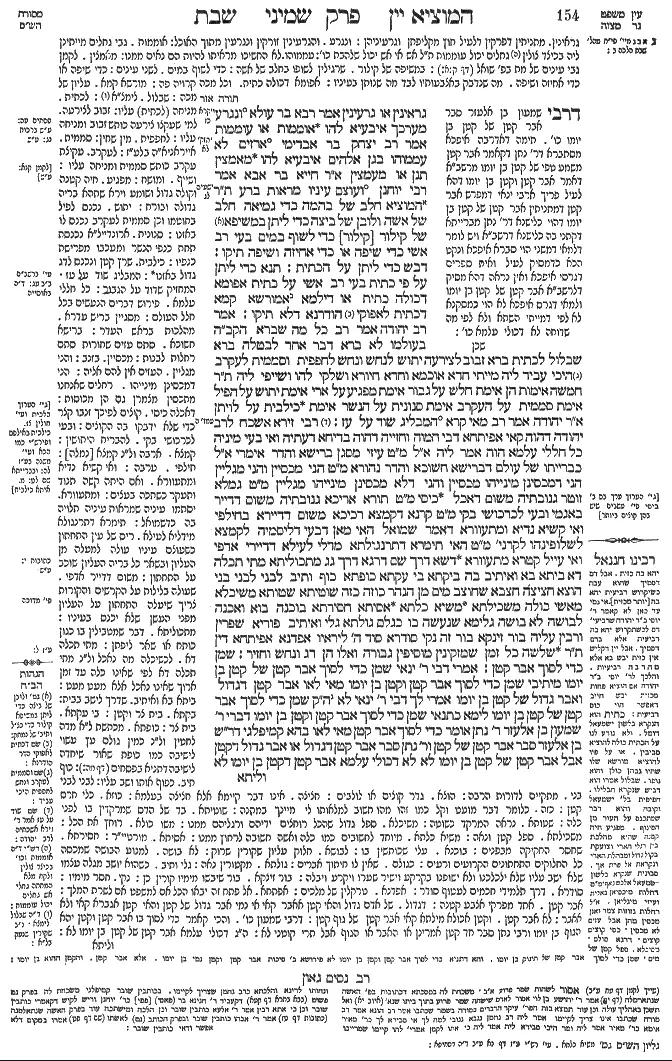
Shabbat 77b - Guemara
גראינין או גרעינין אמר רבא בר עולא (ויקרא כז, יח) ונגרע מערכך איבעיא להו אוממות או עוממות אמר רב יצחק בר אבדימי (יחזקאל לא, ח) ארזים לא עממוהו בגן אלהים איבעיא להו מאמצין תנן או מעמצין א"ר חייא בר אבא אמר רבי יוחנן (ישעיהו לג, טו) ועוצם עיניו מראות ברע ת"ר המוציא חלב של בהמה כדי גמיאה חלב של אשה ולובן של ביצה כדי ליתן במשיפא של קילור [קילור] כדי לשוף במים בעי רב אשי כדי שיפה או כדי אחיזה ושיפה תיקו:
דבש כדי ליתן על הכתית:
תנא כדי ליתן על פי כתית בעי רב אשי על כתית אפומא דכולה כתית או דילמא אמורשא קמא דכתית לאפוקי הודרנא דלא תיקו:
אמר רב יהודה אמר רב כל מה שברא הקב"ה בעולמו לא ברא דבר אחד לבטלה ברא שבלול לכתית ברא זבוב לצירעה יתוש לנחש ונחש לחפפית וסממית לעקרב היכי עביד ליה מייתי חדא אוכמא וחדא חיורא ושלקי להו ושייפי ליה ת"ר חמשה אימות הן אימת חלש על גבור אימת מפגיע על ארי אימת יתוש על הפיל אימת סממית על העקרב אימת סנונית על הנשר אימת כילבית על לויתן א"ר יהודה אמר רב מאי קרא (עמוס ה, ט) המבליג שוד על עז:
רבי זירא אשכח לרב יהודה דהוה קאי אפיתחא דבי חמוה וחזייה דהוה בדיחא דעתיה ואי בעי מיניה כל חללי עלמא הוה אמר ליה א"ל מ"ט עיזי מסגן ברישא והדר אימרי א"ל כברייתו של עולם דברישא חשוכא והדר נהורא מ"ט הני מכסיין והני מגליין הני דמכסינן מינייהו מכסיין והני דלא מכסינן מינייהו מגליין מ"ט גמלא זוטר גנובתיה משום דאכל כיסי מ"ט תורא אריכא גנובתיה משום דדייר באגמי ובעי לכרכושי בקי מ"ט קרנא דקמצא רכיכא משום דדיירא בחילפי ואי קשיא גדיא ומתעוורא דאמר שמואל האי מאן דבעי דליסמיה לקמצא לשלופינהו לקרני' מ"ט האי תימרא דתרנגולתא מדלי לעילא דדיירי אדפי ואי עייל קטרא מתעוורא דשא דרך שם דרגא דרך גג מתכוליתא מתי תכלה דא ביתא בא ואיתיב בה ביקתא בי עקתא כופתא כוף ותיב לבני לבני בני הוצא חציצה חצבא שחוצב מים מן הנהר כוזה כזה שוטיתא שטותא משיכלא מאשי כולה משכילתא משיא כלתא אסיתא חסירתא בוכנה בוא ואכנה לבושה לא בושה גלימא שנעשה בו כגלם גולתא גלי ואיתיב פוריא שפרין ורבין עליה בור זינקא בור זה נקי סודרא סוד ה' ליראיו אפדנא אפיתחא דין ת"ר שלשה כל זמן שמזקינין מוסיפין גבורה ואלו הן דג ונחש וחזיר:
שמן כדי לסוך אבר קטן:
אמרי דבי ר' ינאי שמן כדי לסוך אבר קטן של קטן בן יומו מיתיבי שמן כדי לסוך אבר קטן וקטן בן יומו מאי לאו אבר קטן דגדול ואבר גדול של קטן בן יומו אמרי לך דבי ר' ינאי לא ה"ק שמן כדי לסוך אבר קטן של קטן בן יומו לימא כתנאי שמן כדי לסוך אבר קטן וקטן בן יומו דברי ר' שמעון בן אלעזר ר' נתן אומר כדי לסוך אבר קטן מאי לאו בהא קמיפלגי דר"ש בן אלעזר סבר אבר קטן של קטן ור' נתן סבר אבר קטן דגדול או אבר גדול דקטן אבל אבר קטן של קטן בן יומו לא לא דכולי עלמא אבר קטן דקטן בן יומו לא
Comments from Rashi on Masechet Shabbat Page 77b
גראינין . מתניתין דפרקין דלעיל חוץ מקליפתן וגרעיניהן: ונגרע . והגרעינין זורקין ונגרעין מתוך האוכל: אוממות . גבי גחלים מייתינן ליה בכיצד צולין גחלים יכול עוממות ת"ל אש אי אש יכול שלהבת כו': עממוהו . לא החשיכו מראיתו להיות הם נאים ממנו: מאמצין . לקמן גבי עינים של מת בפ' שואל (דף קנא:): במשיפה של קילור . שרגילין לשופו בחלב של אשה: כדי לשוף במים . לשני עינים: כדי שיפה או כדי אחיזה ושיפה . מה שנדבק באצבעותיו לבד מה שנותן בעיניו: אפומא דכולה כתית . וכל מכה קרויה פה: מורשא קמא . עליון של מכה: שבלול . לימצ"א: לכתית . מניחה (לכתית) עליו: זבוב לצירעה . למי שעקצו צירעה כותש זבוב ומניחה עליו: לחפפית . מין שחין: סממית . אייראניא"ה בלע"ז: לעקרב . עקיצת עקרב כותש סממית ומניחה עליו: ושייף . ומושח: מפגיע . חיה קטנה וקולה גדול ושומע וירא שתהא בריה גדולה ובורח: יתוש . נכנס לפיל בחוטמו וכן סממית לעקרב נכנס לו באזנו: סנונית . ארונדייל"א נכנסת תחת כנפי הנשר ומעכבו מפרישת כנפיו: כילבית . שרץ קטן ונכנס לדג גדול באזנו: המבליג שוד על עז . המחזיק שדוד על הגבור: כל חללי עלמא . פירוש דברים הנעשים בכל חלל העולם: מסגיין בריש עדרא . מהלכות בראש העדר: ברישא חשוכא . סתם עזים שחורות סתם רחלות לבנות: מכסיין . בזנב: והני מגליין . העזים אין להם אליה: הני דמכסינן מינייהו . רחלים שאנחנו מתכסין מצמרן גם הן מכוסות: דאכלה כיסי . קוצים לפיכך זנבו קצר כדי שלא ידבקו בה הקוצים: ובעי לכרכושי בקי . להבריח היתושין: קמצא . ארבה ול"נ קמצא [נמלה]: חילפי . ערבה: ואי קשיא נדיא ומתעוורא . ואם היתה קשה תנוד ותעקר כשתכה בעצים: ומתעוורא . יסתמו עיניה שמראות עיניה תלויה בה כדשמואל: תימרא דתרנגולא מידליא לעילא . ריס של עין התחתון כשעוצם עיניו עולה למעלה מן העליון ובשאר כל בריה העליון שוכב על התחתון: משום דדייר אדפי . שעולה בלילות על הקרשים והקורות צריך שיעלה התחתון על העליון מפני העשן שלא יכנס בעיניו: מתכוליתא . דבר שמטבילין בו כגון כותח או שאר ליפתן: מתי תכלה דא . לכשיכלה מה נאכל ול"נ מתי תכלה דא לפי שאינו כלה עד זמן ארוך שאינו נאכל אלא מעט מעט: ביתא בא ואיתיב . שדרך לישב בבית: בקתא . בית צר וקטן: בי עקתא . בית צר: כופתא . מכתשת ל"א מדה לחטין ול"נ כמין גולם עץ עשוי לישיבה כמו כופת שאור שיחדה לישיבה דתניא בפסחים (דף מה:): כוף תיב . כפוף אותו ושב עליו: לבני לבני בני . מתקיים לדורות הרבה: הוצא . גדר קוצים או לולבים: חציצה . אינו דבר קיימא אלא חציצה בעלמא: כוזא . כלי חרס קטן: כזה . כלומר דבר מועט וקל כמו זהו מהו חשוב למלאותו לי מיינך במתנה: שוטיתא . בד של הדס שמרקדין בו לפני כלה: שטותא . נראה המרקד כשוטה: משיכלא . ספל גדול שהכל רוחצים ידיהם ורגליהם ממנו: משו כולא . רוחץ את הכל: משכילתא . ספל קטן ונאה: משיא כלתא . מיוחד לחשובים כמו כלה ואשה חשובה לרחוץ ממנו: אסיתא . מורטיי"ר: חסירתא . שחסר החקיקה מבפנים: בוכנא . עלי שכותשין בו: לבושא . חלוק עליון שקורין שרוק: לא בושה . למנוע הבושה שמכסה כל החלוקים התחתונים הקרועים ורעים: כגולם . שאין לו חיתוך אברים: גולתא . מקטורין נאה: גלי ותיב . כשהוא יושב מגלה עצמו שלא ישב עליו שלא ילכלכנו ולא ישופנו בקרקע וישיר שערו ויקרע ויבלה: בור זינקא . בור שיבשו מימיו קורין כן: נקי . חסר מימיו: סודרא . דרך תלמידי חכמים לעטוף סודר: אפדנא . טרקלין של מלכים: אפתחא . אל פתח זה יבאו הכל אם למשפט אם לשרת המלך: אבר קטן . אחד מפרקי אצבע קטנה: דגדול . של אדם גדול והאי קטן אאבר קאי אי נמי אבר גדול של קטן והאי קטן אגברא קאי ולא אאבר: לא אבר קטן . וקטן אכולא מילתא קאי אבר קטן של גוף קטן: דרבי שמעון כו' . והכי קאמר כדי לסוך בו אבר קטן וקטן יהא הגוף בן יומו ורבי נתן סבר חד קטן אמרינן או האבר או הגוף אבל תרי קוטני לא: ה"ג דכולי עלמא אבר קטן של קטן בן יומו לא:
Comments from Tosafot - Shabbat 77b
דרבי שמעון בן אלעזר סבר אבר קטן של קטן בן יומו כו' . תימה דאדרבה איפכא מסתברא דר' נתן דקאמר אבר קטן משמע טפי של קטן בן יומו מרשב"א דאמר אבר קטן וקטן בן יומו דהא לעיל פריך ארבי ינאי דמפרש אבר קטן דמתניתין אבר קטן של קטן בן יומו דהוי כלישנא דר' נתן מברייתא דקתני בה כלישנא דרשב"א ויש לומר דלמאי דמשני הוי סברא איפכא ונקט הכא כדמסיק לעיל ואית ספרים דגרסי איפכא ואין נראה דהא מסיק דלרשב"א אבר קטן של קטן בן יומו ולמאי דגרס איפכא לא הוי כמסקנא לא לפי דמייתי השתא ולא לפי מה שדוחה לא דכולי עלמא כו':
Shabbat 77b - Mishnah translated into english
In the mishna at the end of the previous chapter we learned that the measure that determines liability for carrying out foods is calculated without their seeds [garinin]. Is the correct version garinin with an alef or garinin with an ayin? Rava bar Ulla said: It is with an ayin, since it stems from the same root as: “And it shall be subtracted [venigra with an ayin] from your valuation” (Leviticus 27:18).
A dilemma was raised before the Sages: Do we describe dimming coals as omemot with an alef or omemot with an ayin? Rav Yitzḥak bar Avdimi said: It is written with an ayin, as it is stated: “The cedars in the garden of God could not hide it [amamuhu with an ayin]” (Ezekiel 31:8).
A dilemma was raised before the Sages: With regard to closing the eyes of the dead, did we learn in the mishna me’amtzin with an alef, or me’amtzin with an ayin? Rabbi Ḥiyya bar Abba said that Rabbi Yoḥanan said: It is written with an ayin as it is stated: “And closes [ve’otzem with an ayin] his eyes from seeing evil” (Isaiah 33:15).
With regard to carrying out milk, the Sages taught: One who carries out the milk of an animal on Shabbat is liable only for a measure equivalent to that which is swallowed in one gulp. The measure that determines liability for carrying out a woman’s milk and the white of an egg is equivalent to that which is used to place on the part of an eye bandage upon which the ointment is placed directly on the wound. And the aforementioned eye bandage must be sufficiently large to use it to rub both his eyes with water. Rav Ashi raised a dilemma: Is the measure that determines liability for the bandage equivalent to that with which water can be rubbed on both eyes, or is it equivalent to that which can be held and rubbed? Is the part of the bandage held in his hand when applying the bandage to his eyes also taken into account? No resolution was found for this dilemma. Therefore, let it stand unresolved.
We learned in the mishna: The measure that determines liability for carrying out honey is equivalent to that which is used to place on a sore caused by chafing. A tanna taught in a Tosefta: The precise measure is equivalent to that which is placed on the opening of a sore, i.e., on the wound itself. Rav Ashi raised a dilemma: Does the term on a sore mean the measure of honey spread on the opening of the entire sore; or, perhaps it means the measure spread on the primary protuberance of the sore, to the exclusion of the surrounding area upon which he does not spread honey? No resolution was found for this dilemma either. Therefore, let it stand unresolved.
On the subject of sores, the Gemara cites a statement referring to one of the methods for healing a sore. Rav Yehuda said that Rav said: Everything that the Holy One, Blessed be He, created in His world, He did not create anything for naught. He created a snail as a remedy for a sore; He created a fly to be crushed and spread as a remedy on a wasp sting; He created a mosquito as a remedy for a snake bite; and He created the snake itself as a remedy for a skin rash; and He created a gecko as a remedy for a scorpion bite. The Gemara explains: How does one implement the remedy? He brings two geckos, one black and one white, cooks them, and spreads the resulting ointment on the affected area.
With regard to these creatures, the Gemara cites that which our Sages taught: There are five dreads, i.e., dread that the weak cast over the mighty: The dread of the mafgia, a small creature, over the lion; the dread of the mosquito over the elephant; the dread of the gecko over the scorpion; the dread of the swallow over the eagle; the dread of the kilbit, a small fish, over a whale. Rav Yehuda said that Rav said: What is the verse that alludes to these matters? As it is written: “He that causes destruction [shod] to flash upon the mighty, so that destruction comes upon the fortress” (Amos 5:9), which is interpreted as: He who lifts the downtrodden [shadud] over the mighty.
On the topic of the nature of the world, the Gemara relates that Rabbi Zeira found Rav Yehuda, who was standing at the entrance of his father-in-law’s house, and observed that he was in an especially cheerful mood. And Rabbi Zeira understood that were he to ask Rabbi Yehuda about anything in the entire world, he would tell him the answer. He therefore posed questions to him on a variety of topics unrelated to halakha. He asked: Why do goats walk in front of the flock and then ewes follow? He said to him: It is just as it was in the creation of the world, which at first was dark and then light followed. Goats, which are typically black, precede the ewes, which are typically white. And he asked: Why are the genitals of these ewes covered with a tail, whereas these goats are exposed? He answered: These ewes, whose wool we use to cover ourselves, are rewarded in that they are covered; and those goats, whose hair we do not use to cover ourselves, are exposed. And he asked: Why is the camel’s tail short? He answered: Because a camel eats thorns, and a long tail would become entangled in the thorns. And he asked: Why is the ox’s tail long? He answered: Because the ox lives in a swamp and must fend off mosquitoes.
He continued to ask: Why is the grasshopper’s antenna soft? He answered: Because it lives in the plains among the grass, and if the antenna were hard it would break and the grasshopper would go blind. When the grasshopper loses its antenna it is unable to move, as Shmuel said: One who seeks to blind a grasshopper should remove its antenna. And he asked: Why does the chicken’s lower eyelid cover the upper one? He answered: Because a chicken lives on rafters in houses, and if the smoke from the houses were to enter its eyes without the protection of the eyelid, it would go blind. He asked further: Why is a door called dasha in Aramaic? He said to him: It is an acronym for derekh sham, which means through there. Why is a stair called darga? He said to him: It is an acronym for derekh gag, which means the way to the roof. Why are spices called mitkolita? He said to him: It is an acronym for matai tikhleh da, which means when will this be finished. Since spices are used sparingly, they last a long time. Why is a house called beita? He said to him: It is an acronym for bo ve’eitiv ba, which means come and I will sit in it. Why is a small house called bikta? He said to him: It is an acronym for bei akta, which means a narrow house.
A barrel is called kufta, which is an acronym for kuf vetiv, which means turn it over and sit. Bricks are called livnei, which is an allusion to livnei benei, which means for the children of children. A fence made of thorns is called hutza and Rav Yehuda said that it is merely a ḥatzitza, which means partition, as opposed to a true fence. A jug used for drawing water is called a ḥatzba because it hews [ḥotzev] water from the river. A small jug is called kuza, alluding to kazeh, which means: Give me one like that. Myrtle branches with which people dance at a wedding are called shutita, an allusion to shetuta, which means madness, as the frenzied dancing appears to be madness. The large vessel used for washing is called meshikhla, which is an acronym for mashei kula, which means: It washes all. A small vessel used for washing is called mashkhilta, and Rav Yehuda explained that it is an acronym for mashya kalta, which means: It washes the bride. A mortar is called asita, alluding to ḥasirta, which means lacking, since it has a large cavity. The pestle that is inserted into the mortar for pounding its contents is called bukhna, which is an acronym for bo ve’akkena, which means: Come and I will strike it.
An outer garment is called levusha, which is an acronym for lo busha, which means no shame, as one who is clothed is no longer ashamed. A broad outer garment is called gelima, an allusion to the fact that, by wearing it, one is transformed into an amorphous golem-like figure, as his limbs are indistinguishable. A beautiful coat is termed golta, which is an acronym for geli ve’eitiv, which means reveal, remove the coat, and only then I will sit, so that the coat will not get dirty. A bed is called purya, an allusion to the fact that people parin veravin, which means procreate, upon it. An empty pit is called bor zinka, which is an acronym for bor ze naki, which means that this pit is empty of water. The head covering of Torah scholars is called sudara, an acronym for sod yareh, which is a reference to the verse: “The counsel of the Lord is with them who fear Him [sod Hashem lire’av]” (Psalms 25:14). A palace is called apadna, which is an acronym for apitḥa dein, meaning: To this entrance all come. The Gemara cites an additional baraita related to the nature of the creatures. There are three creatures that grow mightier with age, and they are the fish, and the snake, and the pig.
We learned in the mishna: The measure that determines liability for carrying out oil is equivalent to that which is used to spread on a small limb. The school of Rabbi Yannai said it should be explained as follows: The measure that determines liability for carrying out oil is equivalent to that which is used to spread on a small limb of a day-old child. The Gemara raises an objection from a baraita: The measure that determines liability for carrying out oil is equivalent to that which is used to spread on a small limb and a day-old child. Does this not mean: A small limb of an adult and a large limb of a day-old child? The Gemara rejects this: The school of Rabbi Yannai could have said to you: No, this is what the baraita is saying: The measure that determines liability for carrying out oil is equivalent to that which is used to spread on a small limb, and the small limb in question is that of a day-old child.
The Gemara suggests: Let us say that this is parallel to a dispute between tanna’im, as it was taught in a baraita: The measure that determines liability for carrying out oil is equivalent to that which is used to spread on a small limb and a day-old child; this is the statement of Rabbi Shimon ben Elazar. Rabbi Natan says: Equivalent to that which is used to spread on a small limb. Is it not that they disagree about the following? Rabbi Shimon ben Elazar holds: It refers to a small limb of a small child, and Rabbi Natan holds: The measure for liability is equivalent to that which is used to spread on a small limb of an adult or a large limb of a child, but for a measure equivalent to that which is used to spread on a small limb of a day-old child, no, one is exempt. The Gemara rejects this: No, everyone agrees that for carrying out oil in a measure equivalent to that which is used to spread on a small limb of a day-old child, no, one is exempt,
Traduction : The William Davidson digital edition of the Koren Noé Talmud, with commentary by Rabbi Adin Even-Israel Steinsaltz.