 Talmud Bavli
Hullin 127b : Youtube
Rabbi Dr. Moshe WeisblumYoutube
1 video class :
Hullin Page 127b
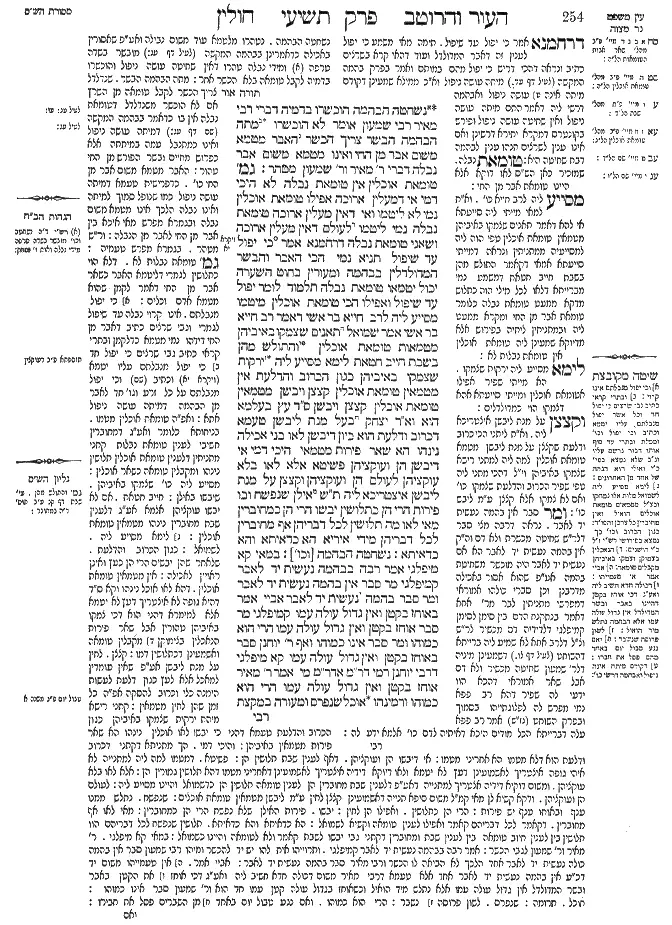
Hullin 127b - Guemara
נשחטה הבהמה הוכשרו בדמיה דברי רבי מאיר רבי שמעון אומר לא הוכשרו מתה הבהמה הבשר צריך הכשר האבר מטמא משום אבר מן החי ואינו מטמא משום אבר נבלה דברי ר' מאיר ור' שמעון מטהר:
גמ׳ טומאת אוכלין אין טומאת נבלה לא היכי דמי אי דמעלין ארוכה אפילו טומאת אוכלין נמי לא ליטמו ואי דאין מעלין ארוכה טומאת נבלה נמי ליטמו לעולם דאין מעלין ארוכה ושאני טומאת נבלה דרחמנא אמר (ויקרא יא, לז) כי יפול עד שיפול תניא נמי הכי האבר והבשר המדולדלין בבהמה ומעורין בחוט השערה יכול יטמאו טומאת נבלה תלמוד לומר יפול עד שיפול ואפילו הכי טומאת אוכלין מיטמו מסייע ליה לרב חייא בר אשי דאמר רב חייא בר אשי אמר שמואל תאנים שצמקו באיביהן מטמאות טומאת אוכלין והתולש מהן בשבת חייב חטאת לימא מסייע ליה ירקות שצמקו באיביהן כגון הכרוב והדלעת אין מטמאין טומאת אוכלין קצצן ויבשן מטמאין טומאת אוכלין קצצן ויבשן ס"ד עץ בעלמא הוא וא"ר יצחק בעל מנת ליבשן טעמא דכרוב ודלעת הוא כיון דיבשן לאו בני אכילה נינהו הא שאר פירות מטמאי היכי דמי אי דיבשן הן ועוקציהן פשיטא אלא לאו בלא עוקציהן לעולם הן ועוקציהן וקצצן על מנת ליבשן איצטריכא ליה ת"ש אילן שנפשח ובו פירות הרי הן כתלושין יבשו הרי הן כמחוברין מאי לאו מה תלושין לכל דבריהן אף מחוברין לכל דבריהן מידי איריא הא כדאיתא והא כדאיתא:
נשחטה הבהמה [וכו']:
במאי קא מיפלגי אמר רבה בבהמה נעשית יד לאבר קמיפלגי מר סבר אין בהמה נעשית יד לאבר ומר סבר בהמה נעשית יד לאבר אביי אמר באוחז בקטן ואין גדול עולה עמו קמיפלגי מר סבר אוחז בקטן ואין גדול עולה עמו הרי הוא כמוהו ומר סבר אינו כמוהו ואף ר' יוחנן סבר באוחז בקטן ואין גדול עולה עמו קא מיפלגי דרבי יוחנן רמי דר"מ אדר"מ מי אמר ר' מאיר אוחז בקטן ואין גדול עולה עמו הרי הוא כמוהו ורמינהו אוכל שנפרס ומעורה במקצת
Comments from Rashi on Masechet Hullin Page 127b
נשחטה הבהמה . נטהרו מלטמא עוד משום נבילה ואע"פ שאסורין באכילה כדאמרינן בבהמה המקשה (לעיל חולין דף עג:) מובשר בשדה טרפה ומידי נבלה טהרו דאין שחיטה עושה ניפול והוכשרו בדמיה לקבל טומאה בלא הכשר אחר: מתה הבהמה הבשר . שנדלדל צריך הכשר לקבל טומאה מן השרץ אם לא הוכשר משנדלדל דטומאת נבלה אין בו כדאמר בבהמה המקשה (שם דף עג:) דמיתה עושה ניפול ואינו כמתנבל עמה במיתתה אלא כפרוש מחיים ובשר הפורש מן החי טהור: האבר מטמא משום אבר מן החי כו' . כדפרישית טעמא דמיתה עושה ניפול כמו שנופל סמוך למיתה ואינו נבלה הלכך אינו מטמא משום נבלה. ובגמרא מפרש מאי איכא בין אבר מן החי לאבר מן הנבלה: ור"ש מטהר . בגמרא מפרש טעמיה: גמ' טומאת נבלות לא . דלא הוי כתלושין לגמרי דליטמא האבר כשאר אבר מן החי דאמר לקמן שהוא מטמא אדם וכלים: כי יפול מנבלתם . אינו קרוי נבלה עד שיפול לגמרי וגבי שרצים כתיב דאבר מן החי דידהו נמי מטמא כדלקמן ובתרי קראי כתיב גבי שרצים כי יפול חד כי יפול מנבלתם עליו יטמא (ויקרא יא) וכתיב (שם) וכי יפול מנבלתם על כל זרע וגו' חד לאבר מן הבהמה דמיתה עושה ניפול אתא: ואפ"ה טומאת אוכלין מטמו . בניחותא. כלומר ואע"ג דמחוברין חשיבי לענין טומאת נבלות קתני מתניתין דלענין טומאת אוכלין תלושין נינהו ומקבלין טומאה כשאר אוכלין: מסייע ליה כו' שצמקו באיביהן . שיבשו באילן: חייב חטאת . אם לא יבשו עוקציהן. אלמא אע"ג דלענין שבת מחוברין נינהו מטמאין טומאת אוכלין: לימא מסייע ליה . לשמואל: כגון הכרוב והדלעת . שלאחר שהן יבשים הרי הן כעץ ואינן ראויין לאכילה: אין מטמאין טומאת אוכלין . דהא לאו אוכל נינהו וקא ס"ד דהיא גופה לא איצטריך דעץ לא יטמא אלא למימרא דהני הוא דכי צמקו באיביהן טהורין אבל שאר פירות הנאכלין בצימוקן מקבלין טומאה ואשמעינן דכתלושין דמו: קצצן . לחין על מנת ליבשן אע"פ שאין עומדין למאכל אלא לעץ כגון דלעת לעשות הימנה כלי וכרוב להסקה אפ"ה כל זמן שהן לחין מטמאין: קתני רישא מיהת ירקות שצמקו באיביהן כגון הכרוב והדלעת טעמא דהני כי יבשו לאו אוכלין נינהו הא שאר פירות מטמאין באיביהן: והיכי דמי . הך מתניתא דקתני דכרוב ודלעת הוא דלא מטמו הא אחריני מטמו: אי דיבשו הן ועוקציהן . דאף לענין שבת תלושין הן: פשיטא . דמטמו למה ליה למתנייה לא איהי גופה איצטריך לאשמועינן דעץ לא יטמא ולאו דיוקא דידיה איצטריך לאשמועינן דאחריני מטמו דהא תלושין גמורין הן: אלא לאו בלא עוקציהן . ומשום דוקיא דידיה אצטריך למתנייה דאע"פ דלענין שבת מחוברין הן לענין טומאה תלושין הן כדשמואל והיינו מסייע ליה: לעולם הן ועוקציהן . ודקא קשיא לן מאי קמ"ל משום סיפא תנייה דאשמועינן קצצן לחין ע"מ ליבשן מטמאין טומאת אוכלים: שנפשח . נתלש ממנו ענף ובאותו ענף יש פירות: הרי הן כתלושין . ואפילו הן לחין: יבשו . פירות האילן שלא נפשח הרי הן כמחוברין: מאי לאו אף מחוברין . דקאמר לכל דבריהם קאמר ואפילו לענין טומאה וקשיא לשמואל: הא כדאיתא והא כדאיתא . תלושין שנפשח לכל דבריהם הוו תלושין בין לענין חיוב טומאה בין לענין שבת ומחוברין דקתני גבי יבשו לשבת קאמר ולא לטומאה והיינו כשמואל: במאי קא מיפלגי . ר' מאיר ור' שמעון לגבי הכשר: אמר רבה בבהמה נעשית יד לאבר קמיפלגי . ותרוייהו אית להו יש יד להכשר ומיהו רבי שמעון סבר אין בהמה כולה נעשית יד לאבר אחד הלכך לא הביאה לו הכשר ורבי מאיר סבר בהמה נעשית יד לאבר: אביי אמר . אין טעמייהו משום יד דכ"ע אין בהמה נעשית יד לאבר אחד אלא טעמא דרבי מאיר משום דכולה חדא חשיב ליה ואע"ג דכי אוחז את הקטן באבר ובשר המדולדל אין גדול עולה עמו אלא נתלש מיד הואיל וכשאוחז בגדול עולה קטן עמו חד הוא ור' שמעון סבר אינו כמוהו: אוכל . תרומה: שנפרס . לשון פרוסה נשבר:
Comments from Tosafot - Hullin 127b
דרחמנא אמר כי יפול עד שיפול . תימה מאי משמע כי יפול לענין זה דאבר המדולדל ועוד דהאי קרא בשרצים כתיב ונראה דהכי דריש כי יפול מהם במותם ואמר בפרק בהמה המקשה (לעיל חולין דף עד.) מיתה עושה ניפול וא"כ ממילא שמעינן דקודם מיתה אינה עושה ניפול ואבהמה דרשי ליה דאמר התם מיתה עושה ניפול ואין שחיטה עושה ניפול ופירש בקונטרס דמקרא יתירא דרשינן ואם אינו ענין לשרצים תנהו ענין לבהמה דבת שחיטה היא: טומאת נבלה . שמזכיר כאן הש"ס לאו דוקא אלא היינו טומאת אבר מן החי: מסייע ליה לרב חייא כו' . וא"ת למאי מייתי ליה סייעתא אי להא דאמר תאנים שצמקו באיביהן מטמאין טומאת אוכלין טפי הוה ליה למסייעיה ממתניתין ונראה דמייתי סייעתא אמאי דקאמר התולש מהן בשבת חייב חטאת דמשמע נמי מברייתא דלאו לכל מילי הוה כתלוש מדקא ממעט טומאת נבלה כלומר טומאת אבר מן החי ומקרא ממעט ליה ובמתניתין ליתיה בפירוש אלא מדיוקא שמעינן ליה טומאת אוכלין אין טומאת נבלות לא: לימא מסייע ליה ירקות שצמקו . הא מייתי שפיר אפילו אטומאת אוכלין ומייתי סייעתא אהא דצמקו הוי כמדולדלים: וקצצן על מנת ליבשן איצטריכא ליה . וא"ת ליתני הכי כרוב ודלעת שקצצן על מנת ליבשן מטמא טומאת אוכלין למה ליה למתני רישא שצמקו באיביהן וי"ל דהכי מתני ליה טפי שפיר הכרוב והדלעת שצמקו כו' ואם לא צמקו אלא קצצן ע"מ ליבש כו': ומר סבר אין בהמה נעשית יד לאבר . נראה דרבה מצי סבר דלר"ש שחיטה מכשרת ולא דם וה"ק אין בהמה נעשית יד לאבר הא אם נעשית יד לאבר היה מוכשר משחיטת בהמה אע"פ שהוא אסור באכילה מדרבנן וכן סברי כולהו אמוראי דמפרשי מתניתין לבר מר' אחא דאמר בנתקנח הדם בין סימן לסימן קמיפלגי דלדידיה דם מכשיר לר"ש וצ"ל דלרב אחא לא שמיע ליה ברייתא דהשוחט (לעיל חולין דף לו.) דשמעינן מיניה דלר' שמעון שחיטה מכשיר ולא דם אבל שאר אמוראי דהכא הוו ידעי לה שפיר דהא רב פפא נמי מפרש לה לפלוגתייהו בסמוך ובפרק השוחט (גז"ש) אמר רב פפא עלה דברייתא הכל מודים היכא דאיתיה לדם כו' אלמא ידע לה:
Hullin 127b - Mishnah translated into english
If the animal was slaughtered, although this act of slaughter does not render it permitted for consumption by a Jew (see 73b), the limb and the flesh were thereby rendered susceptible to impurity by coming in contact with the blood of the slaughtered animal, as blood is one of the seven liquids; this is the statement of Rabbi Meir. Rabbi Shimon says: They were not rendered susceptible to impurity through the animal’s own blood; they are rendered susceptible only once they have been wet with another liquid.
If the animal died without slaughter, the hanging flesh needs to be rendered susceptible to impurity in order to become impure, as its halakhic status is that of flesh severed from a living animal, which is ritually pure and does not have the status of an unslaughtered carcass. The hanging limb imparts impurity as a limb severed from a living animal but does not impart impurity as the limb of an unslaughtered carcass; this is the statement of Rabbi Meir. And Rabbi Shimon deems the limb ritually pure.
GEMARA: The mishna states that the limb of an animal that was partially severed and remains hanging from the animal imparts impurity as food if one had intent to eat it. The Gemara infers: It imparts impurity as food, yes, but it does not impart the impurity of a carcass, which can be transmitted to people and utensils in addition to food.
The Gemara asks: What are the circumstances? If the limb can heal and reattach to the animal’s body then it should not be susceptible even to impurity as food. And if it cannot heal, it should impart the impurity of a carcass as well.
The Gemara answers: Actually, the mishna is discussing a case where the limb will not heal, and the reason that the limb does not impart impurity of a carcass is that the impurity of a carcass is different and unique, as the Merciful One states with regard to the impurity of a carcass: “And if any of their carcass fall upon any sowing seed” (Leviticus 11:37), indicating that the severed limb of an animal is not considered a carcass until it completely falls from the animal.
This explanation is also taught in a baraita: With regard to the limb and the flesh of an animal that were partially severed and remain hanging from the animal and are connected to the animal by a connector the size of a strand of hair, one might have thought that they impart the impurity of a carcass. Therefore, the verse states: “And if any of the carcass fall,” indicating that a severed limb does not impart the impurity of a carcass until it completely falls from the animal. And nevertheless, despite the fact that it is not considered severed with regard to the impurity of a carcass, such a limb is considered severed with regard to being susceptible to impurity as food.
This explanation supports the opinion of Rav Ḥiyya bar Ashi, as Rav Ḥiyya bar Ashi said that Shmuel said: With regard to figs that dried while still attached to their tree, despite the fact that they are still attached, they are considered as if they have been picked and are susceptible to impurity as food. But with regard to one who picks them on Shabbat they are considered attached, and he is liable to bring a sin offering. Just as a partially severed limb of an animal is considered both attached and severed with regard to different halakhot, so too this dried fruit is considered both attached and detached with regard to different halakhot.
Let us say that a baraita (Tosefta, Okatzin 2:11) supports the opinion of Shmuel, who holds that dried figs still attached to the tree are considered as if they are detached with regard to susceptibility to impurity as food: Vegetables that dried while they are attached to their plant, such as cabbage and gourd, which become hard as wood and inedible when dried, are not susceptible to impurity as food. But if one cut them when they were still moist and then dried them in order to use them for fuel, or, in the case of gourds, to make utensils out of them, they are susceptible to impurity as food.
The Gemara asks: Does it enter your mind that if one cut them and dried them they are susceptible to impurity as food? Such a vegetable is merely wood, and it is inedible. And Rabbi Yitzḥak says: The baraita is discussing a case where one cut the vegetables when they were still moist in order to dry them. The novelty of the baraita is that even though one intends to dry the vegetables and render them inedible, as long as they are still moist they are susceptible to impurity as food.
The Gemara infers: The reason for this halakha in the baraita is that it is discussing cabbage and gourd: Since one dried them, they are inedible and consequently are not susceptible to impurity as food. But other types of produce, which are edible when dried, are susceptible to impurity.
The Gemara explains the suggested support to Shmuel: What are the circumstances? If one dried both the produce itself and its stems, isn’t it obvious that the produce is no longer considered attached to the plant and is susceptible to impurity? If so, it would be unnecessary for the baraita to teach this. Rather, isn’t the baraita discussing a case where one dried the produce without drying its stems? Accordingly, in such a case the produce is considered detached with regard to impurity even though it is considered attached with regard to Shabbat, in accordance with the statement of Shmuel.
The Gemara rejects this interpretation: The baraita is not necessarily discussing that case. Actually, the baraita is discussing a case where both the produce itself and its stems were dried. And although it appears that the halakha is obvious in such a case, it was necessary for the baraita to mention it in order to teach the latter clause of the baraita: In a case where one cut the cabbage and gourd when they were still moist in order to dry them, they are susceptible to impurity as long as they are still moist.
The Gemara suggests: Come and hear a challenge to the opinion of Shmuel from a baraita: In the case of a tree from which a branch broke off, and the branch has fruit attached to it, even if the fruit is still moist it is considered detached from the tree. But if the branch did not break off, and the fruit dried on the tree, it is considered attached. What, isn’t the ruling of the baraita that just as in the first clause the fruit on the detached branch is considered detached with regard to all matters, the halakhot of both Shabbat and impurity, so too in the latter clause the fruit that dried on the tree is considered attached to the tree with regard to all matters, even the transmission of impurity, contrary to the opinion of Shmuel?
The Gemara rejects this challenge: Are the cases comparable? This case is as it is, and that case is as it is. In the first clause of the baraita, the fruit on the detached branch is considered detached with regard to all matters. In the latter clause of the baraita, the dried fruit on the tree is considered attached with regard to Shabbat but detached with regard to impurity.
§The mishna teaches: If the animal was slaughtered, Rabbi Meir holds that with the blood of the slaughtered animal the limb and the flesh were rendered susceptible to impurity. Rabbi Shimon says that they were not rendered susceptible with the animal’s own blood. The Gemara asks: With regard to what principle do Rabbi Meir and Rabbi Shimon disagree?
Rabba said: The mishna is discussing a case where the blood of the slaughtered animal came into contact with the body of the animal but not with the partially severed limb. The tanna’im agree that if an appendage that constitutes a handle is rendered susceptible to impurity, the food to which it is attached is also rendered susceptible. But they disagree with regard to whether an animal constitutes a handle for its limb. One Sage, Rabbi Shimon, holds that an animal does not constitute a handle for its limb, and therefore the limb is not rendered susceptible to contract impurity along with the body of the animal. And one Sage, Rabbi Meir, holds that an animal constitutes a handle for its limb, and therefore the limb is rendered susceptible along with the body of the animal.
Abaye said a different explanation of the dispute between Rabbi Meir and Rabbi Shimon: The mishna is discussing a case where the blood of the slaughtered animal came into contact with the body of the animal but not with the partially severed limb, and both tanna’im agree that an animal does not constitute a handle for its limb. But they also agree that if the liquid comes into contact with only part of the food it renders the entire item susceptible to impurity. Therefore, if the partially severed limb is considered part of the animal it is rendered susceptible to impurity along with the animal. Rabbi Meir and Rabbi Shimon disagree with regard to whether the limb is considered part of the animal, and generally speaking, with regard to any case where a small part of an item is hanging off the larger part such that if one grasps and lifts the small part the large part does not ascend with it.
One Sage, Rabbi Meir, holds that although if one grasps and lifts the small part the large part does not ascend with it, the small part is still considered one and the same with the large part. Therefore, a partially severed limb is rendered susceptible to impurity along with the body of the animal. And one Sage, Rabbi Shimon, holds that the small part is not considered one and the same with the large part in such a case, and therefore the partially severed limb is not rendered susceptible to impurity along with the body of the animal.
And Rabbi Yoḥanan also holds in accordance with the explanation of Abaye that the tanna’im disagree with regard to the status of a small part of an item that is hanging off the larger part such that one grasps the small part and the large part does not ascend with it.
As Rabbi Yoḥanan raises a contradiction between one statement of Rabbi Meir and another statement of Rabbi Meir: Did Rabbi Meir actually say that even in a case where one grasps the small part of an item and the large part does not ascend with it, the small part is still considered one and the same with the large part?
One can raise a contradiction to this statement from a mishna (Tevul Yom 3:1): With regard to a piece of food that was sliced from a larger piece of food and remains partially connected to the larger piece, the entire item is considered one and the same with regard to impurity. If one who was previously ritually impure and immersed that day and is waiting for nightfall for the purification process to be completed touched either piece of the item, the entire item becomes impure.
Traduction : The William Davidson digital edition of the Koren Noé Talmud, with commentary by Rabbi Adin Even-Israel Steinsaltz.