 Talmud Bavli
The learning on the whole site is dedicated : L'ilui Nishmat Reuven ben Rivka SEBBAG
The learning on the whole site is dedicated : L'ilui Nishmat Nissim ben Barukh Malka
The learning on the whole site is dedicated : L'ilui Nishmat Margalit bat Ledicia
Hullin 123b : Youtube
Rabbi Dr. Moshe WeisblumYoutube
1 video class :
Hullin Page 123b
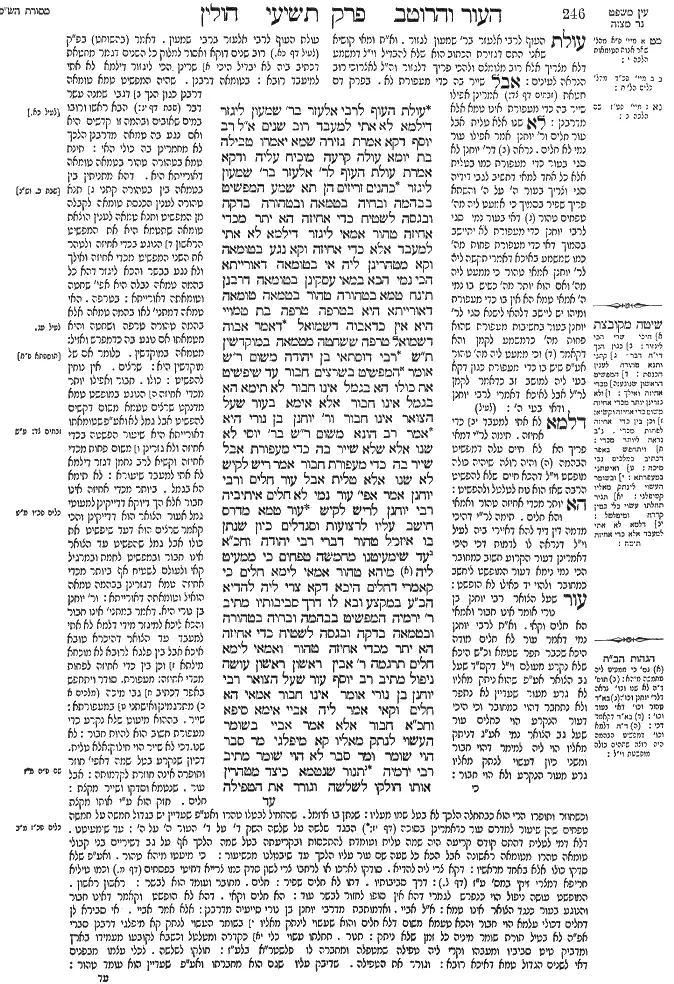
Hullin 123b - Guemara
עולת העוף לרבי אלעזר ברבי שמעון ליגזר דילמא לא אתי למעבד רוב שנים א"ל רב יוסף דקא אמרת גזירה שמא יאמרו טבילה בת יומא עולה קרעה מוכיח עליה ודקא אמרת עולת העוף לר' אלעזר בר' שמעון ליגזר כהנים זריזים הן תא שמע המפשיט בבהמה ובחיה בטמאה ובטהורה בדקה ובגסה לשטיח כדי אחיזה הא יתר מכדי אחיזה טהור אמאי ליגזר דילמא לא אתי למעבד אלא כדי אחיזה וקא נגע בטומאה וקא מטהרינן ליה אי בטומאה דאורייתא הכי נמי הכא במאי עסקינן בטומאה דרבנן תינח טמא בטהורה טהור בטמאה טומאה דאורייתא היא בטרפה טרפה בת טמויי היא אין כדאבוה דשמואל דאמר אבוה דשמואל טרפה ששחטה מטמאה במוקדשין ת"ש רבי דוסתאי בן יהודה משום ר"ש אומר המפשיט בשרצים חבור עד שיפשיט את כולו הא בגמל אינו חבור לא תימא הא בגמל אינו חבור אלא אימא בעור שעל הצואר אינו חבור ור' יוחנן בן נורי היא אמר רב הונא משום ר"ש בר' יוסי לא שנו אלא שלא שייר בה כדי מעפורת אבל שייר בה כדי מעפורת חבור אמר ריש לקיש לא שנו אלא טלית אבל עור חלים ורבי יוחנן אמר אפי' עור נמי לא חלים איתיביה רבי יוחנן לריש לקיש עור טמא מדרס חישב עליו לרצועות וסנדלים כיון שנתן בו איזמל טהור דברי רבי יהודה וחכ"א עד שימעיטנו מחמשה טפחים כי ממעיט ליה מיהא טהור אמאי לימא חלים כי קאמרי דחלים היכא דקא צרי ליה להדיא הב"ע במקצע ובא לו דרך סביבותיו מתיב ר' ירמיה המפשיט בבהמה ובחיה בטהורה ובטמאה בדקה ובגסה לשטיח כדי אחיזה הא יתר מכדי אחיזה טהור ואמאי לימא חלים תרגמה ר' אבין ראשון ראשון עושה ניפול מתיב רב יוסף עור שעל הצואר רבי יוחנן בן נורי אומר אינו חבור אמאי הא חלים וקאי אמר ליה אביי אימא סיפא וחכ"א חבור אלא אמר אביי בשומר העשוי לנתק מאליו קא מיפלגי מר סבר הוי שומר ומר סבר לא הוי שומר מתיב רבי ירמיה תנור שנטמא כיצד מטהרין אותו חולקו לשלשה וגורר את הטפילה
Comments from Rashi on Masechet Hullin Page 123b
עולת העוף לרבי אלעזר ברבי שמעון . דאמר (בהשוחט) בפ"ק (לעיל חולין דף כא.) רוב שנים דוקא ואסור למלוק כל השנים דגמר מחטאת דכתיב ביה לא יבדיל היכי שרינן הכי ליגזור דילמא לא אתי למיעבד רובא: בטומאה דרבנן . שהיה המפשיט טמא טומאה דרבנן כגון הנך דגבי שמנה עשר דבר (שבת דף יג:) הבא ראשו ורובו במים שאובים ובהמה זו קדשים היא ואם נגע בה טמאה מדרבנן הלכך לא מחמרינן בה כולי האי: תינח טמא בטהורה טהור בטמאה טומאה דאורייתא היא . דהא מתניתין בין בטמאה בין בטהורה קתני תנא טהורה לענין הכנסת טומאה לקבלה מן המפשיט ותנא טמאה לענין הוצאת טומאה שתטמא היא את המפשיט הראשון הנוגע בכדי אחיזה ולטהר את השני המפשיט מכדי אחיזה ואילך ולא נגע בבשר והכא ליגזר דהא כל בהמה טמאה נבלה היא אפי' שחטה וטומאתה דאורייתא: בטרפה . האי טמאה דמתני' לאו בהמה טמאה אלא בהמה טהורה טרפה ושחטה והיא מטמאתו אם נוגע בה כדמפרש ואזיל: מטמאה במוקדשין . כלומר אם של מוקדשין היא: שרצים אין נוחין להפשיט: כולו . חבור ואפילו יותר מכדי אחיזה הנוגע במופשט טמא. מדנקט שרצים טעמא משום דקשים להפשיט אבל גמל לא ואע"פ שטומאתו דאורייתא היא שיעור הפשטה בכדי אחיזה ולא גזרינן משום פחות מכדי אחיזה וקשיא לרב נחמן דגזר דילמא לא אתי למעבד שיעורא: לא תימא הא בגמל . ביותר מכדי אחיזה אינו חבור אלא הך דיוקא דדייקינן למעוטי גמל אעור הצואר הוא דדייקינן והכי קאמר שרצים הוא דעד שיפשיט את כולו אבל גמל שהפשיט עד הצואר אינו חבור ובמפשיט לחמת ובמרגיל קאי ולעולם לשטיח אף ביותר מכדי אחיזה טמא דגזרינן בבהמה טמאה הואיל וטומאתה דאורייתא: ור' יוחנן בן נורי היא . דאמר במתני' אינו חבור והכא ליכא למיגזר מידי דלמא לא אתי למעבד עד הצואר דהיכרא טובא איכא אבל בין פלגא לרובא לא מוכחא מילתא וכן בין כדי אחיזה לפחות מכדי אחיזה: מעפורת . סודר. ויתחפש באפר דכתיב גבי מיכה (מלכים א כ) מתרגמינן ואישתני במעפורתא: שייר . בההוא מיעוט שלא נקרע כדי מעפורת חשוב הוא להיות חבור: לא שנו . דכי לא שייר הוי חילוק: אלא טלית . דכיון שנקרע בטל שמה דאפי' חוזר ותופרה אינה חוזרת לקדמותה: אבל עור . שנטמא וסדקו ושייר מקצת: חלים . חזק הוא ע"י אותו מקצת וכשחוזר ותופרו הרי הוא כבתחלה הלכך לא בטל שמו מעליו: שנתן בו איזמל . שהתחיל לבטלו טהרו ואע"פ שעדיין יש בגדול חמשה על חמשה טפחים שהן שיעור למדרס עור כדאמרינן בסוכה (דף יז:) הבגד שלשה על שלשה השק ד' על ד' העור ה' על ה': עד שימעיטנו . דלא דמי לטלית דהתם קודם קריעה היה שמה טלית ועומדת להתכסות ובקריעתה בטל שמה הלכך אף על גב דשיריים בני קבולי טומאה טהרו מטומאה ראשונה אבל הכא כל שעה שם עור עליו הלכך עד שיבטלנו מכשיעור: כי מיעטו מיהא טהור . ואע"פ שלא סדקו כולו אלא באחד מראשיו: דקא צרי ליה להדיא . סודקו לארכו או לרחבו. צרי לשון סדק כמו צרייא דחיטי בפסחים (דף מ.) וכמו טיליא חריפא דמצרי זיקי במס' ע"ז (דף ל.): דרך סביבותיו . דתו לא חלים שפיר: חלים . מחובר ועומד הוא לבשר: ראשון ראשון . המופשט עושה ניפול הוי כנפרש לגמרי דהא אין סופו לחזור לבשר עוד: הא חלים וקאי . דהא לא הופשט וקאמר דאינו חבור והנוגע בעור כנגד הצואר אינו טמא: א"ל אביי . ואדמותבת מדרבי יוחנן בן נורי סייעיה מדרבנן: אלא אמר אביי . אי סבירא לן דחלים דכולי עלמא הוי חבור והכא טעמא משום דלא חלים והוא שעשוי לינתק מאליו בשומר העשוי לנתק קא מיפלגי דרבנן סברי אפ"ה לא בטיל תורת שומר מיניה כל זמן שלא ניתק: תנור . תחלתו עשוי כלי כקדרה ומטלטל וכשבא לקובעו מעמידו בארץ ומדביק טיט סביביו ומעבהו וקרי ליה טפילה שמטפלה ומחברה לו פלשטר"א בלע"ז: חולקו לשלשה . לכלי עצמו מבפנים דאי לשנים הגדול טמא דאיכא רובא: וגורר את הטפילה . שדיבק עליו שגם הוא מחברתו ואע"פ שעדיין הוא עומד טהור:
Comments from Tosafot - Hullin 123b
עולת העוף לרבי אלעזר בר' שמעון לגזור . וא"ת ומאי קושיא שאני התם דגזירת הכתוב הוא שלא להבדיל וי"ל דמשמע דלא מצריך אלא רוב מצומצם ולהכי פריך דלגזור וה"ל לאצרוכי רוב הנראה לעינים: דלמא לא אתי למעבד כדי אחיזה . תימה לר"י דמאי פריך הא לא חייס עלה דמפשיט הבהמה והיה רוצה שיהיה כולה מופשט וי"ל דהכא חייס שלא להפשיט הרבה שאז הוא נוח לטלטל ולהפשיט: אבל שייר בה כדי מעפורת לא . בפרק דם חטאת (זבחים דף צד:) אמרינן אפילו שייר בה כדי מעפורת אינו טמא אלא מדרבנן: לא שנו אלא טלית אבל עור חלים ור' יוחנן אמר אפילו עור נמי לא חלים . נראה דר' יוחנן לא סגי בעור כדי מעפורת כמו בטלית אלא כל אחד למאי דחשיב לגבי דידיה סגי וצריך בעור ה' על ה' והשתא פריך שפיר בסמוך כי אמעט ליה מה' טפחים טהור דאי בעור נמי סגי לרבי יוחנן כדי מעפורת לא יתיישב בסמוך דאי כדי מעפורת פחות מה' כמו שמשמע באיכא דאמרי תקשה ליה לר' יוחנן אמאי טהור כי ממעט ליה מה' ואם הוא יותר מה' כשיש בו נמי ה' אמאי טמא הא אין בו כדי מעפורת ומיהו יש ליישב דלהאי לישנא סגי לר' יוחנן בעור בחשיבות מעפורת שהוא פחות מה' כדמשמע לקמן והא דקאמר וכי ממעט ליה מה' טהור אע"פ שיש בו כדי מעפורת כגון דקא בעי ליה למושב זב כדאמר לקמן לר"ל אבל לאיכא דאמרי לרבי יוחנן ודאי בעי ה': הא יותר מכדי אחיזה טהור ואמאי והא חלים . תימה לר"י דהיכי מדמה דין דיד להא דאיירי ביה לעיל וי"ל דנראה לו לדמות דכי היכי דאמרינן דעור הקרוע חשוב כמחובר הכי נמי נימא דעור המופשט ליחשב כמחובר ולהוי יד כאילו לא הופשט: עור שעל הצואר רבי יוחנן בן נורי אומר אינו חבור ואמאי הא חלים וקאי . וא"ת לרבי יוחנן נמי דאמר עור לא חלים מודה היכא שכבר תפר שטמא וכ"ש היכא שלא נקרע מעולם וי"ל דקס"ד שעל גב הצואר אע"פ שהוא ניתק מאליו לא גרע מעור שעדיין לא נתפר ולא נתחבר דהוי כמחובר וכי היכי דעור הנקרע הוי כחלים עור שעל גב הצואר נמי אע"ג דניתק מאליו הוי ליה למימר דהוי חבור ומשני כיון דעשוי לנתק מאליו גרע מעור הנקרע ולא הוי חבור:
Hullin 123b - Mishnah translated into english
so too, with regard to a bird burnt offering according to the opinion of Rabbi Elazar, son of Rabbi Shimon, who holds that one is required to pinch merely a majority of two simanim in the nape of the neck in order to prepare it for sacrifice, let him decree against pinching the majority of two simanim lest one come to not perform the pinching on the majority of two simanim, but rather on merely half of them.
Rav Yosef responded to Rabba’s two refutations and said to him: With regard to that which you said, that a rabbinic decree is necessary even with regard to a garment that was immersed that day lest onlookers say that immersion of a garment on that same day is sufficient, there is no reason for such a concern. This is because its tear proves that the garment is pure due to the tear, and not because one is allowed to wear an immersed garment while eating pure food before sunset.
And with regard to that which you said, that with regard to a bird burnt offering according to the opinion of Rabbi Elazar, son of Rabbi Shimon, let him decree against pinching the majority of the simanim lest one fail to pinch the majority, in fact there is no reason for such a concern. Rav Yosef explains: The reason there is no concern is that pinching is performed by the priests, who are vigilant with regard to mitzvot.
The Gemara suggests: Come and hear a refutation to Rabba bar Avuh’s explanation of the mishna in tractate Kelim from the mishna here: In the case of one who flays a domesticated animal or an undomesticated animal, a ritually impure animal or a ritually pure animal, a small animal or a large animal, if he is flaying the animal for the purpose of using the hide as a carpet, the halakhic status of the hide remains that of flesh until he has flayed the measure of grasping the hide.
The Gemara infers: But after one has flayed more than a measure of grasping the hide, the hide is pure. Why is this so? Let the Sages decree that even a hide that was flayed more than the measure of grasping is susceptible to impurity lest one who intends to flay more than a measure of grasping come to complete only a measure of grasping, and he is thereby touching a source of impurity, and we might mistakenly deem him pure.
The Gemara answers: If the mishna were discussing impurity by Torah law, indeed the Sages would issue such a decree. But here we are dealing with impurity by rabbinic law, and therefore the Sages did not issue such a decree.
The Gemara objects: According to this answer, the case in the mishna of an impure person who flays a pure animal works out well. That could be referring to a case of impurity by rabbinic law. But in every case of a pure person who flays an impure animal, i.e., an unslaughtered animal carcass, the impurity of the animal is by Torah law. Therefore, in such a case the Sages should have issued a decree. The Gemara explains: The case taught in the mishna of a person who flays an impure animal is referring to a pure animal that was properly slaughtered, but after the slaughter the animal was found to have a wound that would have caused it to die within twelve months, thereby rendering it a tereifa. Such an animal imparts impurity by rabbinic law.
The Gemara asks: Is a pure animal that is found to be a tereifa capable of imparting impurity? The Gemara answers: Yes, in accordance with the opinion of Shmuel’s father, as Shmuel’s father said: A tereifa that one slaughtered imparts impurity by rabbinic law if it is a sacrificial animal. Accordingly, the mishna is referring to the case of a sacrificial animal that was found to be a tereifa.
The Gemara suggests: Come and hear a refutation of Rabba bar Avuh’s explanation of the mishna in tractate Kelim from a baraita (Tosefta 8:19): Rabbi Dostai ben Yehuda says in the name of Rabbi Shimon: With regard to one who flays creeping animals, its hide is considered to have a connection with the flesh, and it imparts impurity of a creeping animal until he flays the animal in its entirety.
The Gemara infers: This halakha applies only with regard to creeping animals, but with regard to a camel or other non-kosher animals, when the hide is flayed more than a measure of grasping it is not considered to have a connection with the flesh and is pure, even though when the measure of grasping is flayed it is impure. Apparently, there is no rabbinic decree that even a hide that was flayed more than the measure of grasping imparts impurity lest one who intends to flay more than a measure of grasping come to flay only a measure of grasping, contrary to the opinion of Rabba bar Avuh.
The Gemara rejects this proof: Do not say that this statement indicates that with regard to a camel, when the hide is flayed more than a measure of grasping it is not considered to have a connection with the flesh. Rather, say that this statement indicates that only with regard to a creeping animal is the hide considered to have a connection with the flesh until one flays the animal in its entirety. But with regard to a camel carcass and other non-kosher animals, in a case where one seeks to fashion a jug and begins flaying from the legs, if he removed the entire hide except for the hide over the neck, it is not considered to have a connection to the flesh, and this statement is in accordance with the opinion of Rabbi Yoḥanan ben Nuri stated in the mishna.
§The Gemara returns to discuss, and limit the scope of, the previously cited mishna (Kelim 28:8): In the case of a ritually impure garment that one began to tear, once the majority of the garment is torn, the two sections are no longer considered to have a connection, and the garment is pure. Rav Huna says in the name of Rabbi Shimon, son of Rabbi Yosei: The mishna taught that an impure garment, most of which has been torn, is no longer impure only when one did not leave untorn a part of the garment that is the measure of a scarf. But if he left an untorn piece that is the measure of a scarf, it is considered to have a connection, and the garment remains ritually impure.
Reish Lakish said: The mishna taught only with regard to an impure garment, most of which has been torn, that it is no longer impure, but an impure hide that was torn in such a manner remains impure because it is repairable. And Rabbi Yoḥanan said: Even a hide that was torn in such a manner is no longer impure because it is not repairable.
Rabbi Yoḥanan raised an objection to the opinion of Reish Lakish from a mishna (Kelim 26:9): In the case of a hide that is impure with impurity imparted by treading, if the owner intended with regard to the hide to make it into straps and sandals, when he applies a scalpel [izmel] to the hide, the hide becomes pure; this is the statement of Rabbi Yehuda. And the Rabbis say: The hide does not become pure until he reduces the size of the hide to a measure of less than five handbreadths. In any event, when he reduces the hide to a measure of less than five handbreadths, everyone agrees that it becomes pure. Why is this so? Let us say according the opinion of Reish Lakish that the hide should not become pure, as it is repairable.
Reish Lakish responded to Rabbi Yoḥanan: When I said that a torn hide is repairable, I was referring to a case where one cut the hide in a straight line. By contrast, here we are dealing with a case where one cut the hide in a circular manner. In such a case, the hide is not repairable.
Rabbi Yirmeya raises an objection to the opinion of Reish Lakish from the mishna: In the case of one who flays either a domesticated animal or an undomesticated animal, a ritually pure animal or a ritually impure animal, a small animal or a large animal, if he is flaying the animal for the purpose of using the hide as a carpet, the halakhic status of the hide remains that of flesh until he has flayed the measure of grasping. Rabbi Yirmeya infers: But once one has flayed more than the measure of grasping, the hide is pure. But according to Reish Lakish, why is this so? Let us say that the hide is repairable, i.e., it can be sewn back on. Rabbi Avin interpreted the mishna and explained that one piece after one piece, i.e., each piece that is flayed is rendered fallen and disconnected from the flesh, as it will never be reattached to the flesh, unlike the case of a torn hide, which may be sewn back together.
Rav Yosef raises an objection to the opinion of Reish Lakish from another ruling in the mishna: With regard to the hide over the neck, Rabbi Yoḥanan ben Nuri says: It is not considered to have a connection to the flesh, as the hide is merely loosely connected to the neck itself, and it is pure. According to Reish Lakish, why is this so? Doesn’t the hide exist in its repaired state, i.e., isn’t it still connected to the neck itself? If an impure hide that was torn and can be repaired remains impure, this should certainly be the halakha with regard to hide that was never moved from its initial state.
Abaye said to Rav Yosef: Instead of objecting to the opinion of Reish Lakish due to the statement of Rabbi Yoḥanan ben Nuri, say the latter clause of the mishna: And the Rabbis say: The hide covering the neck is considered to have a connection to the flesh, a statement that supports the opinion of Reish Lakish according to your reasoning.
Rather, Abaye said: The dispute between Reish Lakish and Rabbi Yoḥanan is irrelevant to the dispute in the mishna between Rabbi Yoḥanan ben Nuri and the Rabbis. In the mishna, they disagree with regard to whether an appendage, such as the hide of the neck, that protects the flesh but is prone to become detached by itself is considered to be protection. One Sage, i.e., the Rabbis, holds that it is considered to be protection, and one Sage, Rabbi Yoḥanan ben Nuri, holds that it is not considered to be protection.
Rabbi Yirmeya raises an objection to the opinion of Reish Lakish from a mishna (Kelim 5:7): With regard to an oven that has become impure, how does one purify it? One divides the oven into three parts and scrapes off the layer of plaster that surrounds the oven
Traduction : The William Davidson digital edition of the Koren Noé Talmud, with commentary by Rabbi Adin Even-Israel Steinsaltz.