 Talmud Bavli
Hullin 115b : Youtube
Rabbi Dr. Moshe WeisblumYoutube
1 video class :
Hullin Page 115b
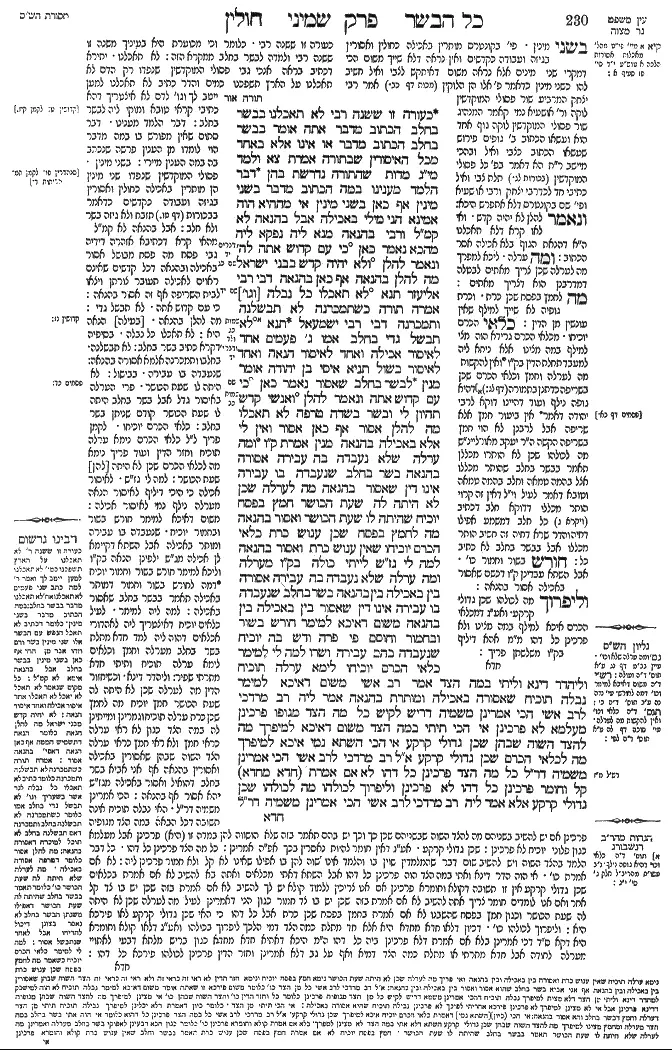
Hullin 115b - Guemara
כעורה זו ששנה רבי לא תאכלנו בבשר בחלב הכתוב מדבר אתה אומר בבשר בחלב הכתוב מדבר או אינו אלא באחד מכל האיסורין שבתורה אמרת צא ולמד מי"ג מדות שהתורה נדרשת בהן דבר הלמד מענינו במה הכתוב מדבר בשני מינין אף כאן בשני מינין אי מההיא הוה אמינא הני מילי באכילה אבל בהנאה לא קמ"ל ורבי בהנאה מנא ליה נפקא ליה מהכא נאמר כאן (דברים יד, ב) כי עם קדוש אתה לה' ונאמר להלן (דברים כג, יח) ולא יהיה קדש בבני ישראל מה להלן בהנאה אף כאן בהנאה דבי רבי אליעזר תנא (דברים יד, כא) לא תאכלו כל נבלה [וגו'] אמרה תורה כשתמכרנה לא תבשלנה ותמכרנה דבי רבי ישמעאל תנא (שמות כג, יט) לא תבשל גדי בחלב אמו ג' פעמים אחד לאיסור אכילה ואחד לאיסור הנאה ואחד לאיסור בשול תניא איסי בן יהודה אומר מנין לבשר בחלב שאסור נאמר כאן (דברים יד, ב) כי עם קדוש אתה ונאמר להלן (שמות כב, ל) ואנשי קדש תהיון לי ובשר בשדה טרפה לא תאכלו מה להלן אסור אף כאן אסור ואין לי אלא באכילה בהנאה מנין אמרת ק"ו ומה ערלה שלא נעבדה בה עבירה אסורה בהנאה בשר בחלב שנעבדה בו עבירה אינו דין שאסור בהנאה מה לערלה שכן לא היתה לה שעת הכושר חמץ בפסח יוכיח שהיתה לו שעת הכושר ואסור בהנאה מה לחמץ בפסח שכן ענוש כרת כלאי הכרם יוכיחו שאין ענוש כרת ואסור בהנאה למה לי גז"ש לייתי כולה בק"ו מערלה ומה ערלה שלא נעבדה בה עבירה אסורה בין באכילה בין בהנאה בשר בחלב שנעבדה בו עבירה אינו דין שאסור בין באכילה בין בהנאה משום דאיכא למימר חורש בשור ובחמור וחוסם פי פרה ודש בה יוכיח שנעבדה בהם עבירה ושרו למה לי למימר כלאי הכרם יוכיחו לימא ערלה תוכיח וליהדר דינא וליתי במה הצד אמר רב אשי משום דאיכא למימר נבלה תוכיח שאסורה באכילה ומותרת בהנאה אמר ליה רב מרדכי לרב אשי הכי אמרינן משמיה דריש לקיש כל מה הצד מגופו פרכינן מעלמא לא פרכינן אי הכי תיתי במה הצד משום דאיכא למיפרך מה להצד השוה שבהן שכן גדולי קרקע אי הכי השתא נמי איכא למיפרך מה לכלאי הכרם שכן גדולי קרקע א"ל רב מרדכי לרב אשי הכי אמרינן משמיה דר"ל כל מה הצד פרכינן כל דהו לא אם אמרת (חדא מחדא) קל וחומר פרכינן כל דהו לא פרכינן וליפרוך לכולהו מה לכולהו שכן גדולי קרקע אלא אמר ליה רב מרדכי לרב אשי הכי אמרינן משמיה דר"ל
Comments from Rashi on Masechet Hullin Page 115b
כעורה זו ששנה רבי . כלומר וכי מכוערת היא בעיניך משנה זו ששנה רבי ולמדה לבשר בחלב ממקרא הזה: לא תאכלנו . יתירא דכתיב בראה אנכי גבי פסולי המוקדשין שנפדו (דברים יב, טז) רק הדם לא תאכלנו על הארץ תשפכנו כמים והדר כתיב (דברים יב, כה) לא תאכלנו למען ייטב לך וגו' לדם לא איצטריך דהא כתיבי קראי טובא ומוקי ליה לבשר בחלב: דבר הלמד מענינו . דבר סתום שאין מפורש בו במה מדבר הוי לומדו מן הענין פרשה שנכתב בה במה הענין מיירי: בשני מינין . פסולי המוקדשין שנפדו שני מינין הן מותרין באכילה כחולין ואסורין בגיזה ועבודה כקדשים כדאמר בבכורות (דף טו.) תזבח ולא גיזה בשר ולא חלב: אבל בהנאה לא קמ"ל . מהאי קרא דכתיבא אזהרה דידיה גבי פסח מה פסח מבושל אסור באכילה ובהנאה דכל קדשים שאינם ראוים לאכילה תעובר צורתן ויצאו לבית השריפה אף זה אסור בהנאה: כי עם קדוש אתה . לא תבשל גדי: מה להלן בהנאה . [בעילה] הנאה היא: לא תאכלו כל נבלה . בסיפיה דקרא כתיב בשר בחלב: לא תבשלנה . בחלבו ותמכרנה אלמא אסורה בהנאה: שנעבדה בו עבירה . בבישול: לא היתה לו שעת הכושר . פרי הערלה באיסור גדל אבל בשר בחלב היתה לו שעת הכושר קודם שניתן בשר בחלב: כלאי הכרם יוכיחו . לקמן פריך ל"ל כלאי הכרם נימא ערלה תוכיח וחזר הדין ועוד פריך נימא מה לכלאי הכרם שכן לא היתה [להן] שעת הכושר: למה לי גז"ש . לאיסור אכילה כי היכי דיליף לאיסור הנאה מערלה נילף נמי לאיסור אכילה: משום דאיכא למימר חורש בשור ובחמור יוכיח . שנעבדה בו עבירה ומותר באכילה אבל השתא דקיימא לן אכילה מג"ש ילפינן הנאה בק"ו וליכא למימר חורש בשור וחמור יוכיח דמה לחורש בשור וחמור דמותר באכילה תאמר בבשר בחלב שאסור באכילה: למה ליה למימר . לעיל כלאים יוכיח דאיצטריך ליה לאהדורי אכלאים דהוה ליה למד חדא מתלת בשר בחלב מערלה וחמץ וכלאים לימא ערלה תוכיח ותיתי חדא מתרתי שפיר: וליהדר דינא . וכשיחזור הדין מה לערלה שכן לא היתה לה שעת הכושר חמץ יוכיח מה לחמץ שכן כרת ערלה תוכיח וגמרינן ומייתינן לה במה הצד כגון לא ראי ערלה כראי חמץ ולא ראי חמץ כראי ערלה הצד השוה שבהן שאסורין באכילה ואסורין בהנאה אף אני אביא בשר בחלב דהואיל ואסור באכילה מגז"ש יהא אסור אף בהנאה: הכי אמרינן משמיה דר"ל . האי נבלה תוכיח אינה תשובה דכל הבאה במה הצד מגופיה פרכינן אם יש להשיב בשניהם מה להצד השוה שבשניהם שכן כך וכך יש בהם תאמר בזה שלא הושווה להן במדה זו (היא) פרכינן אבל מעלמא כגון פלוני יוכיח לא פרכינן: שכן גדולי קרקע . אע"ג דאין חומר להיות נאסרין בכך אפ"ה אמרינן: כל מה הצד פרכינן כל דהו . כל דבר הלמד בהצד השוה ויש להשיב שום דבר שהמלמדין שוין בו והלמד אינו שוה להן בו אפילו שאינו לא קל ולא חמור פרכינן ליה: לא אם אמרת כו' . אי הוה הדר דינא ואתי במה הצד הוה פרכינן כל דהו אבל השתא דאתי מכלאים ואתה בא להשיב לא אם אמרת בכלאים שכן גדולי קרקע אין זו תשובה דקולא וחומרא פרכינן אם אנו צריכין ללמוד קולא יש לך להשיב לא אם אמרת בזה שכן יש בו צד קל אחר ואם אנו לומדים חומר צריך אתה להשיב לא אם אמרת בזה שכן יש בו צד חמור כגון הני דאמרינן לעיל מה לערלה שכן לא היתה לה שעת הכושר וכגון חמץ בפסח שהשבנו לא אם אמרת בחמץ בפסח שכן כרת אבל כל דהו כי האי שכן גדולי קרקע לאו פירכא היא: וליפרוך לכולהו כו' . דכיון דלאו חדא מחדא היא אלא חד מתלת כמה הצד דמי הלכך ליפרוך בכולהו ואע"ג דלאו קולא וחומרא היא דקא ס"ד דכי אמרינן בלא אם אמרת דלא פרכינן ביה כל דהו ה"מ היכא דאתיא חדא מחדא כגון בריש מלתא דבעי לאתויי מערלה לחודה אבל חדא מתרתי או מתלת כמה הצד דמיא ואף על גב דלא אמרינן וחזר הדין פרכינן לכולהו פירכא כל דהו:
Comments from Tosafot - Hullin 115b
בשני מינין . פי' בקונטרס מותרין באכילה כחולין ואסורין בגיזה ועבודה כקדשים ואין נראה דלא שייך משום הכי דמקרי שני מינים אלא נראה משום דאיתקש לצבי ואיל חשיב להו כשני מינין כדאמר פ' אלו הן הלוקין (מכות דף כב.) אמר רבי יצחק המרביע שור פסולי המוקדשין לוקה ור' אושעיא נמי קאמר המנהיג שור פסולי המוקדשין לוקה גוף אחד הוא ועשאו הכתוב ב' גופים פירוש שעשאו הכתוב כצבי ואיל ובהכי מיישב ר"ת הא דאמר בפ' כל פסולי המוקדשין (בכורות לג.) תלת צבי ואיל כתיבי חד לכדרבי יצחק ורבי אושעיא ופי' שם בקונטרס דלא אתפרש היכא: ונאמר להלן לא יהיה קדש . ואי לאו קרא דלא תאכלנו ה"א דהנאת הגוף בלא אכילה אסר הכתוב: ומה ערלה . ליכא למפרך מה לערלה שכן צריך מאתים לבטלה דמדרבנן הוא דצריך מאתים: מה לחמץ בפסח שכן כרת . וכרת גופיה לא שייך למילף שאין עונשין מן הדין: כלאי הכרם יוכיחו . מכלאי הכרם גרידא הוה מצי למילף במה מצינו אלא ניחא ליה למעבד תחלת הדין בק"ו ואין להקשות מה לערלה וחמץ וכלאי הכרם שכן בשריפה כדתנן בתמורה (דף לג:) דהיא גופה נילף ועוד דהיינו דוקא לרבי יהודה דאמר אין ביעור חמץ אלא שריפה אבל לרבנן לא הוי חמץ בשריפה הקשה ה"ר יעקב מאורליינ"ש מה לכולהו שכן לא הותרו מכללן תאמר בבשר בחלב שהותר מכללו אצל בהמה טמאה וחלב בהמה טמאה וטובא דאמר לעיל וי"ל דאין זה קרוי הותר מכללו דדוקא חלב דכתיב (ויקרא ג) כל חלב דמשמע אפילו דחיה והדר שרא דחיה זה חשיב הותר מכללו אבל בבשר בחלב לא כתיב כל: חורש בשור וחמור כו' . אבל השתא עבדינן ק"ו דכשם שאסור באכילה אסור בהנאה: וליפרוך מה לכולהו שכן גדולי קרקע . ואע"ג דמכלאי הכרם איכא למילף במה מצינו ולא פרכינן כל דהו מ"מ אהא דיליף בק"ו משלשתן פריך:
Hullin 115b - Mishnah translated into english
Is that derivation that Rabbi Yehuda HaNasi taught ugly, that you derive a new one? The verse states with regard to an animal’s blood: “You shall not eat it; you shall pour it upon the earth as water” (Deuteronomy 12:24), and the next verse adds: “You shall not eat it; that it may go well with you, and with your children after you.” Rabbi Yehuda HaNasi teaches that the redundant second verse is not referring to the prohibition of blood. Rather, the verse is speaking of the prohibition of meat cooked in milk, teaching that it is prohibited for consumption.
Do you say that the verse is speaking of the prohibition of meat cooked in milk? Or perhaps it is only referring to one of the other prohibitions in the Torah? You say: Go out and learn from the thirteen hermeneutical principles, one of which is: A matter that is derived from its context. To what are the adjacent verses referring? They are referring to consecrated animals that were redeemed, which are a combination of two types: They are non-sacred in that they may be eaten, but they are prohibited for shearing and work, like consecrated animals. Here too, one may conclude that the verse is referring to a prohibition that involves two types of food, i.e., the prohibition of meat cooked in milk.
Reish Lakish replied to Rabbi Yoḥanan: My exposition is still necessary, since if the source for the prohibition of eating meat cooked in milk were from that verse cited by Rabbi Yehuda HaNasi alone, I would say that this statement applies only to the prohibition of eating meat cooked in milk, but not to that of deriving benefit from it. The verse cited with regard to the Paschal offering teaches us that even deriving benefit is prohibited, just as it is prohibited to derive benefit from a disqualified Paschal offering.
The Gemara asks: And Rabbi Yehuda HaNasi, from where does he derive that meat cooked in milk is prohibited for benefit? The Gemara responds: He derives it from here, as it is stated here: “For you are a sacred [kadosh] people unto the Lord your God. You shall not cook a kid in its mother’s milk” (Deuteronomy 14:21). And it is stated below: “Neither shall there be a sodomite [kadesh] of the sons of Israel” (Deuteronomy 23:18). The similar expressions teach that just as below, the prohibition of sodomy is a prohibition that involves enjoyment, i.e., deriving benefit, not eating, so too here, meat cooked in milk is prohibited with regard to deriving benefit.
The school of Rabbi Eliezer taught: The verse states: “You shall not eat of any animal carcass; you may give it to the stranger who is within your gates, that he may eat it; or you may sell it to a foreigner; for you are a sacred people to the Lord your God; you shall not cook a kid in its mother’s milk” (Deuteronomy 14:21). The Torah stated the prohibition of meat cooked in milk after the halakha of an animal carcass to teach that when you sell a carcass to a gentile, you shall not cook it in milk and then sell it, i.e., meat cooked in milk is prohibited for benefit and may not be sold.
The school of Rabbi Yishmael taught: The Torah states three times: “You shall not cook a kid in its mother’s milk” (Exodus 23:19, 34:26; Deuteronomy 14:21). One verse serves to teach the prohibition against eating meat cooked in milk, and one serves to teach the prohibition against deriving benefit from it, and one serves to teach the prohibition against cooking meat in milk.
It is taught in a baraita: Isi ben Yehuda says: From where is it derived that it is prohibited to eat meat cooked in milk? It is stated here: “For you are a sacred people unto the Lord your God. You shall not cook a kid in its mother’s milk” (Deuteronomy 14:21). And it is stated below: “And you shall be sacred men unto Me; therefore you shall not eat any flesh that is torn of animals in the field [tereifa]; you shall cast it to the dogs” (Exodus 22:30). Just as below it is prohibited to eat a tereifa, so too here it is prohibited to eat meat cooked in milk.
And from this I have derived only that it is prohibited for consumption. From where do I derive that it is prohibited for benefit as well? You can say it can be derived by an a fortiori inference: Just as with regard to the prohibition against eating the fruit of a tree during the first three years after its planting [orla], which is treated less stringently as no sin has been committed in the planting of the tree and its production of fruit, it is prohibited for benefit, is it not right that meat cooked in milk, with regard to which a sin has been committed, should be prohibited for benefit?
The Gemara rejects this, as orla exhibits a unique stringency: What is unique about orla? It is unique in that it never had a time when it was fit. The same cannot be said about meat and milk, which were each permitted on their own before being cooked together.
The Gemara suggests: Let leavened bread on Passover prove the point, as it had a time when it was fit, before Passover, and yet it is prohibited for benefit. The Gemara rejects this inference as well: What is unique about consumption of leavened bread on Passover? It is unique in that it is punishable by karet, unlike the prohibition of meat cooked in milk.
The Gemara comments: Let the prohibition of diverse kinds in a vineyard prove the point, as it is not punishable by karet, and yet it is prohibited to derive benefit from the product.
The Gemara asks: Why do I need both Isi ben Yehuda’s verbal analogy to teach the prohibition of consumption and the a fortiori inference to teach the prohibition of benefit? Let all of it, both the prohibition of consumption and the prohibition against deriving benefit, be derived by an a fortiori inference from orla: Just as orla, which is treated less stringently, as no sin has been committed in the tree’s planting, is nevertheless prohibited both for consumption and for benefit; is it not right that meat cooked in milk, with regard to which a sin has been committed, should be prohibited both for consumption and for benefit?
The Gemara responds: That inference would be invalid because one could say: The cases of one who plows with an ox and with a donkey, and one who muzzles the mouth of a cow and threshes with it prove it invalid. As in those cases, a sin has been committed through them, and yet benefit from the products of these actions is permitted. One cannot refute a verbal analogy with logical reasoning.
The Gemara asks further: Why do I need to say, as was stated above, that the case of diverse kinds in a vineyard proves that benefit from meat and milk is prohibited? At that point, two other cases, orla and leavened bread on Passover, had already been offered as proof. Although they were rejected because they both possess a unique stringency, each lacks the stringency possessed by the other. Therefore, let us say that the case of orla proves that the stringency for consumption of leavened bread on Passover, i.e., the penalty of karet, is irrelevant, and vice versa. And let the inference revert to its starting point, and let the halakha with regard to meat cooked in milk be derived by analogy from the common element of the two sources, i.e., the prohibition against both consumption and benefit.
Rav Ashi said: Such a derivation cannot be suggested, because one can say that the case of an unslaughtered animal carcass proves it invalid, as an animal carcass is prohibited for consumption and yet it is permitted for benefit.
Rav Mordekhai said to Rav Ashi: We say in the name of Reish Lakish as follows: For any analogy derived from the common element of two sources, one can refute the analogy only by invoking conflicting details of the two sources themselves, e.g., here, some stringency shared by orla and leavened bread, but not by meat cooked in milk. One cannot refute the analogy from an external case, as you do.
The Gemara asks: If so, then the question remains: Why not let the halakha be derived by analogy from the common element of orla and leavened bread on Passover? The Gemara responds: Because the analogy can be refuted as follows: What is unique about the common element of orla and leavened bread? It is unique in that they both involve produce that grows from the ground, whereas meat and milk do not grow from the ground.
The Gemara counters: If so, then even now that the Gemara has invoked diverse kinds in a vineyard to prove the point, the derivation can be refuted in the same manner: What is unique about the prohibition of diverse kinds in a vineyard? It is unique in that it involves produce that grows from the ground.
Rav Mordekhai said to Rav Ashi: We say in the name of Reish Lakish as follows: For any analogy derived from the common element of two sources, one can refute the analogy by invoking any factor shared by the two source cases but not by the target case. But this is insufficient to refute an analogy to a single source from a single source using the standard formulation: No, if you say the halakha applies to the source case, which possesses a unique factor X, must you say the same of the target case, which does not? One can refute such analogies using this formulation only by way of an a fortiori inference, i.e., if the unique factor X is a stringency. But one cannot refute it by simply mentioning any unique factor, e.g., that diverse kinds in a vineyard grow from the ground.
The Gemara counters: But one need not invoke the case of diverse kinds in a vineyard by itself, since it is invoked in addition to the cases of orla and leavened bread. Consequently, this is effectively a derivation from the common element of all three sources, not from one single case to another. If so, let us refute the derivation from all of them: What is unique about all of the cases? They are unique in that they involve produce that grows from the ground.
Rather, Rav Mordekhai said to Rav Ashi: We say in the name of Reish Lakish as follows:
Traduction : The William Davidson digital edition of the Koren Noé Talmud, with commentary by Rabbi Adin Even-Israel Steinsaltz.