 Talmud Bavli
The learning on the whole site is dedicated : L'ilui Nishmat Ledicia bat David Banoun
The learning on the whole site is dedicated : L'ilui Nishmat אסתר בת חיים
The learning on the whole site is dedicated : L'ilui Nishmat Chemouel Eliezer ben Batcheva
Bava Metzia 18b : Youtube
Daf TubeYoutube
1 video class :
Bava Metzia Page 18b
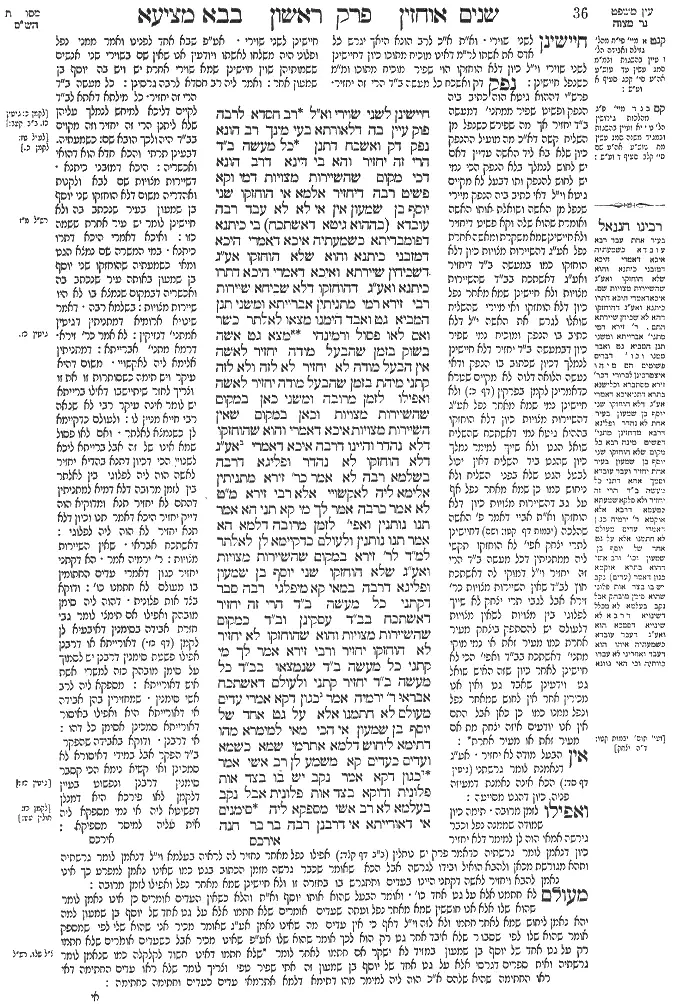
Bava Metzia 18b - Guemara
חיישינן לשני שוירי וא"ל רב חסדא לרבה פוק עיין בה דלאורתא בעי מינך רב הונא נפק דק ואשכח דתנן כל מעשה ב"ד הרי זה יחזיר והא בי דינא דרב הונא דכי מקום שהשיירות מצויות דמי וקא פשיט רבה דיחזיר אלמא אי הוחזקו שני יוסף בן שמעון אין אי לא לא עבד רבה עובדא (בההוא גיטא דאשתכח) בי כיתנא דפומבדיתא כשמעתיה איכא דאמרי היכא דמזבני כיתנא והוא שלא הוחזקו אע"ג דשכיחין שיירתא ואיכא דאמרי היכא דתרו כיתנא ואע"ג דהוחזקו דלא שכיחא שיירות רבי זירא רמי מתניתין אברייתא ומשני תנן המביא גט ואבד הימנו מצאו לאלתר כשר ואם לאו פסול ורמינהי מצא גט אשה בשוק בזמן שהבעל מודה יחזיר לאשה אין הבעל מודה לא יחזיר לא לזה ולא לזה קתני מיהת בזמן שהבעל מודה יחזיר לאשה ואפילו לזמן מרובה ומשני כאן במקום שהשיירות מצויות וכאן במקום שאין השיירות מצויות איכא דאמרי והוא שהוחזקו דלא נהדר והיינו דרבה איכא דאמרי אע"ג דלא הוחזקו לא נהדר ופליגא דרבה בשלמא רבה לא אמר כר' זירא מתניתין אלימא ליה לאקשויי אלא רבי זירא מ"ט לא אמר כרבה אמר לך מי קא תני הא אמר תנו נותנין ואפי' לזמן מרובה דלמא הא אמר תנו נותנין ולעולם כדקיימא לן לאלתר למ"ד לר' זירא במקום שהשיירות מצויות ואע"ג שלא הוחזקו שני יוסף בן שמעון ופליגא דרבה במאי קא מיפלגי רבה סבר דקתני כל מעשה ב"ד הרי זה יחזיר דאשתכח בב"ד עסקינן וב"ד כמקום שהשיירות מצויות והוא שהוחזקו לא יחזיר לא הוחזקו יחזיר ורבי זירא אמר לך מי קתני כל מעשה ב"ד שנמצאו בב"ד כל מעשה ב"ד יחזיר קתני ולעולם דאשתכח אבראי ר' ירמיה אמר כגון דקא אמרי עדים מעולם לא חתמנו אלא על גט אחד של יוסף בן שמעון אי הכי מאי למימרא מהו דתימא ליחוש דלמא אתרמי שמא כשמא ועדים כעדים קא משמע לן רב אשי אמר כגון דקא אמר נקב יש בו בצד אות פלונית ודוקא בצד אות פלונית אבל נקב בעלמא לא רב אשי מספקא ליה סימנים אי דאורייתא אי דרבנן רבה בר בר חנה
Comments from Rashi on Masechet Bava Metzia Page 18b
חיישינן לשני שוירי . אע"פ שבא אחד לפנינו ואמר ממני נפל ופלוני היה משלחו לאשתו ויודעין אנו שאין שם בשוירי שני אנשים ששמותיהן שוין חיישינן שמא שוירי אחרת יש ויש בה יוסף בן שמעון אחר: ואמר ליה רב חסדא לרבה גרסינן: כל מעשה ב"ד הרי זה יחזיר . כל מילתא דאתא לב"ד לקיים דליכא למיחש לנמלך עליהן שלא ליתנן הרי זה יחזיר וזה מקוים בב"ד היה ולכך הובא שם: כשמעתיה . דבעינן תרתי והכא חדא הוא דהואי ואכשריה: היכא דמזבני כיתנא . דשיירות מצויות שם לבא ולקנות ואהדריה משום דלא הוחזקו שני יוסף בן שמעון בעיר שנכתב בה ולא חיישינן לומר יש עיר אחרת ששמה כזו: ואיכא דאמרי היכא דתרו כיתנא . במי המשרה שם נמצא הגט ומאי כשמעתיה שהוחזקו שני יוסף בן שמעון באותה עיר שנכתב בה ואכשריה דבמקום שנמצא בו לא היו שיירות מצויות: בשלמא רבה . דאמר שינויא ארומיא דמתניתין דגיטין אמתני' דנזיקין: לא אמר כר' זירא . דרמא מתני' אברייתא: דמתניתין אלימא ליה לאקשויי . משום דהיא עיקר ויש תימה כשסותרות זו את זו וצריך לחזר שיתיישבו דאילו ברייתא יש לומר אינה עיקר רבי לא שנאה רבי חייא מניין לו: ולעולם כדקיימא לן כשנמצא לאלתר . ואם לאו פסול שמא אינו של זה אבל ברייתא ליכא לשנויי הכי דכיון דתנא בהדיא יחזיר לאשה הוה ליה לפלוגי בין לאלתר בין לזמן מרובה דלא דמיא למתניתין דהתם לא יחזיר תנא ומדוקיא הוה דייק יחזיר היכא דאמר תנו וכיון דלא תנא יחזיר לא הוה ליה לפלוגי: דאשתכח אבראי . שאין השיירות מצויות: ר' ירמיה אמר . הא דקתני יחזיר כגון דאמרי עדים החתומין בו מעולם לא חתמנו כו': ודוקא בצד אות פלונית . דהוה ליה סימן מובהק ואפילו אם תימצי לומר גבי חזרת אבידה בסימנין דאיבעיא לן לקמן (בבא מציעא דף כז.) דאורייתא או דרבנן אפילו פשטת סימנין דרבנן יש לסמוך על סימן מובהק כזה למשרי אשת איש דאורייתא: מספקא ליה לרב אשי סימנין . שמחזירין בהן אבידה אי דאורייתא היא ואפילו באיסור דאורייתא סמכינן אסימן כל דהו: אי דרבנן . ודוקא באבידה שהפקר ב"ד הפקר אבל במידי דאיסורא לא סמכינן ואי קשיא נימא הכי קסבר סימנין דרבנן ונפשוט בעיין דלקמן לאו פירכא היא דמנלן דפשיטא ליה אי נמי מספקא ליה אית עליה למיסר מספיקא:
Comments from Tosafot - Bava Metzia 18b
חיישינן לשני שוירי . וא"ת א"כ לרב הונא היאך יגרש כל אדם את אשתו לר"מ דאינו מוכיח מתוכו כיון דחיישינן לשני שוירי וי"ל כיון דלא הוחזקו הוי שפיר מוכיח מתוכו ומ"מ כשנפל חיישינן: נפק דק ואשכח כל מעשה ב"ד הרי זה יחזיר . פרש"י דההוא גיטא הוה כתיב ביה הנפק ופשיט שפיר ממתני' דמעשה ב"ד יחזיר אך מה שפירש כשנפל מן השליח קשה דא"כ מה מועיל ההנפק כיון שלא בא ליד האשה עדיין דאם יש לחוש לנמלך בלא הנפק הכי נמי יש לחוש להנפק ותו דבעל לא מקיים גיטא וי"ל דאי כתיב ביה הנפק מיירי שנפל מן האשה ושואלת אותו האשה ואומרת שהוא שלה וקא פשיט דיחזיר ולא חיישינן שמא משקרת ומאשה אחרת נפל אע"ג דהשיירות מצויות כיון דלא הוחזקו כמו במעשה ב"ד דיחזיר ואע"ג דאשתכח בב"ד שהשיירות מצויות ולא חיישינן שמא מאחר נפל כיון דלא הוחזקו ואי מיירי שהשליח שואלו לגרש את האשה י"ל דלא כתיב בו הנפק ומוכיח נמי שפיר כיון דבמעשה ב"ד יחזיר דלא חיישינן לנמלך דכיון שכתוב בו הנפק ודאי נעשה הלואה דלוה לא מקיים שטרא כדאמרינן לקמן בפרקין (בבא מציעא דף כ:) ולא חיישינן נמי שמא מאחר נפל אע"ג דהשיירות מצויות כיון דלא הוחזקו בההיא גיטא נמי דאשתכח שהשליח שואל הגט ולא שייך למימר נמלך כיון שהגט ביד השליח דאין יכול לבטל הגט שלא בפני השליח ולא ניחוש כמו כן שמא מאחר נפל אף על גב דהשיירות מצויות כיון דלא הוחזקו וא"ת אביי דאמר פ' האשה שהלכה (יבמות דף קטו: ושם) דחיישינן לתרי יצחק אפי' לא הוחזקו תקשי ליה ממתניתין דכל מעשה ב"ד הרי זה יחזיר וי"ל דמוקי לה דאשתכח חוץ לב"ד שאין השיירות מצויות כר' זירא אבל לגבי תרי יצחק לא שייך לפלוגי בין מצויות לשאין מצויות דלעולם יש להסתפק ביצחק מעיר אחרת כמו מעיר זאת אי נמי מוקי מתני' דאשתכח בב"ד ואפי' הכי לא חיישינן לאחר כיון שזה האיש שואל גט וידעינן שאבד גט ואין אנו מכירין אחר אין לחוש שמאחר נפל ונפל ממנו כמו כן כאן אבל התם אין אנו יודעים איזה יצחק מת אם מעיר זאת או מעיר אחרת: אין הבעל מודה לא יחזיר . אע"ג דנאמנת לומר גרשתני (גיטין דף סד:) הכא אינה נאמנת דמעיזה פניה כיון דהגט מסייעה: ואפילו לזמן מרובה . תימה כיון שמודה שממנה נפל וכבר גירשה אמאי הוה לן למימר דלא יחזיר כיון דנאמן לומר גרשתיה כדאמר פרק יש נוחלין (ב"ב דף קלד:) אפילו נפל מאחר נחזיר לה לראיה בעלמא וי"ל דנאמן לומר גרשתיה ותהא מגורשת מכאן ולהבא הואיל ובידו לגרשה אבל הכא שאומר שכבר גרשה מזמן הכתוב בגט כמו שאינו נאמן למפרע כך אינו נאמן להבא ויחזיר לאשה דקתני היינו בעדים ותתגרש בו בחזרה זו ולא חיישינן שמא מאחר נפל ואפילו לזמן מרובה: מעולם לא חתמנו אלא על גט אחד כו' . ואומר הבעל שהוא אותו יוסף וא"ת והלא כשאין העדים אומרים כן אינו נאמן לומר שהוא שלו אלא אנו חוששין שמא מאחר נפל ועתה שעדים אומרים שלא חתמו אלא על גט אחד של יוסף בן שמעון למה יהא נאמן ליחוש שמא לאחר חתמו ולא לזה וי"ל דאף כי אין עדים מה שאינו נאמן אע"ג שאומר מכיר אני שהוא שלי לפי שמספק אומר שהוא שלו לפי שסבור שלא איבד אחר גט רק הוא לכך אומר שהוא שלו אע"פ שאינו מכיר אבל כשעדים אומרים שלא חתמו רק על גט אחד של יוסף בן שמעון במזיד לא ישקר אם חתמו לאחר לומר שלא חתמו דאינו חשוד לקלקלה כמו שנאמן לומר גרשתיה ואית ספרים דגרסי אלא על גט אחד של יוסף בן שמעון זה אתי שפיר טפי וצריך לומר שלא ראו עדים החתימה דאי ראו החתימה שהיא שלהם א"כ הוה ליה למימר מהו דתימא דלמא אתרמאי עדים כעדים וחתימה כחתימה:
Bava Metzia 18b - Mishnah translated into english
We are concerned about the possibility that there are two cities named Sheviri and that this bill of divorce may belong to someone else who lives in the other Sheviri, and therefore it should not be returned. And Rav Ḥisda said to Rabba about this issue: Go out and examine this halakha, as in the evening Rav Huna will ask you about it. He went out, examined it, and discovered a relevant source, as we learned in a mishna (20a): One must return any court enactment, i.e., a promissory note that has been authenticated by the court, to its owner. Since the bill of divorce was found in the court, it is in this category and must be returned.
The Gemara concludes its proof that even in a place where passing caravans are common, the concern that the bill of divorce belongs to another couple applies only if it is known that there is another couple in the same locale with the same names as those written in the bill of divorce: And the court of Rav Huna is comparable to a place where passing caravans are common, as many people from different places pass through for judgment. And yet, Rabba resolved that if one finds a bill of divorce there, he should return it. Evidently he holds that if it is established that there are two people named Yosef ben Shimon in the city, then there is indeed a concern and the document should not be returned, but if not, there is no concern.
The Gemara relates that Rabba performed an action, i.e., issued a practical ruling, with regard to a certain bill of divorce that was found in a flax house in the city of Pumbedita, in accordance with his halakha, and he instructed that the bill of divorce should be returned.
There is disagreement as to the exact details of the case. There are those who say that this occurred in the place where people sell flax, and it is specifically because it was not established that two couples with the same names lived in the city where the bill of divorce was written that Rabba ruled that the bill of divorce should be returned despite the fact that passing caravans are common there.
And there are those who say that it occurred in the place where people soak flax, and he ruled that the bill of divorce should be returned even though it was established that there were two couples with the same names living in the city where the bill of divorce was written, as passing caravans are uncommon there.
Similarly, Rabbi Zeira raises a contradiction between the mishna and a baraita, and he resolves the contradiction employing the same distinction. We learned in the mishna: With regard to an agent who was bringing a bill of divorce to a woman and he lost it, if he found it immediately, the bill of divorce is still valid, but if not, it is not valid. And Rabbi Zeira raises a contradiction between this mishna and a baraita that states: If one found a woman’s bill of divorce in the marketplace, in a case when the husband admits that he wrote and gave it to the wife, the finder must return it to the wife; but if the husband does not admit to this, he may return it neither to this one, the husband, nor to that one, the wife.
In any event, the baraita teaches that in a case when the husband admits that he wrote it, the finder must return it to the wife, and this is the halakha even if it was found after a long time.
And Rabbi Zeira answers that here, in the case of the mishna, the bill of divorce is valid only if it is found immediately, as it is a case where it is found in a place where passing caravans are common. And there, in the baraita, the bill of divorce can be returned even if it was found after a long time, as it is a case where it is found in a place where passing caravans are uncommon.
The Gemara compares the rulings of Rabba and Rabbi Zeira. There are those who say, with regard to Rabbi Zeira’s statement that the finder should not return the bill of divorce in a place where passing caravans are common: And this applies specifically in a case where it is established that there are two couples in the town with the same names. In that case, Rabbi Zeira holds that the bill of divorce should not be returned, and this is the same ruling as that of Rabba. And there are those who say: In a place where passing caravans are common, even if it is not established that there are two couples with the same names, the bill of divorce should not be returned, and Rabbi Zeira disagrees with the ruling of Rabba.
The Gemara asks: Granted, Rabba does not state his explanation in accordance with that of Rabbi Zeira and raise a contradiction from the baraita, as he holds that a mishna serves as a stronger basis for raising a difficulty than a baraita, as the Mishna, redacted by Rabbi Yehuda HaNasi, employs more precise language; but what is the reason that Rabbi Zeira does not state his explanation in accordance with that of Rabba and raise a contradiction from the Mishna?
The Gemara answers: Rabbi Zeira could have said to you: Does the mishna actually teach that if the one who wrote the document says: Give it to the intended recipient, the finder must give it to him, and that this is the halakha even if a long time passed since it was lost? This was only an inference from the mishna. Perhaps the mishna merely means to indicate that if the writer says: Give it to the intended recipient, the finder must give it to him, but actually, this is to be understood as we maintain in the mishna in Gittin, that this halakha applies only if the document was found immediately. Therefore, Rabbi Zeira posed his question from the baraita.
The Gemara asks: According to the one who says that according to the opinion of Rabbi Zeira a document may not be returned in a place where passing caravans are common, and this is the halakha even if it was not established that there are two people named Yosef ben Shimon in town, and he disagrees with Rabba, with regard to what do Rabbi Zeira and Rabba disagree? What is the foundation of their dispute?
The Gemara answers: Rabba maintains his opinion based on the mishna (20a) that teaches: One must return any court enactment. He understands that we are dealing with a document that was found in court, and a court is equivalent to a place where passing caravans are common. And therefore, he maintains that it is specifically in a place where it is established that there are two people with the same name that the finder should not return the document to its presumed owner; but in a place where it is not established that there are two people with the same name, he should return it.
And Rabbi Zeira, who disagrees with Rabba, could have said to you: Does the mishna teach that one must return any court enactment that was found in court? It teaches that one must return any court enactment, without specifying the location where the court enactment was found, and it is actually referring to a case where the documents were found outside the court. If it was found inside the court, it should not be returned. Therefore, Rabbi Zeira was not convinced by Rabba’s proof.
Rabbi Yirmeya states an alternative resolution to the contradiction between the mishna here and the baraita, on the one hand, and the mishna in Gittin on the other: A found bill of divorce should be returned only in a case where the witnesses who signed the bill of divorce say: We have never signed a bill of divorce of a person named Yosef ben Shimon other than this one, in which case there is no concern that the bill of divorce belongs to someone else.
The Gemara asks: If that is so, what is the purpose of stating that one returns the bill of divorce? Since it clearly belongs to him, there is no question that it must be returned to him. The Gemara answers that it is necessary lest you say that one should be concerned that perhaps it happened that another bill of divorce was written in which the names of the husband and the wife are identical to the names of the husband and wife of the second bill of divorce, and the names of the witnesses on that bill of divorce are identical to the names of the witnesses on this bill of divorce, when in fact they are different witnesses. To counter this, the mishna teaches us that this is not a concern.
Rav Ashi stated another resolution to the contradiction: The bill of divorce should be returned only in a case where the person claiming to have lost it provides a clear-cut distinguishing mark, e.g., he says: There is a hole in the bill of divorce next to such and such a letter.
The Gemara comments: And Rav Ashi permits one to return such a bill of divorce specifically when the one claiming to have lost it says that the hole is next to such and such a letter, as that is a clear-cut distinguishing mark. But if he said only that it had a hole without mentioning its precise location, one should not return the bill of divorce, as that is not considered a clear-cut distinguishing mark.
The Gemara explains: Rav Ashi is uncertain whether a lost item is returned to its owner on the basis of distinguishing marks by Torah law or whether it is by rabbinic law. Therefore, in the case of a bill of divorce, he holds that one may rely only on a clear-cut distinguishing mark, as everyone agrees that a lost item is returned to its owner on the basis of a clear-cut distinguishing mark by Torah law.
The Gemara relates that Rabba bar bar Ḥana
Traduction : The William Davidson digital edition of the Koren Noé Talmud, with commentary by Rabbi Adin Even-Israel Steinsaltz.