 Talmud Bavli
The learning on the whole site is dedicated : L'ilui Nishmat Avraham Ben Simha
The learning on the whole site is dedicated : L'ilui Nishmat Chemouel Eliezer ben Batcheva
The learning on the whole site is dedicated : For the success of Elyahou ben H'anna & family
Bava Kamma 10b : Youtube
Daf TubeYoutube
2 video classes :
Bava Kamma Page 10b
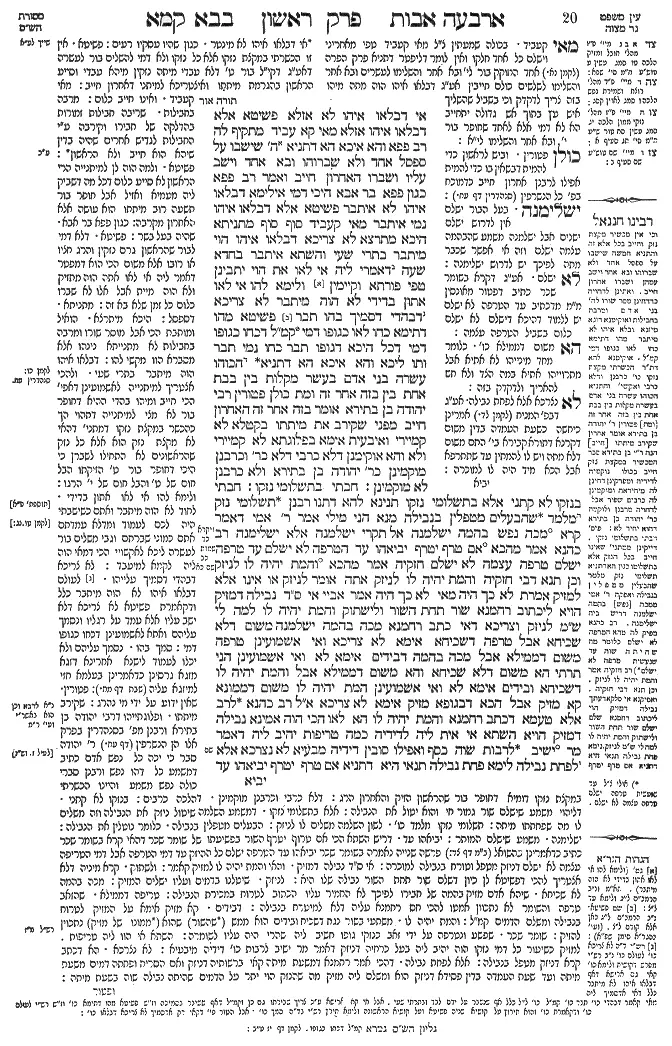
Bava Kamma 10b - Guemara
אי דבלאו איהו לא אזלא פשיטא אלא דבלאו איהו אזלא מאי קא עביד מתקיף לה רב פפא והא איכא הא דתניא ה' שישבו על ספסל אחד ולא שברוהו ובא אחד וישב עליו ושברו האחרון חייב ואמר רב פפא כגון פפא בר אבא היכי דמי אילימא דבלאו איהו לא איתבר פשיטא אלא דבלאו איהו נמי איתבר מאי קעביד סוף סוף מתניתא היכא מתרצא לא צריכא דבלאו איהו הוי מיתבר בתרי שעי והשתא איתבר בחדא שעה דאמרי ליה אי לאו את הוי יתבינן טפי פורתא וקיימין ולימא להו אי לאו אתון בדידי לא הוה מיתבר לא צריכא דבהדי דסמיך בהו תבר פשיטא מהו דתימא כחו לאו כגופו דמי קמ"ל דכחו כגופו דמי דכל היכא דגופו תבר כחו נמי תבר ותו ליכא והא איכא הא דתניא הכוהו עשרה בני אדם בעשר מקלות בין בבת אחת בין בזה אחר זה ומת כולן פטורין רבי יהודה בן בתירא אומר בזה אחר זה האחרון חייב מפני שקירב את מיתתו בקטלא לא קמיירי ואיבעית אימא בפלוגתא לא קמיירי ולא והא אוקימנן דלא כרבי דלא כר' וכרבנן מוקמינן כר' יהודה בן בתירא ולא כרבנן לא מוקמינן חבתי בתשלומי נזקו חבתי בנזקו לא קתני אלא בתשלומי נזקו תנינא להא דתנו רבנן תשלומי נזק מלמד שהבעלים מטפלין בנבילה מנא הני מילי אמר ר' אמי דאמר קרא (ויקרא כד, יח) מכה נפש בהמה ישלמנה אל תקרי ישלמנה אלא ישלימנה רב כהנא אמר מהכא (שמות כב, יב) אם טרף יטרף יביאהו עד הטרפה לא ישלם עד טרפה ישלם טרפה עצמה לא ישלם חזקיה אמר מהכא (שמות כא, לד) והמת יהיה לו לניזק וכן תנא דבי חזקיה והמת יהיה לו לניזק אתה אומר לניזק או אינו אלא למזיק אמרת לא כך היה מאי לא כך היה אמר אביי אי ס"ד נבילה דמזיק הויא ליכתוב רחמנא שור תחת השור ולישתוק והמת יהיה לו למה לי ש"מ לניזק וצריכא דאי כתב רחמנא מכה בהמה ישלמנה משום דלא שכיחא אבל טרפה דשכיחא אימא לא צריכא ואי אשמועינן טרפה משום דממילא אבל מכה בהמה דבידים אימא לא ואי אשמועינן הני תרתי הא משום דלא שכיחא והא משום דממילא אבל והמת יהיה לו דשכיחא ובידים אימא לא ואי אשמועינן המת יהיה לו משום דממונא קא מזיק אבל הכא דבגופא מזיק אימא לא צריכא א"ל רב כהנא לרב אלא טעמא דכתב רחמנא והמת יהיה לו הא לאו הכי הוה אמינא נבילה דמזיק הויא השתא אי אית ליה לדידיה כמה טריפות יהיב ליה דאמר מר (שמות כא, לד) ישיב לרבות שוה כסף ואפילו סובין דידיה מבעיא לא נצרכא אלא לפחת נבילה לימא פחת נבילה תנאי היא דתניא אם טרף יטרף יביאהו עד
Comments from Rashi on Masechet Bava Kamma Page 10b
פשיטא . ולמה הוה לן למיתנייה הרי הראשון לא סייע כלום דכל מה דשביק ליה מעמיא ואזיל אבל חופר בור תשעה רוב מיתתו הוא עושה אלא האחרון מקרבה: כגון פפא בר אבא . שהיה בעל בשר: פשיטא . דלא דמי לבור שהראשון גרם נזקין והרג חציו או רובו אלא משום הכי הוא דמפטר דאמר ליה אי לאו אתה הוה מתזיק ולא הוה מיית אבל אלו לא שברו כלום כל זמן שלא בא זה: מתניתא . דספסל: היכא מיתרצא . הואיל ומותבת הכי אבל מוסר שורו ומרבה בחבילות לא מתנייתא נינהו אלא מסברא הוו מקשי להו: דבלאו איהו הוה מיתבר בתרי שעי . ולהכי אצטריך למיתנייה לאשמועינן דאפי' הכי חייב ומיהו בהדי ההיא דחופר בור לא מצי למיתנייה דתהוי הך כהכשר במקצת נזקו דמתני' דהאי לא מקצת נזק הוא אלא כל נזק שהראשונים לא התחילו לשברן כי היכי דחופר בור ט' הזיקתו הבל חום של ט' והבל חום של י' הרגו: ולימא להו אי לאו אתון בדידי . לחוד לא הוה מיתבר ואתם כשישבתי היה לכם לעמוד ומדלא עמדתם אתם כמוני שברתם וגבי משלים בור לעשרה ליכא לאקשויי הכי דמאי הוה ליה לקמא למיעבד: לא צריכא דבהדי דסמיך עלייהו . לעולם דבלאו איהו לא הוה מיתבר כלל ודקאמרת פשיטא לא צריכא דלא ישב עליו אלא עמד על רגליו ונסמך עליהם ואתא לאשמועינן דכחו כגופו דמי: סמך בהו . נסמך עליהם ולא יכלו לעמוד לישנא אחרינא דזגא מזגא גרסינן כדאמרינן בעלמא חזי למיזגא עליה (שבת דף מח.): פטורין . שאין ידוע על ידי מי נהרג: שקירב מיתתו . ופלוגתייהו דרבי יהודה בן בתירא ורבנן מפ' בסנהדרין בפרק אלו הן הנשרפין (דף עח.) ר' יהודה סבר כי יכה כל נפש אדם כתיב דמשמע כל דהו נפש ורבנן סברי כולה נפש משמע והיינו הכשרתי במקצת נזקו דומיא דחופר בור שהראשון הזיק והאחרון הרג: דלא כרבי וכרבנן מוקמינן . דהלכה כרבים: בנזקו לא קתני . דליהוי משמע שישלם שור גמור חי והוא יטול את הנבילה: אלא בתשלומי נזקו . דמשמע השלמה שיטול ניזק את הנבילה וזה משלים לו מה שפחתתו מיתה: תשלומי נזקו מלמד כו' . לשון השלמה משלים לו לניזק: הבעלים מטפלין בנבילה . כלומר נוטלין את הנבילה: ישלימנה . משמע שישלם המותר: יביאהו עד . דריש השתא הכי אם טרוף יטרף השור בפשיעתו של שומר שכר דהאי קרא בשומר שכר כתיב כדאמרינן בהשואל (ב"מ דף צד:) פרשה שנייה נאמרה בשומר שכר יביאהו עד הטרפה ישלם כל ההיזק עד דמי הטרפה אבל דמי הטריפה עצמה לא ישלם דניזק מטפל וטורח בנבילה למוכרה: לניזק . שיטלנו בדמים ועליו ישלים המזיק: אי ס"ד נבילה דמזיק . והאי המת יהיה לו למזיק קאמר: ולשתוק . קרא מיניה דלא אצטריך להכי דפשיטא לן כיון דשלם שור תחת השור נבילה שלו היא: לניזק . שיטלנו בדמים ועליו ישלים המזיק: מכה בהמה לא שכיחא . שיהא אדם מזיק בהמה של חבירו לפיכך לא החמיר עליו הכתוב לטרוח במכירת הנבילה: טריפה דממילא . שהזאב טרפה והשומר לא נתכוון אמטו להכי חס רחמנא עליה דלא למיטרח בנבילה: דבידים . קא מזיק אימא על המזיק לטרוח בנבילה ומשלם הדמים קמ"ל: והמת יהיה לו . משתעי בשור נגח דשכיח ובידים הוא ממש (שהשור) שהוא (ממונו של מזיק) נתכוין להזיק: שומר שכר . שפשע ונטרפה על ידי זאב כנזקי גופו חשיב ליה שהרי היה עליו לשומרה: השתא אי הוו ליה טריפות . למזיק כשיעור כל דמי נזקו הוה יהיב ליה בעל כרחיה דניזק דאמר מר ישיב לרבות כו' דידיה מיבעיא: לא נצרכא . הא דכתב קרא דניזק מטפל בנבילה: אלא לפחת נבילה . דהכי אמר רחמנא דמשעת מיתה קאי ברשותיה דניזק ואם הסריח ופחתה דמים משעת מיתה ועד שעת העמדה בדין פסידא דניזק הוא ומשלם ליה מזיק מה שהנזק הוי יתר על הדמים שהיתה נבילה שוה בשעת מיתה:
Comments from Tosafot - Bava Kamma 10b
כגון פפא בר אבא . מפרש רשב"ם דנקט פפא בר אבא לפי שלסתם בני אדם הוא שאול לכל הבא מאיליו לישב עליה כי סתם ספסל עשוי לכך והוי כמתה מחמת מלאכה אבל פפא בר אבא שהוא משונה וכבד משאר בני אדם סתמא אין שאול לו ולפי' צ"ל כגון פפא בר אבא אכולהו קאי מדקאמר בסמוך דא"ל אי לאו את הוה יתבינן פורתא וקיימין משמע דאם היה נשבר היו חייבין ומיהו לפי המסקנא דמשני דבהדי דקסמך עלייהו אין צריך לפרש דחייב אלא אחרון בלבד ומתוך כך פטר ארבעה בני אדם שישבו על ספסל אחד של אלמנה ושברוהו והר"ר עזריאל חייב לשלם ור"ת מפרש דנקט פפא בר אבא משום דקאמר במסקנא דכחו כגופו דמי ודוקא פפא בר אבא שהוא אדם כבד ומתוך כבדו מונען לעמוד אבל שאר בני אדם שאין כבידין כל כך ואין סמיכתן מעכב מלעמוד אינהו נמי פשעו שלא עמדו וכולן חייבין ולפי זה צריך לומר דרב פפא עצמו בא לתרץ מה שהקשה ותו ליכא: מאי קעביד . בכולה שמעתין צ"ל מאי קעביד טפי מאחריני וישלם כל אחד חלקו ואין לומר דליפטר דתניא פרק הפרה (לקמן בבא קמא נא.) אחד החוקק בור לי' ובא אחר והשלימו לעשרים ובא אחר והשלימו לשלשים כולם חייבין אע"ג דבלאו איהו הוה מתה מיהו בזה צריך לדקדק וכי בשביל שהשליך איש עץ בתוך אש גדולה יתחייב הא לא דמי אלא לאחד שחופר בור י' ובא אחר והשלימו לי"א: כולן פטורין . וביש לראשון כדי להמית דבשאין בו כדי להמית אפילו לרבנן אחרון חייב כדמוכח בפ' כל הנשרפין (סנהדרין דף עח.): ישלימנה . בעל הבור ישלם אין לדרוש ישלם ישלים אבל ישלמנה משמע שהבהמה עצמה ישלם וזה אי אפשר שכבר מתה לפיכך יש לדרוש ישלימנה: לא ישלם . אע"ג דקרא בשומר שכר כתיב דפטור מאונסין מ"מ מדכתיב עד הטרפה לא ישלם יש ללמוד דהיכא דישלם לא ישלם כלום בשביל הטרפה עצמה: הא משום דממילא כו' . כלומר מחד מינייהו לא אתיא אבל מתרוייהו אתיא במה הצד ולא חש להאריך ולדקדק בזה: לא נצרכא אלא לפחת נבילה . אע"ג דבפ' המניח (לקמן בבא קמא לד.) אמרינן כיחשה כשעת העמדה בדין משום דקרנא דתורא קבירא בי' התם משום דלא מתה ויש לו להמתין עד שתתרפא אבל הכא מיד היה לו למוכרה:
Bava Kamma 10b - Mishnah translated into english
If the fire would not have spread to another person’s field without him adding bundles the fire, it is obvious that he alone is liable for the damage because he alone did everything that led to the damage. Rather, the case must be one where the fire would have spread even without him. The Gemara asks: But if that is the case, what did he do by adding bundles of wood? The fire would have spread without him, so he did not cause even part of the damage. It is apparent, then, that the mishna is not referring to this case.
Rav Pappa objects to the claim of the baraita that the mishna refers only to one specific case: But isn’t there also that which is taught in a baraita: With regard to a case in which five people were sitting on one bench [safsal] and it did not break, and then one additional person came and sat upon it and broke it with his added weight, the latter individual is liable for all the damage. And Rav Pappa said by way of clarification that this applies in a case where the last individual to sit down was as heavy as Pappa bar Abba. Since he could have potentially broken it even on his own, he had no right to use it. In this case, even though the weight of the first five individuals was presumably a contributing factor in causing the damage, since the damage was ultimately caused by the additional weight of the last individual, he is liable for all of the damage. Seemingly, this is an additional example of the mishna’s principle, and the baraita should have mentioned it.
The Gemara rejects this suggestion: What are the circumstances? If we say that without him the bench would never have broken under the weight of the first five people, then it is obvious that the last individual is liable for all the damage, as ultimately it was his action alone that caused the damage. Rather, it must be that even without him the bench would have broken under the weight of the first five people, and the last individual sat down just as it was about to break. The Gemara asks: But if that is the case, what did he do, i.e., why should he be liable at all? It is apparent, then, that the mishna is not referring to this case.
The Gemara asks: Ultimately, how is the baraita cited by Rav Pappa to be explained? As the Gemara explained, the ruling of the baraita is understandable only if it is referring to a case where the bench would not have broken without him. But if that is the case, as the Gemara noted, it is obvious and therefore unnecessary to state it.
The Gemara explains: No, it is necessary in a case where without him it would have broken in two hours, and now it broke in one hour. The baraita teaches that the last individual alone is liable and not the first five, as they can say to the last individual: Were it not for you, we would have sat a little bit more and then stood up; consequently, the bench would never have broken. Therefore, it was ultimately you who caused the bench to break, and therefore only you are liable.
The Gemara rejects this suggestion, because in that situation the last individual would have a valid counterclaim: But let him say to them: Were it not for you continuing to sit on the bench after I sat down, the bench would not have broken, as under my weight alone it would not have broken. Accordingly, we should share the liability for damaging it.
The Gemara offers a different suggestion: No, it is necessary in a case where instantaneously, as he was leaning upon the other five people, the bench broke.
The Gemara asks: If so, it is obvious that he alone is liable, as his action alone caused the damage, and the other five could not have done anything to prevent it as he was leaning upon them.
The Gemara explains: The ruling is necessary lest you say that when one causes damage with one’s direct force it is not equivalent to a situation where one causes damage with one’s body. If he broke the bench by actually sitting down upon it, his action would be considered a direct act of damage completed with his body and he alone would be liable even though the other peoples’ weight was a contributing factor. In this case, since he broke the bench by merely leaning upon the others sitting there, it is his force that led to the damage, not his body, and one might have thought that since the weight of the others certainly contributed to the breakage they should share liability. Therefore, the baraita teaches us that causing damage with one’s direct force is equivalent to causing damage with one’s body. And it teaches that the halakha is that anywhere that one would be liable if his body broke something, one is also liable if his force broke something.
The Gemara continues to consider the possibility that there are additional cases covered by the mishna’s ruling aside from the one listed in the baraita: And are there not more cases? But isn’t there also the case of that which is taught in a baraita: If one was beaten by ten people with ten sticks, whether they beat him simultaneously or one after the other, and he died, they are all exempt from liability for killing him. Rabbi Yehuda ben Beteira says: Where they beat him sequentially, the last individual to beat him alone is liable, because he hastened his death. In this case, the other individuals contributed to the man’s death, but the last one alone is liable. Why didn’t the baraita also mention this case?
The Gemara explains: The baraita is not speaking of one’s liability to receive the death penalty, only of one’s liability to pay damages.
And if you wish, say instead that the baraita is not speaking of an issue that is the subject of a dispute. The Gemara asks: But isn’t it? But didn’t we uphold that the case stated in the baraita concerning a pit is subject to a dispute, and it is not in accordance with the opinion of Rabbi Yehuda HaNasi, but of the Rabbis? The Gemara explains: We will interpret the baraita to be in accordance with the opinion of the Rabbis and not to be in accordance with the opinion of Rabbi Yehuda HaNasi, but we will not interpret it to be in accordance with the opinion of Rabbi Yehuda ben Beteira and not in accordance with the opinion of the Rabbis. In other words, although we will interpret the baraita as referring to a case that is subject to a dispute, that applies only if it is in accordance with the majority opinion in that dispute.
§ The mishna teaches: In any case in which I facilitated part of the damage it caused, I am liable for payments of restitution for damage it caused, as if I were the one who facilitated the entire damage. The Gemara notes that the mishna does not teach: I am liable for the damage it caused, rather: I am liable for payments of restitution for damage it caused. The Hebrew terms: Payments of restitution [tashlumim], and: To complete [lehashlim], share the same Hebrew root. This alludes to the halakha that the payment of damages is required only in order to complete the injured party’s compensation, which is already partially accounted for, as the injured party is able to recover his dead animal’s current value by selling its carcass. Accordingly, the one liable for the damage is not required to pay the animal’s prior value; rather, he must pay only the difference in its value from before it was damaged and its current state.
The Gemara notes: We already learned this, as the Sages taught in a baraita: The mishna uses the term: Payments of restitution for damage, as opposed to simply stating: One is liable for the damage caused, to allude to the halakha that the one who is liable must pay only for the decrease in the value of the animal. This assumes that the injured party is able to recover his animal’s current value by selling the carcass. Therefore, the mishna teaches that the owner of the injured animal attends to, i.e., retains ownership of, the animal carcass so that, if he wishes to, he may sell it and keep the proceeds.
The Gemara asks: From where are these matters derived? Rabbi Ami said: As the verse states: “One who strikes an animal shall pay for it [yeshallemenna]” (Leviticus 24:18). Do not read the final word yeshallemenna, meaning he shall pay for it; rather, read it as though it were vocalized as yashlimenna, meaning he shall complete it, to teach that he shall complete the injured party’s compensation, which is already partially accounted for by the injured party’s right to sell his animal’s carcass.
Rav Kahana said that this halakha is derived from here: The verse states with regard to a case where an animal was entrusted with a paid bailee who did not fulfill his duty to safeguard it, and the animal was attacked by a wild beast: “If it be torn in pieces, let him bring a witness, the torn animal he shall not pay” (Exodus 22:12). Rav Kahana expounds the verse to mean that he shall pay only up until the value of the torn animal; but he shall not pay for the torn animal itself. In other words, he pays only the difference in value between the animal before it was injured and its current torn state. If the owner of the injured animal wishes to fully recover his loss he must sell the animal’s carcass and keep the proceeds.
Ḥizkiyya said that this halakha is derived from here: The verse states with regard to a person’s ox that fatally gored another ox: “He shall pay an ox for the ox, and the carcass shall be his” (Exodus 21:36), meaning the carcass belongs to the injured party, the owner of the gored animal.
And similarly, the school of Ḥizkiyya taught in a baraita: The verse states: “And the carcass shall be his” (Exodus 21:36). The verse means the carcass belongs to the injured party. Do you say it belongs to the injured party? Or perhaps it belongs only to the one liable for the damage? To this suggestion, you should say: It could not have been that.
The Gemara asks: What does the baraita mean by: It could not have been that?
Abaye said: If it enters your mind to say that the animal carcass is the property of the one liable for the damage, let the Merciful One write: “He shall pay an ox for the ox,” and then be silent and state no more. Why do I need the verse to continue: “And the carcass shall be his”? Conclude from it that the carcass belongs to the injured party.
The Gemara notes: And it is necessary to have multiple sources for this halakha, as if the Merciful One wrote only: “One who strikes an animal shall pay for it,” I could claim that only in that case does one have to pay for only part of the damage because it is an uncommon occurrence. But in the case of a torn animal, which is a common occurrence, I will say that his liability should not be limited to the difference in value between what the animal had been worth and the carcass, but he should pay for the entire value of the injured animal. Therefore, it is necessary to explicitly state the halakha also in that case.
And if the Torah had taught us only the case of a torn animal, I could claim that only in that case does one have to pay for only part of the damage because the damage occurred by itself, i.e., it was not directly caused by the one liable for it. But in the case of one who strikes an animal, who does so by direct action, I will say that his liability should not be limited. Therefore, it is necessary to explicitly state the halakha also in that case.
And if the Torah had taught us only these two cases, I could claim that only in those cases does one have to pay for only part of the damage, this one because it is an uncommon occurrence, and that one because the damage occurred by itself. But in a case where one’s ox gores another’s ox, of which the Torah states: “And the carcass shall be his,” which is a common occurrence, and the damage is considered to have been inflicted by its owner’s direct action, since it was under his guard, I will say his liability should not be limited.
And if the Torah had taught us only the case in the verse “And the carcass shall be his,” I could claim that only in that case does one have to pay for only part of the damage because it is one’s property that causes damage. But here, in the case of one who strikes another’s animal, where one causes damage with one’s own body, I will say his liability should not be limited. Therefore, it is necessary to explicitly state the halakha in each case.
Rav Kahana said to Rav: But according to the statement of Ḥizkiyya, as explained by Abaye, the only reason the injured party retains ownership of the carcass is that the Merciful One wrote: “And the carcass shall be his,” but were it not for that I would say that the carcass is the property of the one liable for the damage.
Rav Kahana questions the need for the Torah to teach this: Now, if the one liable for the damage had in his possession the carcasses of several torn animals, he could give the injured party a carcass as payment, as the Master said above (7a): The verse states: “He shall recompense” (Exodus 21:34), to include items worth money, and even bran, a relatively inferior commodity, as valid items with which to pay restitution. Is it necessary for the Torah to teach that he can pay restitution with his, i.e., the injured party’s, animal carcass? Granting ownership of the carcass to the injured party seems pointless, because even had the Torah granted it to the one liable for the damage, he could give it to the injured party as payment.
The Gemara explains: It is necessary only for the issue of who sustains the loss due to the diminishing value of the carcass between its death and when the case is brought before the court. By granting ownership of the carcass to the injured party from the moment of the animal’s death, the Torah limits the damages to the difference between the value of the animal when it was alive and its value immediately after it is killed, irrespective of what happens to the carcass afterward.
The Gemara asks: Shall we say that the issue of the diminishing value of the carcass is a dispute between tanna’im? As it is taught in a baraita: The verse states with regard to a case where an animal was entrusted with a paid bailee and was attacked by a wild beast: “If it be torn in pieces, let him bring a witness [ed]” (Exodus 22:12).
Traduction : The William Davidson digital edition of the Koren Noé Talmud, with commentary by Rabbi Adin Even-Israel Steinsaltz.