 Talmud Bavli
Bava Kamma 13b : Youtube
Daf TubeYoutube
2 video classes :
Bava Kamma Page 13b
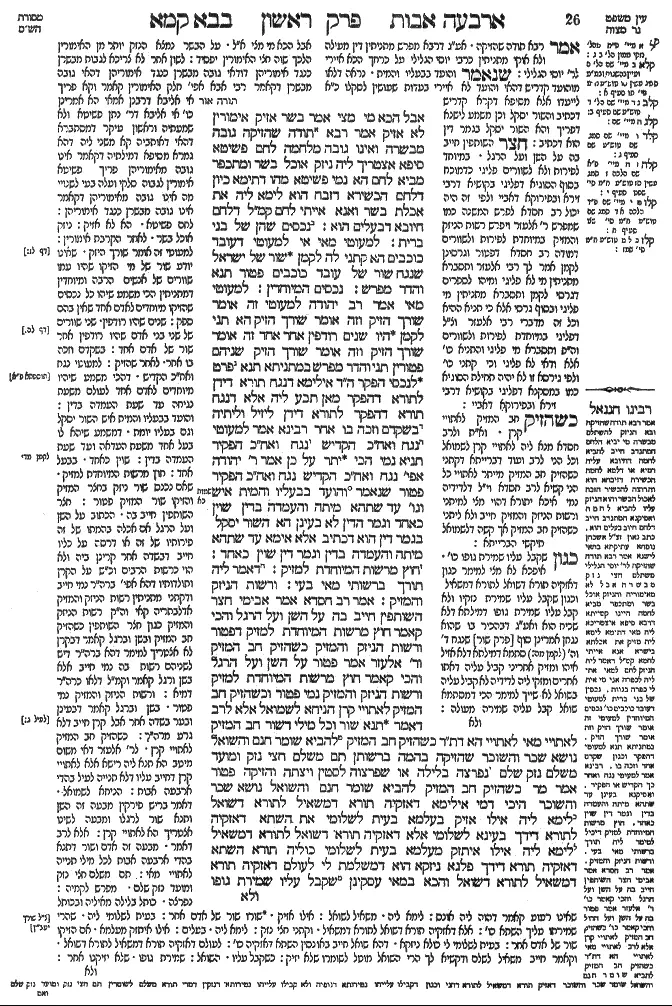
Bava Kamma 13b - Guemara
אבל הכא מי מצי אמר בשר אזיק אימורין לא אזיק אמר רבא תודה שהזיקה גובה מבשרה ואינו גובה מלחמה לחם פשיטא סיפא אצטריך ליה ניזק אוכל בשר ומתכפר מביא לחם הא נמי פשיטא מהו דתימא כיון דלחם הכשירא דזבח הוא לימא ליה את אכלת בשר ואנא אייתי לחם קמ"ל דלחם חיובא דבעלים הוא:
נכסים שהן של בני ברית:
למעוטי מאי אי למעוטי דעובד כוכבים הא קתני לה לקמן שור של ישראל שנגח שור של עובד כוכבים פטור תנא והדר מפרש נכסים המיוחדין למעוטי מאי אמר רב יהודה למעוטי זה אומר שורך הזיק וזה אומר שורך הזיק הא תני לקמן היו שנים רודפין אחר אחד זה אומר שורך הזיק וזה אומר שורך הזיק שניהם פטורין תני והדר מפרש במתניתא תנא פרט לנכסי הפקר ה"ד אילימא דנגח תורא דידן לתורא דהפקר מאן תבע ליה אלא דנגח תורא דהפקר לתורא דידן ליזיל וליתיה בשקדם וזכה בו אחר רבינא אמר למעוטי נגח ואח"כ הקדיש נגח ואח"כ הפקיר תניא נמי הכי יתר על כן אמר ר' יהודה אפי' נגח ואח"כ הקדיש נגח ואח"כ הפקיר פטור שנאמר (שמות כא, כט) והועד בבעליו והמית איש וגו' עד שתהא מיתה והעמדה בדין שוין כאחד וגמר הדין לא בעינן הא השור יסקל בגמר דין הוא דכתיב אלא אימא עד שתהא מיתה והעמדה בדין וגמר דין שוין כאחד:
חוץ מרשות המיוחדת למזיק:
דאמר ליה תורך ברשותי מאי בעי:
ורשות הניזק והמזיק:
אמר רב חסדא אמר אבימי חצר השותפין חייב בה על השן ועל הרגל והכי קאמר חוץ מרשות המיוחדת למזיק דפטור ורשות הניזק והמזיק כשהזיק חב המזיק ור' אלעזר אמר פטור על השן ועל הרגל והכי קאמר חוץ מרשות המיוחדת למזיק ורשות הניזק והמזיק נמי פטור וכשהזיק חב המזיק לאתויי קרן הניחא לשמואל אלא לרב דאמר תנא שור וכל מילי דשור חב המזיק לאתויי מאי לאתויי הא דת"ר כשהזיק חב המזיק להביא שומר חנם והשואל נושא שכר והשוכר שהזיקה בהמה ברשותן תם משלם חצי נזק ומועד משלם נזק שלם נפרצה בלילה או שפרצוה לסטין ויצתה והזיקה פטור אמר מר כשהזיק חב המזיק להביא שומר חנם והשואל נושא שכר והשוכר היכי דמי אילימא דאזקיה תורא דמשאיל לתורא דשואל לימא ליה אילו אזיק בעלמא בעית לשלומי את השתא דאזקיה לתורא דידך בעינא לשלומי אלא דאזקיה תורא דשואל לתורא דמשאיל לימא ליה אילו איתזק מעלמא בעית לשלומי כוליה תורא השתא דאזקיה תורא דידך פלגא ניזקא הוא דמשלמת לי לעולם דאזקיה תורא דמשאיל לתורא דשואל והכא במאי עסקינן שקבל עליו שמירת גופו
Comments from Rashi on Masechet Bava Kamma Page 13b
אבל הכא מי מצי א"ל . על הבשר נמצא הנזק יותר מן האימורין הלכך שוה חצי האימורין יפסיד: לשון אחר לא צריכא לגבות מבשרן כנגד אימוריהן . דודאי גובה מבשרן כנגד אימוריהן דהאי גובה מבשרן דקאמר רבי אבא אפי' חלק האימורין קאמר וקא פריך אי אליבא דרבנן אמאי הא אמרינן כו' אי אליבא דר' נתן פשיטא ולא שמעתיה וראשון עיקר דמסתברא דהאי דאותביה קא משני ליה דהא גמרא מסיפא דמילתיה דקאמר אינו גובה מאימוריהן פריך פשיטא אימורין לגבוה סלקי ועלה בעי לשנויי מה אינו גובה מאימוריהן דקאמר אינו גובה מבשרן כנגד אימוריהן: לחם פשיטא . הא לא אזיק: ניזק אוכל בשר . לאחר הקרבת אימורין: למעוטי זה אומר שורך היזק . שאינו יודע שור של מי הזיקו שהיו עמו שוורים של אנשים הרבה ומיוחדין דמתניתין הכי משמע שיהו כל נכסים שהזיקו מיוחדים לאדם אחד שאין בהם ספק: שנים שהיו רודפין . שני שוורים של שני בני אדם שהיו רודפין אחר שור של אדם אחד: בשקדם וזכה בו אחר . לאחר שהזיק: למעוטי נגח ואח"כ הקדיש . דהכי משמע שיהיו מיוחדים לאדם אחד לעולם משעת נגיחה עד שעת העמדה בדין: והועד בבעליו והמית איש השור יסקל וגם בעליו יומת . דמשמע שיהא לו בעל אחד משעת העדאה ועד שעת העמדה בדין: שוין כאחד . בבעל אחד: חוץ מרשות המיוחדת למזיק . שאם נכנס שור ניזק בחצר המזיק והזיקו שור המזיק פטור: חצר השותפין חייב בה . הכתוב על השן ועל הרגל אם אכלה בהמתו של זה פירותיו של זה או דרסה על כליו חייב דבשדה אחר קרינן ביה ולא הוי כרשות הרבים וכ"ש על הקרן ותולדותיו דהא אפי' ברה"ר נמי חייב ודקתני מתניתין רשות הניזק והמזיק אדלבתריה קאי וה"ק רשות הניזק והמזיק כגון חצר השותפין כשהזיק חב המזיק ובשן וברגל קאמר דבקרן לא אצטריך למימר דהא ברה"ר דיש לשניהם רשות בה נמי חייב אלא בשן ורגל קאמר וקמ"ל דלאו כרה"ר דמיא: ורשות הניזק והמזיק נמי פטור . בשן וברגל קאמר דבעינן ובער בשדה אחר אבל קרן חייב דלא גרע מרה"ר: כשהזיק חב המזיק לאתויי קרן . לר' אלעזר דאי משום מיטב הא תנא ליה רישא אלא לאתויי קרן דחייב עליו דלא תנייה לעיל בהדי ארבעה אבות: הניחא לשמואל . דאמר בריש פירקין מבעה זה השן ותנא שור לרגלו ומבעה לשינו אצטריך הא לאתויי קרן: אלא לרב דאמר . מבעה זה אדם ושור דתנא בהדי ארבעה אבות לכל מילי תנייה לאתויי מאי: תם משלם חצי נזק ומועד נזק שלם . מפרש לקמיה: נפרצה . כותל בלילה מאיליה ובכותל שאינו רעוע קאמר דהוה ליה אונס: לימא ליה . משאיל לשואל: אילו אזיק . שורו שור של אדם אחר: בעית לשלומי ליה . שהרי שמירתו עליך השתא כו': אלא דאזקיה תורא דשואל לתורא דמשאיל . וקתני חצי נזק: לימא ליה . בעלים: אילו איתזק מעלמא . אם הזיקו שור של אדם אחר: בעית לשלומי לי כולא ניזקא . דהא שואל חייב באונסין השתא דאזקיה כו': לעולם דאזקיה תורא דמשאיל לתורא דשואל . וקאמר חייב משאיל לשלם ודקשיא לך הרי השואל מוטל לשומרו שלא יזיק: כשקבל עליו . השואל: שמירת גופו . שלא יזיקנו אחר:
Comments from Tosafot - Bava Kamma 13b
אמר רבא תודה שהזיקה . אע"ג דרבא מפרש מתניתין דין מעילה ולא אוקי מתניתין כרבי יוסי הגלילי על כרחך הכא איירי לר' יוסי הגלילי: שנאמר והועד בבעליו והמית . נראה דלאו מוהועד קדריש דהאי והועד לא איירי בעדות שעושין לסקלו כ"א לייעדו אלא מסיפא דקרא קדריש דכתיב והשור יסקל וכן משמע לישנא דפריך והא השור יסקל בגמר דין הוא דכתיב: חצר השותפין חייב בה על השן ועל הרגל . במיוחד לפירות ולא לשוורים פליגי כדמוכח בסוף הסוגיא דפליגי בקושיא דרבי זירא ובפירוקא דאביי ולפי זה היה יכול רב חסדא לפרש המשנה כמו שמפרש ר' אלעזר ויפרש רשות הניזק והמזיק במיוחדת לפירות ולשוורים דמודה רב חסדא דפטור וגרסינן לקמן אמר לך רבי אלעזר ותסברא מתניתין מי לא פליגי ומיהו לספרים דגרסי לקמן ותסברא מתניתין מי פליגי ובסוף גרסי אלא כי תניא ההיא וכל זה מדברי רבי אלעזר וצ"ל דפליגי במיוחדת לפירות ולשוורים וה"פ ותסברא מי פליגי והתניא כו' אלא ודאי לא פליגי וכי קתני כו' ולפי גירסא זו לא יהיה תחילת הסוגיא כמו במסקנא דפליגי בקושיא דרבי זירא ובפירוקא דאביי: כשהזיק חב המזיק לאתויי קרן . וא"ת ולרב חסדא מנא ליה לאתויי קרן לשמואל וכל הני לרב ועוד דברייתא דקתני כשהזיק חב המזיק מייתר לאתויי כל הני קשיא לרב חסדא וי"ל דלדידיה נמי איכא יתורא דהוי מצי למיתני ורשות הניזק והמזיק חייב ולא ליתני כשהזיק חב המזיק אך קשה דלשמואל תיקשי הברייתא: כגון שקבל עליו שמירת גופו כו' . איפכא לא מצי למימר כגון דאזקיה תורא דשואל לתורא דמשאיל וכגון שקבל עליו שמירת נזקיו ולא קבל עליו שמירת גופו דמילתא דלא שכיח הוא ואע"ג דבהכיר בו שהוא נגחן אמרינן סוף [פרק שור] שנגח ד' וה' (לקמן בבא קמא מה:) סתמא דמילתא דלא אזיל איהו ומזיק אחריני קביל עליה דאתו אחרים ומזקי ליה לדידיה לא קביל עליה בשואל לא שייך למימר הכי דמסתמא שואל קבל עליה שמירה מעולה:
Bava Kamma 13b - Mishnah translated into english
But here, in the case of damage caused by an animal consecrated as a peace-offering, is the injured party actually able to say: Only the meat of the animal caused damage but the sacrificial portions did not cause damage? Since the entire animal caused the damage, he does not collect the full cost of the damage from the meat portions of the one who brought the offering.
Rava says: In the case of an innocuous animal consecrated as a thanks-offering that caused damage, the injured party collects damages from its meat, i.e., from the portion of the offerings that would have been eaten by the one who brought the offering, but he does not collect from its bread, i.e., from the offering of forty loaves of bread that accompanies the sacrifice of the animal.
The Gemara asks: Isn’t it obvious that he does not collect from the bread? The bread is not part of the animal that caused damage.
The Gemara answers: It was necessary for Rava to state this because of the latter clause of his ruling, which states: The injured party eats the meat portions of the offering according to the value of the damages owed to him, but the one achieving atonement, i.e., the one bringing the offering, brings the bread.
The Gemara asks: Isn’t this also obvious? Why should anyone else bring the bread? The Gemara explains: Lest you say, since the bread is a necessary qualifying factor for the thanks-offering, as without it one does not fulfill one’s obligation, let the owner of the offering say to the one eating it, why should you eat the meat and I bring the bread? If you wish to eat, you should bring the bread. Therefore, Rava teaches us that the offering of the loaves of bread is the obligation of the owners of the offering.
§ The mishna teaches: One is liable only for damage caused to property that belongs to members of the covenant.
The Gemara asks: This clause serves to exclude what? If it serves to exclude the property of a gentile, isn’t that already explicitly taught in the mishna below (37b): In the case of an ox of a Jew that gored an ox of a gentile, the Jew is exempt. The Gemara answers: The tanna teaches this as a principle in the mishna here and then explains it in greater detail in the mishna below.
The mishna continues: One is liable only for assigned property. The Gemara asks: This clause serves to exclude what? Rav Yehuda said: This clause serves to exclude a case in which an animal is injured but it is unclear which of two oxen, owned by different people, caused the damage. The owner of this ox says to the owner of the other: Your ox caused the damage. And the owner of that ox says to the owner of the other: Your ox caused the damage. Since it cannot be proven which ox actually caused the damage, neither owner is liable. The intention of the mishna is that one is liable only where the belligerent ox is assigned to, i.e., is known to be the property of, a specific individual.
The Gemara asks: Isn’t that explicitly taught in the mishna below (35a): If two oxen were seen pursuing a single ox, and then the single ox is found to be injured, and the owner of this ox says to the owner of the other: Your ox caused the damage. And the owner of that ox says to the owner of the other: Your ox caused the damage. In such a case, both of them are exempt since it is uncertain which one is guilty. The Gemara answers: The tanna teaches this as a principle in the mishna here and then explains it in greater detail in the mishna below.
It was taught in a baraita in explanation of the mishna that the term assigned property serves to exclude ownerless property. The Gemara clarifies: What are the circumstances in which the mishna teaches that one is exempt? If we say it is referring to a case where an ox belonging to us, i.e., to a Jew, gored an ownerless ox, it is obvious that the owner bears no liability, as who is claiming damages from him? Rather, it must be referring to a case where an ownerless ox gored an ox belonging to us, and it teaches that the injured party does not have a right to damages.
The Gemara asks: What is the point of this halakha? If the injured party wishes to recover his losses, let him go and take the belligerent ox for himself, since it is currently ownerless. The Gemara explains: The mishna teaches that the injured party does not have any right to the ox, in order to teach that in a case where another person preceded him and acquired it, the injured party has no claim to it.
Ravina said an alternative interpretation of the mishna: The term assigned property serves to exclude a case in which an ox gored and subsequently its owner consecrated it, or where it gored and subsequently its owner declared it ownerless. Since the owners did not own the ox at the time the case was brought before the court, they are exempt from paying. Ravina explains that this is the intention of the mishna: That one is liable only when the property that caused the damage was owned by a responsible party both when it caused the damage and when it was tried. In this case, at the time of the court hearing it was not owned by a responsible party, as it was either consecrated or ownerless.
It is also taught in a baraita: The halakha is that an ox that kills a person is stoned to death. The mishna states (44b) that this does not apply to an ox consecrated to the Temple or an ownerless ox. Moreover, Rabbi Yehuda said: Even if an ox gored and its owner subsequently consecrated it to the Temple, or if an ox gored and its owner subsequently declared it ownerless, the owner is exempt from liability, as it is stated: “And if the ox was wont to gore in time past, and had been forewarned with its owner, and he had not guarded it in, and it killed a man or a woman; the ox shall be stoned, and also its owner shall be put to death” (Exodus 21:29). The repetition of the reference to the owner at the beginning and end of the verse indicates that the ox is not stoned unless the ox’s status as the owner’s property at the time of the death of the victim and at the time of the owner’s standing trial is the same, i.e., the ox is owned by a responsible party for both events.
The Gemara asks: But do we not also require that the ox’s status be the same at the time of the verdict? Isn’t the phrase: “The ox shall be stoned” written with regard to the time of the verdict?
Rather, say that the owner of the ox is exempt unless the ox’s status as the owner’s property at the time of the death of the victim and at the time of the owner’s standing trial and at the verdict is the same, i.e., the ox is owned by a responsible party for all three events.
§ The mishna teaches: One is liable for damage caused in any place except for a domain designated exclusively for the use of the one responsible for the damage. The Gemara explains the reason for this: This is because the one liable for the damage can say to the injured party: What did your ox want in my domain? One does not have to guard his ox from causing damage within his own property, since another person’s animal has no right to be there.
The mishna continues: And one is liable for damage caused in a domain designated for the joint use of the injured party and the one liable for the damage.
The Gemara cites a dispute concerning this case that results in two different ways of interpreting the mishna: Rav Ḥisda says that Avimi says: With regard to a courtyard designated for the joint use of two partners, either one of them is liable for damage caused by the ox of one partner to the property of the other partner while in it, both for the category of Eating and for the category of Trampling. And accordingly, this is what the mishna is saying: One is liable for damage caused in any place except for a domain designated exclusively for the use of the one responsible for the damage, as he is exempt there; but in a domain designated for the joint use of the injured party and the one responsible for the damage, when he causes damage, the one who is responsible for the damage is obligated to pay damages. The statement in the mishna concerning a domain designated for joint use is the beginning of the following clause and introduces a case in which one is liable for damage.
And Rabbi Elazar says: In a courtyard designated for joint use, one is exempt for one’s ox causing damage to the property of his partner in the category of Eating, and for one’s ox causing damage to the property of his partner in the category of Trampling. And accordingly, this is what the mishna is saying: One is liable for damage caused in any place except for a domain designated exclusively for the use of the one responsible for the damage, and one is also exempt for damage done in a domain designated for the joint use of the injured party and the one liable for the damage. The statement in the mishna about a domain designated for joint use is a continuation of the previous clause and adds an additional case in which one is exempt. And the following clause: When one causes damage, the one liable for the damage is obligated to pay damages, serves to add the fact that one is liable for damage in the framework of the category of Goring, which was not previously mentioned in the mishna.
This interpretation of the concluding clause of the mishna, as a reference to Goring, works out well according to Shmuel, in his dispute with Rav (3b) concerning the meaning of Ox and Maveh in the first mishna of this chapter. According to Shmuel they mean Trampling and Eating, respectively, and Goring has yet to be addressed. But according to Rav, who says: The term ox in the mishna includes damage caused by the ox and all matters involving damaging actions that are completed by an ox, including Goring, Eating, and Trampling, Goring is already addressed in the mishna. What is added by the clause: The one liable for the damage is obligated to pay damages?
The Gemara answers: It serves to add that which the Sages taught in a baraita that elucidates the mishna’s statement. The mishna states: When an animal or item one is responsible to safeguard causes damage, the one liable for the damage caused by insufficiently safeguarding it is obligated to pay payments of restitution for damage. This serves to include the cases of an unpaid bailee, a borrower, a paid bailee, and a renter, in which an animal, e.g., an ox, caused damage while in their possession. If the ox was innocuous, he pays half of the damages, and if it was forewarned, he pays the full damages. If the ox was safely enclosed and a wall broke open at night, or if bandits [listin] broke it open and the ox went out and caused damage, he is exempt from liability.
The Gemara analyzes the baraita: The Master said that the mishna states: When an animal or item one is responsible to safeguard causes damage, the one liable for the damage caused by insufficiently safeguarding it is obligated to pay payments of restitution for damage. This serves to include the cases of an unpaid bailee, a borrower, a paid bailee, and a renter. The Gemara asks: What are the circumstances?
If we say that the lender’s ox, which was under the watch of the borrower, injured the borrower’s ox, and the baraita is teaching that the lender is liable to pay the borrower, why is this so? Let the lender say to the borrower: If my ox had injured an ox in the world at large, i.e., someone else’s ox, you, the borrower, would be required to pay, as you were entrusted with safeguarding it. Now that my ox has injured your ox, should I be required to pay?
Rather, the case must be that the borrower’s ox injured the lender’s ox, and the baraita is teaching that the borrower is liable to pay. The Gemara asks: According to this interpretation, the baraita teaches that if the belligerent ox was innocuous, the borrower is liable to pay only half of the damages. But why? Let the lender say to the borrower: By borrowing my ox, you undertook full responsibility for it such that if my ox had been injured by an ox from the world at large, you would be required to pay me for the entire value of my ox, irrespective of whether the belligerent ox was considered innocuous or forewarned. Now that it is your ox that injured my ox, should you have to pay only half of the damages? This interpretation of the baraita is also difficult.
The Gemara explains: Actually, the case is where the lender’s ox injured the borrower’s ox, and with what are we dealing here? This is a case where the borrower undertook the responsibility of safeguarding the body of the lender’s ox from being injured,
Traduction : The William Davidson digital edition of the Koren Noé Talmud, with commentary by Rabbi Adin Even-Israel Steinsaltz.