 Talmud Bavli
The learning on the whole site is dedicated : L'ilui Nishmat Jacques Isaac Ben Amram Loubaton
The learning on the whole site is dedicated : L'ilui Nishmat Reuven ben Rivka SEBBAG
The learning on the whole site is dedicated : L'ilui Nishmat Amram ben Itshak Loubaton
Kiddushin 22b : Youtube
Daf TubeYoutube
2 video classes :
Kiddushin Page 22b
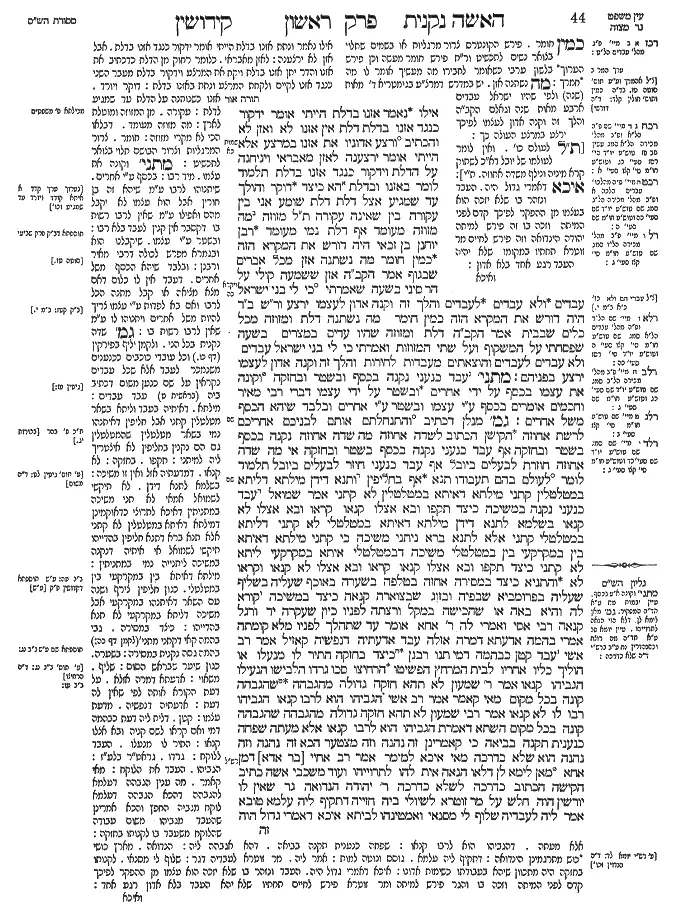
Kiddushin 22b - Guemara
אילו נאמר אזנו בדלת הייתי אומר ידקור כנגד אזנו בדלת דלת אין אזנו לא ואזן לא והכתיב (שמות כא, ו) ורצע אדוניו את אזנו במרצע אלא הייתי אומר ירצענה לאזן מאבראי ויניחנה על הדלת וידקור כנגד אזנו בדלת תלמוד לומר באזנו ובדלת הא כיצד דוקר והולך עד שמגיע אצל דלת דלת שומע אני בין עקורה בין שאינה עקורה ת"ל מזוזה מה מזוזה מעומד אף דלת נמי מעומד רבן יוחנן בן זכאי היה דורש את המקרא הזה כמין חומר מה נשתנה אזן מכל אברים שבגוף אמר הקב"ה אזן ששמעה קולי על הר סיני בשעה שאמרתי (ויקרא כה, נה) כי לי בני ישראל עבדים ולא עבדים לעבדים והלך זה וקנה אדון לעצמו ירצע ור"ש ב"ר היה דורש את המקרא הזה כמין חומר מה נשתנה דלת ומזוזה מכל כלים שבבית אמר הקב"ה דלת ומזוזה שהיו עדים במצרים בשעה שפסחתי על המשקוף ועל שתי המזוזות ואמרתי כי לי בני ישראל עבדים ולא עבדים לעבדים והוצאתים מעבדות לחירות והלך זה וקנה אדון לעצמו ירצע בפניהם:
מתני׳ עבד כנעני נקנה בכסף ובשטר ובחזקהוקונה את עצמו בכסף על ידי אחרים ובשטר על ידי עצמו דברי רבי מאיר וחכמים אומרים בכסף ע"י עצמו ובשטר ע"י אחרים ובלבד שיהא הכסף משל אחרים:
גמ׳ מנלן דכתיב (ויקרא כה, מו) והתנחלתם אותם לבניכם אחריכם לרשת אחוזה הקישן הכתוב לשדה אחוזה מה שדה אחוזה נקנה בכסף בשטר ובחזקה אף עבד כנעני נקנה בכסף בשטר ובחזקה אי מה שדה אחוזה חוזרת לבעלים ביובל אף עבד כנעני חוזר לבעלים ביובל תלמוד לומר (ויקרא כה, מו) לעולם בהם תעבודו תנא אף בחליפין ותנא דידן מילתא דליתא במטלטלין קתני מילתא דאיתא במטלטלין לא קתני אמר שמואל עבד כנעני נקנה במשיכה כיצד תקפו ובא אצלו קנאו קראו ובא אצלו לא קנאו בשלמא לתנא דידן מילתא דאיתא במטלטלי לא קתני דליתא במטלטלי קתני אלא לתנא ברא ניתני משיכה כי קתני מילתא דאיתא בין במקרקעי בין במטלטלי משיכה דבמטלטלי איתא במקרקעי ליתא לא קתני כיצד תקפו ובא אצלו קנאו קראו ובא אצלו לא קנאו וקראו לא והתניא כיצד במסירה אחזה בטלפה בשערה באוכף שעליה בשליף שעליה בפרומביא שבפיה ובזוג שבצוארה קנאה כיצד במשיכה קורא לה והיא באה או שהכישה במקל ורצתה לפניו כיון שעקרה יד ורגל קנאה רבי אסי ואמרי לה ר' אחא אומר עד שתהלך לפניו מלא קומתה אמרי בהמה אדעתא דמרה אזלה עבד אדעתיה דנפשיה קאזיל אמר רב אשי עבד קטן כבהמה דמי תנו רבנן כיצד בחזקה התיר לו מנעלו או הוליך כליו אחריו לבית המרחץ הפשיטו הרחיצו סכו גרדו הלבישו הנעילו הגביהו קנאו אמר ר' שמעון לא תהא חזקה גדולה מהגבהה שהגבהה קונה בכל מקום מאי קאמר אמר רב אשי הגביהו הוא לרבו קנאו הגביהו רבו לו לא קנאו אמר רבי שמעון לא תהא חזקה גדולה מהגבהה שהגבהה קונה בכל מקום השתא דאמרת הגביהו הוא לרבו קנאו אלא מעתה שפחה כנענית תקנה בביאה כי קאמרינן זה נהנה וזה מצטער הכא זה נהנה וזה נהנה הוא שלא כדרכה מאי איכא למימר אמר רב אחיי [בר אדא] דמן אחא מאן לימא לן דלאו הנאה אית להו לתרוייהו ועוד משכבי אשה כתיב הקישה הכתוב כדרכה לשלא כדרכה ר' יהודה הנדואה גר שאין לו יורשין הוה חלש על מר זוטרא לשיולי ביה חזייה דתקיף ליה עלמא טובא אמר ליה לעבדיה שלוף לי מסנאי ואמטינהו לביתא איכא דאמרי גדול הוה
Comments from Rashi on Masechet Kiddushin Page 22b
אילו נאמר ונתת אזנו בדלת הייתי אומר ידקור כנגד אזנו בדלת . אבל אזן לא ירצענה: אילו נאמר ונתת אזנו בדלת הייתי אומר ידקור כנגד אזנו בדלת . אבל אזן לא ירצענה: לאזן מאבראי . כלומר רחוק מן הדלת כדכתיב את אזנו והדר יתן אזנו בדלת ויקח את המרצע וידקור בדלת מעבר השני כנגד אזנו לקיים ולקחת המרצע ונתת באזנו בדלת: דוקר ויורד . אזנו כשנותנה על הדלת עד שמגיע לדלת: עקורה . מן המזוזה ומוטלת לארץ: מה מזוזה מעומד . דבלאו הכי לא מקרי מזוזה: חומר . צרור המרגליות וצרור הבושם תלוי בצואר לתכשיט: מתני' וקונה את עצמו . מיד רבו: מתני' וקונה את עצמו . מיד רבו: בכסף ע"י אחרים . שיתנוהו לרבו ע"מ שיהא זה בן חורין אבל הוא עצמו לא יקבל מהם ואפילו ע"מ שאין לרבו רשות בו דקסבר אין קנין לעבד בלא רבו: ובשטר ע"י עצמו . שיקבלנו הוא ובגמרא מפרש לכולה דרבי מאיר ורבנן: בכסף ע"י אחרים . שיתנוהו לרבו ע"מ שיהא זה בן חורין אבל הוא עצמו לא יקבל מהם ואפילו ע"מ שאין לרבו רשות בו דקסבר אין קנין לעבד בלא רבו: ובלבד שיהא הכסף משל אחרים . דעבד אין לו כלום דאם מצא מציאה או קבל מתנה הכל לרבו ואם בא לפדות ע"י עצמו צריך להיות משל אחרים ויתנוהו לו ע"מ שאין לרבו רשות בו: גמ' שדה נקנית בכל הני . ולקמן יליף בפירקין (דף כו.) וכל עובדי כוכבים ככנענים משנמכר לעבד אלא שכל עבדים נקראין על שם כנען משום דכתיב ביה (בראשית ט) עבד עבדים: גמ' שדה נקנית בכל הני . ולקמן יליף בפירקין (דף כו.) וכל עובדי כוכבים ככנענים משנמכר לעבד אלא שכל עבדים נקראין על שם כנען משום דכתיב ביה (בראשית ט) עבד עבדים: מילתא . דאיתיה בעבד וליתא בשאר מטלטלין קתני אבל חליפין דאיתנהו נמי בשאר מטלטלין שהמטלטלין גם הם נקנין בחליפין לא איצטריך ליה למיתני: תקפו . בחזקה: לא קנאו . דמדעתיה אזל ואין זו משיכה: בשלמא לתנא דידן . לא תיקשי לשמואל אמאי לא תני משיכה במתניתין דאיכא לתרוצי כדאוקמינן דמילתא דאיתא במטלטלין לא קתני אלא תנא ברא דתנא חליפין בהדייהו תיקשי לשמואל אי איתיה דנקנה במשיכה ליתנייה נמי במתניתין: מילתא דאיתא בין במקרקעי בין במטלטלי . כגון חליפין צירף ושנה עם השאר דאיתנהו במקרקעי אבל משיכה דליתא במקרקעי לא תנא בהדייהו: כיצד במסירה . גבי בהמה קאי דקתני מתני' (לקמן קידושין דף כה:) בהמה גסה נקנית במסירה: בשערה . כגון שיער שבראש הסוס: שליף . משאוי: אדעתא דמרה אזלא . על דעת הקורא אותה לפי שאין לה דעת: אדעתיה דנפשיה . מדעת עצמו: קטן . דלית ליה דעת כבהמה דמי ואם קראו לשם קניה ובא אצלו קנאו: התיר לו מנעלו . העבד ללוקח: גרדו . גראט"ר (גרטי"ר: לגרד) בלע"ז: הגביהו . העבד את הלוקח: מאי קאמר . מה ענין הגבהה דעלמא להגבהה דהכא הגבהה דעלמא לוקח מגביה החפץ והכא אמרינן שהעבד מגביהו משום עבודה שהלוקח משעבד בו לקנותו בחזקה: אלא מעתה . דהגביהו הוא לרבו קנאו: שפחה כנענית תקנה בביאה . דהא אגבהה ליה: הנדואה . מארץ כושי כוש מתרגמינן הינדואה: דתקיף ליה עלמא . גוסס ונוטה למות: אמר ליה . מר זוטרא לעבדיה דגר: שלוף לי מסנאי . לקנותו בחזקה היה מתכוון שיהא בעבודתו כשימות אדונו: איכא דאמרי גדול היה . העבד ונזהר בו שלא יזכה הוא עצמו מן ההפקר לפיכך קדם לפני המיתה וזכה בו והגר פירש למיתה ומר זוטרא פירש לחיים תחתיו שלא יהא העבד בלא אדון רגע אחד:
Comments from Tosafot - Kiddushin 22b
כמין חומר. פירש הקונטרס צרור מרגליות או בשמים שתלוי בצואר נשים לתכשיט ור"ת פירש חומר מעשה וכן פירש הערוך בלשון ערבי כשאומר לחבירו מה מעשיך אומר לו מה חמרך: מה נשתנה אזן . יש במדרש דמרצ"ע בגימטריא ד' מאות (שנה) ולפי שהיו ישראל עבדים ארבע מאות שנה וגאלם הקב"ה והלך זה וקנה אדון לעצמו לפיכך ירצע במרצע העולה כך: [ת"ל לעולם כו' . ואין לומר לעולמו של יובל דא"כ לשתוק קרא מיניה ונילף משדה אחוזה. ת"י]: איכא דאמרי גדול היה . העבד ונזהר בו שלא יזכה הוא בעצמו מן ההפקר לפיכך קדם לפני המיתה וזכה בו זה פירש למיתה יהודה הינדואה וזה פירש לחיים מר זוטרא תחתיו במקומו שלא יהיה העבד רגע אחד בלא אדון:
Kiddushin 22b - Mishnah translated into english
Had the verse stated: His ear to the door, I would say: He should pierce, opposite his ear, into the door alone. In other words, with regard to the door, yes, it should be pierced, but his ear itself, no, it should not be pierced. The Gemara asks: But how could it even be suggested that his ear should not be pierced? But isn’t it written: “And his master shall pierce his ear with an awl” (Exodus 21:6)?
Rather, I would say that the master should pierce his ear outside, i.e., not at the door, and he should place it afterward on the door, and then he should pierce opposite his ear on the door. Therefore, the verse states: “And you shall take the awl and place it through his ear and into the door” (Deuteronomy 15:17). How so? He bores through his ear until he reaches the door.
The baraita adds: Since the verse states “door,” I would derive that this applies to any door, regardless of whether it is detached from its doorpost or whether it is not detached. Therefore, the verse states: “Then his master shall bring him to the court, and shall bring him to the door, or to the doorpost” (Exodus 21:6): Just as a doorpost is upright and attached, so too, a door must be upright and attached to the doorpost.
Rabban Yoḥanan ben Zakkai would expound this verse as a type of decorative wreath [ḥomer], i.e., as an allegory: Why is the ear different from all the other limbs in the body, as the ear alone is pierced? The Holy One, Blessed be He, said: This ear heard My voice on Mount Sinai when I said: “For to Me the children of Israel are slaves” (Leviticus 25:55), which indicates: And they should not be slaves to slaves. And yet this man went and willingly acquired a master for himself. Therefore, let this ear be pierced.
And Rabbi Shimon bar Rabbi Yehuda HaNasi would likewise expound this verse as a type of decorative wreath: Why are the door and a doorpost different from all other objects in the house, that the piercing is performed with them? The Holy One, Blessed be He, said: The door and the doorpost were witnesses in Egypt when I passed over the lintel and when I passed over the two doorposts of houses in which there were Jews (Exodus, chapter 12), and I said: “For to Me the children of Israel are slaves,” and they should not be slaves to slaves. And I delivered them at that time from slavery to freedom, and yet this man went and acquired a master for himself. Therefore, let him be pierced before them, as they are witnesses that he violated God’s will.
MISHNA: A Canaanite slave is acquired by means of money, by means of a document, or by means of the master taking possession of him. And he can acquire himself, i.e., his freedom, by means of money given by others, i.e., other people can give money to his master, and by means of a bill of manumission if he accepts it by himself. This is the statement of Rabbi Meir. And the Rabbis say: The slave can be freed by means of money given by himself, and by means of a bill of manumission if it is accepted by others, provided that the money he gives belongs to others, not to him. This is because the slave cannot possess property, as anything owned by a slave is considered his master’s.
GEMARA: The Gemara asks: From where do we derive that these are the modes by which a slave can be acquired? The Gemara answers: As it is written with regard to Canaanite slaves: “And you shall bequeath them to your children as an ancestral inheritance” (Leviticus 25:46). The verse juxtaposes Canaanite slaves to an ancestral field: Just as an ancestral field can be acquired by means of money, by means of a document, or by means of the owner taking possession of it, so too, a Canaanite slave can be acquired by means of money, by means of a document, or by means of the master taking possession of him.
The Gemara asks: If so, perhaps one can interpret this juxtaposition differently: Just as an ancestral field returns to its owners in the Jubilee Year, so too a Canaanite slave returns to his prior owners in the Jubilee Year. Therefore, the verse states: “Of them you may take your slaves forever” (Leviticus 25:46), which indicates that the sale is permanent.
A Sage taught in a baraita that a Canaanite slave can also be acquired by means of symbolic exchange, i.e., a pro forma act of acquisition performed by the giving of an item, usually a kerchief, effecting the transfer of ownership of an article. The Gemara asks: And why doesn’t the tanna of our mishna mention acquisition through symbolic exchange? The Gemara answers: He teaches only the effectiveness of modes of acquisition which are not effective in transferring the ownership of movable property, as it is a novelty that these are effective, as one may have thought that a slave can be acquired only in the same manner as movable property is acquired. He does not teach the effectiveness of modes of acquisition which are effective in transferring the ownership of movable property, as it is not a novelty that a slave can be acquired in that manner.
Shmuel says: A Canaanite slave can be acquired by means of pulling, as can movable property. How is pulling performed in the case of a slave? If the master took him by force and the slave came to him, he has thereby acquired him. But if the master called him and he came to him willingly, he has not acquired him.
The Gemara comments: Granted, according to the opinion of the tanna of our mishna, it is clear why he did not list pulling as a mode of acquisition, as he does not teach the effectiveness of modes of acquisition that are effective in transferring the ownership of movable property; he teaches only the effectiveness of modes of acquisition that are not effective in transferring the ownership of movable property. Pulling is effective with movable property. But according to the opinion of the tanna of the baraita, who taught the mode of symbolic exchange, let him teach pulling as well. The Gemara answers: When he teaches his baraita, which includes acquisition through symbolic exchange, he teaches the effectiveness of modes of acquisition that are effective in transferring the ownership of both land and movable property. He does not teach the effectiveness of pulling, which is effective in transferring the ownership of movable property but is not effective in transferring the ownership of land.
The Gemara returns to analyze Shmuel’s statement: How does one acquire a slave through pulling? If the master took him by force and he came to him, he has acquired him. If he called him and he came to him, he has not acquired him. The Gemara asks: And has he not acquired him if he called him? But isn’t it taught in a baraita: How is an animal acquired through passing? If he grabbed it by its hoof, or by its hair, or by the saddle on it, or by the load [shalif] on it, or by the bit [bifrumbiya] in its mouth, or by the bell on its neck, he has acquired it.
How is an animal acquired by pulling? If he calls it and it comes, or he if hits it with a stick and it runs before him, once it lifts a foreleg and a hind leg from where it was standing, he acquires it. Rabbi Asi, and some say Rabbi Aḥa, says: It is not enough if the animal lifts its feet. Rather, one does not acquire it until it walks the distance of its full height in the presence of the one acquiring it. In any event, this indicates that calling is an effective use of the mode of pulling.
The Sages say in response that there is a difference between the acquisition of a slave and that of an animal. An animal walks by the will of its owner, as it is domesticated and follows the orders of its master. Consequently, if it comes when called it is as though it was pulled. By contrast, a slave walks by his own will. Consequently, even if a slave comes when called, this cannot be considered acquisition through pulling, as the master has performed no act of acquisition. Rav Ashi said: A slave who is a minor is considered like an animal. Since he has no will of his own, he can be acquired through calling, like an animal.
§ The Sages taught (Tosefta 1:5): How does one acquire a slave through possession? If the slave removes the master’s shoe, or carries his garments after him to the bathhouse, or undresses him, or bathes him, or anoints him, or scrubs the oil off him, or dresses him, or puts on his shoes, or lifts him, the master acquires him. Rabbi Shimon says: Acquisition through the mode of possession should not be considered greater than acquisition using the mode of lifting, as lifting acquires property in any situation. With regard to this last statement the Gemara asks: What is Rabbi Shimon saying here? The first tanna also said that a slave can be acquired by lifting.
Rav Ashi says that one can infer from the statement of the first tanna: If a slave lifts his master, the master acquires him, as he is performing labor for the master. But if his master lifts the slave, the master does not acquire him, as the slave has not performed labor for his master. With regard to this Rabbi Shimon says: Acquisition through possession should not be greater than acquisition through lifting, as lifting acquires property in any situation. Consequently, one can acquire a slave even by lifting him.
The Gemara asks: Now that you said that if a slave lifts his master, the master acquires him, consider the following ramification of this ruling: If that is so, let a Canaanite maidservant be acquired by means of sexual intercourse with the master, as it is possible to claim she lifts him during the act of intercourse. The Gemara answers: When we say that one acquires a slave through the labor the slave performs for him, that applies to a situation where this master benefits and that slave suffers. In this manner the master exercises his authority over the slave. Here, with regard to sexual intercourse, it is a case where this master benefits and this Canaanite maidservant likewise benefits. Since both sides derive benefit, it cannot be seen as an act of acquisition.
The Gemara asks: If he engages in intercourse in an atypical manner, i.e., anal intercourse, with her, what can be said? In that case the woman does not benefit from the intercourse. Rav Aḥai bar Adda of the place called Aḥa said: Who will tell us, i.e., it is not obvious, that there is no benefit for both of them, i.e., there is benefit only for the man, when they engage in intercourse in an atypical manner? And furthermore, it is written: “Lyings with a woman” (Leviticus 18:22). The plural form indicates that there are two ways of engaging in sexual intercourse with a woman: In this manner the verse compares typical sexual intercourse to intercourse in an atypical manner.
§ The Gemara relates: Rabbi Yehuda from India was a convert who had no heirs. When he became ill Mar Zutra entered to ask about his health. When he saw that his condition intensified, i.e., that he was about to die, Mar Zutra said to Rabbi Yehuda’s slave: Remove my shoes and take them to my house. He wanted to acquire the slave upon the death of his master, as when a convert without heirs dies, the first person to claim his property acquires it. The Gemara comments: There are those who say that this slave was an adult man,
Traduction : The William Davidson digital edition of the Koren Noé Talmud, with commentary by Rabbi Adin Even-Israel Steinsaltz.