 Talmud Bavli
The learning on the whole site is dedicated : L'ilui Nishmat Amram ben Itshak Loubaton
The learning on the whole site is dedicated : L'ilui Nishmat Jamila bat Chlomo Abensour
The learning on the whole site is dedicated : L'ilui Nishmat אסתר בת חיים
Kiddushin 12a : Youtube
Daf TubeYoutube
2 video classes :
Kiddushin Page 12a
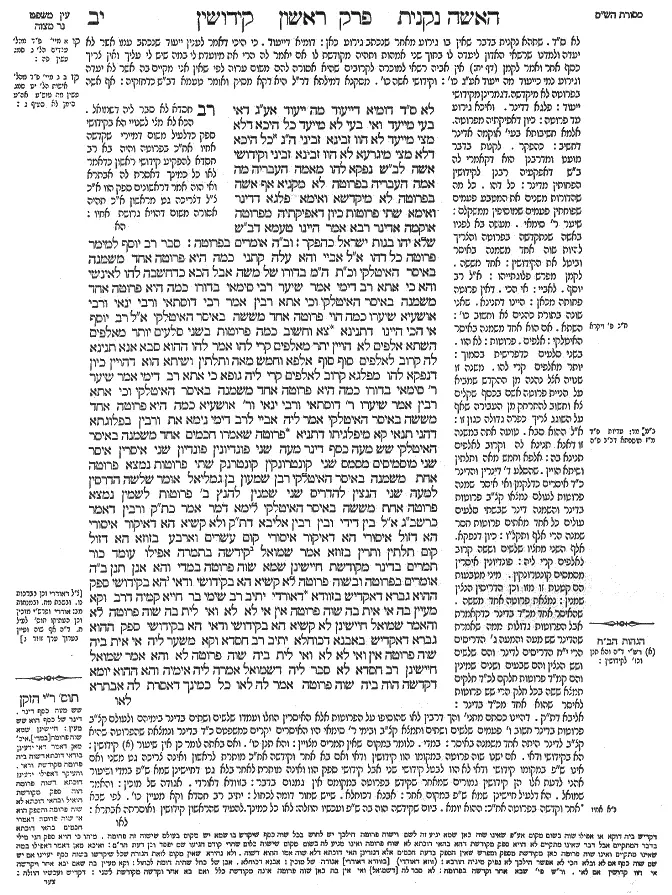
Kiddushin 12a - Guemara
לא ס"ד דומיא דייעוד מה ייעוד אע"ג דאי בעי מייעד ואי בעי לא מייעד כל היכא דלא מצי מייעד לא הוו זבינא זביני ה"נ כל היכא דלא מצי מיגרעא לא הוו זבינא זביני וקידושי אשה לב"ש נפקא להו מאמה העבריה מה אמה העבריה בפרוטה לא מקניא אף אשה בפרוטה לא מיקדשא ואימא פלגא דדינר ואימא שתי פרוטות כיון דאפיקתיה מפרוטה אוקמה אדינר רבא אמר היינו טעמא דב"ש שלא יהו בנות ישראל כהפקר :
וב"ה אומרים בפרוטה :
סבר רב יוסף למימר פרוטה כל דהו א"ל אביי והא עלה קתני כמה היא פרוטה אחד משמנה באיסר האיטלקי וכ"ת ה"מ בדורו של משה אבל הכא כדחשבה להו לאינשי והא כי אתא רב דימי אמר שיער רבי סימאי בדורו כמה היא פרוטה אחד משמנה באיסר האיטלקי וכי אתא רבין אמר רבי דוסתאי ורבי ינאי ורבי אושעיא שיערו כמה הוי פרוטה אחד מששה באיסר האיטלקי א"ל רב יוסף אי הכי היינו דתנינא צא וחשוב כמה פרוטות בשני סלעים יותר מאלפים השתא אלפים לא הויין יתר מאלפים קרי להו אמר להו ההוא סבא אנא תנינא לה קרוב לאלפים סוף סוף אלפא וחמש מאה ותלתין ושיתא הוא דהויין כיון דנפקא להו מפלגא קרוב לאלפים קרי ליה גופא כי אתא רב דימי אמר שיער ר' סימאי בדורו כמה היא פרוטה אחד משמנה באיסר האיטלקי וכי אתא רבין אמר שיערו ר' דוסתאי ורבי ינאי ור' אושעיא כמה היא פרוטה אחד מששה באיסר האיטלקי אמר ליה אביי לרב דימי נימא את ורבין בפלוגתא דהני תנאי קא מיפלגיתו דתניא פרוטה שאמרו חכמים אחד משמנה באיסר האיטלקי שש מעה כסף דינר מעה שני פונדיונין פונדיון שני איסרין איסר שני מוסמיסים מסמס שני קונטרונקין קונטרנק שתי פרוטות נמצא פרוטה אחת משמנה באיסר האיטלקי רבן שמעון בן גמליאל אומר שלשה הדרסין למעה שני הנצין להדריס שני שמנין להנץ ב' פרוטות לשמין נמצא פרוטה אחת מששה באיסר האיטלקי לימא דמר אמר כת"ק ורבין דאמר כרשב"ג א"ל בין דידי ובין רבין אליבא דת"ק ולא קשיא הא דאיקור איסורי הא דזול איסורי הא דאיקור איסורי קום עשרים וארבע בזוזא הא דזול קום תלתין ותרין בזוזא אמר שמואל קידשה בתמרה אפילו עומד כור תמרים בדינר מקודשת חיישינן שמא שוה פרוטה במדי והא אנן תנן ב"ה אומרים בפרוטה ובשוה פרוטה לא קשיא הא בקידושי ודאי הא בקידושי ספק ההוא גברא דאקדיש בזוודא דאורדי יתיב רב שימי בר חייא קמיה דרב וקא מעיין בה אי אית בה שוה פרוטה אין אי לא לא ואי לית בה שוה פרוטה לא והאמר שמואל חיישינן לא קשיא הא בקידושי ודאי הא בקידושי ספק ההוא גברא דאקדיש באבנא דכוחלא יתיב רב חסדא וקא משער ליה אי אית ביה שוה פרוטה אין ואי לא לא ואי לית ביה שוה פרוטה לא והא אמר שמואל חיישינן רב חסדא לא סבר ליה דשמואל אמרה ליה אימיה והא ההוא יומא דקדשה הוה ביה שוה פרוטה אמר לה לאו כל כמינך דאסרת לה אבתרא
Comments from Rashi on Masechet Kiddushin Page 12a
לא ס"ד . שתהא נקנית בדבר שאין בו גירוע מאחר שנכתב גירוע כאן: דומיא דייעוד . כי היכי דאמר לענין ייעוד שנכתב עמו אשר לא יעדה ולמדנו שרשאי האדון ליעדה לו בתוך שני אמהות ותהיה מקודשת לו אם יאמר לה הרי את מיועדת לי במה שיש לי עליך ואין צריך כסף אחר ואמר לקמן (קידושין דף יח:) אין אביה רשאי למוכרה לקרובים שהיא אסורה להם משום ערוה לפי שאין אני מקיים בה אשר לא יעדה וגירוע נמי כייעוד מה ייעוד אע"ג כו': לא הוו . בשני סלעים כדפרישית בסמוך: וקידושי אשה כו' . מסקנא דמילתא דר"ל היא דקא מסיק ואומר טעמא דב"ש כדחזקיה: אף אשה בפרוטה לא מיקדשה . דגמרינן מקידושי ייעוד: פלגא דדינר . ואיכא גירוע עד פרוטה: כיון דאפיקתיה מפרוטה . אלמא חשיבותא בעי' אוקמה אדינר דחשיב: כהפקר . לקנות בדבר מועט ומדרבנן הוא דקאמרי לה ב"ש דאפקעיה רבנן לקידושין הפחותין מדינר: כל דהו . כל מה שהדורות משנים את המטבע פעמים שפוחתין פעמים שמוסיפין ממשקלם: שיער ר' סימאי . מעשה בא לפניו באשה שנתקדשה בפרוטה והצריך להיות שוה אחד משמנה באיסר וביטל את הקידושין: אחד מששה . לקמן מפרש פלוגתייהו: א"ל רב יוסף . לאביי: אי הכי . דאין פרוטה פחותה מכאן: היינו דתנינא . שאני שונה בתורת כהנים צא וחשוב כו': אלפים . פרוטות: השתא . אם הוא אחד משמנה באיסר האיטלקי: אלפים . פרוטות: לא הוו . בשני סלעים כדפרישית בסמוך: יותר מאלפים קרי להו . משנה זו שנויה אצל נהנה מן ההקדש שמביא על הניית פרוטה אשם בכסף שקלים צא וחשוב להתרחק מן העבירה שאף על השוגג צריך כפרה גדולה כגון זו: א"ל ההוא סבא . טועה אתה במשנה זו דאנא תנינא לה וקרוב לאלפים תנינא בה: אלפא וחמש מאה ותלתין ושיתא הויין . שהסלע ד' דינרין והדינר כ"ד איסרים כדלקמן ואי איסר שמנה פרוטות לעולם נמצאו קצ"ב פרוטות בדינר והשמנה דינר שבשתי סלעים עולים כל אחד מאתים פרוטות חסר שמנה הרי אלף ותקל"ו: כיון דנפקא . אלף השני מחציו שלשים וששה קרוב לאלפים קרי ליה: שיער ר' סימאי . מעשה בא לפניו באשה שנתקדשה בפרוטה והצריך להיות שוה אחד משמנה באיסר וביטל את הקידושין: אחד מששה . לקמן מפרש פלוגתייהו: פונדיונין איסרין מסמסים קונטרונקין . מיני מטבעות הם קטנות זו מזו וכן הדריסין הנצין שמנין: נמצאת פרוטה אחד מששה . שהאיסר אחד מכ"ד בדינר כדקאמרת אבל הפרוטות גדולות ממה שאמרת שהדינר שש מעה והמעה ג' הדריסים הרי י"ח הדריסים לדינר והם שלשים ושש הנצין והם שבעים ושנים שמינין והם קמ"ד פרוטות חלקם לכ"ד חלקים תמצא ששה בכל חלק הרי שש פרוטות לאיסר שהוא אחד מכ"ד בדינר: א"ל ההוא סבא . טועה אתה במשנה זו דאנא תנינא לה וקרוב לאלפים תנינא בה: אליבא דת"ק . דהיינו כסתם מתני' והך דרבין לאו שהוסיפו על הפרוטות אלא האיסרין הוזלו ועמדו שלשים ושתים בדינר בימיהם ולעולם קצ"ב פרוטות בדינר חשוב ו' פעמים שלשים ושתים ותמצא קצ"ב ובימי ר' סימאי היו האיסרים יקרים כמשפטם כ"ד בדינר ונמצאת שהפרוטה שהיא קצ"ב לדינר היתה אחד משמנה באיסר: במדי . כלומר במקום שאין תמרים מצויין: והא תנן כו' . ואם באתה לומר כן אין שיעור קידושין: הא בקידושי ודאי . אם ישנו שוה פרוטה במקומו הוו קידושין ודאי ואם בא אחר וקידשה אח"כ מותרת לראשון ואינה צריכה גט משני ואם אינו ש"פ במקומו קידושי ודאי לא הוו לבטל קידושי שני אבל קידושי ספק הוו ואינה מותרת לאחר בלא גט דחיישינן שמא ש"פ במדי ושיעור אהני לדעת אלו הן קידושין גמורים שמאחר שקידש בפרוטה במקומם אין גמגום בדבר: בזוודא דאורדי . אגודה של מוכין: והאמר שמואל . הא דלעיל חיישינן שמא ש"פ במקום אחר: אבנא דכוחלא . שייש שחור דומה לכחול: יתיב רב חסדא וקא מעיין כו' . לפי שבא אחר וקדשה בפרוטה אח"כ: ההוא יומא . ביום שקידשה הוה בה ש"פ ועכשיו הוזלה: לאו כל כמינך . להעיד שהראשון קידושין ואוסרתה אבתרא:
Comments from Tosafot - Kiddushin 12a
רב חסדא לא סבר ליה דשמואל . הכא לא מצי לשנויי הא בקידושי ספק כדלעיל משום דמיירי שקדשה אחיו אח"כ בפרוטה והיה בא רב חסדא להפקיע קידושי ראשון כדאמר לאו כל כמינך דאסרת לה אבתרא ואי הוה אמר דראשונים ספק הוו א"כ צ"ל דצריכה גט מראשון א"כ תהיה אסורה משום דהויא גרושת אחיו:
Kiddushin 12a - Mishnah translated into english
The Gemara rejects this suggestion: This cannot enter your mind, as the halakha of deduction must be similar to the halakha of designation, i.e., the process by which a master designates his Hebrew maidservant as a wife for him or his son (Exodus 21:8–9). Just as with designation, although the halakha is that if he desires, he may designate her and if he does not desire, he is not required to designate her, nevertheless anywhere that he cannot designate her, e.g., in a case where they are related and she is therefore forbidden to him, her sale is not a valid sale, so too here, with regard to her redemption, anywhere that she cannot deduct an amount from her purchase price, her sale is not a valid sale.
The Gemara notes: And according to the opinion of Beit Shammai the mode of betrothal of a woman by money is derived from the case of a Hebrew maidservant, as follows: Just as a Hebrew maidservant cannot be acquired with one peruta, so too a woman cannot be betrothed with one peruta.
The Gemara asks: Even if Beit Shammai derive their opinion from here, how does this prove that a woman can be betrothed only with a minimum of one dinar? But why not say she can be betrothed with half a dinar, or say that she can be betrothed with two perutot, as it is possible to fulfill the redemption of a Hebrew maidservant if her sale was for either of these amounts? The Gemara answers: Since this comparison excludes betrothal with one peruta, as it indicates that a woman can be betrothed only with money of significant value, the Sages established the minimum amount at one dinar, which is a coin of substantial value.
Rava said a different explanation: This is the reasoning of Beit Shammai, who hold that a woman can be betrothed only with a minimum of one dinar: The daughters of Israel should not be treated like ownerless property. Allowing women to be betrothed with such a small amount as one peruta is disrespectful to them.
§ The mishna teaches: And Beit Hillel say that a woman can be betrothed with one peruta, or with any item that is worth one peruta. Rav Yosef thought to say: One peruta means any amount. There is no defined value, as a woman may be betrothed with one peruta regardless of its value at the time. Abaye said to him: But isn’t it taught with regard to this in the mishna itself: How much is one peruta? It is one-eighth of the Italian issar. This shows there is a defined value for one peruta.
And if you would say: This statement applies only to the generation of Moses, i.e., this was the value of one peruta in the time of the Torah, but now, at any later time, its value is determined by that which people consider one peruta, that claim cannot be correct. As when Rav Dimi came from Eretz Yisrael he said: Rabbi Simai estimated in his generation: How much is one peruta? It is one-eighth of the Italian issar. And when Ravin came from Eretz Yisrael to Babylonia he said that Rabbi Dostai and Rabbi Yannai and Rabbi Oshaya estimated: How much is one peruta? It is one-sixth of the Italian issar.
Rav Yosef said to Abaye: If so, then this is in conflict with that which we learned in a baraita: Go and calculate how many perutot there are in two sela: More than two thousand. Now there are not even two thousand, and you call them: More than two thousand? Rather, the peruta is certainly worth less than one-eighth of the Italian issar. A certain old man said to them: I teach this baraita as saying: Close to two thousand. The Gemara asks: Ultimately, according to the calculation of one-eighth of an issar, the number of perutot in two sela is 1,536, which is nowhere near two thousand. The Gemara answers: Since it passes half of the second thousand it is called: Close to two thousand.
The Gemara discusses the matter itself. When Rav Dimi came from Eretz Yisrael he said: Rabbi Simai estimated in his generation: How much is one peruta? It is one-eighth of the Italian issar. And when Ravin came he said that Rabbi Dostai and Rabbi Yannai and Rabbi Oshaya estimated: How much is one peruta? It is one-sixth of the Italian issar. Abaye said to Rav Dimi: Shall we say that you and Ravin disagree with regard to the issue that is the subject of the dispute between these tanna’im.
As it is taught in a baraita: The peruta mentioned by the Sages is one-eighth of the Italian issar. Six silver ma’a are one dinar, and one ma’a is worth two pundeyon. In a pundeyon there are two issar, and an issar is two masmas. A masmas is worth two konterank, and a konterank is two perutot. By this calculation, one finds that one peruta is one-eighth of the Italian issar.
Rabban Shimon ben Gamliel says: This is not the case; rather, there are three hadreis to a ma’a, two henetz to a hadreis, two shamin to a henetz, and two perutot to a shamin. Consequently, one finds that one peruta is one-sixth of the Italian issar. Shall we say that one Master agrees with the first tanna, and Ravin, who said his ruling in the name of Rabbi Dostai and Rabbi Yannai and Rabbi Oshaya, agrees with Rabban Shimon ben Gamliel?
Rav Dimi said to Abaye: Both my statement and that of Ravin are in accordance with the opinion of the first tanna, and it is not difficult. This statement of mine is referring to when the issar increased in value in relation to silver coins, and this statement of Ravin is referring to when the issar decreased in value. The Gemara elaborates: When the issar increased in value, twenty-four issar stood at one dinar; when they decreased in value, thirty-two issar stood at one dinar. If so, there is a set ratio between the value of a peruta and the value of silver, and there are 192 perutot in one dinar. By contrast, the ratio between the value of a copper issar and silver dinars fluctuates, so that sometimes an issar will be worth eight perutot while at other times it is worth only six.
§ Shmuel says: If man betrothed a woman with a date, she is betrothed even if a kor of dates is worth one dinar, which would mean that one date is worth much less than one peruta. The reason is that although a date has little value here, we are concerned that perhaps it is worth one peruta in Media or in some other distant place where dates are expensive. Therefore, she is betrothed in this location as well.
The Gemara asks: But didn’t we learn in the mishna that Beit Hillel say: With one peruta or with an item worth one peruta, but not less? The Gemara explains: This is not difficult. This statement in the mishna is referring to betrothal whose status is certain. Betrothal with one peruta or an item worth one peruta is certainly valid. Conversely, this case stated by Shmuel is referring to betrothal whose status is uncertain. Although the item is not worth one peruta here, there is a concern that the betrothal might nevertheless be valid.
The Gemara relates: There was a certain man who betrothed a woman with a bundle of rags [zavda de’urdei]. Rav Shimi bar Ḥiyya sat before Rav and examined the bundle to see if it had the value of one peruta. If it was worth one peruta, yes, she was betrothed, and if not, no, she was not betrothed. The Gemara asks: And if it does not have the value of one peruta, is she not betrothed? But didn’t Shmuel say that we are concerned that the item might be worth one peruta in Media? The Gemara explains: This is not difficult. This ruling of Rav Shimi bar Ḥiyya is referring to betrothal whose status is certain, whereas this statement of Shmuel is referring to betrothal whose status is uncertain.
The Gemara further relates: There was a certain man who betrothed a woman with a blue marble stone. Rav Ḥisda sat and estimated whether it was worth one peruta. If it was worth one peruta, yes, she was betrothed, and if not, no, she was not betrothed. The Gemara asks: And if it does not have the value of one peruta, is she not betrothed? But didn’t Shmuel say that we are concerned that the item might be worth one peruta in Media? The Gemara answers: Rav Ḥisda does not hold in accordance with that opinion of Shmuel, as he holds that if the item is not worth one peruta in the place where the betrothal occurred, the betrothal is invalid.
The mother of the man who offered the betrothal said to Rav Ḥisda: But on that day that he betrothed her it was worth one peruta. He said to the mother: It is not in your power to render her forbidden to a later man. If another comes and betroths her, his betrothal is not dismissed due to this earlier act. Since the marble stone is not worth one peruta now, the betrothal of the second man may be valid.
Traduction : The William Davidson digital edition of the Koren Noé Talmud, with commentary by Rabbi Adin Even-Israel Steinsaltz.