 Talmud Bavli
The learning on the whole site is dedicated : L'ilui Nishmat יוסף בן מושה
The learning on the whole site is dedicated : L'ilui Nishmat אליעזר בן רחל
The learning on the whole site is dedicated : L'ilui Nishmat Yaakov ben Myriam
Kiddushin 21a : Youtube
Daf TubeYoutube
2 video classes :
Kiddushin Page 21a
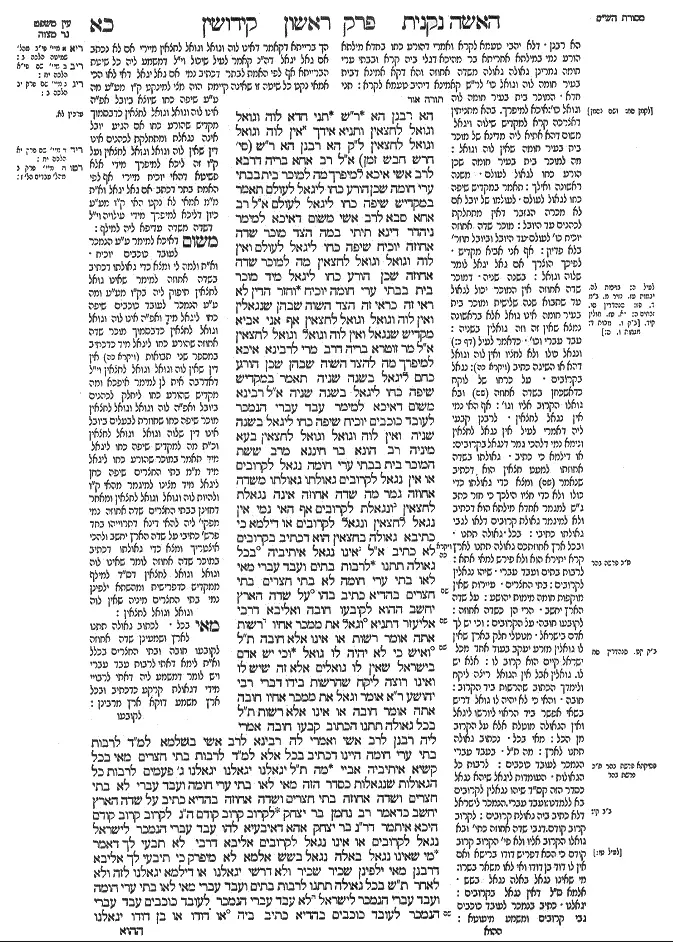
Kiddushin 21a - Guemara
הא רבנן הא ר"ש תני חדא לוה וגואל וגואל לחצאין ותניא אידך אין לוה וגואל וגואל לחצאין ל"ק הא רבנן הא ר"ש (סימן חרש חבש זמן) א"ל רב אחא בריה דרבא לרב אשי איכא למיפרך מה למוכר בית בבתי ערי חומה שכן הורע כחו ליגאל לעולם תאמר במקדיש שיפה כחו ליגאל לעולם א"ל רב אחא סבא לרב אשי משום דאיכא למימר ניהדר דינא תיתי במה הצד מוכר שדה אחוזה יוכיח שיפה כחו ליגאל לעולם ואין לוה וגואל וגואל לחצאין מה למוכר שדה אחוזה שכן הורע כחו ליגאל מיד מוכר בית בבתי ערי חומה יוכיח וחזר הדין לא ראי זה כראי זה הצד השוה שבהן שנגאלין ואין לוה וגואל וגואל לחצאין אף אני אביא מקדיש שנגאל ואין לוה וגואל וגואל לחצאין א"ל מר זוטרא בריה דרב מרי לרבינא איכא למיפרך מה להצד השוה שבהן שכן הורע כחם ליגאל בשנה שניה תאמר במקדיש שיפה כחו ליגאל בשנה שניה א"ל רבינא משום דאיכא למימר עבד עברי הנמכר לעובד כוכבים יוכיח שיפה כחו ליגאל בשנה שניה ואין לוה וגואל וגואל לחצאין בעא מיניה רב הונא בר חיננא מרב ששת המוכר בית בבתי ערי חומה נגאל לקרובים או אין נגאל לקרובים גאולתו גאולתו משדה אחוזה גמר מה שדה אחוזה אינה נגאלת לחצאין ונגאלת לקרובים אף האי נמי אין נגאל לחצאין ונגאל לקרובים או דילמא כי כתיבא גאולה בחצאין הוא דכתיב בקרובים לא כתיב א"ל אינו נגאל איתיביה (ויקרא כה, כד) בכל גאולה תתנו לרבות בתים ועבד עברי מאי לאו בתי ערי חומה לא בתי חצרים בתי חצרים בהדיא כתיב בהו (ויקרא כה, לא) על שדה הארץ יחשב ההוא לקובעו חובה ואליבא דרבי אליעזר דתניא (ויקרא כה, כה) וגאל את ממכר אחיו רשות אתה אומר רשות או אינו אלא חובה ת"ל (ויקרא כה, כו) ואיש כי לא יהיה לו גואל וכי יש אדם בישראל שאין לו גואלים אלא זה שיש לו ואינו רוצה ליקח שהרשות בידו דברי רבי יהושע ר"א אומר וגאל את ממכר אחיו חובה אתה אומר חובה או אינו אלא רשות ת"ל בכל גאולה תתנו הכתוב קבעו חובה אמרי ליה רבנן לרב אשי ואמרי לה רבינא לרב אשי בשלמא למ"ד לרבות בתי ערי חומה היינו דכתיב בכל אלא למ"ד לרבות בתי חצרים מאי בכל קשיא איתיביה אביי מה ת"ל יגאלנו יגאלנו יגאלנו ג' פעמים לרבות כל הגאולות שנגאלות כסדר הזה מאי לאו בתי ערי חומה ועבד עברי לא בתי חצרים ושדה אחוזה בתי חצרים ושדה אחוזה בהדיא כתיב על שדה הארץ יחשב כדאמר רב נחמן בר יצחק לקרוב קרוב קודם ה"נ לקרוב קרוב קודם היכא איתמר דר"נ בר יצחק אהא דאיבעיא להו עבד עברי הנמכר לישראל נגאל לקרובים או אינו נגאל לקרובים אליבא דרבי לא תבעי לך דאמר מי שאינו נגאל באלה נגאל בשש אלמא לא מיפרק כי תיבעי לך אליבא דרבנן מאי ילפינן שכיר שכיר ולא דרשי יגאלנו או דילמא יגאלנו לזה ולא לאחר תא שמע בכל גאולה תתנו לרבות בתים ועבד עברי מאי לאו בתי ערי חומה ועבד עברי הנמכר לישראל לא עבד עברי הנמכר לעובד כוכבים עבד עברי הנמכר לעובד כוכבים בהדיא כתיב ביה (ויקרא כה, מט) או דודו או בן דודו יגאלנו
Comments from Rashi on Masechet Kiddushin Page 21a
הא רבנן . דלא יהבי טעמא לקרא ואמרי דהורע כחו בחדא מילתא הורע נמי במילתא אחריתא בר מהיכא דגלי ביה קרא ובבתי ערי חומה גמרינן גאולה גאולה משדה אחוזה והא דקא אמינא דבית בעיר חומה לוה וגואל כו' לר"ש קאמינא דיהיב טעמא לקרא: תני חדא . המוכר בית בעיר חומה לוה וגואל כו': איכא למיפרך . בהא מתניתין דאצרכה קרא למקדיש שילוה ויגאל משום דהא אתיא ליה מדינא של מוכר בית בעיר חומה שאין לוה וגואל: מה למוכר בית בעיר חומה שכן הורע כחו לגאול לעולם . משנה ראשונה ואילך: תאמר במקדיש שיפה כחו לגאול לעולם . לעולמו של יובל אם לא מכרה הגזבר דאין מתחלקת לכהנים עד היובל: מוכר שדה אחוזה יוכיח כו' לעולם . עד היובל וביובל חוזר' בלא פדיון: אף אני אביא מקדיש . לפיכך הוצרך אם גאל יגאל לומר שלוה וגואל: איכא למיפרך . בהא מתניתין דאצרכה קרא למקדיש שילוה ויגאל משום דהא אתיא ליה מדינא של מוכר בית בעיר חומה שאין לוה וגואל: בשנה שניה . דמוכר שדה אחוזה אין המוכר יכול לגאול עד שתבוא שנה שלישית ומוכר בית בעיר חומה אינו גואל אלא בראשונה נמצא שאין זה וזה גואלין בשניה: עבד עברי וכו' . כדאמר לעיל (קידושין דף כ:) ונגאל כולו ולא לחציו ואין לוה וגואל דהא או השיגה כתיב (ויקרא כה): נגאל בקרובים . על כרחו של לוקח כדאשכחן בשדה אחוזה (שם) ובא גואלו הקרוב אליו וגו': אף האי נמי אין נגאל לחצאין . לרבנן קבעי ליה דאמרי לעיל אין נגאל לחצאין ונימא נמי דלהכי גמר דנגאל בקרובים: או דילמא כי כתיב . גאולתו בשדה אחוזתו למעט חצאין הוא דכתיב שנאמר (שם) ומצא כדי גאולתו כדי כולו ולא כדי חציו הילכך כי חזר כתב ג"ש למגמר אחדא מילתא הוא דכתיב ולא למיגמר גאולת קרובים דלאו לגבי גאולתו כתיבי: בכל גאולה תתנו . ובכל ארץ אחוזתכם גאולה תתנו לארץ קרא יתירא הוא ולא פירש למאי אתא: לרבות בתים ועבד עברי . שיהו נגאלין לקרובים: בתי החצרים . עיירות שאין מוקפות חומה מימות יהושע: על שדה הארץ יחשב . הרי הן כשדה אחוזה: לקובעו חובה . על הקרובים: וכי יש לך אדם בישראל . מנוטלי חלק בארץ שאין לו גואלין מזרע יעקב בעוד אחד מכל ישראל קיים הוא קרוב לו: אלא יש לו . גואלין אבל אין הגואל רוצה ליקח ולימדך הכתוב שהרשות ביד הקרוב: אלא יש לו . גואלין אבל אין הגואל רוצה ליקח ולימדך הכתוב שהרשות ביד הקרוב: חובה . והאי כי לא יהיה לו גואל דריש בשאי אפשר ביד הראוי ליורשו ליגאל ואין הגאולה מוטלת אלא על הקרוב מן הכל: מאי בכל . נכתוב גאולה תתנו לארץ: מה ת"ל . בעבד עברי הנמכר לעובד כוכבים: לרבות כל הגאולות . העומדות ליגאל שיהא נגאל כסדר הזה קס"ד שיהו נגאלין לקרובים בא ללמדנו: ועבד עברי . הנמכר לישראל דלא כתיב ביה גאולת קרובים: לקרוב קרוב קודם . דגבי שדה אחוזה כתי' ובא גואלו הקרוב אליו ולא פי' הקרוב קרוב קודם כי הכא דפריש דודו ברישא ואם אין לו דוד בן דודו ואי לאו משאר בשרו: ועבד עברי . הנמכר לישראל דלא כתיב ביה גאולת קרובים: מי שאינו נגאל באלה נגאל בשש . אלמא ס"ל דאין נגאל בקרובים: יגאלנו . כתיב בנמכר לעובד כוכבים גבי קרובים ומשמע מיעוטא: לרבות בתים ועבד עברי . שיהו נגאלין לקרובים:
Comments from Tosafot - Kiddushin 21a
משום דאיכא למימר ע"ע הנמכר לעובד כוכבים יוכיח. וא"ת ולמה לי ומצא כדי גאולתו דכתיב בשדה אחוזה למימר שאינו גואל לחצאין תיפוק ליה בק"ו מע"ע ומה ע"ע הנמכר לעובד כוכבים שיפה כחו ליגאל מיד ואפ"ה אינו לוה וגואל וגואל לחצאין כדבסמוך מוכר שדה אחוזה שהורע כחו ליגאל מיד כדכתיב במספר שני תבואות (ויקרא כה) אין דין שאין לוה וגואל וגואל לחצאין וי"ל דאדרבה אית לן למימר איפכא ומה מקדיש שהורע כחו ליחלק לכהנים ביובל ואפ"ה לוה וגואל וגואל לחצאין מוכר שיפה כחו שחוזרת לבעלים ביובל אינו דין שלוה וגואל וגואל לחצאין וכ"ת מה למקדיש שיפה כחו ליגאל מיד תאמר במוכר שהורע כחו ליגאל מיד מ"מ בתי החצרים שיפה כחן ליגאל מיד מצינו למיגמר מהאי ק"ו ולהיות לוה וגואל וגואל לחצאין ומאחר דחזינן בבתי החצרים שדה אחוזה נמי מפקי' ליה להאי דינא דתרוייהו בחד פרש' כתיבי על שדה הארץ יחשב ולהכי איצטריך ומצא כדי גאולתו דכתיב במוכר שדה אחוזה לומר שאינו לוה וגואל וגואל לחצאין דס"ד למילף ממקדיש כדפרישית ומהשתא ילפינן נמי בתי החצרים מיניה שאין לוה וגואל וגואל לחצאין: מאי בכל . לכתוב גאולה תתנו לארץ ושמעינן שדה אחוזה לקובעו חובה ובתי החצרים בכלל וא"ת לימא דאתי לרבות עבד עברי ויש לומר דמשמע ליה דאתי לרבויי מידי דגאולת קרקע כדכתיב ובכל ארץ משמע דוקא ארץ מרבינן:
Kiddushin 21a - Mishnah translated into english
This second baraita is in accordance with the opinion of the Rabbis, and that baraita, which teaches that one can borrow money and redeem the house and partially redeem it, is in accordance with the opinion of Rabbi Shimon.
The Gemara states: It is taught in one baraita with regard to the houses of walled cities: One can borrow money and redeem it, and one can partially redeem it, and it is taught in another baraita: One cannot borrow money and redeem it, nor can one partially redeem. Apparently, there is a contradiction between these two baraitot. The Gemara answers as above: This is not difficult. This baraita is in accordance with the opinion of the Rabbis, and that baraita is in accordance with the opinion of Rabbi Shimon.
The Gemara provides a mnemonic device for the names of the Sages who raise the dilemmas cited below and those to whom the questions are addressed: Ḥeresh, ḥavash, zeman. They allude to the following interlocutors: Ḥeresh alludes to Rav Aḥa, son of Rava, and Rav Ashi; ḥavash alludes to Rav Aḥa Sava and Rav Ashi; and zeman alludes to Mar Zutra, son of Rav Mari, and Ravina.
Rav Aḥa, son of Rava, said to Rav Ashi: The comparison detailed earlier (20b) between one who sells a house and one who consecrates a field, can be refuted as follows: What is unique about one who sells a house among the houses of walled cities is that his power is diminished, in that he is not able to redeem it forever, since he cannot redeem it after a year has passed (see Leviticus 25:30). Shall you say the same with regard to one who consecrates his field, as his power is enhanced in that he is able to redeem forever?
Rav Aḥa Sava said to Rav Ashi: The comparison is valid, because it can be said that the argument returns, as one can learn in a different manner. Let this matter be derived by an analogy derived from the common factor of two sources: The halakha of one who sells an ancestral field can prove it, as his power is enhanced in that he is able to redeem the field forever, and he cannot borrow money and redeem it, and he cannot partially redeem it. And if you say: What is unique about one who sells an ancestral field is that his power is diminished in that he is not able to redeem it immediately, the case of one who sells a house from among houses of walled cities can prove otherwise. Although one can redeem the house immediately, he cannot borrow money and redeem it, nor partially redeem it.
And the derivation has reverted to its starting point, as one could alternate the explanations for each side with their respective refutations. Ultimately, the aspect of this case, an ancestral field, is not like the aspect of that case, a house from among houses of walled cities. Their common denominator is that they can be redeemed, and one cannot borrow money and redeem them, and likewise, one cannot partially redeem them. I will also bring the case of one who consecrates his field and rule that it may be redeemed, but one cannot borrow money and redeem it, and one cannot partially redeem it.
Mar Zutra, son of Rav Mari, said to Ravina: This derivation, based on the common denominator, can be refuted as follows: What is unique to their common denominator is that their power is diminished in that they are unable to redeem the respective properties during the second year, as in neither case can they be redeemed in the second year. One who sells a house in a walled city cannot redeem it beyond the first year, while one who sells an ancestral field cannot redeem it during the first two years. Shall you say the same with regard to one who consecrated his field, as his power is enhanced in that he is able to redeem the field in the second year?
Ravina said to him that the derivation is valid because it can be said that the case of a Hebrew slave sold to a gentile can prove otherwise, as his power enhanced in that he is able to redeem himself in the second year, and nevertheless he cannot borrow money and redeem himself, and he cannot partially redeem himself.
The Gemara discusses a similar matter. Rav Huna bar Ḥinnana raised a dilemma before Rav Sheshet: In the case of one who sells a house from among the houses of walled cities, can it be redeemed by relatives or can it not be redeemed by relatives? Is the ability to redeem a house limited to the seller himself? The Gemara presents the two sides of the dilemma: Does one derive the verbal analogy of “ge’ullato” (Leviticus 25:29) and “ge’ullato” (Leviticus 25:26) from an ancestral field in this manner: Just as an ancestral field cannot be partially redeemed and yet it can be redeemed by relatives, so too, this house also cannot be partially redeemed and yet it can be redeemed by relatives?
Or perhaps, when the word ge’ula is written in the case of an ancestral field, it is written with regard to partial redemption; but the word redemption is not written with regard to relatives. If so, the verbal analogy does not apply to the halakha of redemption by relatives. Rav Sheshet said to him: The house cannot be redeemed by relatives.
Rav Huna bar Ḥinnana raised an objection to the ruling of Rav Sheshet from a baraita that deals with the verse: “And in all of your ancestral land you shall grant redemption for the land” (Leviticus 25:24). This verse serves to include houses and a Hebrew slave. What, is it not correct to say that the term houses is referring to houses of walled cities, indicating that they can also be redeemed by relatives? The Gemara rejects this suggestion: No, this is referring to houses in open areas without walls.
The Gemara asks: With regard to houses in open areas without walls, it is explicitly written: “Shall be reckoned with the field of the country” (Leviticus 25:31), meaning that they are like ancestral fields. If so, there is no need for another verse to teach this halakha. The Gemara answers: That verse: “And in all of your ancestral land you shall grant redemption for the land” (Leviticus 25:24), serves to establish that redemption by relatives is an obligation, and this is in accordance with the opinion of Rabbi Eliezer.
As it is taught in a baraita, with regard to a verse that deals with one who sells ancestral land: “And he shall redeem that which his brother has sold” (Leviticus 25:25), this redemption is optional, i.e., if he wishes to do so he may redeem the land. Do you say that it is optional or is it nothing other than an obligation? The verse states concerning an ancestral field that was sold: “And if a man has no one to redeem it” (Leviticus 25:26). This verse is puzzling: But is there a man in Israel who does not have redeemers? Every Jew has a relative of some sort, even if he must trace his family tree back all the way to Jacob. Rather, this is referring to one who has a relative who does not want to purchase, i.e., redeem, the land, as he has permission to refrain from doing so, since this redemption is optional. This is the statement of Rabbi Yehoshua.
Rabbi Eliezer says that when the verse states: “And he shall redeem that which his brother has sold,” this redemption is an obligation. Do you say that it is an obligation, or is it only optional? The verse states: “And in all of your ancestral land you shall grant redemption for the land” (Leviticus 25:24). Here the verse established it as obligatory. This is the interpretation of the verses according to Rabbi Eliezer.
The Sages said to Rav Ashi, and some say Ravina said this to Rav Ashi: Granted, according to the one who says that the verse serves to include houses of walled cities, this is as it is written “in all.” “In all” serves to include a case omitted by the phrase “you shall grant a redemption for the land.” But according to the one who says that it serves to include houses in open areas without walls, what is meant by the term “in all”? It was already taught that these houses are included in the category of ancestral fields, and therefore they are referred to by the expression “redemption for the land.” No answer was found to this question and the Gemara states that it is a difficulty.
Abaye raised an objection to this opinion that houses in walled cities cannot be redeemed by relatives. It is taught in a baraita: What does it mean when the verse states: “May redeem him,” “may redeem him,” and “may redeem him” (Leviticus 25:48–49), three times? This serves to include all redemptions, and that they are redeemed in this order: In the case of a Hebrew slave sold to a gentile, if he does not redeem himself he can be redeemed by a brother; if he is not redeemed by a brother, then he can be redeemed by an uncle or some other relative. What, is it not correct to say that this inclusion is referring to houses of walled cities and a Hebrew slave, that they too can be redeemed by relatives? The Gemara rejects this interpretation: No, it includes houses in open areas and an ancestral field.
The Gemara asks: But the cases of houses in open areas and the case of an ancestral field are written explicitly: “Shall be reckoned with the field of the country” (Leviticus 25:31). The Gemara answers: This is as Rav Naḥman bar Yitzḥak said, that the verse detailing the redemption by relatives stated with regard to an ancestral field teaches that the closer of a relative one is to the seller, the earlier one is in the order of redeeming the ancestral field. The obligation or merit to redeem the field applies first to one who is more closely related to the seller. So too, with regard to houses in open areas, this verse teaches that the closer of a relative one is to the seller, the earlier one is in the order of redeeming the house.
The Gemara asks: Where was this opinion of Rav Naḥman bar Yitzḥak originally stated? The Gemara answers that it was stated with regard to this issue, as a dilemma was raised before the Sages: Can a Hebrew slave sold to a Jew be redeemed by his relatives or can he not be redeemed by his relatives? The Gemara comments: According to the opinion of Rabbi Yehuda HaNasi, you should not raise the dilemma, as he says: One who is not redeemed by these relatives is redeemed by six years of service. Evidently, Rabbi Yehuda HaNasi holds that a Hebrew slave sold to a gentile cannot be redeemed by his relatives.
When you raise the dilemma, it is according to the opinion of the Rabbis. What is the halakha? Does one derive the verbal analogy comparing “hired worker” (Leviticus 25:40) and “hired worker” (Leviticus 25:53) from the case of a Jew sold to a gentile, and say that just as one can be redeemed by one’s relatives if sold to a gentile, so too, one can be redeemed if sold to a Jew? And at the same time one does not interpret homiletically the phrase “may redeem him” (Leviticus 25:48), stated with regard to one sold to a gentile, as a restricting term. Or perhaps the phrase “may redeem him” is in fact a restricting term, which indicates that this halakha applies only to this slave, i.e., only one sold to a gentile can be redeemed by relatives, and it does not apply to another slave, one sold to a Jew.
Come and hear a baraita: “And in all of your ancestral land you shall grant redemption for the land” (Leviticus 25:24). The inclusive expression “in all” serves to include houses and a Hebrew slave. What, is it not correct to say that this includes houses of walled cities and a Hebrew slave sold to a Jew? The Gemara rejects this interpretation: No, one can say that this is referring to a Hebrew slave sold to a gentile.
The Gemara asks: It is explicitly written with regard to a Hebrew slave sold to a gentile: “Either his uncle or his uncle’s son may redeem him” (Leviticus 25:49). If so, it is unnecessary to derive the option of redemption by a relative from an inclusive expression in a different verse.
Traduction : The William Davidson digital edition of the Koren Noé Talmud, with commentary by Rabbi Adin Even-Israel Steinsaltz.