 Talmud Bavli
The learning on the whole site is dedicated : L'ilui Nishmat Chemouel Eliezer ben Batcheva
The learning on the whole site is dedicated : L'ilui Nishmat Margalit bat Ledicia
The learning on the whole site is dedicated : L'ilui Nishmat Avraham Ben Simha
Kiddushin 77a : Youtube
Daf TubeYoutube
2 video classes :
Kiddushin Page 77a
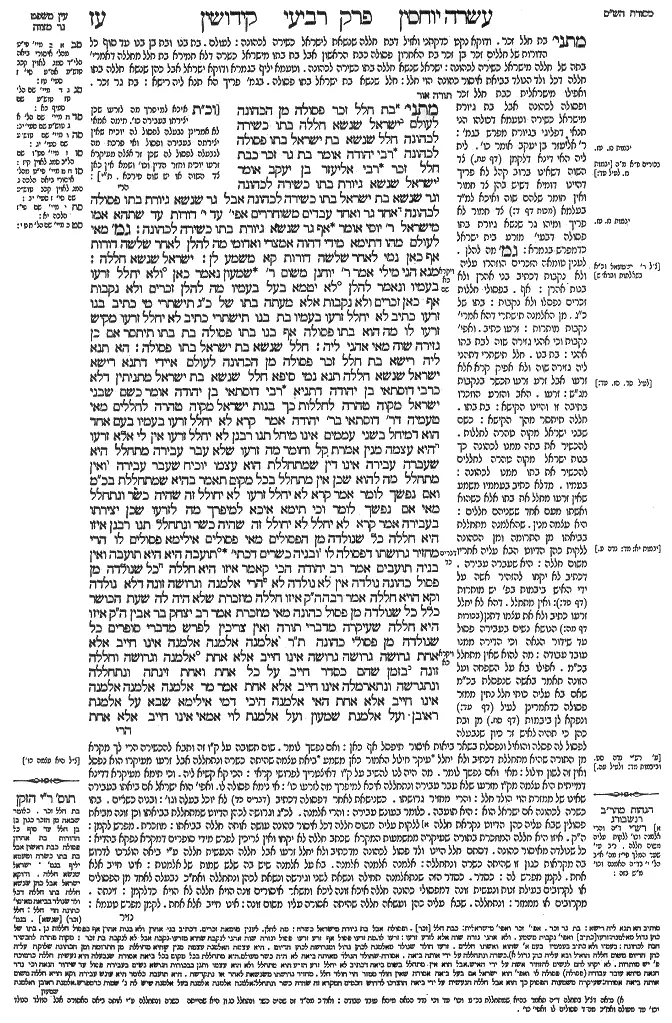
Kiddushin 77a - Guemara
מתני׳ בת חלל זכר פסולה מן הכהונה לעולם ישראל שנשא חללה בתו כשירה לכהונה חלל שנשא בת ישראל בתו פסולה לכהונה רבי יהודה אומר בת גר זכר כבת חלל זכר רבי אליעזר בן יעקב אומר ישראל שנשא גיורת בתו כשירה לכהונה וגר שנשא בת ישראל בתו כשירה לכהונה אבל גר שנשא גיורת בתו פסולה לכהונה אחד גר ואחד עבדים משוחררים אפי' עד י' דורות עד שתהא אמו מישראל ר' יוסי אומר אף גר שנשא גיורת בתו כשירה לכהונה גמ׳ מאי לעולם מהו דתימא מידי דהוה אמצרי ואדומי מה להלן לאחר שלשה דורות אף כאן נמי לאחר שלשה דורות קא משמע לן ישראל שנשא חללה מנא הני מילי אמר ר' יוחנן משום ר' שמעון נאמר כאן (ויקרא כא, טו) ולא יחלל זרעו בעמיו ונאמר להלן (ויקרא כא, ד) לא יטמא בעל בעמיו מה להלן זכרים ולא נקבות אף כאן זכרים ולא נקבות אלא מעתה בתו של כ"ג תישתרי מי כתיב בנו זרעו כתיב לא יחלל זרעו בעמיו בת בנו תישתרי כתיב לא יחלל זרעו מקיש זרעו לו מה הוא בתו פסולה אף בנו בתו פסולה בת בתו תיתסר אם כן גזירה שוה מאי אהני ליה חלל שנשא בת ישראל בתו פסולה הא תנא ליה רישא בת חלל זכר פסולה מן הכהונה לעולם איידי דתנא רישא ישראל שנשא חללה תנא נמי סיפא חלל שנשא בת ישראל מתניתין דלא כרבי דוסתאי בן יהודה דתניא רבי דוסתאי בן יהודה אומר כשם שבני ישראל מקוה טהרה לחללות כך בנות ישראל מקוה טהרה לחללים מאי טעמיה דר' דוסתאי בר' יהודה אמר קרא לא יחלל זרעו בעמיו בעם אחד הוא דמיחל בשני עממים אינו מיחל תנו רבנן לא יחלל זרעו אין לי אלא זרעו היא עצמה מנין אמרת קל וחומר מה זרעו שלא עבר עבירה מתחלל היא שעברה עבירה אינו דין שמתחללת הוא עצמו יוכיח שעבר עבירה ואין מתחלל מה להוא שכן אין מתחלל בכל מקום תאמר בהיא שמתחללת בכ"מ ואם נפשך לומר אמר קרא לא יחלל זרעו לא יחולל זה שהיה כשר ונתחלל מאי אם נפשך לומר וכי תימא איכא למיפרך מה לזרעו שכן יצירתו בעבירה אמר קרא לא יחלל לא יחולל זה שהיה כשר ונתחלל תנו רבנן איזו היא חללה כל שנולדה מן הפסולים מאי פסולים אילימא פסולים לו הרי מחזיר גרושתו דפסולה לו ובניה כשרים דכתי' (דברים כד, ד) תועבה היא היא תועבה ואין בניה תועבים אמר רב יהודה הכי קאמר איזו היא חללה כל שנולדה מן פסול כהונה נולדה אין לא נולדה לא הרי אלמנה וגרושה זונה דלא נולדה וקא הויא חללה אמר רבה ה"ק איזו חללה מוזכרת שלא היה לה שעת הכושר כלל כל שנולדה מן פסול כהונה מאי מוזכרת אמר רב יצחק בר אבין ה"ק איזו היא חללה שעיקרה מדברי תורה ואין צריכין לפרש מדברי סופרים כל שנולדה מן פסולי כהונה ת"ר אלמנה אלמנה אלמנה אינו חייב אלא אחת גרושה גרושה גרושה אינו חייב אלא אחת (ויקרא כא, יד) אלמנה וגרושה וחללה זונה בזמן שהם כסדר חייב על כל אחת ואחת זינתה ונתחללה ונתגרשה ונתארמלה אינו חייב אלא אחת אמר מר אלמנה אלמנה אלמנה אינו חייב אלא אחת האי אלמנה היכי דמי אילימא שבא על אלמנת ראובן ועל אלמנת שמעון ועל אלמנת לוי אמאי אינו חייב אלא אחת
Comments from Rashi on Masechet Kiddushin Page 77a
מתני' בת חלל זכר . ודוקא נקט כדקתני ואזיל דבת חללה שנשאת לישראל כשירה לכהונה: לעולם . בת בנו ובת בן בנו עד סוף כל הדורות של חללים זכר בן זכר בת האחרון פסולה כבת הראשון אבל בת בתו מישראל כשרה דלא חמירא בת חלל מחללה דאמרי' בתה של חללה מישראל כשירה לכהונה: ישראל שנשא חללה בתו כשירה לכהונה . וטעמא יליף בגמרא ודוקא ישראל אבל כהן שנשא חללה בתו חללה דכל ולד הנולד בביאת איסור כהונה הוי חלל: חלל שנשא בת ישראל בתו פסולה . בגמ' פריך הא תנא ליה רישא: בת גר זכר . ואפילו מישראלית כבת חלל זכר ופסולה לכהונה אבל בת גיורת מישראל כשירה וטעמא דכולהו הני תנאי דפליגי בגיורת מפרש בגמ': ר' אליעזר בן יעקב אומר כו' . לית ליה האי דינא דלקמן (קידושין דף עח.) צד השוה דשאינו ברוב קהל לא פריך דהיינו דומיא דשיש בהן צד חמור ואין חומר שלהם שוה ואיכא למ"ד בעלמא (מכות דף ד:) צד חמור לא פריך ומיהו גר שנשא גיורת בתו פסולה דבעי' מזרע בית ישראל כדמפרש בגמרא: גמ' מה להלן . לענין טומאה הזכרים הוזהרו עליה ולא נקבות דכתיב בני אהרן ולא בנות אהרן: אף . בפסולי חללות זכרים נפסלו ולא נקבות: גמ' מה להלן . לענין טומאה הזכרים הוזהרו עליה ולא נקבות דכתיב בני אהרן ולא בנות אהרן: אף . בפסולי חללות זכרים נפסלו ולא נקבות: בתו של כ"ג . מן האלמנה תישתרי דהא אמרי' נקבות מותרות: זרעו כתיב . ואפי' נקבות וכי אהני גזירה שוה לבת בתו אהני: בת בנו . חלל תישתרי דתהני ליה גזירה שוה ולא אפיק קרא אלא זרעו אבל זרע זרעו תכשר בנקבות מג"ש: זרעו . האב והזרע הוזכרו בתיבה זו והיינו הקישא: בת בתו . חללה תיתסר מהך הקישא: כשם שבני ישראל מקוה טהרה לחללות . להכשיר את בתה ממנו לכהונה כך בנות ישראל מקוה טהרה לחללים להכשיר את בתו ממנו לכהונה: בעמיו . מדלא כתיב בעממיו משמע שאין זרעו מחלל את בתו אלא כשהוא ואשתו מעם אחד ששניהם חללים: היא עצמה מנין . שהאלמנה מתחללת בביאתו מן התרומה ומן הכהונה ללקות כהן הדיוט הבא עליה אחריו משום חללה: היא שעברה עבירה . דכתיב לא יקחו להזהיר אשה על ידי האיש ביבמות בפ' יש מותרות (דף פד:): ואין מתחלל . דהא לא יחלל זרעו כתיב ולא את עצמו דתנן (בכורות דף מה:) הנושא נשים בעבירה פסול עד שידור הנאה וכי הדירה ממנו עובד עבודה: מה להוא שאין מתחלל בכ"מ . אפילו בא על השפחה ועל הזונה תאמר באשה שנפסלת בכ"מ שאם בא עליה כותי חלל נתין ממזר פסולה כדאמרינן לעיל (קידושין דף עד:) ונפקא לן ביבמות (דף סח.) מן ובת כהן כי תהיה לאיש זר כיון שנבעלה לפסול לה פסלה והואיל ונפסלת בשאר ביאות איסור תיפסל אף כאן: ואם נפשך לומר . שום תשובה על ק"ו זה ותבא להכשירה הרי לך מקרא מן התורה שהיא מתחללת דכתיב ולא יחלל עיקר חילול האמור כאן משמע ביאת עצמה שהיתה כשרה ונתחללה אבל זרעו מעיקרו הוא נפסל ואין זה לשון חילול: מאי ואם נפשך לומר . מה היה לנו להשיב על ק"ו דאיצטריך לפרושי קראי: הכי קא קשיא ליה . וכי תימא מעיקרא דדינא דמייתית היא עצמה מק"ו מזרעו שלא עבר עבירה ונתחללה איכא למיפרך מה לזרעו כו': אי נימא פסולה לו . ואפי' הוא ישראל אם ביאתו בעבירה שאינו של ממזרת הוי הולד חלל: והרי מחזיר גרושתו . כשנישאת לאחר דפסולה דכתיב (דברים כד) לא יוכל בעלה וגו': ובניה כשרים . בתו כשרה לכהונה אם ישראל הוא: היא תועבה . כלומר בעונש עבירה: הכי קא קשיא ליה . וכי תימא מעיקרא דדינא דמייתית היא עצמה מק"ו מזרעו שלא עבר עבירה ונתחללה איכא למיפרך מה לזרעו כו': והרי אלמנה . לכ"ג וגרושה לכהן הדיוט שמתחללת בביאתו וכן זונה מביאת פסולין שבא עליה כהן הדיוט נקראת חללה ללקות עליה משום חללה דכל איסור כהונה עושה אותה חללה בביאתו: מוזכרת . מפרש לקמן: ה"ק איזו היא חללה . המוזכרת בתורה שעיקרה ממשמעות המקרא שכתב חללה לא יקחו ואין צריכין לפרש מידי סופרים דמקרא נפקא בהדיא: כל שנולדה מאיסור כהונה . דסתם חלל היינו ולד פסול לכהונה מדכתיב ולא יחלל זרעו אבל חללה הנעשית חללה ע"י ביאה הוצרכו לדרוש בה מקראות כגון זו שהיתה כשרה ונתחללה: אלמנה אלמנה אלמנה . בא על אלמנה שיש בה שלש שמות של אלמנות: אינו חייב אלא אחת . לקמן מפרש לה: כסדר . כסדר הזה שנתאלמנה תחילה ונשאת לשני וגירשה ונשאת לכהן ונתחללה ואח"כ נבעלה לאחד מן הפסולים או לקרובים בעילת זנות ונעשית זונה דמפסולי כהונה חללה איכא זונה ליכא ומשאר איסורים זונה הויא חללה לא הויא כדלקמן: זינתה . מקרובים או מממזר: ונתחללה . שבא עליה כהן ועשאה חללה שהיתה אסורה עליו משום זונה: אינו חייב אלא אחת . לקמן מפרש טעמא:
Comments from Tosafot - Kiddushin 77a
[וכ"ת איכא למיפרך מה לזרעו שכן יצירתו בעבירה כו' . תימה אמאי לא אמרינן נבעלה לפסול לה יוכיח שאין יצירתה בעבירה ופסול ואי פרכת מה לנבעלה לפסול לה שכן זר אצלה מעיקרא זרעו יוכיח וחזר הדין וכו' ושמא אין כאן צד השוה או יש שום פירכא. ת"י]:
Kiddushin 77a - Mishnah translated into english
MISHNA: The daughter of a male ḥalal is unfit to marry into the priesthood forever. In other words, all daughters of male descendants of a ḥalal are prohibited from marrying priests, as they have the status of ḥalalot. If there was an Israelite who married a ḥalala, his daughter is fit to marry into the priesthood, whereas if there was a ḥalal who married a Jewish woman, his daughter is unfit to marry into the priesthood. Rabbi Yehuda says: The daughter of a male convert is like the daughter of a male ḥalal, and she is also prohibited from marrying into the priesthood.
Rabbi Eliezer ben Ya’akov disagrees and says: If there was an Israelite who married a female convert, his daughter is fit to marry into the priesthood, and similarly if there was a convert who married a Jewish woman, his daughter is fit to marry into the priesthood. But if there was a male convert who married a female convert, his daughter is unfit to marry into the priesthood. With regard to both converts and emancipated Canaanite slaves, their daughters are unfit to marry into the priesthood even up to ten generations. This halakha applies to the offspring until his mother is born Jewish. Rabbi Yosei says: Even if there was a male convert who married a female convert, his daughter is fit to marry into the priesthood.
GEMARA: What is the meaning of the statement that the daughter of a ḥalal is unfit forever? The Gemara explains: It is necessary lest you say that the halakha should be just as it is in the case of an Egyptian convert and an Edomite convert, and that just as there, with regard to an Egyptian and an Edomite, their descendants are permitted to enter into the congregation after three generations, so too here, the daughter of a descendant of a ḥalal should also be allowed to marry into the priesthood after three generations. The mishna therefore teaches us that this prohibition is permanent.
The mishna teaches that in the case of an Israelite who married a ḥalala, his daughter is fit to marry into the priesthood. The Gemara asks: From where are these matters derived? Rabbi Yoḥanan says in the name of Rabbi Shimon that it is stated here: “And he shall not profane his offspring among his people” (Leviticus 21:15), and it is stated there: “He shall not defile himself, being a chief man among his people” (Leviticus 21:4): Just as there the prohibition against a priest contracting ritual impurity from a corpse applies to males but not females; so too here, with regard to the profanation of his offspring, where the term “among his people” is also employed, it is males who are rendered unfit and who render their daughters unfit to marry into the priesthood when they are ḥalalim, but not females.
The Gemara asks: If that is so, that profanation applies only to males, the daughter of a High Priest and a widow should be permitted to marry into the priesthood, and there should be no status of a ḥalala. The Gemara rejects this: Is it written that his son is profaned? It is written: “His offspring,” which includes his daughter, as the verse reads: “He shall not profane his offspring among his people.” Nevertheless, the daughter of his ḥalala daughter, who is already the third generation, is permitted as a result of the verbal analogy.
The Gemara asks: If so, that the granddaughter is permitted as a result of the verbal analogy, the daughter of his son should also be permitted. The Gemara answers: It is written: “He shall not profane his offspring,” by which the Torah links his offspring to him: Just as for him, his daughter is unfit; so too for his son, the son of a High Priest, his daughter is unfit. The Gemara asks: In that case, the daughter of his daughter from an Israelite should be prohibited, just as his own daughter is unfit. The Gemara answers: If so, that his daughter’s daughter is also unfit, of what use is the verbal analogy of: “He shall not defile himself, being a chief man among his people”? It must teach that his daughter’s daughter is fit.
§ The mishna teaches that if there was a ḥalal who married a Jewish woman, his daughter is unfit to marry into the priesthood. The Gemara questions this ruling: Wasn’t this already taught in the first clause: The daughter of a male ḥalal is unfit to marry into the priesthood forever? The Gemara answers: Since it taught in the first clause about an Israelite who married a ḥalala, it also taught in the latter clause about a ḥalal who married a Jewish woman, to present the complete ruling.
The Gemara comments: The mishna is not in accordance with the opinion of Rabbi Dostai ben Yehuda, as it is taught in a baraita: Rabbi Dostai ben Yehuda says: Just as the sons of Israel are a ritual bath of purity for ḥalalot, i.e., the daughter of a ḥalala who marries an Israelite does not transmit her status of a ḥalala, and their daughters may marry priests, so the daughters of Israel are a ritual bath of purity for ḥalalim, and their daughters may marry priests. The Gemara asks: What is the reason of Rabbi Dostai, son of Rabbi Yehuda? The Gemara explains that the verse states: “He shall not profane his offspring among his people” (Leviticus 21:15), which teaches: It is among one people that he profanes, i.e., the offspring is a ḥalal only when he and his wife are both profaned, i.e., ḥalalim, but among two peoples he does not profane. If the mother is of a different people, i.e., not a ḥalala, the offspring is of unflawed lineage.
The Sages taught: The verse states that a priest may not engage in intercourse with a woman who is forbidden to him, so that “he shall not profane his offspring.” I have derived only that his offspring resulting from a union with a woman forbidden to him is profaned, i.e., has the status of a ḥalal; from where do I derive that she herself, i.e., the woman who engaged in forbidden intercourse with the priest, is also disqualified from marrying into the priesthood? You can say it is an a fortiori inference: If his offspring, who did not commit a transgression, is profaned, is it not logical that she, who did commit a transgression, is similarly profaned?
The Gemara responds: He, the priest himself, shall prove otherwise, as he committed a transgression but he is not profaned. Although he may not serve in the Temple while he remains married to her, he regains his status of a fit priest once he divorces her. The Gemara rejects this: What is notable about the priest? He is notable in that he is a male, and in no case is a male priest profaned by engaging in forbidden intercourse. Will you say the same with regard to her, a woman, who is disqualified from marrying a priest in all cases? For example, if she engages in intercourse with a man of flawed lineage, she assumes the status of a zona and is permanently disqualified from marrying into the priesthood.
And if it is your wish to say that this reasoning is faulty, there is a different proof: The verse states: “He shall not profane his offspring,” which means that the priest may not engage in intercourse with a woman who is forbidden to him so that someone shall not become profaned. The verse is referring to this woman who was at one time fit and then became profaned. In other words, the term profanation does not apply to his offspring, as they were never fit to begin with. Rather, it is referring to the woman with whom he engaged in intercourse, as, since she was initially fit to marry into the priesthood, she can be described as becoming profaned.
The Gemara asks: What is the meaning of: If it is your wish to say that this reasoning is faulty, in what way is it faulty? The Gemara explains the counterargument: And if you would say that the a fortiori argument can be refuted as follows: What is notable about his offspring? He is notable in that he is formed through a transgression. Since the woman was not formed through a transgression, one cannot derive the halakha pertaining to her from that of the offspring. The Gemara therefore continues that even if one were to state that counterargument, the verse nevertheless states: “He shall not profane his offspring,” which means that the priest may not engage in intercourse with a woman who is forbidden to him so that someone shall not become profaned. The verse is referring to this woman who was at one time fit and then became profaned.
§ The Sages taught: Who is a ḥalala? The term is referring to any woman born from people of flawed lineage. The Gemara asks: What is the meaning of people of flawed lineage? If we say it means she was born from someone unfit for him, i.e., a woman forbidden to this particular man due to a family relationship or for some other reason, isn’t there the case of one who remarries his divorcée after she had been married to someone else in the interim; she is unfit for him, and yet her children are fit. As it is written with regard to this case: “That is an abomination” (Deuteronomy 24:4), and this is interpreted to mean: That marriage is an abomination, but the children of that marriage are not an abomination and are entirely fit.
Rav Yehuda says: This is what the Sages are saying: Who is a ḥalala? The term is referring to any woman born from one unfit for the priesthood. The Gemara questions this: This implies that one who was born, yes, she is a ḥalala, but one who was not born from one unfit for the priesthood is not a ḥalala. Aren’t there the cases of a widow, or a divorced woman, or a zona who engaged in intercourse with a priest? They were not born from one who was unfit for the priesthood, and yet such a woman is a ḥalala.
Rabba said: This is what the Sages are saying: Who is the ḥalala mentioned that did not have a moment of fitness at all, but was unfit from birth? She is any woman born from one unfit for the priesthood. The Gemara asks: What is the meaning of the term: Mentioned? Where was she mentioned? Rav Yitzḥak bar Avin said: This is what the Sages are saying: Who is the ḥalala whose prohibition is rooted in the words of a verse in the Torah, and it is not necessary to clarify her prohibition further by the words of the Sages? She is any woman born from one unfit for the priesthood. With regard to such a woman the verse explicitly states: “He shall not profane his offspring.” By contrast, the halakha that a woman who engages in forbidden intercourse with a priest becomes a ḥalala is not explicit in the Torah, but is learned through an exposition of the Sages.
§ The Sages taught: If a High Priest engages in sexual intercourse with a widow, a widow, a widow, he is liable to receive only one set of lashes. Similarly, if a priest engages in intercourse with a divorcée, a divorcée, a divorcée, he is liable to receive only one set of lashes.
If a High Priest engages in sexual intercourse with a woman who was a widow, and then was a divorcée, and then was a ḥalala, and then was a zona, when the changes to her status occurred in that order, that she was first widowed, then remarried and was divorced, and subsequently engaged in intercourse with a priest, thereby becoming a ḥalala, and then she engaged in intercourse with a gentile or a forbidden relative, thereby becoming a zona, the High Priest is liable to receive lashes for each and every one of these transgressions each time he engages in intercourse with her. By contrast, if she first became a zona by engaging in intercourse with a gentile or a forbidden relative, and then became a ḥalala by engaging in intercourse with a priest, and subsequently she divorced, remarried, and was widowed, a High Priest who now engages in intercourse with her is liable to receive only one set of lashes.
The Gemara proceeds to clarify this baraita. The Master said in the baraita: If a High Priest engages in intercourse with a widow, a widow, a widow, he is liable to receive only one set of lashes. The Gemara asks: What are the circumstances of this widow? If we say that he engaged in sexual intercourse with three widows: With Reuven’s widow, and with Shimon’s widow, and with Levi’s widow, why is he liable to receive only one set of lashes?
Traduction : The William Davidson digital edition of the Koren Noé Talmud, with commentary by Rabbi Adin Even-Israel Steinsaltz.