 Talmud Bavli
The learning on the whole site is dedicated : L'ilui Nishmat Reuven ben Rivka SEBBAG
The learning on the whole site is dedicated : L'ilui Nishmat יוסף בן מושה
The learning on the whole site is dedicated : L'ilui Nishmat Jacques Isaac Ben Amram Loubaton
Kiddushin 73a : Youtube
Daf TubeYoutube
2 video classes :
Kiddushin Page 73a
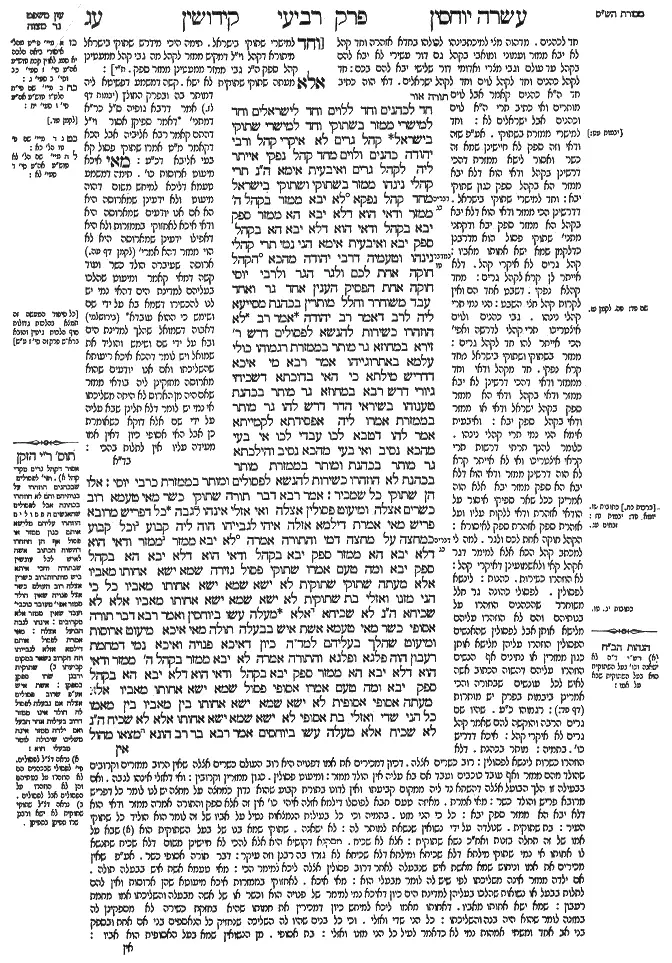
Kiddushin 73a - Guemara
חד לכהנים וחד ללוים וחד לישראלים וחד למישרי ממזר בשתוקי וחד למישרי שתוקי בישראל קהל גרים לא איקרי קהל ורבי יהודה כהנים ולוים מחד קהל נפקי אייתר ליה לקהל גרים ואיבעית אימא ה"נ תרי קהלי נינהו ממזר בשתוקי ושתוקי בישראל מחד קהל נפקא (דברים כג, ג) לא יבא ממזר בקהל ה' ממזר ודאי הוא דלא יבא הא ממזר ספק יבא בקהל ודאי הוא דלא יבא הא בקהל ספק יבא ואיבעית אימא הני נמי תרי קהלי נינהו וטעמיה דרבי יהודה מהכא (במדבר טו, טו) הקהל חוקה אחת לכם ולגר הגר ולרבי יוסי חוקה אחת הפסיק הענין אחד גר ואחד עבד משוחרר וחלל מותרין בכהנת מסייעא ליה לרב דאמר רב יהודה אמר רב לא הוזהרו כשירות להנשא לפסולים דרש ר' זירא במחוזא גר מותר בממזרת רגמוהו כולי עלמא באתרוגייהו אמר רבא מי איכא דדריש מילתא כי האי בדוכתא דשכיחי גיורי דרש רבא במחוזא גר מותר בכהנת טענוהו בשיראי הדר דרש להו גר מותר בממזרת אמרו ליה אפסידתא לקמייתא אמר להו דטבא לכו עבדי לכו אי בעי מהכא נסיב ואי בעי מהכא נסיב והילכתא גר מותר בכהנת ומותר בממזרת מותר בכהנת לא הוזהרו כשירות להנשא לפסולים ומותר בממזרת כרבי יוסי אלו הן שתוקי כל שמכיר אמר רבא דבר תורה שתוקי כשר מאי טעמא רוב כשרים אצלה ומיעוט פסולין אצלה ואי אזלי אינהו לגבה כל דפריש מרובא פריש מאי אמרת דילמא אזלה איהי לגבייהו הוה ליה קבוע וכל קבוע כמחצה על מחצה דמי והתורה אמרה (דברים כג, ג) לא יבא ממזר ממזר ודאי הוא דלא יבא הא ממזר ספק יבא בקהל ודאי הוא דלא יבא הא בקהל ספק יבא ומה טעם אמרו שתוקי פסול גזירה שמא ישא אחותו מאביו אלא מעתה שתוקי שתוקית לא ישא שמא ישא אחותו מאביו כל כי הני מזנו ואזלי בת שתוקית לא ישא שמא ישא אחותו מאביו אלא לא שכיחא ה"נ לא שכיחא אלא מעלה עשו ביוחסין ואמר רבא דבר תורה אסופי כשר מאי טעמא אשת איש בבעלה תולה מאי איכא מיעוט ארוסות ומיעוט שהלך בעליהם למדינת הים כיון דאיכא פנויה ואיכא נמי דמחמת רעבון הוה פלגא ופלגא והתורה אמרה לא יבא ממזר בקהל ה' ממזר ודאי הוא דלא יבא הא ממזר ספק יבא בקהל ודאי הוא דלא יבא הא בקהל ספק יבא ומה טעם אמרו אסופי פסול שמא ישא אחותו מאביו אלא מעתה אסופי אסופית לא ישא שמא ישא אחותו בין מאביו בין מאמו כל הני שדי ואזלי בת אסופי לא ישא שמא ישא אחותו אלא לא שכיח ה"נ לא שכיח אלא מעלה עשו ביוחסים אמר רבא בר רב הונא מצאו מהול
Comments from Rashi on Masechet Kiddushin Page 73a
חד לכהנים . מדהוה מצי למיכתבינהו לכולהו בחדא אזהרה וחד קהל לא יבא ממזר ועמוני ומואבי בקהל גם דור עשירי לא יבא להם בקהל עד עולם וגבי מצרי ואדומי דור שלישי יבא להם בכם: חד לקהל כהנים וחד לקהל לוים וחד לקהל ישראלים . דאי הוה כתיב חד ה"א כהנים קאמר אבל לוים מותרים ואי כתיב תרי ה"א לוים וכהנים אבל ישראלים לא: וחד למישרי ממזרת בשתוקי . אע"פ שזה ודאי וזה ספק לא חיישינן שמא זה כשר ואסור לישא ממזרת דהכי דרשינן בקהל ודאי הוא דלא יבא ממזר הא בקהל ספק כגון שתוקי יבא: וחד למישרי שתוקי בישראל . דדרשינן הכי ממזר ודאי הוא דלא יבא בקהל הא ממזר ספק יבא ודקתני מתני' שתוקי פסול הוא מדרבנן כדלקמן שמא ישא אחותו מאביו: קהל גרים לא איקרי קהל . דלא אייתר לן קרא לקהל גרים: מחד קהלא נפקי . דשבט אחד הם ואין לקרות קהל חצי השבט: הני נמי תרי קהלי נינהו . גבי כהנים ולוים איצטריכו תרי קהלי לדרשה ואפי' הכי אייתר להו חד לקהל גרים: ממזר בשתוקי ושתוקי בישראל מחד קרא נפקי . חד מקהל ודאי וחד מממזר ודאי דהכי דרשינן לא יבא ממזר ודאי בקהל ודאי הא ממזר ספק בקהל ישראל ודאי או ממזר ודאי בקהל ספק יבא: ואיבעית אימא הני נמי תרי קהלי נינהו . כלומר להנך תרתי דרשות תרי קראי איצטריכו ואי לא אייתר קרא לא הוה דרשינן ממזר ודאי הוא דלא יבא הא ספק ממזר יבא אלא הוה אמרינן ככל שאר ספיקי איסור על הודאי אזהרת ודאי ללקות עליו ועל אזהרת ספק אזהרת ספק לאיסורא: הני נמי תרי קהלי נינהו . גבי כהנים ולוים איצטריכו תרי קהלי לדרשה ואפי' הכי אייתר להו חד לקהל גרים: הקהל חוקה אחת לכם ולגר . למה לי למכתב קהל הכא אלא למימר דגר אקהל קאי ולאשמועינן דאיקרי קהל: לא הוזהרו כשירות . כהנות: לינשא לפסולין . לפסולי כהונה גר חלל משוחרר שהכהנים הוזהרו על בנותיהם והם לא הוזהרו עליהם מלישא אותן אבל לפסולין שהאנשים הפסולין הוזהרו עליהן מלישא אותן כגון ממזרין או נתינים אף הנשים הוזהרו עליהם דהשוה הכתוב אשה לאיש לכל עונשים שבתורה והכי אמרינן ביבמות בפרק יש מותרות (דף פד:): רגמוהו כ"ע . שהיו שם גרים הרבה והוקשה להם שאמר קהל גרים לא איקרי קהל: איכא דדריש כו' . בתמיה: מותר בכהנת . דלא הוזהרו כשרות לינשא לפסולין: רוב כשרים אצלה . דכיון דמכירים את אמו דפנויה היא רוב העולם כשרים אצלה שאין הרוב ממזרים וקרובים שהולד מהם ממזר ואף עובד כוכבים ועבד אם בא עליה אין הולד ממזר: ומיעוט פסולין . כגון ממזרין וקרובין: ואי דאזלי אינהו לגבה . ואם בבעילה זו הלך הבועל אצלה דהשתא נד ליה ממקום קביעתו ואין לדונו בתורת קבוע שהוא נדון כמחצה על מחצה יש לנו לומר כל דפריש מרובא פריש והולד כשר: מאי אמרת . מאיזה טעם תבא לפוסלו דילמא אזלה איהי כו' אין זה אלא ספק והתורה אמרה ממזר ודאי הוא דלא יבא הא ממזר ספק יבא: כל כי הני מזנו . בתמיה וכי כל בעילות הנמצאות נטיל על אביו של זה לומר הוא הוליד כל שתוקי העיר: בת שתוקית . שנולדה על ידי נשואין שנשאת למותר לה: לא ישאנה . שתוקי שמא בנו של בעל השתוקית הוא שבא על אמו של זה תחלה בזנות ואח"כ נשא שתוקית: אלא לא שכיח . מסקנא דקושיא היא אלא להכי לא חיישינן משום דלא שכיח שתנשא לו אחותו אי נמי שתוקי מילתא דלא שכיחא ומילתא דלא שכיחא לא גזרו בה רבנן וזה עיקר: דבר תורה אסופי כשר . אע"פ שאין מכירים את אמו וניחוש שמא מאשת איש שנבעלה לאחר דרוב פסולין אצלה ליכא למימר הכי: מאי טעמא אשת איש בבעלה תולה . אם ילדה ממזר אינה משליכתו לפי שיש לה לומר מבעלי הוא: מאי איכא . לאחזוקי בממזרות איכא מיעוטא שהן ארוסות ואין להם לתלות בבעל או נשואות שהלכו בעליהן למדינת הים כיון דאיכא נמי למימר של פנויה הוא וכשר או של אשה מבעלה והשליכתו אמו מחמת רעבון: שמא ישא אחותו מאביו . דאחותו מאמו ליכא למיחש כיון דמכירין את חמותו שהיא בחזקת כשירה לא מספקינן לה במזנה לומר שהוא היה בנה והשליכתו: כל הני שדי ואזלי . וכי כל בנים שהיו לה השליכה שנחזיק כל הנאספים בני אם אחת ובספק בני אב אחד ומשתי אמהות נמי לא כדאמר לעיל כל הני מזנו ואזלי: אלא לא שכיח . מסקנא דקושיא היא אלא להכי לא חיישינן משום דלא שכיח שתנשא לו אחותו אי נמי שתוקי מילתא דלא שכיחא ומילתא דלא שכיחא לא גזרו בה רבנן וזה עיקר: בת אסופי . מן הנשואין שמא בעל האסופית הוא אביו:
Comments from Tosafot - Kiddushin 73a
[וחד למישרי שתוקי בישראל . תימה היכי מידרש שתוקי בישראל מיתורא דקהל וי"ל דמקיש ממזר לקהל מה גבי קהל ממעטינן קהל ספק ה"נ גבי ממזר ממעטינן ממזר ספק. ת"י]: אלא מעתה שתוקי שתוקית לא ישא . קשה דמשמע דפשיטא ליה דמותר בה ובפרק החולץ (יבמות דף לז.) אמר דרבא גופיה ס"ל כר"א דמתני' דאמר ספיקן אסור וי"ל דהתם קאמר רבא אליביה אבל הכא דקאמר מ"ט אמרו שתוקי פסול קא בעי אליבא דכ"ע: מאי איכא מיעוט ארוסות כו' . תימה דמשמע טעמא דליכא למיחש משום דהוה מיעוט ולא ידעינן שמארוסה היא הא אם אנו יודעים שמארוסה היא ודאי איכא לאחזוקי בממזרות ולא היא דאפילו ידעינן שמארוסה היא לא הוי ממזר דהא אמרי' (לקמן קידושין דף עה.) ארוסה שעיברה הולד כשר ועוד קשה דמאי קאמר ומיעוט שהלכו בעליהם למדינת הים דהאי נמי יש לנו להכשירו דשמא בא על ידי שם ושימש כי ההוא עובדא (בירושלמי) דאבוה דשמואל שהלך למדינת הים ובא על ידי שם ושימש והוליד את שמואל ויש לומר דהכא איכא ריעותא שהשליכתו ואם אנו יודעים שהוא מארוסה מחזקינן ליה בודאי ממזר שאם היה מן הארוס לא היתה משליכתו אי נמי יש לומר דלא תלינן שבא עליה על ידי שם אלא דוקא כשאומרת כן אבל האי אסופי כיון דאין אמו מעידה עליו אין לתלות בהכי:
Kiddushin 73a - Mishnah translated into english
One is referring to priests, to teach that people with flawed lineage may not enter their congregation; and one is referring to Levites; and one to Israelites; and one serves to permit a mamzer to marry a shetuki, since a mamzer is prohibited from entering only the congregation of God, but he may marry someone who is not definitely a member of the congregation, e.g., a shetuki; and one serves to permit a shetuki to marry an Israelite, as only one who is a definite mamzer may not marry an Israelite. As for the congregation of converts, it is not called a congregation at all, and they may marry those prohibited from entering the congregation of Israel. And Rabbi Yehuda holds that priests and Levites are derived from one instance of the word “congregation,” since they are from the same tribe, that of Levi. Consequently, one instance of the word “congregation” remains for him to interpret. He interprets it as referring to the congregation of converts, and deems it prohibited for a mamzer to enter that congregation as well.
And if you wish, say: So too, Rabbi Yehuda agrees with Rabbi Yosei that Levites and priests are two congregations, since there are special halakhot of marriage that apply only to priests. Rather, Rabbi Yehuda holds that the permissibility of the marriage of a mamzer with a shetuki and a shetuki with an Israelite is derived from one instance of the word “congregation,” from the verse: “A mamzer shall not enter into the congregation of the Lord” (Deuteronomy 23:3).
This is accomplished by inferring the following: It is one who is a definite mamzer who may not enter, but one who is a mamzer as a result of an uncertainty, e.g., a shetuki, may enter. And similarly, it is into the congregation of those with definite unflawed lineage that a mamzer may not enter, but into a congregation of those with uncertain lineage, e.g., a shetuki, he may enter. This verse therefore teaches that both types of marriage are permitted. In any event, Rabbi Yehuda remains with one instance of the word “congregation” to interpret, from which he derives that it is also prohibited for a convert to marry a mamzeret.
And if you wish, say: These too, one who is a definite mamzer and one who is a mamzer as the result of an uncertainty, are two congregations, each requiring its own verse, and the reason of Rabbi Yehuda is from here: “As for the congregation, there shall be one statute both for you, and for the stranger that sojourns with you” (Numbers 15:15), which indicates that converts are considered like Israelites with regard to their being included in the category of “congregation.” And according to Rabbi Yosei, who holds that a convert may marry a mamzeret, the phrase “one statute” interrupts the matter, and converts are not considered part of the congregation of God.
§ The Gemara comments: The statement of the Tosefta that a convert, and an emancipated slave, and a ḥalal are all permitted to marry the daughter of a priest supports the opinion of Rav, as Rav Yehuda says that Rav says: Women of unflawed lineage who are daughters of priests were not prohibited from marrying those disqualified from the priesthood due to flawed lineage [ḥalalim], since that prohibition applies only to male priests.
Rabbi Zeira taught in Meḥoza: It is permitted for a convert to marry a mamzeret. Everyone stoned him with their etrogim, since the many converts present were insulted by his statement, which they understood to mean that converts are not members of God’s congregation. Rava said: Is there a person who teaches such a matter in a place where there are commonly converts? He should have been more circumspect. Rava himself taught this in Meḥoza to ameliorate the situation: It is permitted for a convert to marry the daughter of a priest. They carried him on silk [beshira’ei] for elevating the honor of converts. He later taught them: It is permitted for a convert to marry a mamzeret. They said to him: You have forfeited the honor of your first sermon. Rava said to them: I have done for you what is good for you. If a convert wishes, he may marry from here, i.e., from those of pure lineage, and if he wishes, he may marry from here, i.e., a mamzeret.
The Gemara concludes: And the halakha is: It is permitted for a convert to marry the daughter of a priest, and it is permitted for him to marry a mamzeret. It is permitted for a convert to marry the daughter of a priest, since women of unflawed lineage were not prohibited from marrying those disqualified for the priesthood. And it is permitted for him to marry a mamzeret, in accordance with the opinion of Rabbi Yosei, who holds that the congregation of converts is not called a congregation.
§ The mishna teaches: And these are the last two categories: A shetuki is any person who knows the identity of his mother but does not know the identity of his father. Rava says: By Torah law, a shetuki is fit to enter the congregation. What is the reason for this? Most are fit with regard to her, i.e., most men are fit to engage in intercourse with an unmarried woman, and only a minority are unfit with regard to engaging in intercourse with her. There are few men who are related to a woman in a way that would render the offspring mamzerim.
Rava analyzes two possibilities: And if they came to her, i.e., if the father came to the mother’s location when the child was conceived, the following principle with regard to an uncertain prohibition takes effect: Anything that separates from its fixed location is presumed to have separated from the majority of items like it in that location. If the father separated from the population at large and came to the mother, one can assume that he was from the majority, who are of unflawed lineage. What might you say, that perhaps she went to them, and the child was conceived in the place where the father was? In such a case, it is an uncertain prohibition located in its fixed place, and the halakhic principle is: Anything fixed is considered as though it were half and half, i.e., fifty percent, and it remains a case of uncertainty, and it should be prohibited for the shetuki to marry a Jew with unflawed lineage.
And in any case, this does not suffice to prevent her shetuki child from marrying a Jew with unflawed lineage, since the Torah states: “A mamzer shall not enter into the congregation of the Lord” (Deuteronomy 23:3), which indicates: It is a definite mamzer who may not enter, but one who is a mamzer as a result of an uncertainty may enter. Similarly, it is into a congregation of those with definite unflawed lineage that he may not enter, but into a congregation of those with uncertain lineage he may enter. Therefore, even if it is uncertain if one is a mamzer, by Torah law he may marry a Jew with unflawed lineage.
And for what reason did the Sages nevertheless say that a shetuki is of flawed lineage? Due to a rabbinic decree, lest he marry his sister from his father, since the identity of his father is unknown. The Gemara asks: If that is so, it should not be permitted for a shetuki to marry even a female shetuki, lest he marry his sister from his father.
The Gemara responds: And do people engage in licentiousness to such an extent that one should be concerned that all the children of unknown paternity in one city were fathered by the same man? By the same reasoning, there should also be a decree that a shetuki may not marry the daughter of a female shetuki from a proper marriage, lest he marry his sister from his father, since the man who married the female shetuki might have been his father. Rather, it must be that it is not common for a shetuki to happen to marry his sister, and therefore he may marry the daughter of a female shetuki. So too, it is not common for him to happen to marry his sister, and the Sages would not issue a decree to prevent this from occurring.
The question therefore remains, why did they render it prohibited for a shetuki to marry a Jew with unflawed lineage? The Gemara answers that it is not prohibited for a shetuki to marry a Jew with unflawed lineage due to any halakhic concern. Rather, the Sages established a higher standard with regard to lineage, in that they rendered it prohibited for people from unknown backgrounds to marry those with unflawed lineage.
And Rava says a similar statement: By Torah law, a foundling, a child found in the marketplace whose parents are unknown, is fit, and there is no concern that the child is a mamzer. What is the reason for this? A married woman who becomes pregnant through extramarital intercourse, which results in the child being a mamzer, ascribes the child to her husband. Since everyone assumes that her husband is the father, she has no reason to abandon the child in the marketplace. What case is there where a mother would want to abandon her mamzer child? There is the minority of situations involving betrothed women who committed adultery but cannot claim that her betrothed is the father, as they had not been living together. And there is the minority of women whose husbands have gone overseas and could not have fathered the children.
Since there are many other cases of unmarried women who do abandon their children although those children have unflawed lineage, and there are also children with unflawed lineage who are abandoned by their parents due to hunger, the concern that the child is a mamzer is no more than half and half, i.e., fifty percent. And the Torah states: “A mamzer shall not enter into the congregation of the Lord” (Deuteronomy 23:3), which indicates: It is one who is a definite mamzer who may not enter, but one who is a mamzer as a result of an uncertainty may enter. Similarly, it is into a congregation of those with definite unflawed lineage that he may not enter, but into a congregation of those with uncertain lineage he may enter. This child is a mamzer as the result of an uncertainty, and by Torah law may marry a Jew with unflawed lineage.
And for what reason did the Sages say that a foundling is unfit? Lest he marry his sister from his father. The Gemara asks: If that is so, it should not be permitted for a foundling to marry even a female foundling, lest he marry his sister from either his father or his mother. The Gemara rejects this: Are they continually throwing away all these children? Is it likely that the same parents abandoned both a son and a daughter? If you accept that suggestion, it should not be permitted for him to marry the daughter of a foundling, lest he marry his sister, as perhaps the father of the one he wishes to marry is his father as well. Rather, it must be that it is not common for a foundling to happen to marry his sister, and therefore he may marry the daughter of a foundling. So too, it is not common for him to happen to marry his sister, and the Sages would not make a decree to prevent this from occurring.
The question therefore remains: Why did they prohibit a foundling from marrying a Jew with unflawed lineage? The Gemara answers that it is prohibited for a foundling to marry a Jew with unflawed lineage not due to any halakhic concern. Rather, the Sages established a higher standard with regard to lineage, in that they rendered it prohibited for people from unknown backgrounds to marry those with unflawed lineage.
§ Rava bar Rav Huna says: If an abandoned boy was found circumcised,
Traduction : The William Davidson digital edition of the Koren Noé Talmud, with commentary by Rabbi Adin Even-Israel Steinsaltz.