 Talmud Bavli
Kiddushin 36a : Youtube
Daf TubeYoutube
2 video classes :
Kiddushin Page 36a
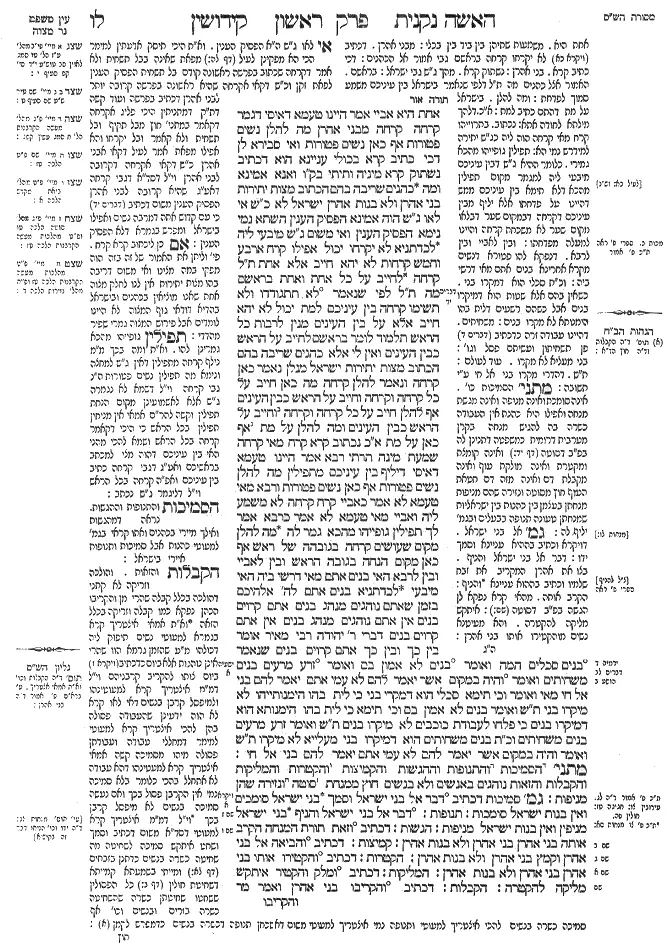
Kiddushin 36a - Guemara
אחת היא אביי אמר היינו טעמא דאיסי דגמר קרחה קרחה מבני אהרן מה להלן נשים פטורות אף כאן נשים פטורות ואי סבירא לן דכי כתיב קרא בכולי עניינא הוא דכתיב נשתוק קרא מיניה ותיתי בק"ו ואנא אמינא ומה כהנים שריבה בהם הכתוב מצות יתירות בני אהרן ולא בנות אהרן ישראל לא כ"ש אי לאו ג"ש הוה אמינא הפסיק הענין השתא נמי נימא הפסיק הענין ואי משום ג"ש מיבעי ליה לכדתניא לא יקרחו יכול אפילו קרח ארבע וחמש קרחות לא יהא חייב אלא אחת ת"ל קרחה לחייב על כל אחת ואחת בראשם מה ת"ל לפי שנאמר (דברים יד, א) לא תתגודדו ולא תשימו קרחה בין עיניכם למת יכול לא יהא חייב אלא על בין העינים מנין לרבות כל הראש תלמוד לומר בראשם לחייב על הראש כבין העינים ואין לי אלא כהנים שריבה בהם הכתוב מצות יתירות ישראל מנלן נאמר כאן קרחה ונאמר להלן קרחה מה כאן חייב על כל קרחה וקרחה וחייב על הראש כבין העינים אף להלן חייב על כל קרחה וקרחה וחייב על הראש כבין העינים ומה להלן על מת אף כאן על מת א"כ נכתוב קרא קרח מאי קרחה שמעת מינה תרתי רבא אמר היינו טעמא דאיסי דיליף בין עיניכם מתפילין מה להלן נשים פטורות אף כאן נשים פטורות ורבא מאי טעמא לא אמר כאביי קרח קרחה לא משמע ליה ואביי מאי טעמא לא אמר כרבא אמר לך תפילין גופייהו מהכא גמר לה מה להלן מקום שעושים קרחה בגובהה של ראש אף כאן מקום הנחה בגובה הראש ובין לאביי ובין לרבא האי בנים אתם מאי דרשי ביה האי מיבעי לכדתניא בנים אתם לה' אלהיכם בזמן שאתם נוהגים מנהג בנים אתם קרוים בנים אין אתם נוהגים מנהג בנים אין אתם קרוים בנים דברי ר' יהודה רבי מאיר אומר בין כך ובין כך אתם קרוים בנים שנאמר (ירמיהו ד, כב) בנים סכלים המה ואומר (דברים לב, כ) בנים לא אמון בם ואומר (ישעיהו א, ד) זרע מרעים בנים משחיתים ואומר (הושע ב, א) והיה במקום אשר יאמר להם לא עמי אתם יאמר להם בני אל חי מאי ואומר וכי תימא סכלי הוא דמקרי בני כי לית בהו הימנותייהו לא מיקרו בני ת"ש ואומר בנים לא אמון בם וכי תימא כי לית בהו הימנותא הוא דמיקרו בנים כי פלחו לעבודת כוכבים לא מיקרו בנים ת"ש ואומר זרע מרעים בנים משחיתים וכ"ת בנים משחיתים הוא דמיקרו בני מעלייא לא מיקרו ת"ש ואומר והיה במקום אשר יאמר להם לא עמי אתם יאמר להם בני אל חי מתני׳ הסמיכות והתנופות וההגשות והקמיצות והקטרות והמליקות והקבלות והזאות נוהגים באנשים ולא בנשים חוץ ממנחת סוטה ונזירה שהן מניפות גמ׳ סמיכות דכתיב (ויקרא א, ב) דבר אל בני ישראל וסמך בני ישראל סומכים ואין בנות ישראל סומכות תנופות (ויקרא ז, כג) דבר אל בני ישראל והניף בני ישראל מניפין ואין בנות ישראל מניפות הגשות דכתיב (ויקרא ו, ז) וזאת תורת המנחה הקרב אותה בני אהרן בני אהרן ולא בנות אהרן קמיצות דכתיב (ויקרא ב, ב) והביאה אל בני אהרן וקמץ בני אהרן ולא בנות אהרן הקטרות דכתיב (ויקרא ג, ה) והקטירו אותו בני אהרן בני אהרן ולא בנות אהרן המליקות דכתיב (ויקרא א, טו) ומלק והקטיר איתקש מליקה להקטרה הקבלות דכתיב (ויקרא א, ה) והקריבו בני אהרן ואמר מר
Comments from Rashi on Masechet Kiddushin Page 36a
אחת היא. משמעות שתיהן בין ביד בין בכלי: מבני אהרן . דכתיב (ויקרא כא) לא יקרחו קרחה בראשם גבי אמור אל הכהנים: דכי כתיב קרא . בני אהרן: נשתוק קרא . מהך ג"ש גבי ישראל: בראשם . האמור אצל כהנים מה ת"ל דלפי שנאמר בישראל בין עיניכם משמע סמוך לפדחת: ומה להלן . בישראל על מת דהתם כתיב למת: א"כ . דלהך מילתא לחודה אתא: נכתוב . בתרוייהו קרח מאי קרחה הוה ליה כג"ש יתירה למידרש נמי הא: תפילין גופייהו מהכא גמירי . כלומר ההיא ג"ש דבין עיניכם מיבעי ליה למגמר מקום תפילין מהכא דלא תימא בין עיניכם ממש דהיינו על פדחתו אלא יליף מבין עיניכם דקרחה דבמקום שער דבלאו מקום שער לא משכחת קרחה והיינו למעלה מפדחתו: ובין לאביי ובין לרבא . דנפקא להו פטורא דנשים מקרא אחרינא בנים אתם מאי דרשי ביה: וכ"ת סכלי הוא דמקרו בני . כשאין בהם אלא שטות הוא דמיקרו בנים אבל כשהם רשעים דלית בהו הימנותא לא מקרו בנים: וכ"ת סכלי הוא דמקרו בני . כשאין בהם אלא שטות הוא דמיקרו בנים אבל כשהם רשעים דלית בהו הימנותא לא מקרו בנים: משחיתים . דהיינו עבודה זרה כדכתיב (דברים ד) פן תשחיתון ועשיתם פסל וגו': בני מעליא לא מקרו . עוד לעולם: ת"ש . דהדרי מקרו בני אל חי ע"י תשובה: מתני' הסמיכות כו' . אינה סומכת ואינה מניפה ואינה מגשת מנחה ואפילו היא כהנת אין העבודה כשרה בה להגיש מנחה בקרן מערבית דרומית כמשפטה דתנינן לה בפ"ב דסוטה (דף יד:) ואינה קומצת ומקטרת ואינה מולקת עוף ואינה מקבלת דם ואינה מזה דם חטאת העוף חוץ מסוטה ונזירה שהם מניפות מנחתן בעצמן בין כהנות בין ישראליות שמנחתן טעונה תנופה בבעלים ובגמ' יליף לה: מתני' הסמיכות כו' . אינה סומכת ואינה מניפה ואינה מגשת מנחה ואפילו היא כהנת אין העבודה כשרה בה להגיש מנחה בקרן מערבית דרומית כמשפטה דתנינן לה בפ"ב דסוטה (דף יד:) ואינה קומצת ומקטרת ואינה מולקת עוף ואינה מקבלת דם ואינה מזה דם חטאת העוף חוץ מסוטה ונזירה שהם מניפות מנחתן בעצמן בין כהנות בין ישראליות שמנחתן טעונה תנופה בבעלים ובגמ' יליף לה: גמ' אל בני ישראל . דויקרא וכתיב בההוא עניינא וסמך ידו: גמ' אל בני ישראל . דויקרא וכתיב בההוא עניינא וסמך ידו: דבר אל בני ישראל והניף . בצו את אהרן המקריב את זבח שלמיו וכתיב בההוא עניינא והניף: הקרב אותה . מהאי קרא נפקא לן הגשה בפ"ב דסוטה (שם:): איתקש מליקה להקטרה . והא מעיטנא נשים מוהקטירו אותו בני אהרן:
Comments from Tosafot - Kiddushin 36a
אי לאו ג"ש ה"א הפסיק הענין . וא"ת היכי תיסק אדעתין למימר הכי הא מפקינן לעיל (קידושין דף לה:) מפאת שאינה בבל תשחית ולא אמר דקרחה שכתוב בפרשה ראשונה קודם בל תשחית הפסיק הענין לפאת זקן וכ"ש דקאי אקרחה שהיא ראשונה בפרשה קרובה יותר לבני אהרן דכתיב בפרשה ועוד קשה דת"ק דמתניתין היכי פליג אקרחה דקאמר במתני' חוץ מבל תקיף ובל תשחית ולא קאמר ובל יקרחו והא אפילו מפאת אמר לעיל דקאי אבני אהרן כ"ש דקאי אקרחה דקרובה לבני אהרן וי"ל דסד"א דגבי קרחה דאע"ג שהיא קרובה לבני אהרן הפסיק הענין משום דכתיב (דברים יד) כי עם קדוש אתה דמרבה נשים ואפילו בישראל ומפרש בגמרא דלא הפסיק הענין: אם כן ליכתוב קרא קרח . פי' וליתן את האמור של זה בזה הוה מפקי במה מצינו ואי משום דריבה בהו מצות יתירות אין לנו לחלק מצוה אחת שאנו מוציאין בכהנים ובישראל בהדיא דודאי גוף המצוה לא היינו לומדים אבל פירוש המצוה גמרי שפיר מהדדי: תפילין גופייהו מהכא גמרינן להו . וא"ת ומה בכך מ"מ נילף קרחה מתפילין דאין ג"ש למחצה ונימא מה תפילין נשים פטורות ה"נ גבי קרחה וי"ל דשמא לא נגמרה ג"ש אלא לאשמועינן מקום הנחת תפילין וקשה להר"ם אמאי אין מניחין תפילין בכל הראש כי היכי דקאמר קרחה בכל הראש ושמא להכי מהני האי בין עיניכם דהוה מצי למכתב בראשיכם ואע"ג דגבי קרחה כתיב בין עיניכם ואפ"ה קרחה בכל הראש וי"ל דליגמר ג"ש נכתב: הסמיכות והתנופות וההגשות . נראה דמהגשות ואילך מיירי בכהנים ואתו קראי בגמ' למעוטי כהנות אבל סמיכות ותנופות איירי בישראל: הקבלות והזאות . והולכה וזריקה לא קתני דהולכה בכלל קבלה שהרי מן והקריבו הכהן נפקא כמו קבלה וזריקה בכלל הזאה וא"ת אמאי איצטריך קרא בגמרא למעוטי נשים תיפוק ליה דכולהו מ"ע שהזמן גרמא הוו שהרי אינן נוהגות אלא ביום כדכתיב (ויקרא ז) ביום צותו להקריב קרבניהם וי"ל דמ"מ איצטריך קרא למעוטינהו ולמיפסל קרבן בנשים דאי לאו קרא לא הוה ידעינן שהעבודה פסולה בהן להכי איצטריך קרא למעוטי למימר דמחללי עבודה ועבודתן פסולה מיהו מסמיכה קשה אמאי איצטריך קרא למעטינהו דהא עבודה לא אתחלל בהכי כלומר בלא סמיכה נמי אין הקרבן פסול בכך ואם נעשה סמיכה בנשים לא מיפסל קרבן בכך. וי"ל דמ"מ איצטריך קרא למעוטי דסד"א משום דכתיב וסמך ושחט איתקש סמיכה לשחיטה מה שחיטה כשרה בנשים כדתנן בזבחים (דף לא:) ומייתי בשמעתא קמייתא דשחיטת חולין (דף ב:) כל הפסולין ששחטו שחיטתן כשרה שהשחיטה כשרה בזרים ובנשים וכו' אף סמיכה כשרה בנשים להכי איצטריך למעוטי ותנופה נמי איצטריך למעוטי משום דאשכחן תנופה דכשרה בנשים כדמפרש לקמן:
Kiddushin 36a - Mishnah translated into english
are one prohibition.
Abaye said that this is the reason of Isi for exempting women from the prohibition against baldness: As he learns the prohibition against causing baldness in grief over someone who is dead through a verbal analogy from the prohibition against causing baldness stated with regard to the sons of Aaron. The verse states with regard to priests: “They shall not make baldness upon their head” (Leviticus 21:5). Just as there, with regard to priests, women are exempt, as the expression “the sons of Aaron” serves to exclude the daughters of Aaron, so too here, women are exempt.
The Gemara asks: But if we maintain that when the Merciful One writes: “The sons of Aaron” (Leviticus 21:1), it is written with regard to the entire matter of that chapter, including the prohibition against causing baldness, let the verse be silent about this prohibition concerning all Jews. And this halakha could be derived through an a fortiori inference, as I could say the following: If in the case of priests, for whom the verse includes additional mitzvot, the prohibition against causing baldness applies only to the sons of Aaron and not the daughters of Aaron, is it not all the more so the case with regard to Israelites, who have fewer mitzvot, that only the men should be obligated and not the women?
The Gemara answers: Nevertheless, the verbal analogy is necessary. As, were it not for the verbal analogy I would say that the halakhot of ritual impurity concluded discussion of that matter, and the prohibition against causing baldness applies to all the descendants of Aaron, including women.
The Gemara asks: If so, now too, let us say that the halakhot of ritual impurity concluded discussion of that matter, and it is prohibited for the daughters of Aaron as well to cause baldness. And if you maintain that the reason the prohibition stated with regard to priests does not apply to women is due to the verbal analogy employing the term “make baldness,” which serves to connect the halakha stated with regard to priests with the halakha stated with regard to all Jews, this verbal analogy is necessary for that which is taught in a baraita: The verse states: “They shall not make baldness [yikreḥu korḥa]” (Leviticus 21:5). If the verse had stated only “yikreḥu,” one might have thought that even if one made four or five patches of baldness he would be obligated for only one violation, as there is only one prohibition against making a bald spot. Therefore the verse also states “korḥa,” to render him liable for each and every one of the bald spots.
The baraita continues: What is the meaning when the verse states: “Upon their head” (Leviticus 21:5), with regard to the prohibition against a priest causing baldness? Because it is stated: “You shall not cut yourselves, nor make any baldness between your eyes for the dead” (Deuteronomy 14:1), one might have thought that he is obligated only for removing the hair between the eyes. From where is it derived to include the entire head in this prohibition? When the verse states “upon their head,” it serves to render a priest liable for removing hair on his entire head like the spot between the eyes.
The baraita continues: And I have derived only that this halakha applies to priests, for whom the verse includes additional mitzvot; from where do we derive that it applies to every Israelite, i.e., all Jews are liable for each and every bald spot and for the entire head? It is stated here, with regard to priests, “baldness,” and it is stated there, with regard to non-priests, “baldness.” Just as here, with regard to priests, one is obligated for each and every bald spot, and one is obligated for the entire head like the spot between the eyes, so too there, with regard to all Jews, one is obligated for each and every bald spot, and one is obligated for the entire head like the spot between the eyes.
The baraita continues: And conversely, just as there, in the case of Israelites, it is referring specifically to causing baldness over someone who is dead, so too here, with regard to priests, it is prohibited to cause baldness only over someone who is dead, not in other circumstances. This baraita shows that the verbal analogy is required for the halakhot of bald spots. How, then, can it teach the exemption of women? The Gemara answers: If it is so that it may be used only for one purpose, let the verse be written merely bald [keraḥ]. What is meant by the term “baldness [korḥa]”? Conclude two conclusions from it, both the verbal analogy that exempts women and the halakha that each bald spot constitutes a separate violation.
Rava said that this is Isi’s reason, as he derives the verbal analogy of “between your eyes” with regard to baldness from phylacteries, concerning which it says: “And they shall be for frontlets between your eyes” (Deuteronomy 11:18): Just as there, with regard to phylacteries, women are exempt, so too here, in the case of baldness, women are exempt. The Gemara asks: And what is the reason that Rava did not state the same reason as Abaye? The Gemara answers: Rava does not learn anything from the distinction between keraḥ and korḥa, as he maintains that no halakha can be derived from this slight difference in language.
The Gemara further asks: And what is the reason that Abaye did not state the same reason as Rava? The Gemara answers that Abaye could have said to you: Phylacteries themselves are derived from here, i.e., the meaning of the phrase “between your eyes” stated with regard to phylacteries is understood from the case of baldness: Just as there, with regard to a bald spot, “between your eyes” is referring to a place where baldness is formed, a spot where there is hair, which is on the upper part of the head but not actually between the eyes, so too, the place where phylacteries are donned is on the upper part of the head.
The Gemara asks: And both Abaye and Rava, what do they derive from this verse: “You are the sons to the Lord your God” (Deuteronomy 14:1)? According to the first explanation of Isi’s opinion, the exclusion of women is derived from this phrase, whereas they derive that halakha from a different source. The Gemara answers: This verse is necessary for that which is taught in a baraita: The verse: “You are the sons to the Lord your God,” indicates that when you act like sons and cleave to the Holy One, Blessed be He, you are called sons, but when you do not act like sons you are not called sons. This is the statement of Rabbi Yehuda.
And Rabbi Meir says: Either way you are still called sons, as it is stated: “They are foolish sons” (Jeremiah 4:22). And it also states: “Sons in whom there is no faithfulness” (Deuteronomy 32:20). And it states: “A seed of evildoers, sons who deal corruptly” (Isaiah 1:4). And it states: “And it shall come to pass that, instead of what was said to them: You are not My people, it shall be said to them: Sons of the living God” (Hosea 2:1).
The Gemara asks: Why is it necessary to cite these additional proofs introduced by the phrase: And it states? All these verses apparently make the same point. The Gemara explains why all the quotes are necessary. And if you would say: Granted, when they are foolish they are still called sons, as the verse states: “Foolish sons,” but when they do not have faithfulness they are not called sons; therefore, come and hear another verse. And that verse states: “Sons in whom there is no faithfulness.”
And if you would say: It is when they do not have faithfulness that they are called sons, as stated, but when they worship idols they are not called sons anymore; therefore, come and hear: And the verse states: “A seed of evildoers, sons who deal corruptly,” which alludes to the corruption of idol worship. And if you would say that although they are called “sons who deal corruptly,” they are no longer called full-fledged sons of God once they have sinned, come and hear: And the verse states: “And it shall come to pass that, instead of what was said to them: You are not My people, it shall be said to them: Sons of the living God.” This verse indicates that when the Jews repent they are again called full-fledged sons of God.
MISHNA: With regard to the placing of hands on the head of an offering, and the waving of certain offerings, and the bringing near of meal-offerings to the corner of the altar, and the removal of a handful from meal-offerings, and the burning of sacrificial parts on the altar, and the pinching of bird-offerings, and the collecting of blood of offerings in a vessel, and the sprinkling of blood, these apply to men and not to women. All these mitzvot apply specifically to men and not to women, except for the meal-offering of a sota, and the meal-offering of a nazirite woman, which these women wave.
GEMARA: From where is it derived that placing of hands on the head of an offering applies only to men? As it is written: “Speak to the sons of Israel…and he shall place his hand” (Leviticus 1:2–4), which indicates that the sons of Israel place hands on offerings, but the daughters of Israel do not place hands.
The Gemara explains that the halakha of waving is derived from the following verse: “Speak to the sons of Israel…and he shall wave” (see Leviticus 7:29–30), which likewise teaches that the sons of Israel wave, but the daughters of Israel do not wave.
§ With regard to bringing near, this is as it is written: “And this is the law of the meal-offering: The sons of Aaron shall bring it near” (Leviticus 6:7). This teaches that the sons of Aaron bring the meal-offering near, but not the daughters of Aaron.
With regard to the removal of a handful, this is as it is written: “And he shall bring it to the sons of Aaron, the priests, and he shall remove a handful” (Leviticus 2:2). This teaches that the sons of Aaron take a handful, but not the daughters of Aaron.
With regard to the burning of sacrificial parts, this is as it is written: “And the sons of Aaron shall burn it” (Leviticus 3:5). This teaches that it is the sons of Aaron who burn the parts, but not the daughters of Aaron.
With regard to pinching, this is as it is written: “And he shall pinch…and he shall burn” (Leviticus 1:15). The verse juxtaposes killing to burning, and just as the burning of an offering must be performed by men, so too pinching may be performed only by men.
With regard to receiving, this is as it is written: “And the sons of Aaron shall present the blood” (Leviticus 1:5). And the Master said in explanation of this verse:
Traduction : The William Davidson digital edition of the Koren Noé Talmud, with commentary by Rabbi Adin Even-Israel Steinsaltz.