 Talmud Bavli
The learning on the whole site is dedicated : L'ilui Nishmat Avraham Ben Simha
The learning on the whole site is dedicated : L'ilui Nishmat Margalit bat Ledicia
The learning on the whole site is dedicated : L'ilui Nishmat Yaakov ben Myriam
Kiddushin 8a : Youtube
Daf TubeYoutube
2 video classes :
Kiddushin Page 8a
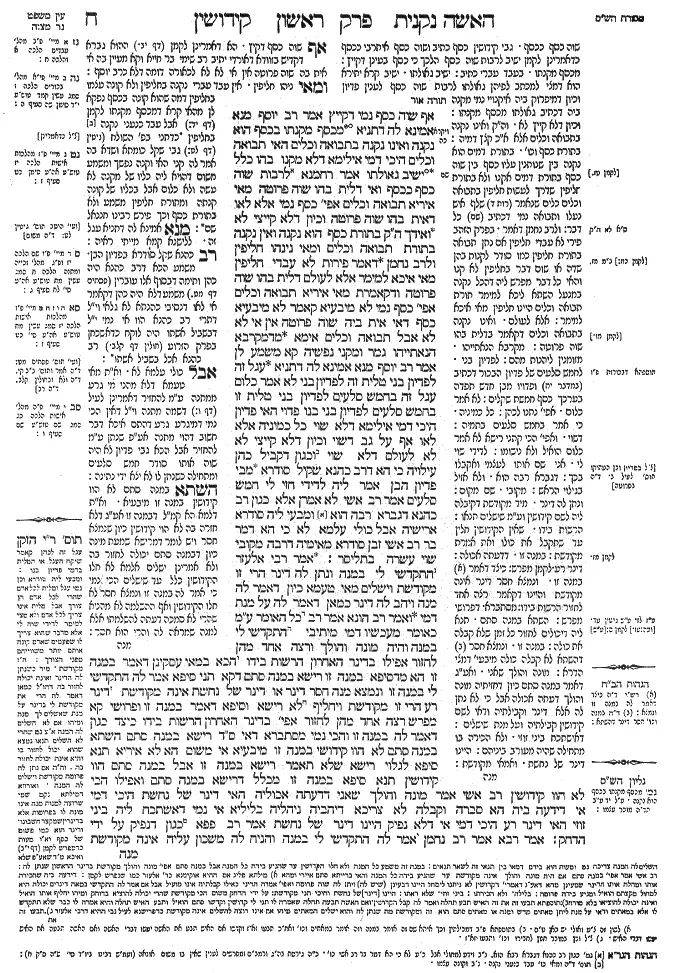
Kiddushin 8a - Guemara
אף שוה כסף נמי דקייץ אמר רב יוסף מנא אמינא לה דתניא (ויקרא כה, נא) מכסף מקנתו בכסף הוא נקנה ואינו נקנה בתבואה וכלים האי תבואה וכלים היכי דמי אילימא דלא מקנו בהו כלל (ויקרא כה, נא) ישיב גאולתו אמר רחמנא לרבות שוה כסף ככסף ואי דלית בהו שוה פרוטה מאי איריא תבואה וכלים אפי' כסף נמי אלא לאו דאית בהו שוה פרוטה וכיון דלא קייצי לא ואידך ה"ק בתורת כסף הוא נקנה ואין נקנה בתורת תבואה וכלים ומאי נינהו חליפין ולרב נחמן דאמר פירות לא עבדי חליפין מאי איכא למימר אלא לעולם דלית בהו שוה פרוטה ודקאמרת מאי איריא תבואה וכלים אפי' כסף נמי לא מיבעיא קאמר לא מיבעיא כסף דאי אית ביה שוה פרוטה אין אי לא לא אבל תבואה וכלים אימא מדמקרבא הנאתייהו גמר ומקני נפשיה קא משמע לן אמר רב יוסף מנא אמינא לה דתניא עגל זה לפדיון בני טלית זה לפדיון בני לא אמר כלום עגל זה בחמש סלעים לפדיון בני טלית זו בחמש סלעים לפדיון בני בנו פדוי האי פדיון היכי דמי אילימא דלא שוי כל כמיניה אלא לאו אף על גב דשוי וכיון דלא קייצי לא לא לעולם דלא שוי וכגון דקביל כהן עילויה כי הא דרב כהנא שקיל סודרא מבי פדיון הבן אמר ליה לדידי חזי לי חמש סלעים אמר רב אשי לא אמרן אלא כגון רב כהנא דגברא רבה הוא ומבעי ליה סודרא ארישיה אבל כולי עלמא לא כי הא דמר בר רב אשי זבן סודרא מאימיה דרבה מקובי שוי עשרה בתליסר :
אמר רבי אלעזר התקדשי לי במנה ונתן לה דינר הרי זו מקודשת וישלים מאי טעמא כיון דאמר לה מנה ויהב לה דינר כמאן דאמר לה על מנת דמי ואמר רב הונא אמר רב כל האומר ע"מ כאומר מעכשיו דמי מיתיבי התקדשי לי במנה והיה מונה והולך ורצה אחד מהן לחזור אפילו בדינר האחרון הרשות בידו הכא במאי עסקינן דאמר במנה זו הא מדסיפא במנה זו רישא במנה סתם דקא תני סיפא אמר לה התקדשי לי במנה זו ונמצא מנה חסר דינר או דינר של נחשת אינה מקודשת דינר רע הרי זו מקודשת ויחליף לא רישא וסיפא דאמר במנה זו ופרושי קא מפרש רצה אחד מהן לחזור אפי' בדינר האחרון הרשות בידו כיצד כגון דאמר לה במנה זו והכי נמי מסתברא דאי ס"ד רישא במנה סתם השתא במנה סתם לא הוו קידושי במנה זו מיבעיא אי משום הא לא איריא תנא סיפא לגלוי רישא שלא תאמר רישא במנה זו אבל במנה סתם הוו קידושין תנא סיפא במנה זו מכלל דרישא במנה סתם ואפילו הכי לא הוו קידושין רב אשי אמר מונה והולך שאני דדעתה אכוליה האי דינר של נחשת היכי דמי אי דידעה ביה הא סברה וקבלה לא צריכא דיהביה ניהליה בליליא אי נמי דאשתכח ליה ביני זוזי האי דינר רע היכי דמי אי דלא נפיק היינו דינר של נחשת אמר רב פפא כגון דנפיק על ידי הדחק :
אמר רבא אמר רב נחמן אמר לה התקדשי לי במנה והניח לה משכון עליה אינה מקודשת
Comments from Rashi on Masechet Kiddushin Page 8a
שוה כסף ככסף . גבי קידושין כסף כתיב ושוה כסף איתרבי ככסף כדאמרינן לקמן ישיב לרבות שוה כסף הלכך כי כסף בעינן דקייץ: מכסף מקנתו . בעבד עברי כתיב: שוה כסף ככסף . גבי קידושין כסף כתיב ושוה כסף איתרבי ככסף כדאמרינן לקמן ישיב לרבות שוה כסף הלכך כי כסף בעינן דקייץ: ישיב גאולתו . ישיב קרא יתירא הוא דמצי למכתב לפיהן גאולתו לרבות שוה כסף לענין פדיון וכיון דמיפרוק ביה איקנויי נמי מקנה ביה דכתיב גאולתו מכסף מקנתו: וכיון דלא קייץ לא . וה"ק ואינו נקנה בתבואה וכלים אלא א"כ קצץ דמיה: בתורת כסף וכו' . בתורת דמים הוא נקנה בין שנותנין עליו כסף בין שוה כסף בתורת דמים אקנו ולא בתורת חליפין שדרך לעשות חליפין בתבואה וכלים כלים שנאמר (רות ד) שלף איש נעלו ותבואה נמי דכתיב (שם) כל דבר: ולרב נחמן דאמר . בפרק הזהב פירי לא עבדי חליפין אם נתן תבואה בתורת חליפין כמו סודר לקנות בהן שדה או שום דבר בחליפין לא קנו והאי כל דבר מפרש ליה דהכל נקנה במנעל השתא ליכא למימר תורת תבואה וכלים היינו חליפין מאי איכא למימר: אלא לעולם . ואינו נקנה בתבואה וכלים דקאמר בדלית בהו שוה פרוטה: מקרבא הנאתייהו . מזומנין ליהנות מהם: לפדיון בני . לחמש סלעים של פדיון הבכור דכתיב (במדבר יח) ופדויו מבן חדש תפדה בערכך כסף חמשת שקלים: לא אמר כלום . אפי' נתנו לכהן: כל כמיניה . כי אמר בחמש סלעים בתמיה: דשוי . ואפי' הכי קתני רישא לא אמר כלום הואיל ולא נישומו: לדידי שוי לי . אני שם אותו לעצמי ואקבלו בכך: דגברא רבה הוא . ולא אזיל בגילוי הראש: מקובי . שם מקום: ונתן לה דינר . מיד מקודשת דקיבלה ליה לשם קידושין וע"מ שישלים תנאו: הרשות בידו . שאין הקידושין חלין עד שתקבל את כולו ואת אמרת מקודשת: במנה זו . דדעתה אכולה: דינר רע . לקמן מפרש: כיצד דאמר במנה זו . ונמצא חסר דינר אינה מקודשת והיינו דקאמר רצה אחד לחזור הרשות בידו: הרשות בידו . שאין הקידושין חלין עד שתקבל את כולו ואת אמרת מקודשת: כיצד דאמר במנה זו . ונמצא חסר דינר אינה מקודשת והיינו דקאמר רצה אחד לחזור הרשות בידו: מסתברא . דפרושי מפרש: השתא במנה סתם . תנא ליה דיכולים לחזור כל זמן שלא קבלה את כולה: במנה זו . דדעתה אכולה: במנה זו . ונמצא חסר דהשתא לא קבלה כולה מיבעי' דמצי הדרא: מונה והולך שאני . ואע"ג דאמר במנה סתם כיון דחזיתיה מונה והולך דעתה אכולה אבל כי לא נתן לה אלא דינר וקבילתיה ודאי לשם קידושין קבילתיה ועל מנת שישלים: דאישתכח ביני זוזי . ולא הכירה בו מתחילה שהיה מעורב ביניהם: היינו דינר של נחשת . ואמאי מקודשת:
Comments from Tosafot - Kiddushin 8a
אף שוה כסף דקיץ . הא דאמרינן לקמן (קידושין דף יב.) ההוא גברא דקדיש בזוודא דאורדי יתיב רב שימי בר חייא וקא מעיין בה אי אית בה שוה פרוטה אין אי לא לא לכאורה דומה דלא כרב יוסף: ומאי ניהו חליפין . אין עבד עברי נקנה בחליפין ולא קונה עצמו בחליפין דמה שהוא קונה בכסף נפקא לן מהאי קרא דמכסף מקנתו לקמן (קידושין דף יד:) אבל עבד כנעני נקנה בחליפין. כדתני בפ' השולח (גיטין (דף לט:) גבי שקל כומתא ושדא בה אמר לה קני האי וקנה נפשך ומשמע משום דהויא ליה כליו של מקנה לא עשה ולא כלום אבל בכליו של קונה קנתה ומתורת חליפין משמע ולא בתורת כסף וכך פירש רבינו חננאל שם: מנא אמינא לה דתניא עגל זה . ללישנא קמא מייתי ראיה: רב כהנא שקל סודרא בפדיון הבן . משמע הכא דרב כהנא היה כהן ותימה דבסוף אלו עוברין (פסחים דף מט.) משמע דלא היה כהן דקאמר אי לאו דנסיבי כהנתא לא גלאי וי"ל דתרי רב כהנא הוו אי נמי י"ל דבשביל אשתו היה לוקח כדאשכחן בפרק הזרוע (חולין דף קלב.) רב כהנא אכל בשביל אשתו: אבל כולי עלמא לא . וא"ת מאי טעמא דלא מהני מי גרע ממתנה ע"מ להחזיר דאמרינן לעיל (קידושין דף ו:) דשמה מתנה וי"ל דאין הכי נמי דמיגרע גרע דהתם איכא דבר חשוב דהוי מתנה אע"פ שנתן ע"מ להחזיר אבל הכא גבי פדיון לא היה שוה אותו סודר חמש סלעים ומתחילה כשנתן לו לא יצא ידי נתינה: השתא במנה סתם לא הוו קידושין במנה זו מיבעיא . וא"ת דלמא הא קמ"ל דבמנה זו אע"ג דלא חזרה בה לא הוי קידושין כיון שנמצא חסר ויש לומר דמרישא שמעת מינה כיון דבמנה סתם יכולה לחזור בה ולא אמרינן ישלים אלמא לא חלו הקידושין כלל עד שישלים הכי נמי כי אמר לה במנה זו ונמצא חסר לא חלו הקידושין ואף ההשלמה לא מהניא שהרי לא סמכה דעתה להשלמתו אלא למנה שמראה לה והרי הוא חסר:
Kiddushin 8a - Mishnah translated into english
so too, an item worth money must be set, i.e., it must have a clearly defined value.
Rav Yosef said: From where do I say this opinion? As it is taught in a baraita with regard to redeeming a Hebrew slave: “He shall give back the price of his redemption out of the money that he was bought for” (Leviticus 25:51), which indicates: He is acquired specifically through money and he is not acquired through grain or vessels.
Rav Yosef explains: What are the circumstances of these grains and vessels? If we say that a Hebrew slave cannot be acquired through them at all, as money alone may be used, the Merciful One states: “He shall give back the price of his redemption,” which serves to include all modes of repayment as valid equivalents of money, i.e., an item worth money is the same as money. There is no requirement to use money in particular; it is also possible to use items with monetary value.
And if you say that they do not have the value of one peruta, why mention specifically grain and vessels? Even money that is not worth one peruta cannot be used for acquiring a slave. Rather, is it not speaking here about a case where the grain and vessels do have the value of one peruta, but since they lack a set value, no, a Hebrew slave cannot be redeemed with them? The comparison with money teaches that a Hebrew slave can be redeemed only with an item that has a clearly defined value, like money.
And the other Sage, Rabba, who maintains that appraisal is not necessary, would respond: The tanna is referring to an item worth one peruta, but he is not teaching that one cannot redeem a slave with items whose value is not set. Rather, this is what he is saying: A Hebrew slave is acquired through the mode of money, and he is not acquired through the mode of grain or vessels. And what is this mode particular to the acquisition of grain and vessels? This is referring to symbolic exchange. A slave cannot be acquired through the mode of acquisition of symbolic exchange.
The Gemara notes: This explanation is valid only according to those who say that grain can be acquired through the mode of exchange; but according to the opinion of Rav Naḥman, who said that produce cannot effect symbolic exchange, as this mode of acquisition applies only to vessels, what can be said? Why does the tanna mention grain if grain cannot be used in symbolic exchange? Rather, the Gemara rejects this explanation in favor of the following: Actually, this is referring to a case where the grain and utensils do not have the value of one peruta. And as for that which you said: Why mention specifically grain and vessels; even money that is not worth one peruta cannot acquire either, one could say that the tanna is speaking utilizing the style of: It is not necessary.
The Gemara elaborates: It is not necessary to state with regard to money that if it has the value of one peruta, yes, one effects acquisition with it, and if not, then no, one cannot effect acquisition with it. But with regard to grain and vessels, one might say that as their benefit is readily available, i.e., one can enjoy them immediately in their current state, perhaps the slave decides and transfers ownership of himself to the master by even less than the worth of one peruta. Therefore, the tanna teaches us that an article less than the value of one peruta cannot effect acquisition notwithstanding the above reasoning.
Rav Yosef said: From where do I say that betrothal can be effected only with an item with a clearly defined value? As it is taught in a baraita (Tosefta, Bekhorot 6:4), that if one says to a priest: This calf should be for the redemption of my firstborn son, or: This cloak should be for the redemption of my firstborn son, then he has said nothing. But if he said: This calf worth the value of five sela should be for the redemption of my firstborn son, or: This cloak worth the value of five sela should be for the redemption of my firstborn son, then his son is redeemed.
The Gemara clarifies: What are the circumstances with regard to this redemption with a calf or a cloak that has no clearly defined value? If we say that they are not worth five sela, is it in his power to give a priest less than the established amount? Why would it even be considered that perhaps the son is redeemed? Rather, is it not referring to a case where even though they are worth this amount, one may not redeem with them in the case of the first clause since their value is not set? This shows that there is a difference between an item that has a set value and one that does not.
The Gemara rejects this suggestion: No; actually, this is referring to a case where the calf or cloak is not worth five sela, and the latter clause is referring to a case where the priest accepted upon himself to value the items as though they were worth this amount, which is why the son is redeemed. This is like this incident in which Rav Kahana, who was a priest, took a cloth [sudara] from the house of a man obligated to perform the redemption of his firstborn son. Rav Kahana said to the man: For me, I view this cloth as though it were worth five sela.
Rav Ashi said: We said that it is possible to redeem one’s son in this manner only when the priest is an individual such as Rav Kahana, who is a great man and is required to wear a cloth on his head. It was common practice for important people to wear a scarf on their heads. But with regard to everyone else, i.e., those who do not wear these cloths and cannot say it is worth that amount to them, no, they may not perform the redemption of the firstborn son in this manner. The Gemara cites a proof that a distinguished individual who needs a cloth will pay a large amount for one. This is like this incident in which Mar bar Rav Ashi bought a cloth from Rabba’s mother from Kovei for thirteen dinars, despite the fact that it was worth ten, because he needed a cloth.
§ Rabbi Elazar says: If a man said to a woman: Be betrothed to me with one hundred dinars, and he gave her one dinar out of the one hundred, she is betrothed immediately and he must subsequently complete the payment of the remainder of the amount he promised her. What is the reason for this? Since he said to her: Be betrothed to me with one hundred dinars, and yet he gave her only one dinar, he is like one who said to her: Be betrothed to me on the condition that I will give you one hundred dinars. In other words, he betroths her now with one dinar on the condition he will pay the remaining ninety-nine in the future. The betrothal therefore takes effect immediately, and he owes her the rest of the one hundred dinars.
The Gemara adds: And this is in accordance with the opinion that Rav Huna says that Rav says: With regard to anyone who states a provision employing the phrase: On the condition, it is tantamount to his stipulating that the agreement take effect retroactively from now. An agreement stipulated by means of the phrase: On the condition, takes effect immediately. This is not like an ordinary agreement, which takes effect only after the condition has been fulfilled.
The Gemara raises an objection from a baraita (Tosefta 2:10). If a man says to a woman: Be betrothed to me with one hundred dinars, and while he was counting the money, one of them wanted to retract the betrothal, it is in the power of either of them to do so even when only the last dinar remains to be given. This indicates that the betrothal does not take effect until the entire one hundred dinars has been paid.
The Gemara answers: With what are we dealing here? This is a case where he says to the woman: Be betrothed to me with this one hundred dinars. In this case the entire one hundred dinars, not just the first dinar, constitutes the betrothal money. The Gemara raises a difficulty with this answer: From the fact that the latter clause of the baraita uses the expression: With this one hundred dinars, it can be inferred that the first clause is dealing with an unspecified one hundred dinars.
As it is taught in the latter clause of that baraita, if he said to a woman: Be betrothed to me with this one hundred dinars, and it was found to be one hundred dinars less a dinar, or if it included a dinar of copper instead of silver, she is not betrothed. If one of the dinars was found to be a flawed dinar, i.e., it was a silver dinar but it was so worn that it would not be universally accepted, she is betrothed, and he must exchange that dinar for a different one. Since the latter clause of the baraita emphasizes the term: This one hundred dinars, evidently the first clause of the baraita must be referring to an unspecified one hundred dinars.
The Gemara rejects this opinion: No; one can say that the first clause and the latter clause are both referring to a case where he said: With this one hundred dinars, and the latter clause is explaining the first clause, as follows: If one of them wishes to retract the betrothal, it is in the power of either of them to do so even when only the last dinar remains to be given. How so? This is referring to a case where he said to her: With this one hundred dinars.
The Gemara comments: And so too, it is reasonable to explain the baraita this way, as, if it enters your mind that the first clause is referring to an unspecified one hundred dinars, consider the following: Now if it is not a betrothal in a case involving an unspecified one hundred dinars, and she can retract her agreement to the betrothal, is it necessary to say that she can retract it when he says: With this one hundred dinars? If that were the correct interpretation of the first clause, the ruling in the last clause would be unnecessary.
The Gemara rejects this proof: If it is due to that reason, there is no conclusive argument, i.e., the proof of the argument is inconclusive. The reason is that one could say that the tanna taught the latter clause to reveal the meaning of the first clause. The function of the latter clause is not to teach a novel halakha, but to preempt a mistaken reading of the first clause. The latter clause was stated so that you should not mistakenly say that the first clause is referring only to a situation when he said: With this one hundred dinars, but in a case of an unspecified one hundred dinars, it would be a betrothal. Therefore, the tanna taught in the latter clause: With this one hundred dinars, which teaches by inference that the first clause is referring to an unspecified one hundred dinars, and even so it is not a betrothal. Although this proof is rejected, the Gemara remains with its explanation that the first clause is referring to a case where he said to her: With this one hundred dinars.
Rav Ashi said: It is unnecessary to explain that the first clause of the baraita is referring to a case where he said: With this one hundred dinars, as a situation where he was counting the money is different. The reason is that she has the entirety of the one hundred dinars in mind, and therefore she will not be content with some of the money. His continuous action indicates that they both expect that he will give her the entire one hundred dinars, and consequently both parties can retract their agreement until he finishes counting.
The Gemara further analyzes the baraita: What are the circumstances of this copper dinar mentioned here? If she knows that it is a copper dinar, she knew and accepted this coin as a dinar. If so, she cannot later retract her betrothal. The Gemara answers: No; it is necessary in a case where he gave her this dinar at night and at the time she did not see that it was copper. Alternatively, it was found among the other dinars, and she did not notice that one of them one was copper.
The Gemara further asks: What are the circumstances of this flawed dinar, also mentioned in the baraita? If it cannot be spent, i.e., it cannot pass as a silver dinar, this is exactly like a copper dinar, as it too is not worth a full dinar. Rav Pappa said: This is referring to a case where the dinar can be spent with difficulty, i.e., it is difficult, but not impossible, to find someone who will accept it.
§ Rava says that Rav Naḥman says: If one said to a woman: Be betrothed to me with one hundred dinars, and instead of giving it to her he gave her collateral for the money, she is not betrothed.
Traduction : The William Davidson digital edition of the Koren Noé Talmud, with commentary by Rabbi Adin Even-Israel Steinsaltz.