 Talmud Bavli
Hullin 49b : Youtube
Rabbi Dr. Moshe WeisblumYoutube
1 video class :
Hullin Page 49b
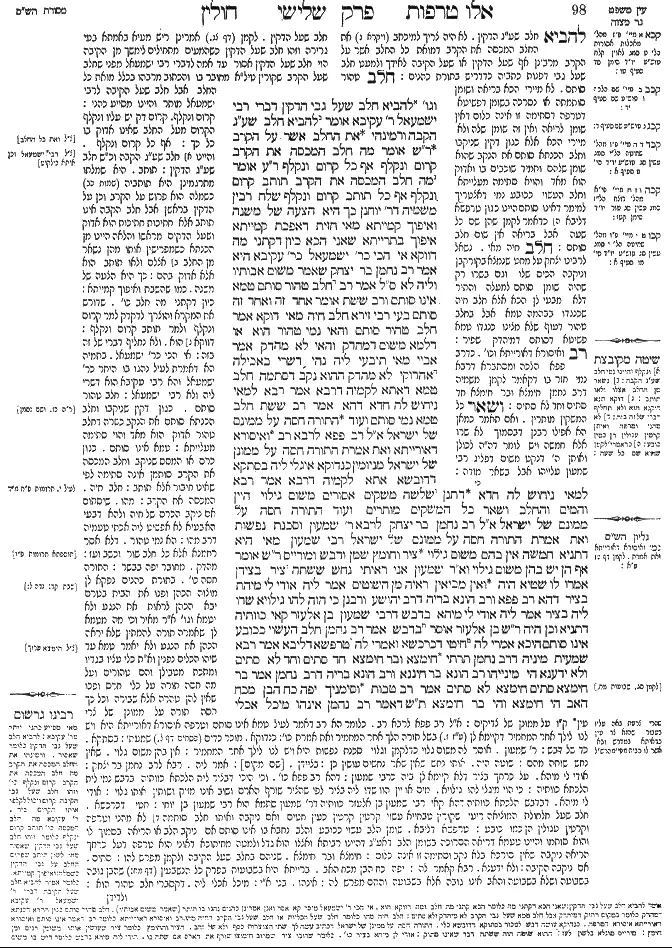
Hullin 49b - Guemara
וגו' להביא חלב שעל גבי הדקין דברי רבי ישמעאל ר' עקיבא אומר להביא חלב שע"ג הקבה ורמינהי את החלב אשר על הקרב ר"ש אומר מה חלב המכסה את הקרב קרום ונקלף אף כל קרום ונקלף ר"ע אומר מה חלב המכסה את הקרב תותב קרום ונקלף אף כל תותב קרום ונקלף שלח רבין משמיה דר' יוחנן כך היא הצעה של משנה ואיפוך קמייתא מאי חזית דאפכת קמייתא איפוך בתרייתא שאני הכא כיון דקתני מה דווקא אי הכי כר' ישמעאל כר' עקיבא היא אמר רב נחמן בר יצחק שאמר משום אבותיו וליה לא ס"ל אמר רב חלב טהור סותם טמא אינו סותם ורב ששת אומר אחד זה ואחד זה סותם בעי רבי זירא חלב חיה מאי דוקא אמר חלב טהור סותם והאי נמי טהור הוא או דלמא משום דמהדק והאי לא מהדק אמר אביי מאי תיבעי ליה נהי דשרי באכילה אהדוקי לא מהדק ההוא נקב דסתמה חלב טמא דאתא לקמיה דרבא אמר רבא למאי ניחוש לה חדא דהא אמר רב ששת חלב טמא נמי סותם ועוד התורה חסה על ממונם של ישראל א"ל רב פפא לרבא רב ואיסורא דאורייתא ואת אמרת התורה חסה על ממונן של ישראל מניומין כנדוקא איגלי ליה בסתקא דדובשא אתא לקמיה דרבא אמר רבא למאי ניחוש לה חדא דתנן שלשה משקים אסורים משום גילוי היין והמים והחלב ושאר כל המשקים מותרים ועוד התורה חסה על ממונם של ישראל א"ל רב נחמן בר יצחק לרבא ר' שמעון וסכנת נפשות ואת אמרת התורה חסה על ממונם של ישראל רבי שמעון מאי היא דתניא חמשה אין בהם משום גילוי ציר וחומץ שמן ודבש ומורייס ר"ש אומר אף הן יש בהן משום גילוי וא"ר שמעון אני ראיתי נחש ששתה ציר בצידן אמרו לו שטיא הוה ואין מביאין ראיה מן השוטים אמר ליה אודי לי מיהת בציר דהא רב פפא ורב הונא בריה דרב יהושע ורבנן כי הוה להו גילויא שדו ליה בציר אמר ליה אודי לי מיהא בדבש דרבי שמעון בן אלעזר קאי כוותיה דתניא וכן היה ר"ש בן אלעזר אוסר בדבש אמר רב נחמן חלב העשוי ככובע אינו סותם היכא אמרי לה חיטי דכרכשא ואמרי לה טרפשא דליבא אמר רבא שמעית מיניה דרב נחמן תרתי חימצא ובר חימצא חד סתים וחד לא סתים ולא ידענא הי מינייהו רב הונא בר חיננא ורב הונא בריה דרב נחמן אמר בר חימצא סתים חימצא לא סתים אמר רב טבות וסימניך יפה כח הבן מכח האב הי חימצא והי בר חימצא ת"ש דאמר רב נחמן אינהו מיכל אכלי
Comments from Rashi on Masechet Hullin Page 49b
חלב שעל הדקין . לקמן (חולין דף צג.) אמרינן ריש מעיא באמתא בעי גרירה וזהו חלב שעל הדקין כשהמעים מתחילים לימשך מן הקיבה הוי חלב שעל הדקין אסור עד אמה לדברי רבי ישמעאל מפני שחלב שעל הקרב שקורין טיל"א מחובר בו והכתוב מרבהו בכלל מואת כל החלב אבל חלב שעל הקיבה לרבי ישמעאל מותר והיינו מסייע כהני: קרום ונקלף . קרום דק יש עליו ונקלף הקרום מעל החלב שאינו אדוק בו כל כך: אף כל קרום ונקלף . והיינו חלב שע"ג הקבה וכ"ש חלב שע"ג הדקין: תותב . היא שמלתו מתרגמינן היא תותביה (שמות כב). כשמלה הוא פרוש על הקרב וכן על הדקין בראשן אבל חלב הקבה אינו תותב אלא חתיכות חתיכות הוא אדוק ושעל הדקים מראשו והלאה היינו מן הכנתא כשמפרישין אותו מהן נשאר מן החלב אצלם ולאו תותב הוא אלא אדוק בהם: כך היא הצעה של משנה . כמו שהשבת ואיפוך קמייתא: כיון דקתני מה חלב כו' . שדורש את המקרא והוצרך לדקדק למר קרום ונקלף ולמר תותב קרום ונקלף: דווקא הוא . ולא נחליף דברי של זה בזה: אי הכי כר' ישמעאל . בתמיה. הא דאמרת לעיל נהגו בו היתר כר' ישמעאל והא רבי עקיבא הוא דשרי ליה ולא רבי ישמעאל: חלב טהור סותם . כגון דקין שניקבו וחלב הכנתא סותם את הנקב כשרה דחלב טהור אדוק הוא מאד והוי סתימה מעלייתא: טמא אינו סותם . כגון כרס או המסס שניקב וחלב המכסה את הקרב סותמן אינה סתימה לפי שאינו חיבור אלא תותב: חלב חיה . המכסה את הקרב: מהו . שיסתום אם ניקב הכרס של חיה ולהא דבעי הא בעיא לא אפשיט ליה אכתי טעמיה דרב מהו: הא נמי טהור . דלא אסר רחמנא אלא כל חלב שור וכשב ועז: מהדק . מחובר יפה בבשר: התורה חסה כו' . בתורת כהנים נפקא לן מוצוה הכהן ופנו את הבית בטרם יבא הכהן לראות את הנגע ולא יטמא וגו' א"ר מאיר וכי מה מטמא לן שאמרה תורה להמתין שלא יראה הכהן את הנגע ולא יאמר טמא עד שיהו הכלים נפנין וא"ת כלי עציו בגדיו ומתכת מטבילן והם טהורים ועל מה חסה תורה על כלי חרס ופכו שאין להן טהרה אלא שבירה וכל כך חסה תורה על ממונן של צרי עין ק"ו על ממונן של צדיקים: א"ל רב פפא לרבא רב . כלומר הא רב דאמר לעיל טמא אינו סותם וטרפה איסורא דאורייתא היא ויש לנו לילך אחר המחמיר דקיימא לן (ע"ז ז.) בשל תורה הלך אחר המחמיר ואת אמרת כו': כנדוקא . מוכר כדים (פסחים דף ל.) שמעתי: בסתקא . כד של דבש: ר' שמעון אוסר לה משום גלוי כדלקמן וגלוי סכנת נפשות היא ויש לנו לילך אחר המחמיר: אין בהן משום גלוי . שאין נחש שותה מהם: בציידן . [שם מקום]: שוטה היה . אותו נחש שאין שאר נחשים עושין כן: אמר ליה . רבא לרב נחמן בר יצחק: אודי לי מיהא . על כרחך בציר דלא קיימא לן ביה כרבי שמעון: דהא רב פפא כו' . וכי היכי דבציר לית הלכתא כוותיה בדבש נמי לית הלכתא כוותיה: כי הוי מיגלי להו גילויא . מים או יין הוו שדו ליה בציר לפי שהציר שורף הארס ושוב אינו מזיק ושותין אותו גלוי: אודי לי מיהא . דבדבש הלכתא כוותיה דהא קאי רבי שמעון בן אלעזר כוותיה דר' שמעון סתמא הוא רבי שמעון בן יוחי: חטי דכרכשא . חלב שעל חלחולת המוציאה ריעי שקורין טבחיי"א עשוי קרטין קרטין כעין חטים ואם ניקבה ואותו חלב סותמה לא מהני וטרפה וקרטין עגולין הן כמו כובע: טרפשא דליבא . שומן הלב עשוי ככובע והלב נחבא בו אינו סותם אם ניקב הלב או הריאה בסמוך לו והוא סותמו. והיינו טעמא דריאה הסרוכה בשומן הלב דאע"ג דהיינו רביתא ואצלו הוא גדל ולמטה מחיתוכא דאוני הוא טרפה דעל כרחך הריאה ניקבה שאין סירכא בלא נקב וסתימה זו אינה כלום: חימצא ובר חימצא . שניהם בחלב שעל הקיבה ולקמן מפרש להו: סתים . אם ניקבה הקיבה: ולא ידענא . רבא קאמר לה: יפה כח הבן מכח האב . ברייתא היא בשבועות בפרק כל הנשבעין (דף מח:) שהבן גובה בשבועה ושלא בשבועה והאב אינו גובה אלא בשבועה והתם מפרש לה: אינהו . בני א"י: מיכל אכלי ליה . דקסברי חלב טהור הוא:
Comments from Tosafot - Hullin 49b
להביא חלב שע"ג הדקין . לא היה צריך למיכתב (ויקרא ג) את החלב המכסה את הקרב דמואת כל החלב אשר על הקרב מרבינן אף שעל הדקין או שעל הקיבה לאידך ולמעט חלב שעל גבי דפנות כתביה כדדריש בתורת כהנים: חלב טהור סותם . לא מיירי הכא בריאה ושומן סותמתה או נסרכה בשומן דפשיטא דטרפה דסתימה זו אינה כלום דאין שומן לריאה ואין זה שומן שלה ולא מיירי הכא אלא כגון דקין שניקבו וחלב הכנתא סותם את הנקב שהוא שומן שלהם ותמיד שוכבים בו ואדוק הוא מאד והויא סתימה מעלייתא וחלב העשוי ככובע נמי דאצטריך למימר דאינו סותם היינו כגון טרפשא דליבא כדאמר לקמן שהן שם כל שעה אבל בריאה אין שום חלב סותם: חלב חיה מאי . נשאל לרבינו יצחק על מחט שנמצא בקורקבן וניקבה הכיס שלו וגם בשרו רק שהיה שומן סותם למעלה והתיר דלא מבעי לן הכא אלא חלב חיה שכנגדו בבהמה טמא אבל בחלב טהור דעוף שלא מצינו כנגדו טמא פשיטא דסותם דמיהדק שפיר: רב ואיסורא דאורייתא וכו' . כדרב פפא הלכה ומסתברא דרבא נמי חזר בו דקאמר לקמן משמיה דרב נחמן חימצא ובר חימצא חד סתים וחד לא סתים: ושאר כל המשקין מותרין . ואם תאמר כמאן הא אפילו רבנן דבסמוך לא שרו אלא חמשה ויש לומר דה"ה לכולן ואותן ה' דנקט משום דפליג רבי שמעון עלייהו אבל בשאר מודה:
Hullin 49b - Mishnah translated into english
the word “all” serves to include the fat that is on the small intestines; this is the statement of Rabbi Yishmael. Rabbi Akiva says: The word “all” serves to include the fat that is on the abomasum. According to Rabbi Yishmael, the fat of the abomasum is permitted.
And the Gemara raises a contradiction from another baraita: The verse states: “The fat that covers the innards, and all the fat that is upon the innards” (Leviticus 3:3). Rabbi Shimon, i.e., Rabbi Yishmael, says: Just as the fat that covers the innards possesses a membrane, and that membrane is easily peeled off, so too, all fat possessing a membrane and whose membrane is easily peeled is forbidden, including the fat on the abomasum. Rabbi Akiva says: Just as the fat that covers the innards is spread out loosely over them, and it possesses a membrane, and the membrane is easily peeled off, so too, all fat that is spread out loosely, and possesses a membrane, and whose membrane is easily peeled, e.g., the fat on the intestines, is forbidden. The fat on the abomasum is fixed tightly and is therefore permitted. It would seem from this baraita that Rabbi Akiva and Rabbi Yishmael contradict themselves.
Ravin sent an answer in the name of Rabbi Yoḥanan: Such is the proper layout of the mishna, i.e., the baraita. The latter attribution of the opinions is correct, and one must reverse the attribution of opinions in the first baraita. Accordingly, Rabbi Akiva deems the fat on the intestines prohibited, while Rabbi Yishmael deems the fat on the abomasum prohibited as well.
The Gemara asks: What did you see that led you to reverse the first baraita? Why not reverse the second baraita instead? The Gemara responds: The second baraita here is different, since it teaches using the formula: Just as. Because it takes care to specifically provide the textual justifications for the opinions, it is presumably accurate about the attributions as well.
The Gemara asks: If so, how can Rabbi Oshaya claim above that the priests acted in accordance with the opinion of Rabbi Yishmael? It was actually in accordance with the opinion of Rabbi Akiva. Rav Naḥman bar Yitzḥak said: Rabbi Oshaya meant only that Rabbi Yishmael says the lenient opinion in the name of his forefathers, but Rabbi Yishmael himself does not hold accordingly, and he considers the fat of the abomasum forbidden.
§ The Gemara discusses a connection between the issue of fats and that of tereifot: Rav says: Kosher fat effectively seals a perforation that it covers, and the animal is not rendered a tereifa. Non-kosher fat does not effectively seal a perforation, and the animal is a tereifa. And Rav Sheshet says: Both this and that fat effectively seal a perforation.
Rabbi Zeira raises a dilemma: With regard to the fat of an undomesticated animal, all of which is permitted for consumption, what is the halakha? Shall one say that Rav specifically said that kosher fat seals a perforation, and since this too, i.e., all the fat of an undomesticated animal, is kosher, it is all considered an effective seal? Or perhaps Rav specified that permitted fat of a domesticated animal seals a perforation only because it is firmly attached. But this, the fat on the innards of an undomesticated animal, is not firmly attached, and it is not an effective seal, even though it is permitted for consumption.
Abaye said: Why does Rabbi Zeira raise this dilemma? Granted that the fat of the innards is permitted for consumption, but still, it is not firmly attached and clearly does not form an effective seal.
The Gemara relates: There was a certain perforation that was sealed by non-kosher fat that came before Rava. Rava said: With regard to what need we be concerned? First, doesn’t Rav Sheshet say: Non-kosher fat also effectively seals a perforation? And furthermore, in general, the Torah spares the money of the Jewish people, and it is appropriate to rule leniently in this regard. Rav Pappa said to Rava: But there is also the opinion of Rav that non-kosher fat does not seal a perforation, and this dispute concerns a prohibition by Torah law, and yet you say that the Torah spares the money of the Jewish people? One cannot rely on this principle to rule in accordance with the lenient opinion with regard to such matters.
The Gemara relates a similar episode: Manyumin the jug maker had a jug [bisteka] full of honey that was left uncovered, and he was concerned it might have been contaminated by snake venom. He came before Rava to inquire as to the halakha. Rava said: With regard to what need we be concerned? First, as we learned in a mishna (Terumot 8:4): Three liquids are prohibited due to exposure: Wine, water, and milk; and all other liquids are permitted. Honey, therefore, is permitted. And furthermore, the Torah spares the money of the Jewish people. Rav Naḥman bar Yitzḥak said to Rava: But there is also the opinion of Rabbi Shimon that exposed honey is prohibited, and this dispute concerns a matter of mortal danger, and yet you say that the Torah spares the money of the Jewish people?
The Gemara clarifies: What is this opinion of Rabbi Shimon? As it is taught in a baraita: Five liquids are not subject to the prohibition of exposure, since snakes do not drink from them: Fish brine, vinegar, oil, honey, and fish gravy [morayes] made from fish brine mixed with oil and salt. Rabbi Shimon says: Even they are subject to prohibition due to exposure. And Rabbi Shimon said: I once saw a snake that drank fish brine in Tzaidan. The Rabbis said to him: That snake was strange, i.e., it behaved differently than other snakes, and one does not bring a proof from strange creatures.
Rava said to Rav Naḥman bar Yitzḥak: Concede to me, at least, with regard to fish brine that it is not prohibited by exposure, as when Rav Pappa and Rav Huna, son of Rabbi Yehoshua, and the Sages would have a case of exposure of some liquid, they would cast it into fish brine. The sharpness of the brine neutralizes the snake venom. Accordingly, just as the halakha is not in accordance with the opinion of Rabbi Shimon with regard to fish brine, so too it is not in accordance with his opinion with regard to honey. Rav Naḥman bar Yitzḥak said to him: Concede to me, at least, with regard to honey that it is prohibited by exposure, as Rabbi Shimon ben Elazar held in accordance with the opinion of Rabbi Shimon. As it is taught in a baraita: And likewise, Rabbi Shimon ben Elazar would deem exposed honey prohibited.
The Gemara returns to the initial discussion with regard to fats and perforations: Rav Naḥman says: Permitted fat that is made like a hat does not effectively seal a perforation, even though it is permitted for consumption. The Gemara clarifies: Where is this fat? Some say it is the grains of fat found on the rectum, which, if perforated, renders the animal a tereifa. And some say that it is the membrane surrounding the heart, which, if perforated to the chambers, renders the animal a tereifa.
§ Rava said: I heard from Rav Naḥman about two fats found on the abomasum, in different places. One is called the ḥimtza and one the bar ḥimtza, meaning: Son of ḥimtza. One effectively seals a perforation of the abomasum, and one does not effectively seal a perforation of the abomasum. But I do not know which of them is which. Rav Huna bar Ḥinnana and Rav Huna, son of Rav Naḥman, said: The bar ḥimtza seals; the ḥimtza does not seal. Rav Tavot said: And your mnemonic is: The power of the son is greater than the power of the father.
The Gemara asks: Which is the ḥimtza and which is the bar ḥimtza? The Gemara suggests: Come and hear proof from that which Rav Naḥman says with regard to one of the fats on the abomasum. Can it be that they, the residents of Eretz Yisrael, eat it, considering it permitted for consumption,
Traduction : The William Davidson digital edition of the Koren Noé Talmud, with commentary by Rabbi Adin Even-Israel Steinsaltz.