 Talmud Bavli
Yevamot 104b : Youtube
Daf TubeYoutube
1 video class :
Yevamot Page 104b
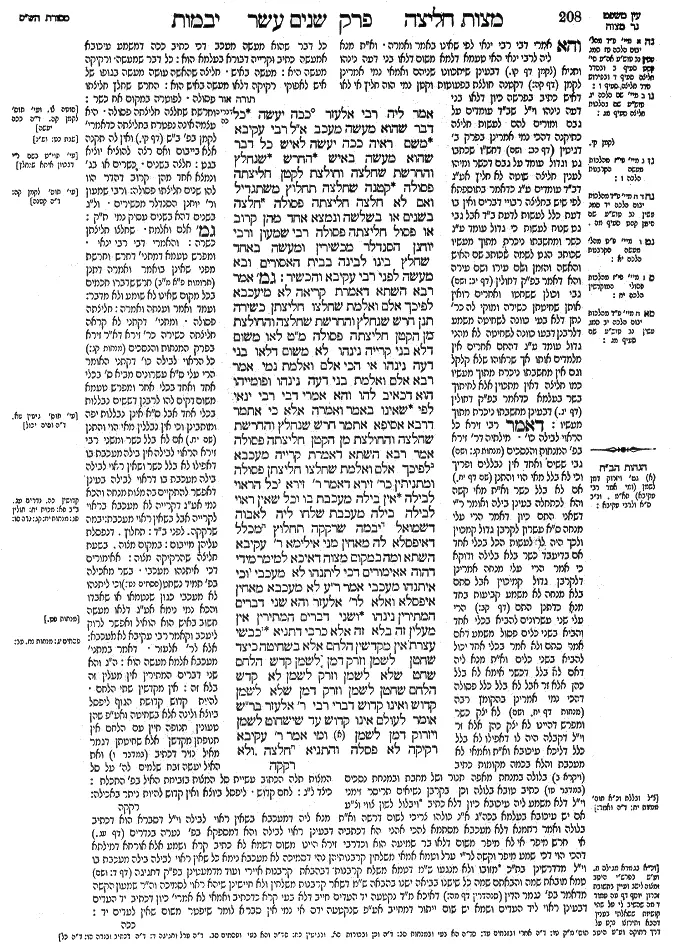
Yevamot 104b - Guemara
אמר ליה רבי אלעזר (דברים כה, ט) ככה יעשה כל דבר שהוא מעשה מעכב א"ל רבי עקיבא משם ראיה ככה יעשה לאיש כל דבר שהוא מעשה באיש החרש שנחלץ והחרשת שחלצה וחולצת לקטן חליצתה פסולה קטנה שחלצה תחלוץ משתגדיל ואם לא חלצה חליצתה פסולה חלצה בשנים או בשלשה ונמצא אחד מהן קרוב או פסול חליצתה פסולה רבי שמעון ורבי יוחנן הסנדלר מכשירין ומעשה באחד שחלץ בינו לבינה בבית האסורים ובא מעשה לפני רבי עקיבא והכשיר:
גמ׳ אמר רבא השתא דאמרת קריאה לא מיעכבא לפיכך אלם ואלמת שחלצו חליצתן כשירה תנן חרש שנחלץ והחרשת שחלצה והחולצת מן הקטן חליצתה פסולה מ"ט לאו משום דלא בני קרייה נינהו לא משום דלאו בני דעה נינהו אי הכי אלם ואלמת נמי אמר רבא אלם ואלמת בני דעה נינהו ופומייהו הוא דכאיב להו והא אמרי דבי רבי ינאי לפי שאינו באמר ואמרה אלא כי אתמר דרבא אסיפא אתמר חרש שנחלץ והחרשת שחלצה והחולצת מן הקטן חליצתה פסולה אמר רבא השתא דאמרת קרייה מעכבא לפיכך אלם ואלמת שחלצו חליצתן פסולה ומתניתין כר' זירא דאמר ר' זירא כל הראוי לבילה אין בילה מעכבת בו וכל שאין ראוי לבילה בילה מעכבת שלחו ליה לאבוה דשמואל יבמה שרקקה תחלוץ מכלל דאיפסלא לה מאחין מני אילימא ר' עקיבא השתא ומה במקום מצוה דאיכא למימר מידי דהוה אאימורים דכי ליתנהו לא מעכבי וכי איתנהו מעכבי אמר ר"ע לא מעכבא מאחין איפסלא ואלא לר' אלעזר והא שני דברים המתירין נינהו ושני דברים המתירין אין מעלין זה בלא זה אלא כרבי דתניא כבשי עצרת אין מקדשין הלחם אלא בשחיטה כיצד שחטן לשמן וזרק דמן לשמן קדש הלחם שחט שלא לשמן וזרק לשמן לא קדש הלחם שחטן לשמן וזרק דמן שלא לשמן קדוש ואינו קדוש דברי רבי ר' אלעזר בר"ש אומר לעולם אינו קדוש עד שישחוט לשמן ויזרוק דמן לשמן ומי אמר ר' עקיבא רקיקה לא פסלה והתניא חלצה ולא
Comments from Rashi on Masechet Yevamot Page 104b
כל דבר שמעשה . ורקיקה מעשה היא: מעשה באיש . חליצה שהאשה עושה מעשה בגופו של איש לאפוקי רקיקה דלאו מעשה באיש הוא: החרש שחלץ חליצתו פסולה . לפוטרה במקום אח כשר: וחרשת שחלצה חליצתה פסולה . היא עצמה אינה נפטרת בחליצתה כדאמרי' לקמן בפ' ב"ש (יבמות דף קי.) ואין לה תקנה אלא בייבום ואם רצה להוציא יוציא בגט: חלצה בשנים . כשרים או בג' ונמצא אחד מהן קרוב דהדר הוו להו שנים חליצתו פסולה: ורבי שמעון ור' יוחנן הסנדלר מכשירים . ול"ג בשנים דהא בשנים עסיק נמי ת"ק: גמ' אלם ואלמת . שחלצו חליצתן כשרה: והאמרי דבי רבי ינאי . ומפרש טעמא דמתני' דחרש וחרשת מפני שאינן בואמר ואמרה דתנן (תרומות פ"א מ"ב) חרש שדברו חכמים בכל מקום שאינו לא שומע ולא מדבר: ועמד ואמר וענתה ואמרה: חליצתה פסולה . ומתני' דקתני לא קראה חליצתה כשירה כר' זירא דא"ר זירא בפרק המנחות והנסכים (מנחות קג:) כל הראוי לבילה כו' דקתני האומר הרי עלי ס"א עשרונים מביא ס' בכלי אחד ואחד בכלי אחר ומפרש טעמא משום דקים להו לרבנן דששים נבללות בכלי אחד אבל ס"א אינן נבללות יפה ומותבינן וכי אין נבללין מאי הוי והתנן (שם יח.) אם לא בלל כשר ומשני רבי זירא הראוי לבילה אין בילה מעכבת בו דאפילו לא בלל כשר ושאין ראוי לבילה בילה מעכבת בו דראוי לבילה בעינן דאפשר להתקיים בה מצות מנחה והכא נמי אע"ג דקרייה לא מעכבא בראוי לקרייה אבל בשאין ראוי מעכבת: יבמה שרקקה . לפני ב"ד: תחלוץ . דנפסלת עליהן מייבום: במקום מצוה . בשעת חליצה שהרקיקה מצוה: אאימורים דכי איתנהו מעכבי . בשר מאכילה בפ' תמיד נשחט (פסחים נט:) וכי ליתנהו לא מעכבי כגון שנטמאו או שאבדו והכא נמי נימא אע"ג דלאו מעשה חשוב באיש הוא הואיל ואפשר לרוק ליעכב וקאמר רבי עקיבא לא מעכבא: אלא לר' אלעזר . דאמר במתני' מעכבא אלמא מעשה הוא: ה"ג והא שני דברים המתירין אין מעלין זה בלא זה: אין מקדשין שתי הלחם . להיות קדוש קדושת הגוף ליפסל ביוצא ולינה אלא בשחיטה ואע"פ שהן טעונין תנופה חיין עם הלחם אין תנופתן מקדשן אלא שחיטתן דגמר מאיל נזיר דכתיב (במדבר ו) ואת האיל יעשה זבח שלמים לה' על סל המצות תלה הכתוב עשיית סל המצות בזביחת האיל בפ' התכלת: כיצד ל"ג: לחם קדוש ליפסל ביוצא ואין קדוש להיות ניתר באכילה:
Comments from Tosafot - Yevamot 104b
ככה יעשה דבר שהוא מעשה מעכב . וא"ת ולמ"ד (סנהדרין דף סה:) דעקימת פיו הוי מעשה היכי ממעטינן קריאה וי"ל דמ"מ מעשה גרוע הוא יותר מרקיקה אי נמי לא דמי למנהיג בקול שהוא מעשה גדול: והא אמרי דבי רבי ינאי לפי שאינו באמר ואמרה . וא"ת מנא ליה לרבי ינאי האי טעמא דלמא משום דלאו בני דעה נינהו ותניא (לקמן יבמות דף קו.) דבעינן שיתכוונו שניהם ואמאי נמי אמרינן לקמן (יבמות דף קה:) דקטנה חולצת בפעוטות וקטן נמי הוה חליץ אי לאו דאיש כתיב בפרשה כיון דלאו בני דעה נינהו וי"ל שב"ד עומדים על גבם ומורים להם לעשות חליצה כתיקנה דהכי נמי אמרינן בפרק ב' דגיטין (דף כב: ושם) דחש"ו שכתבו גט וגדול עומד על גבם דכשר ומיהו לענין חליצה שוטה לא חליץ אע"ג דב"ד עומדים ע"ג כדאמר בתוספתא לפי שיש בחליצה רבויי דברים ואין בו דעת כלל לעשות לדעת ב"ד אבל גבי גט שנוח לעשות כי גדול עומד ע"ג כשר ומחשבתו ניכרת מתוך מעשיו שכותב הגט לשמה שכותב שם האיש והאשה והזמן ושם עירו ושם עירה והא דאמר בפ"ק דחולין (דף יב: ושם) גבי וכולן ששחטו ואחרים רואין אותן שחיטתן כשירה ומוקי לה כר' נתן דלא בעי כוונה לשחיטה משמע דלרבנן דבעו כוונה לשחיטה לא מהני גדול עומד ע"ג דהתם אחרים אין מלמדים אותו אך שראוהו שלא קלקל וגם אין מחשבתו ניכרת מתוך מעשיו כמו חליצה דאין מתכוין אלא לחיתוך בשר בעלמא כדאמר בפ"ק דחולין (דף יג.) דבעינן מחשבתו ניכרת מתוך מעשיו: דאמר רבי זירא כל הראוי לבילה כו' . מילתיה דר' זירא בפ' המנחות והנסכים (מנחות קג: ושם) גבי ששים ואחד אין נבללים ופריך וכי לא בלל מאי הוי והתנן (שם דף יח.) אם לא בלל כשר וא"ת מאי קשה והא לכתחלה בעינן בילה ואומר ר"י דשאני התם כיון דאמר הרי עלי מנחה ס"א עשרון לקרבן גדול קמכוין ולכך היה לו לעשות הכל בכלי אחד אם בדיעבד כשר בלא בלילה ודוקא כי אמר הרי עלי מנחה אמרינן דלקרבן גדול קמיכוין אבל סתם בלא מנחה לא משמע קביעות בחד מנא כדתנן התם (דף קב:) הרי עלי שני עשרונים להביא בכלי אחד והביא בשני כלים פסול משמע דאם אמר סתם ולא אמר בכלי אחד יכול להביא בשני כלים וא"ת מנא ליה דאם לא בלל דכשר אימא לא בלל כהן אלא זר אבל לא בלל כלל פסולה דהכי נמי אמרינן בהקומץ רבה (מנחות דף יח. ושם) לא יצק כשר ומפרש דהיינו לא יצק כהן אלא זר וי"ל דקבלה היה לו דאפילו לא בלל כלל דליכא עיכובא וא"ת ואמאי לא מעכבת והלא בכמה מקומות כתיב (ויקרא ב) בלולה במנחת מאפה תנור ושל מחבת ובמנחת נסכים (במדבר טו) כתיב טובא בלולה וכן בקרבן נשיאים תריסר זימני וי"ל דלא משמע ליה עיכובא כיון דלא כתיב ויבלול לשון צווי וצ"ע אם יש עיכובא בעלמא בכה"ג א"נ כולהו צריכי לשום דרשה וא"ת מנא ליה דמעכבא בשאין ראוי לבילה וי"ל דסברא הוא דכתיב בלולה ואמר רחמנא דלא מעכבא מסתמא להכי אהני הא דכתביה דבעינן ראוי לבילה והא דמספקא בפ' נערה בנדרים (דף עג.) אי חרש מיפר אי לא מיפר משום דלאו בר שמיעה הוא וכדרבי זירא היינו משום דשמא לא כתיב קרא ושמע אלא אורחא דמילתא דהכי הוי דכי שמע מיפר וקשה לר"י ערל וטמא אמאי משלחין קרבנותיהן נהי דסמיכה לא מעכבא נימא כל שאין ראוי לבילה בילה מעכבת בו וי"ל מדדרשינן בת"כ מזובו ולא מנגעו ש"מ דטמא משלח קרבנות דבהבאת קרבנות איירי ועוד מדמעטינן בפ"ק דחגיגה (דף ד: ושם) טמא מובאת שמה והבאתם שמה כל שישנו בביאה ישנו בהבאה ש"מ דשאר קרבנות משלחין ולא חיישינן שיהא ראוי לסמיכה וה"ר שמעון הקשה מדאמר בפ' נגמר הדין (סנהדרין דף מה:) דאיכא מ"ד נקטעה יד העדים חייב דלא בעי קרא כדכתיב ואמאי לא אמרי' כיון דכתיב יד העדים דבעינן ראוי ליד העדים ושמא יש שום ייתור דמחייב אע"פ שנקטעה ידם אי נמי אין סברא לומר שיפטר משום שאין לעדים יד:
Yevamot 104b - Mishnah translated into english
Rabbi Elazar said to him: The verse states: “So shall it be done to the man who does not build his brother’s house” (Deuteronomy 25:9). “So” is an exclusionary term indicating that only precisely in this fashion is ḥalitza valid. Therefore, any term that constitutes an action for ḥalitza is indispensable. Rabbi Akiva said to him: You derive proof from there? But it states: “So shall it be done to the man” indicating that only a term constituting an action toward the man, namely any aspect of ḥalitza that concerns the man’s body, such as removal of his shoe, is indispensable. But spitting, which does not involve the man, although it takes place in his presence, is not indispensable.
The mishna lists additional halakhot with regard to ḥalitza. If a deaf-mute man underwent ḥalitza, or a deaf-mute woman performed ḥalitza, or if an adult woman performs ḥalitza with a male minor, her ḥalitza is invalid and the woman may not marry. If a female minor performed ḥalitza, she must perform ḥalitza a second time once she becomes an adult, and if she does not perform the second ḥalitza, her first ḥalitza is invalid. If she performed ḥalitza before two or three judges and one of them is found to be a relative or disqualified as a judge for some other reason, her ḥalitza is invalid. Rabbi Shimon and Rabbi Yoḥanan the Cobbler validate the ḥalitza in this case. And an incident occurred involving a certain person who performed ḥalitza between him and her alone in prison, i.e., not in the presence of others, and the case came before Rabbi Akiva and he validated it.
GEMARA: Rava said: Now that you have said that recitation of the text is not indispensable in order for the ḥalitza to be valid, therefore if a mute man or a mute woman performed ḥalitza, their ḥalitza is valid. Although the statements should be recited ab initio, since the recitation is not indispensable, mute individuals can perform ḥalitza.
The Gemara challenges: But we learned in the mishna above: If a deaf-mute man underwent ḥalitza, or a deaf-mute woman performed ḥalitza, or if a woman performs ḥalitza with a male minor, her ḥalitza is invalid. What is the reason that the ḥalitza is invalid? Is it not because they are not competent to recite the text, thereby indicating that the recitation is necessary even after the fact? The Gemara rejects this assertion: No, the reason for disqualifying a deaf-mute man and woman is because they are not considered to have intellectual capacity, and therefore their actions do not have halakhic significance.
The Gemara asks: If that is so, let us also say that a mute man and woman do not have intellectual capacity. Rava said: A mute man and woman do have intellectual capacity. Rather, it is their mouth that hurts them. Mute individuals have full intellectual capacity; they merely lack a means of expression. The deaf-mute, on the other hand, is not considered to have the mental capacity to speak.
The Gemara challenges again: But didn’t the scholars from the house of study of Rabbi Yannai say that a deaf-mute man and woman are disqualified from participation in ḥalitza because they cannot fulfill the requirements of “he says” (Deuteronomy 25:8) and “she shall say” (Deuteronomy 25:9), and not due to insufficient intellectual capacity? Rather, when that first statement of Rava was said, it was stated concerning the latter clause of the mishna: If a deaf-mute man underwent ḥalitza, or a deaf-mute woman performed ḥalitza, or if a woman performs ḥalitza on a male minor, her ḥalitza is invalid.
Rava said: You have now said that recitation is indispensable, as can be inferred from the mishna disqualifying the deaf-mute. Therefore, if a mute man or woman performed ḥalitza, their ḥalitza is invalid. And the mishna, which indicates in its first clause that recitation is not indispensable, but later states that ḥalitza performed by someone incapable of recitation is invalid, is in accordance with the opinion of Rabbi Zeira with regard to a meal-offering. A meal-offering is generally a mixture of flour and oil. If flour is added to the oil but they are not mixed, they are considered to be fitting to be mixed so long as there is not an excessive amount of flour.
This is that which Rabbi Zeira said: Whatever is fitting to be mixed, mixing is not indispensable to it, and it is valid even if it is not mixed. And whatever is not fit to be mixed, e.g., if the quantity of flour is so great that the ingredients cannot be properly mixed, mixing is indispensable for it and it is invalid if it has not been mixed. From here one may learn a general halakhic principle: There are some actions for which their actual performance is not indispensable, provided they are capable of being performed. An action becomes indispensable only if one is unfit or unable to perform it. With regard to recitation of the verses, although it is not indispensable, a mute person is disqualified from performing ḥalitza because he is not capable of reciting the verses.
They sent the following teaching from Eretz Yisrael to the father of Shmuel: Once a yevama has spat she must perform a complete ḥalitza and may not enter into levirate marriage. The Gemara comments: By inference, you may learn that even though the spitting did not permit her to marry outside the family, she is disqualified from entering into levirate marriage with any of the brothers, and must therefore complete the ḥalitza.
The Gemara asks: In accordance with whose opinion is this halakha taught? If we say it is in accordance with Rabbi Akiva, who stated in the mishna that spitting is not required after the fact, it is difficult, as the following a fortiori reasoning indicates: Now if even in a case where there is a mitzva of ḥalitza, and the yevama is still around and capable of fulfilling the Torah command of spitting, and one might say that spitting should be treated just as it is with regard to the fatty portions of offerings that are to be consumed on the altar, where the halakha is that when they are not present for offering, i.e., they were lost or became ritually impure, they are not considered indispensable to permit the consumption of the offering.
When the fats of the offering are no longer present for offering, it is permitted for the sacrificial meat to be eaten by the priests through the sprinkling of blood alone, even without offering the fatty portions on the altar. But when the fatty portions are present and extant, then they are considered indispensable, and the priests are not permitted to eat their portions of the offering until the fatty portions are burned on the altar.
Based on an analogy to the fatty portions of offerings, one would have said regarding the spitting of a yevama that even if it is not indispensable after the fact, so long as the yevama is around, one would expect that her spitting is indispensable. Yet even so, Rabbi Akiva said in the mishna that spitting is not indispensable to ḥalitza even in such a case, and the ḥalitza is validated by the removal of the shoe alone. Since Rabbi Akiva seems to accord little significance to the spitting, he cannot be the basis for this halakha, as if spitting is never indispensable, could spitting alone disqualify her from entering into levirate marriage with one of the brothers?
But rather, one might say that this teaching is in accordance with the opinion of Rabbi Elazar, who disagrees with Rabbi Akiva and states in the mishna that spitting is indispensable for validating ḥalitza and is necessary alongside the removal of the shoe. Since he accords significance to the spitting, one might have thought that the teaching prohibiting the yevama from levirate marriage is in accordance with his view.
But that is difficult as well, as according to Rabbi Elazar, removal of the shoe and spitting are both necessary, and therefore, they are considered two permitting factors that must be completed in order to fulfill an obligation. And there is a principle accepted by Rabbi Elazar with regard to offerings that should be applicable here: Whenever there are two permitting factors that are indispensable for an offering to be valid, one of those factors cannot elevate one of the subordinate components of the offering to consecrated status without the other. Similarly, since Rabbi Elazar holds that ḥalitza and spitting are both indispensable, if she performs only one of these actions, such as spitting, it is only one of two permitting factors and therefore should not disqualify her for levirate marriage with one of the other yevamin.
Rather, one must say that this teaching is in accordance with the opinion of Rabbi Yehuda HaNasi, who is of the opinion that even one of two permitting factors can effect a change in status without performance of the other factor, as it is taught in a baraita: The lambs sacrificed on the festival of Assembly, i.e., Shavuot, consecrate the loaves that accompany them only by means of their slaughter, as the slaughtering of the lambs consecrates the bread.
How so? If one slaughtered the lambs for their own sake, i.e., as lambs for Shavuot, and the priest sprinkled their blood for their own sake, the loaves are consecrated. However, if one slaughtered them not for their own sake, and the priest sprinkled their blood for their own sake, the loaves are not consecrated, as the factors indispensable in rendering the offering valid were not properly performed. If one slaughtered them for their own sake, and he sprinkled their blood not for their own sake, the fact that the lambs were properly slaughtered renders the loaves partially consecrated. Therefore, the loaves are consecrated to the extent that they cannot be redeemed, but they are not consecrated to the extent that they may be eaten. This is the statement of Rabbi Yehuda HaNasi.
Rabbi Elazar, son of Rabbi Shimon, says: Actually, the loaves are consecrated only when one slaughters the offerings for their own sake and sprinkles their blood for their own sake, i.e., only if both factors indispensable in rendering the offering valid were properly performed. If so, the teaching sent from Eretz Yisrael seems to be in accordance with Rabbi Yehuda HaNasi’s opinion that even if only one of the two permitting factors of slaughter and sprinkling was performed, the loaves will still be consecrated. Likewise, with respect to ḥalitza, where there is a need for two permitting factors, spitting and removal of the shoe, performing one factor such as spitting is sufficient to disqualify the yevama from subsequently entering into levirate marriage.
The Gemara questions the previous assumption with regard to Rabbi Akiva’s opinion on the matter: But did Rabbi Akiva say that spitting does not disqualify the yevama from a later levirate marriage to one of the other brothers? But isn’t it taught in a baraita: If she removed the shoe but did not
Traduction : The William Davidson digital edition of the Koren Noé Talmud, with commentary by Rabbi Adin Even-Israel Steinsaltz.